The European Union’s Long Game

European Union - EU Parliament

The dream of a federal Europe is not dead, or even resting. European political union is a long game – watch closely on a day to day basis and you will notice nothing moving. Only when viewed at a distance of years and decades does the direction of travel become crystal clear

Pete North warns people against complacency:

One political meme travelling around academia at the moment is that the vision of the EUs founding fathers has stalled and will never become a reality so it’s ok to remain in the EU because there is a different destination of concentric circles bound under a loose alliance. It’s actually a convincing argument when you look at the reality on the ground, but it’s a piece of creative writing which ultimately ignores the nature of the beast.

The founding fathers were savvy in their design of le grande project. They always knew it could never be done all at once because the central vision would never secure a mandate. Integration by deception has always been the modus operandi. It salami slices powers little by little, so gradually that few ever notice. And you’d never see it unless you know what the game plan is. They were long term thinkers. They knew it would take a generation or so to advance their agenda and they had a roadmap to do it.

It has always used funding of local projects to manufacture consent. It’s why you’ll find EU logos emblazoned on any nature reserve or community hall or obscure museum out in the shires, to convince the plebs that their benevolent EU guardians cared more for them than the London government. It is why it funds universities too. Every strata of civil society has an injection of EU cash. Education, NGOs, you name it. And it works.

It is important to rebut the claim from EU apologists that Brexiteers are somehow exaggerating or indulging in conspiracy theories – often a sneering Remainer will say that eurosceptics have been warning about the coming European superstate for decades, and the fact that it has not yet quite arrived means that we are somehow wrong.

While the EU’s “founding fathers” were not exactly shy about their intentions for the nascent union, they also realised that supranationalism and the various tenets of statehood could not be spoken of too often in relation to the EU for fear of scaring people off. The process of integration would have to take place in stages, inching forward at opportune moments and often using crises as a pretext for the transfer of more powers (as we now see with the euro). Richard North and Christopher Booker’s masterful history of the EU, “The Great Deception”, draws on primary sources to spell this out in clear detail.

Pete continues:

The founding fathers always knew a day would come where the legitimacy of the EU would be questioned. And now you see how well their pernicious scheme worked, with the entirely of the civic establishment coming out in favour of remain. They have made idle supplicants of our institutions, robbing them of their vitality, curiosity and dynamism.

And those who speak up about this are often labelled cranks or conspiracy theorists. Except it is a conspiracy and one they published in full. They even founded an academic institution to promote it: “The Robert Schuman Centre for Advanced Studies is an inter-disciplinary research centre at the heart of the European University Institute”. The hellmouth of europhile academics and functionaries.

The modus operandi is encoded into all of the treaties and articles of the EU. It is worked into the philosophy of the institutions and it is designed to resist any kind of reform – especially anything which may introduce democracy. There it lies, dormant in the system, but sufficiently restraining in order to prevent deviation from the path.

It may stall, it may go quiet, but the agenda is always there with the noose ever tightening – engineering for irreversibility. That is why the remains make such an issue of how we leave the EU. It was never meant to be easy. It was always a quicksand trap for democracies. The harder you pull away the more it sucks you in.

And so when we hear the ignorant prattle of cosseted and sinecured LSE academics telling us it’s safe to stay because the dream is dead, they are speaking from a position of naivety and ignorance. The Ghost of Monnet lives on. The ghoulish servants of the ideal still roam the corridors of Brussels and an infest social media spreading their poison, sewing doubts and rewriting history.

The more people learn about the history of the European Union, the more eurosceptic they become – almost every time. And part of that history is a shameful and profoundly undemocratic legacy of integrating slowly and by stealth, patiently overcoming obstacles (like referendum “no” votes) and grinding away to achieve the ultimate objective.

We should certainly not allow a bunch of highly self-interested and fundamentally untrustworthy academics to lull us into a false sense of security at this late stage.


European Union - United Kingdom - Britain - Flags

Agree with this article? Violently disagree? Scroll down to leave a comment.

Follow Semi-Partisan Politics on TwitterFacebook and Medium.

Wait – When I Said That Gordon Brown Should Be Sent To Coventry…

With this intervention by Gordon Brown, the Remain campaign scrapes rock bottom

The worst thing you’ll see all day: Gordon Brown sullying the grounds of the beautiful Coventry Cathedral (my favourite modern cathedral – I used to attend choral evensong while studying at nearby Warwick University) with his latest tawdry intervention in the EU referendum campaign.

Sebastian Mallaby, a Washington Post opinions contributor (and not coincidentally in this case a paid up Remainer) thinks that this is just brilliant:

A few days ago, former Labour prime minister Gordon Brown offered a glimpse of what Britain can be. He paced the ruins of Coventry Cathedral, a medieval gem destroyed by Hitler’s bombs, and praised “a Europe where the only battle is the battle of ideas; a Europe where we fight with arguments and not with armaments.” Staring into the camera, Brown appealed to his countrymen to lead, not leave. “What message would we send to the rest of the world if we, the British people, the most internationally minded of all, were to walk away from our nearest neighbors?”

The best news from this desultory referendum campaign is that Brown’s video has gone viral.

In the video, which I watched while literally shaking with rage, Brown roams around the beautiful ruins, heaping praise on the European Union for ushering in “a Europe where decisions are made by dialogue, discussion and debate”.

But those decisions are not made democratically, are they, Mr. Brown? At least not by any serious definition of the word. Or is the mere existence of the European Parliament supposed to make up for the fact that the only EU institution with even a tenuous claim to the word “democracy” can neither propose new legislation or strike down the bad, and represents an utterly non-existent European demos (hence the abysmally turnout in European elections)?

Until now, I thought the succession of intellectually tepid interventions by the misguided pro-EU bishops were the worst thing to be done to (and by) the Church during this EU referendum. But Gordon Brown has gone and outdone himself, making the hand-wringing apologetics of John Sentamu and Rowan Williams seem positively devout.

Standing in the ruins of the old Coventry Cathedral, and in the shadow of the new – a magnificent and unique British contribution to architecture, conceived and built to the glory of God long before we joined the European Economic Community – Gordon Brown propagated the Remain campaign’s fatuous assertion that the EU single-handedly kept the peace in Europe and is still needed today for this purpose.

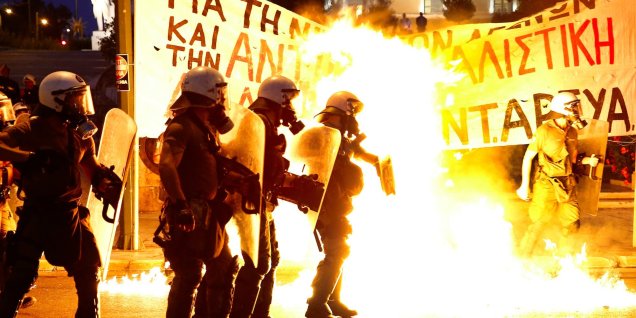
Back on planet Earth, anybody with a brain, a television and an internet connection can see for themselves that the European Union is doing far more to foster resentment and discord between the European countries than sowing peace. Whether it is the promise of young lives being permanently snuffed out or curtailed by 50% youth unemployment or the utter ruin of a small country which ought never to have been allowed to join the calamitous euro experiment in the first place, the last thing the EU is doing is promoting peace, cooperation, tolerance or understanding. I’ve been to Athens. I have seen the anti-German graffiti on every street corner.

Exactly how bad would it have to get for Gordon Brown and his allies in the Remain campaign to feel a twinge of shame or doubt about using Coventry Cathedral, an international emblem of peace and reconciliation, to drum up support for a European Union which has drifted far from the lofty goals of its own mythology, and which only now manages to function at all to the extent that it suppresses democracy and the popular will of the various member states?

I happened to be in Coventry Cathedral on April 21st this year, the Queen’s birthday. And after choral evensong was over, as a tribute the organist played “Orb and Sceptre”, William Walton’s coronation march written for the Queen’s coronation in 1955. In the music echoed centuries of history and independence which Gordon Brown and many in the Remain campaign are apparently willing to cast aside gladly and without a second thought, enthralled instead by a creaking and dysfunctional supranational political union, a mid-century relic which will almost certainly not live to see its hundredth birthday.

But as magnificent as the organ sounded that day, and speaking from a purely personal perspective, it will take a long time to stop the echo of Gordon Brown’s nauseating hymn of praise to the European Union from reverberating around that beautiful cathedral.


Coventry Cathedral - The Latter Glory Of This House Shall Be Greater Than The Former

Coventry Cathedral - Sculpture of Reconciliation

European Union - United Kingdom - Britain - Flags

Images: Semi-Partisan Politics

Agree with this article? Violently disagree? Scroll down to leave a comment.

Follow Semi-Partisan Politics on TwitterFacebook and Medium.

The Significance Of That Bizarre Eddie Izzard Appearance On Question Time

Eddie Izzard, Brexit Ambassador

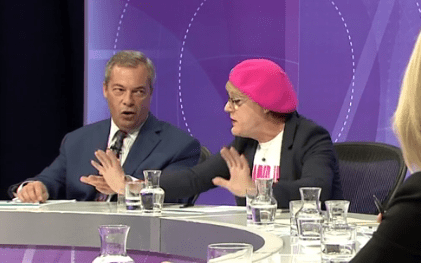
While it was infuriating to watch at the time – I actually had to put down my iPad at times to stop myself tweeting things which I might later regret – Eddie Izzard’s tour de force of ignorance and condescension on BBC Question Time last night will have been a great boon to all Brexiteers.

Here, in one man, is embodied the distilled nature of the entire Remain campaign argument – a child’s level of understanding of the European Union’s history, what it does and how it actually works coupled with an unjustified level of arrogance and assumed intellectual and moral superiority which somehow makes them come off as smug, arrogant, condescending, pitying and self-aggrandising all at the same time.

Eddie Izzard’s strategy for the programme was clearly “Take Down Nigel Farage In A Blaze Of Glory”, and the comedian went at the UKIP leader from the outset. He would have been far better to focus his fire on the others. Nigel Farage is a man who has easily dispatched stageloads of Britain’s leading politicians in a single debate and twice bested Nick Clegg in one-on-one encounters. Coming at him with a paper thin case and the debating style of an over-excited sixth former is never going to work. It certainly didn’t last night.

The shriller Eddie Izzard became, the more he cut across Nigel Farage and make his grandstanding appeals to the audience, the more Farage looked like the adult in the room. As Izzard’s plea for more ice cream became ever more desperate, Farage leaned back in his chair with a look of bemused resignation. Considering that one of the Remain campaign’s key aims is to demonise Farage and then inextricably tie him to the Leave campaign, this was a huge unforced error.

But more than that, it showed the vacuity at the heart of the Remain campaign. Sure, there are a few honourable die hard euro federalists out there – my friend Paddy Briggs is one – but you will scarcely hear from them in this campaign. The only people with a coherent and honourable case for Britain remaining in the EU (and indeed deepening our participation) are shoved in the closet, the Remain campaign’s dirty little secret as they pretend to the rest of us that We Are All Eurosceptics Too.

The rest of the campaign is built on ignorance and fear. Yes of course large swathes of the Leave campaign are little better. But once Remain have dispatched with their meaningless pleasantries about “staying in Europe to reform it” and the importance of “cooperation” (which in europhile land can only take place between countries when facilitated by a supranational political union, for some reason), all they have left are their Armageddon stories about how Brexit would bring us all to economic ruin, or how the supposedly benign and friendly EU would behave like an abusive spouse to a departing Britain.

Pete North agrees:

We’ve heard all the europhile fluff. All the sanctimonious cliches about “not walking away from the table” and “getting in there to make it work better” and “respecting the rules of the club” and when you’re dealing with someone of great charisma it’s hard not to want to buy into that.

These are all positive and constructive sentiments reinforced with words like “cooperation” and “unity”. But sentiment is all it is. Contrivances. And if you hold only a superficial notion of what the EU is, how it works and the actual consequences of it, then that leap of faith is easier to make.

And this perhaps explains the gulf between age groups and voting intentions. Those who have wised up to the EU want out. The youthful ideologues lack the maturity and historical context to see through the veneer of shallow and meaningless rhetoric. This is what the remain camp is banking on.

And this is why I can muster a venomous contempt of Eddie Izzard. Think what you will of him and his politics but he is not a stupid man. Fatuous maybe, but not stupid. He has always been a true believer. He is a europhile to the core. And while they are capable of an extraordinary self-deception one thing europhiles do without exception is lie through their teeth. Up becomes down, black becomes white, dog becomes cat. No lie is too big and any lie will do.

Being a comedian and habitually attuned to audiences accepting a flawed premise in order to relate to the material, Izzard is able to lie with no self-awareness at all. It’s what permits him to lie as often as he does to an extent that even professional politicians would hesitate.

And this is what has characterised the European Union debate for as long as we’ve been having this debate. The attempt by europhiles to frame this as though it were a generational stand off between young progressives and old reactionaries. For one to be against the EU, in the mind of the europhile, one must naturally be a xenophobic, little Englander who could only possibly have selfish motives. This is the deceit that they wish to impress upon those new to the debate.

And this is actually what drives the blood curdling hostility between the two camps. We have a broadly europhile media class. A set of self-regarding luvvies largely culturally and financially insulated from the consequences of EU membership, believing themselves to be the living embodiment of virtue.

People wonder how the country will knit back together after this referendum. I’m not sure that it will. Pete North is certainly convinced that it will not. One thing is certain – there will be no magnanimity from the Remain side if they win.

Sure, a smiling David Cameron might come out of 10 Downing Street and make a little speech about his “renegotiation” just being the start, and how he will continue to fight for change in Europe. I can write the speech in my head already. But it will mean nothing, just as every single one of David Cameron’s convictions is built on sand. The Remain camp will take their gruesome little victory lap and crow about having defeated the forces of “xenophobia and isolationism”, and that will be that. A reconciliation reshuffle? That means nothing.

But the intellectual case for Brexit and the moral case for democracy will not have been defeated. What’s more, those of us who are custodians of these high ideals will not easily forget what has been said about us by sneering, grandstanding, virtue-signalling oiks in the Remain campaign, and their spokesperson Eddie Izzard.

Call someone wrong and they may be angry for a time. Call them morally deficient in some way (as Remainers do with their claims of boomer selfishness etc.) and it will wound a lot more. But call someone stupid and publicly mock them to their face, and you will nurture a resentment and antipathy which are almost impossible to undo. Over the course of this referendum campaign, the Remain camp have done all three.

Fortunately for Brexiteers, the glibness and shallowness of the Remain case become more exposed with every passing day. There is no new layer of complexity once one overturns their false assertion that Brexit means leaving the single market, or that all of the cooperation and partnership they seek can be accomplished just as easily outside of our current political union. The Remainers can hardly wheel out the hardcore euro federalist brigade to make their impassioned case – they would alienate far more people than they could possibly attract with their creepy, dystopian vision.

By contrast, a greater depth to the Brexit case is finally starting to emerge, as more and more influencers in the media pick up on the interim EFTA/EEA (Norway) option as an attractive first step in the Brexit process. Though it has taken an age (and may in fact still have come too late) at least the only thorough, comprehensive and safe plan for achieving Brexit is now finally starting to get a public hearing and an opportunity to allay the concerns of undecided voters.

I still feel that the odds of victory very much favour Remain, no matter what the opinion polls may say two weeks out from Referendum Day. But it is also undeniable that the broader Leave campaign has finally gained some traction – despite, rather than because of Vote Leave.

And if the Remain campaign continues to respond to these turns of events by wheeling out people like Eddie Izzard – who I think probably created a thousand new Brexiteers for every minute he had the floor on last night’s Question Time – then this might be a much more closely run thing after all.


Nigel Farage - Eddie Izzard - BBC Question Time - EU Referendum

European Union - United Kingdom - Britain - Flags

Bottom Image: Huffington Post

Support Semi-Partisan Politics with a one-time or recurring donation:

Agree with this article? Violently disagree? Scroll down to leave a comment.

Follow Semi-Partisan Politics on TwitterFacebook and Medium.

Praising The EU And Supporting Remain Has Become A Virtue Signalling Sport

Monkey Cymbals 2

Don’t take the bait. Don’t take the bait. Don’t take the — ah, screw it

The Huffington Post serves up the worst thing you will read all day (h/t Pete North) in terms of EU referendum commentary – this sneering, virtue signalling attempt at mockery of Brexiteers by author and commentator Johnny Rich.

It’s a bit like W. S. Gilbert’s “little list”, except written by a dribbling imbecile:

Some people think it’s completely irrational to want to leave the EU. So, to avoid looking like you’re ignorant or incapable of understanding the issues, here’s a handy list of 30 excuses you can give for your position.

You don’t have to believe them all, just use whichever you feel comfortable with.

Don’t worry, we are not going to go through them all. I’ll serve up the highlights.

2. Experts don’t always get it right. In fact, because I can think of one example of an expert getting something wrong, I’m going to assume they’re all wrong on the economic consequences of leaving the EU.

Like the experts who told us that Britain would fade away into irrelevance unless we joined the euro? Righty-o. And can we please move on from this tyranny of credentials? Richard Dawkins may hate living in a world where ordinary people get to make decisions based on their own values, but nonetheless it needs pointing out that the EU referendum is primarily a question about democracy, not numbers on an Excel spreadsheet.

4. I believe that there aren’t enough jobs to go round for EU immigrants, despite the fact that more workers create a larger economy, creating more jobs as well as a higher tax take.

This blog happens to be pro immigration and I do not normally like to dwell on this issue, but it needs stating that while more workers do indeed create a larger economy, other critical things like housing, infrastructure and public services do not increase in a smooth line together with the population. It takes concerted effort and political will by local and national government to ensure that our national infrastructure is kept up in line with a rapidly increasing population.

Now, whether you want more immigration or less, I think we can all agree that successive British governments have done a woeful job of ensuring that our housing sector, infrastructure and key services were well positioned to absorb the kind of net migration we have been seeing – whether it was the last Labour government which wanted to sneak in mass immigration under the radar, or the current Conservative government which shamefully prevaricates when it should be expanding airport capacity in London and across the country. So a little less of the smug would be good.

12. I believe that, contrary to intelligence experts, the UK would be safer from terrorists without pooling intelligence with other European countries, even though most of the 7/7 bombers were born and raised in, erm, the UK

I wasn’t aware that intelligence from other European countries could have prevented 7/7, or that intelligence sharing and cooperation can only take place inside a political union. One wonders how Britain manages such close cooperation with the United States despite the two countries not sharing a parliament and a supreme court.

14. I believe I am better represented by the first-past-the-post elected parliamentarians in Westminster than the proportionally representative elected parliamentarians in Brussels and it’s got to be one or the other, rather than both.

Actually, I believe I am best represented by a body which represents a distinct and known demos with which I identify. I happen to feel British, therefore I find legitimacy in the Westminster parliament for all of its flaws. And no, the unelected House of Lords does not excuse a puppet European Parliament elected on pitiful turnouts, beloved by nobody, and which is incapable of proposing new legislation or striking down old laws. We should strive for constitutional reform to renew democratic government in Britain, not give up on it and outsource all of the meaningful decisions to Brussels.

16. I believe the EU is all a Franco-German conspiracy and the best way of defeating it is to, erm, allow the Germans and French to get on with it.

It isn’t a conspiracy at all. To be fair to the European Union and many of its past and current leaders, they are quite open in stating their intention to move toward becoming a common European state. Francois Hollande and Angela Merkel hardly ever shut up about it. It is only here in Britain where people like Johnny Rich stick their heads in the sand and furiously pretend to themselves that the EU is all about “trade and cooperation”, and nothing more.

19. I don’t find Leave’s figure of £350Mn in payments to the EU a week remotely ridiculous, even though it takes no account of either the rebate or payments to the UK.

Thanks, Vote Leave. Thanks a lot. Now you’ve made this sanctimonious little twerp correct about something.

21. I believe Britain’s exit from the EU will bring the whole edifice tumbling down and I don’t like anyone else forming an international collaboration if we’re not part of it, even though, erm, I don’t want to be part of it.

But it is not just an “international collaboration” though, is it? If Johnny Rich (the author) knew anything about the history of the EU and the century-old movement for European political union, he would know that the EU is an explicitly integrationist club with the expressed intention of one day becoming a common European state. We all love collaboration, but somehow every other country in the world outside of Europe seems to have found a way to collaborate well with neighbours and allies without forming a joint political union with them. If Johnny Rich were capable of thinking, this might give him pause for thought.

22. I believe holidaying in Europe will be just as easy and no more expensive because they should be happy to have our fine British pounds, even though after Brexit they might be worth a lot less.

Exchange rate fluctuations take place all the time, and while the pound may lose a small amount of value against other currencies in the short term as investors watch and wait, in the long term this could easily be more than offset by future increases resulting from stronger fundamentals after Brexit. And of course a weaker pound actually helps our exporters and domestic tourism industry. Unless Johnny Rich doesn’t care about British manufacturers and B&B owners?

24. I’d like to be able to rip off music and videos, like they do in China and Russia, because they don’t have those pesky EU intellectual property controls which stop me stealing from artists whose work I like.

I didn’t realise that intellectual property was not protected in Britain, or that one of the key drivers of pro-Brexit sentiment was the prospect of pirating music and videos. But if you say so.

26. I believe an isolated UK will have more influence on a global stage because, well, we used to have an Empire you know. Just like, erm, Egypt, Mongolia and the Aztecs.

No. But I do believe that the fifth largest economy, second (by some measured) ranked military power, nuclear power, P5 UN Security Council member and a country with a vast cultural and diplomatic reach like Britain will do just fine when we speak with our own voice on the international stage rather than squabbling with 27 other countries to influence the collective voice of the EU.

29. I don’t mind my taxes supporting scroungers hundreds of miles away and with whom I have no connection so long as they’re this side of any sea, but I don’t want them supporting no foreign scroungers whose need might be even greater. After all, I do my bit by giving a fiver to Pudsy most years.

Remainers do not have a monopoly on compassion. But it increasingly appears that they do have a near monopoly on unbearable moral sanctimony.

30. I just want to shove it to Cameron and Osborne.

Guilty as charged. But that is not why I support Brexit. It is just a fortunate, delicious coincidence.

35. I genuinely feel no cultural connection to Abba, Archimedes, Aristotle, Bach, Beethoven, Brie, Cervantes, Chanel, Cicero, Croissant, Da Vinci, Einstein, Euclid, Goethe, the Grimms, Homer, Ibsen, Joyce, Leibniz, Michelangelo, Mozart, Pasta, Plato, Pythagoras, Rousseau, Schiller, Socrates, Tapas, Truffaut, Virgil, Zola or whatever, but on the other hand, I’ve got Morris dancing, Robert Burns, bara lafwr and the Orangemen in my veins.

I feel a tremendous amount of cultural connection to many of these artists – and foodstuffs. I live and breathe Bach’s Goldberg Variations. The opening of Beethoven’s fourth piano concerto slows my heart rate and instantly puts me in a more relaxed frame of mind. I find some passages from The Iliad to be some of the most beautiful poetry ever written, instantly bridging the gulf of ages separating the author from our modern world. Schiller, though, I can take or leave.

But crucially, I am able to have all of these connections, affinities and attitudes without needed to belong to the same political union – and eventually the same common European state – as these great artists. Is Johnny Rich really worried that leaving the EU might threaten his bragging rights of association with JS Bach or a bowl of penne? What part of his intellectual and cultural heritage does Rich think will be ripped away if the same supranational political union covering the land of Mozart stops overshadowing him? The man is insane. Or simply deluded.

Basically, Rich has swallowed every facile and superficial argument about the wonders and accomplishments of the European Union, hook, line and sinker. He has no understanding of democracy, and consequently no respect for it. Serious questions about how people can and should wield influence over the decisions affecting their lives go sailing right over his smug little head. Support for the EU is, to Johnny Rich, a mere act of public virtue signalling – a way to showcase to his equally insufferable friends that he is progressive, compassionate, and holds all of the necessary right-on opinions. And the net result is his “little list”, a sneering wink at fellow believers all utterly convinced of the righteousness of their cause.

Or as Pete North put it when citing Johnny Rich’s drivel:

If I didn’t know anything at all about the EU and I was relying on Vote Leave for the arguments to leave the EU – and my only perception of leavers was through the media, I would vote to remain in the EU. But it would mean I was a virtue signalling, lazy narcissist. For the removal of doubt, here is one one of those looks like…

I shouldn’t do it, I know. There is absolutely nothing to be gained from getting into pitched battles with shrill, morally certain HuffPost bloggers, people too dim to do the first bit of research on opposing arguments but always ready with a snarky post or tweet.

But those of us on the thinking Brexit side have probably each spent more time learning the history of the European project and thinking through the various implications of leaving and remaining than Johnny Rich has spent doing whatever he does for a living – writing obscure, unread novels, by the look of it.

And there is only so much that one can take of being mocked and called stupid by the conclave of cavorting village idiots who make up the unthinking, virtue-signalling (and dominant) wing of the Remain camp before one has to punch back.

 

Monkey Cymbals 4

European Union - United Kingdom - Britain - Flags

Support Semi-Partisan Politics with a one-time or recurring donation:

Agree with this article? Violently disagree? Scroll down to leave a comment.

Follow Semi-Partisan Politics on TwitterFacebook and Medium.

Following A Remain Vote, The Slow, Inevitable Descent Into Irrelevance, Apathy…And Worse

Protest - Greece - Athens - EU- European Union

In case of a Remain vote, brace for impact…

Pete North fears the consequences of a Remain vote:

If Britain votes to remain in the EU we will have permanently forfeited most of our rights to influence policy over trade, fishing, aid, energy and agriculture. These are absolutely crucial to our overall domestic industrial policy and these areas have a profound impact on our lives and our economy. Having sealed the deal to no longer take an interest in such affairs, parliament will be able to seal itself into its tiny little bubble where reality may never intrude. It will be the absolute final death of adult politics.

As much as Britain will withdraw from the world, it will largely delegate the important policy areas to the EU technocrats and will instead be fixated permanently on the minutia of our lives. Controlling what we do and our individual choices is all that will be left for them to influence.

And so I can see Britain becoming a distinctly illiberal place, where politicians use their remaining powers to restrict our personal freedoms in what we do, what we consume and what we say to one another. They will become ever more controlling over things which are none of their business. I see a political system making itself wholly redundant and resorting to displacement activity to fill the void.

Consequently the public debate will be an ever more diminished one, where the House of Commons becomes a gallery for vanity and virtue signalling. To many extents we are already there but a remain vote pretty much seals our fate.

It’s hard to disagree with this assessment. Unless, of course, one inhabits the EU apologists’ alternate universe, where a Remain vote signals a new era of enthusiastic British leadership in the European Union (despite not being a member of the euro or Schengen), and the EU starts falling over itself in its desire to reform and respond to the individual concerns of member states.

In Owen Jones / David Cameron / Jeremy Corbyn La-La Land, having positively re-affirmed our commitment to the EU with a Remain vote we will all join hands beneath a rainbow and “work together” to solve the intractable crises and internal contradictions of this creaking, mid century-era political union with a snap of the fingers. But for those of us back on planet Earth, the next few years will actually be profoundly depressing.

Pete continues:

I do not see this coming without a price to pay. Certainly I don’t see that I have a place in the new model of post-democratic politics. We will have a political class which does not believe in Britain’s capabilities and lacks the will to govern.

We will be an insular country of diminished significance having turned our back on global participation. We will have empty shells of political parties neither of which are worth a vote. And voting to be rid of them will accomplish little. We have seen how the system neatly castrates insurgent parties and we have see how those not native to the system can be marginalised. There will be no value in voting.

And when it comes to Euro-elections, where we have the dubious honour of selecting overpaid button pushers to rubber stamp global regulations, the details of which are already decided, we will, at best, send the very worst of what we have in protest. If we even bother at all that is. I won’t.

We will in effect be an occupied country where there is no value in participating in the public debate since the conclusion of any debate will simply not translate into policy or reform.

Consequently politics as a subject heading will be a subheading of light entertainment, where if anybody holding any expertise wishes to influence policy they will depart for Geneva and never look back. Anyone with a hectoring and nannying agenda though, will head for the Westminster gossip bubble.

Meanwhile the disconnect between the governed and the governors will grow. From there, there are only two paths. Permanent idiocracy or a furious backlash the likes we have not seen for generations. There is always a price for turning our backs on democracy. Always.

This echoes my own thoughts exactly –  it is not coincidental that our politicians increasingly seek to meddle in the minutiae of our lives at the very time they are divesting themselves of ever more power and responsibility for any of the truly big political and ideological questions.

And this is the reason why I simply cannot fathom so many people from outside of politics – usually the first ones to grumble about the state of the nation – enthusiastically cheerleading for the status quo and our continued participation in the EU.

Do these people like the fact that voter apathy is a major problem? Do they rejoice in the fact that all of the main political parties in Westminster fit within such a narrow ideological window that the views of many are entirely excluded? Are they happy that the British people have not been called on to strive together towards an important goal of any kind in nearly seventy years, and that we are increasingly a nation of passive, whiny consumers of public services? And assuming they are not happy with the status quo, how on earth to they think that any of this is likely to change while the single biggest drain on our democracy, independence and entrepreneurialism remains intact?

Already we have a parliament in Westminster stuffed to the rafters with politicians who would rather make grandstanding anti-austerity speeches in the hope of going viral on YouTube or wax lyrical about banning Donald Trump from our shores in a dismal act of virtue signalling than actually get to grips with policy. If we continue to divest power and sovereignty to the EU (and as Cameron’s fraudulent renegotiation shows, we sure as hell ain’t getting any of it back) then how is the calibre of our own politicians going to do anything other than decline yet further?

And yes, there will ultimately be a backlash. Pete is right. You can just about get away with governing in an aloof, high-handed and profoundly anti-democratic manner when you are delivering rip roaring economic growth – just ask the dictators of China. But in a mature advanced economy facing serious structural issues, the government can do little to distract us from the gaping chasm where real local democracy and an informed citizenry should be.

At some point the divergence will become too great. The EU’s primary purpose is to steadily integrate the various member states toward the goal of political and economic union – the common European state spoken of so fondly by Francois Hollande last year. This objective overrides everything else. Certainly, trivial matters like mass unemployment in Spain, Italy and Greece are utterly irrelevant compared to the obsessive desire to unite the continent under a single currency and government. The EU simply doesn’t care.

Of course, when the mass political disengagement and civil disorder comes, all of those now eagerly chanting hymns of praise to the EU and encouraging us to vote Remain will feign utter shock. In some cases it may even be genuine. But the blame will lie squarely with them.

For despite our material progress and the current flourishing of London as the world’s capital city, Britain is on a negative democratic trajectory right now, and a vote to remain in the EU is nothing less than a vote to pitch the nose downward a few degrees and turn up the throttle.

And the ground will make no distinction between Remainer or Brexiteer as it rushes up to meet us.


European Union - United Kingdom - Britain - Flags

Top Image: Business Insider

Agree with this article? Violently disagree? Scroll down to leave a comment.

Follow Semi-Partisan Politics on TwitterFacebook and Medium.