Britain’s Surveillance State Expands, Unnoticed

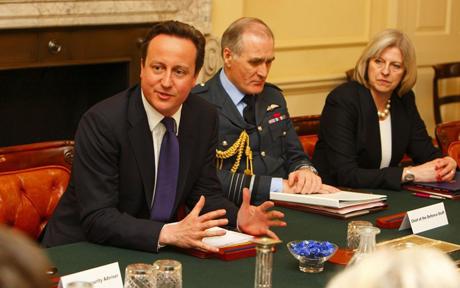
Yesterday, David Cameron told the House of Commons Select Committee on National Security Strategy that he accepted that he and his government had thus far failed to make the case for the extraordinarily invasive government surveillance practices which have been secretly going on beyond the view of the public and our elected MPs, and that he and his ministers needed to do a better job selling the benefits of an intrusive, omniscient government to the British public.
So busy protecting us, he forgot to tell us precisely what he was doing in our name.
So busy protecting us that he forgot to mention precisely what he was doing in the name of our security.

The Guardian reported at the time:

Discussing the communications legislation, Cameron said: “Over time we are going to have to modernise the legislative framework and practice when it comes to dealing with communications data. It is a politically contentious topic. I am not sure we are going to make progress on it in the coming months in terms of legislation, but there may be things short of legislation that we could do.

“I do think politicians, police chiefs, the intelligence services have got a role in explaining what this is all about. Snowden inevitably raises questions about ‘who has access to my data and why’.

“But I am absolutely convinced that proper rules for communication data collection are essential. I do not think we have got across to people yet the absolute basis of this.

“In most of the serious crimes, such as child abduction, comms data – who called who when and where was the phone at the time, not the content of the call – the comms data is absolutely vital.”

It may well be the case that the majority of the most serious crimes are indeed solved by the analysis of telephony metadata by law enforcement agencies. But David Cameron is making an entirely separate argument here. No one is proposing that the police and other law enforcement agencies should be denied access to telephone and other digital records (which are already maintained by the telecoms companies for the purposes of billing) when investigating these crimes, because in these scenarios there will almost always be a suspect in custody or at large who has created reasonable suspicion and is then the target of the search.

What GCHQ and the NSA have been doing, on the other hand, is nothing to do with this standard law enforcement practice of searching the possessions and digital footprints of an active suspect. Rather, they have been collecting reams of metadata (and more) on people who are under no suspicion of doing anything at all, in secret and without permission, to dip in and out of at their leisure. By equating these two entirely different practices, Cameron is trying to make it sound as though people who value and speak out in defence of civil liberties are somehow extremists or absolutists who want to deny basic crimefighting tools to the police. This is clearly not so.

The false equivalence is made fully apparent in this next quote from Cameron:

He continued: “I love watching crime drama on the television, as I should probably stop telling people. There is hardly a crime drama that is not solved without using the data of a mobile communications device. If we don’t modernise the practice and the law over time we will have the communications data to solve these horrible crimes on a shrinking proportion of the total use of the devices.

The Prime Minister is basically saying that because telecoms companies and devices themselves only hold the most recent usage data, it is only through exercising powers of unlimited and total surveillance that the government can maintain a complete picture of a person’s communications, for use should they ever happen to become a suspect in a crime.

Note also that we are no longer even talking about terrorism, but just “horrible crimes”, among which the Prime Minister includes child abduction and a mysterious category of offence called “comms data”. It was bad enough when a government minister could mumble something inane involving the word “terrorism” to justify gaining complete access to a person’s communications and digital life, but through a couple of seemingly-innocuous turns of phrase it seems that David Cameron now wants to broaden the use of pre-emptive digital searches to stop any and all illegal activity. And since the government has no idea who may or may not be harbouring whims of child abduction or committing a ghastly act of “comms data”, the logical inference is that he believes that the security services are perfectly entitled to collect and monitor all of our telecommunications metadata now and forevermore, on the offchance that we do decide to commit one of these crimes.

Park your outrage for a moment, because the most incredible thing of all is not that all of this has apparently been occurring with regularity – that is, collection and use of the telephony metadata of British citizens, not just for counterterrorism and national security purposes but, in Cameron’s own words, also ostensibly to prevent child abduction and any number of other nominated crimes – but that in examining the actions and conduct of his government and himself, the only thing he can find to beat himself up about is the fact that he did not do a sufficiently vigorous job selling this flagrant intrusion of government into personal privacy to the British public.

Where is the oversight? Where is the outrage?

Treading Water On NSA Surveillance

It appears from early reports that President Obama intends to punt on the only recommendations made by his surveillance review group that contained any real meat or hope of unpicking the harms done to the fourth amendment.

The New York Times reports:

Mr. Obama plans to increase limits on access to bulk telephone data, call for privacy safeguards for foreigners and propose the creation of a public advocate to represent privacy concerns at a secret intelligence court. But he will not endorse leaving bulk data in the custody of telecommunications firms, nor will he require court permission for all so-called national security letters seeking business records.

In short, the president is determined to continue bulk collection of communications data undeterred, but is willing to play around with the details of who stores the data (the government, the telecoms companies or some kind of shadowy third party consortium), and in a grand gesture to civil libertarians he is willing to promise to actively monitor the communications of acquaintances of acquaintances of a potential suspect, rather than the current acquaintances of acquaintances of acquaintances. This gesture slightly reduces the chance of Kevin Bacon’s communications being flagged as in some way being linked by the NSA to every terrorist in the world, but is otherwise entirely meaningless.

Amen.
Amen.

Foot-dragging, empty gestures and a continued lack of transparency or accountability from anyone involved. So far, so predictable, perhaps.

But what I find slightly more concerning is the way in which the judiciary (at the behest of Chief Justice John Roberts) is seeking to weigh in on what ultimately is a matter of policy, as the New York Times notes:

The developments came as the nation’s judiciary waded into the highly charged debate. In a letter made public on Tuesday, a judge designated by Chief Justice John G. Roberts Jr. to express the views of the judicial branch warned that some changes under consideration would have a negative “operational impact” on a secret foreign intelligence court.

Judge John D. Bates, a former chief judge of the Foreign Intelligence Surveillance Court, urged Mr. Obama and Congress not to alter the way the court is appointed or to create an independent public advocate to argue against the Justice Department in secret proceedings. Any such advocate, he wrote, should instead be appointed only when the court decided one was needed.

Of course, there need not necessarily be anything sinister about this intervention – apparently made on the grounds that it would eat up too much of the court’s time and create excessive workload if they were required to approve all FBI requests for stored bulk records – but it does seem rather odd to me, at face value, that the judiciary is more eager to weigh in on policy proposals when there is a threat to the smooth running of their working day than they are when there is a plausible argument to be made that the government is acting beyond its constitutional authority. The Times also picks up on this:

It is highly unusual for judges to weigh in on public policy debates involving the other two branches of government, but Judge Bates, the director of the Administrative Office of the United States Court, said that Chief Justice Roberts had designated him to “act as a liaison” and that he had consulted other judges.

But again, this is early reporting with the full details of Obama’s upcoming speech and the work behind it not yet made public.

One begins to wonder why President Obama sets up these review boards or commissions, other than as a cosmetic exercise to give the appearance of open-mindedness and willingness to change course. The Bowles-Simpson debt commission forged a tough but real consensus on reforms to American taxation and spending, and was high-handedly dismissed by the administration, and now it appears that the same is about to happen when another of President Obama’s talking shops is due to report back.

Just enough to annoy the Patriot Act manics and those in the national security complex, and far too little to placate civil libertarians rightly concerned about government overreach that we would never have even been made aware of were it not for the actions of Edward Snowden.

The Obama administration’s lack of anything approaching humility or transparency, even after having been caught in the act, is depressing indeed.

Snowden vs The Elite

Ruth Marcus from the Washington Post and Glenn Greenwald from the Guardian went head-to-head on CNN this Monday, discussing the recent New York Times editorial calling for clemency for US whistleblower Edward Snowden. As the New York Times rightly concluded in their editorial:

When someone reveals that government officials have routinely and deliberately broken the law, that person should not face life in prison at the hands of the same government.

This was not the view of Ruth Marcus, who, showing much in common with the self-serving elitists and power fetishists who festoon Washington D.C., seems to swoon at government overreach and seeks to protect her own kind from any kind of scrutiny or consequences of their actions, whilst happily throwing the little guy or the outsider under the bus at the first opportunity:

Snowden … is seized with infuriating certitude about the righteousness of his cause. Not for Snowden any anxiety about the implications for national security of his theft of government secrets, any regrets about his violations of a duty of secrecy.

Quite how she knows that Snowden has no anxiety about these things is not entirely clear, but since she has never met Snowden I think it would be fair to surmise that she made this statement up. It would harm her cause, cheerleading for the Obama administration and the national security apparatus, if she acknowledged the fact that Snowden may have wrestled with his decision to divulge what he knew, that he had to weigh up the pros and cons of his actions.

It’s never good when experienced, professional commentators seek to drag George Orwell into their arguments, but Marcus indulges herself:

George Orwell himself would have told Snowden to chill — and the author of “Animal Farm” surely would have shown more recognition of the irony of Snowden’s sojourn in Vladimir Putin’s Russia. Does a man whose life is conducted so much online really believe that Putin’s spies are not cyber-peering over his shoulder?

I believe that the irony, such as it is, is that a man from a supposedly free society has more liberty hiding out in Putin’s oppressive Russia than he would in his own native land, for doing nothing more than exposing the secret and unlawful actions of his government. That fact doesn’t make a mockery of Snowden, but it does make the United States look rather bad.

But it is on her next point that Marcus really overreaches:

On behavior, if Snowden is such a believer in the Constitution, why didn’t he stick around to test the system the Constitution created and deal with the consequences of his actions?

And here is where it gets good, because when CNN host Jake Tapper asked Glenn Greenwald to comment on Marcus’ position, he gave it to her with both barrels:


Temporarily putting aside the correctness of Greenwald’s position, the real money quote, and the thing that really gets to the rub of the matter is this:

I think Ruth Marcus’ argument exemplifies everything that’s really horrible about the D.C. media … People in Washington continuously make excuses for those in power when they break the law.

Yes, we see this time and again, and Greenwald has himself addressed this topic at length in his excellent book “With Liberty and Justice for Some”.

But in terms of refuting Marcus’ fatuous and glib suggestion that if Snowden really valued the US. Constitution he should have been willing to surrender himself and submit himself to the American legal system in order to advance his cause and win his case in the court of public opinion, Greenwald correctly states:

“If he had stayed in the United States, as Daniel Elsberg (widely considered to be a hero by most Americans) argued in the Washington Post, he would have been barred from making the very argument that she just said he should have made. Under the Espionage Act, you’re not allowed to come into court and say “I was justified in disclosing this information”, there is no whistleblower exception in the Espionage Act which is why whistleblowers don’t get justice in the United States.”

May this once and forever do away with the misleading assertion by national security fanatics and civil liberty deniers that Edward Snowden ever had – and spurned – a realistic chance of making his case to the public whilst remaining in the United States, or that his flight to Russia is in any way ironic or detracting from the validity and strength of his arguments. This is not the case.

Mediaite also provides a good summary of the exchange here.

On Criminal NSA Overreach

Some very disturbing new findings about the extent to which the  US government uses the vast power of its surveillance apparatus to tackle suspected domestic crime. Of course, up until this point we had been reassured that the draconian collection of telecommunications metadata and the full-on tapping of telephone calls and online communications was used only to help prosecute the “War On Terror”. This has now been revealed to be a total sham.

Rachel Maddow breaks down the extent of this surreptitious, lawless activity on her show:


And Reuters reports:

Reuters has uncovered previously unreported details about a separate program, run by the U.S. Drug Enforcement Administration, that extends well beyond intelligence gathering. Its use, legal experts say, raises fundamental questions about whether the government is concealing information used to investigate and help build criminal cases against American citizens.

The DEA program is run by a secretive unit called the Special Operations Division, or SOD. Here is how NSA efforts exposed by Snowden differ from the activities of the SOD:

Purpose of the programs

NSA: To use electronic surveillance to help the Federal Bureau of Investigation catch terrorists, the U.S. military fight wars, and the Central Intelligence Agency collect intelligence about foreign governments.

SOD: To help the DEA and other law enforcement agents launch criminal investigations of drug dealers, money launderers and other common criminals, including Americans. The unit also handles global narco-terrorism cases.

So to be perfectly clear – the United States government has explicitly decided to allow this vast spying program to be turned inwards to aid local law enforcement in their daily mundane activities. According to the (already flimsy) assurances that we were given when Edward Snowden blew the whistle on the NSA’s secret programmes, the spying apparatus was to be used only to seek out and intercept communications between non-US citizens that represented a terrorism threat. But it turns out that this is not the case. If an intelligence analyst happens to eavesdrop on your telephone call and finds out that you want to (hypothetically) buy some pot from your friendly local drug dealer, that information might then be surreptitiously passed on to the DEA, who could then come and raid your home. Based on intelligence which they have no right to be privy to.

But worst of all is this bombshell:

Disclosure to the accused

NSA: Collection of domestic data by the NSA and FBI for espionage and terrorism cases is regulated by the Foreign Intelligence Surveillance Act. If prosecutors intend to use FISA or other classified evidence in court, they issue a public notice, and a judge determines whether the defense is entitled to review the evidence. In a court filing last week, prosecutors said they will now notify defendants whenever the NSA phone-records database is used during an investigation.

SOD: A document reviewed by Reuters shows that federal drug agents are trained to “recreate” the investigative trail to conceal the SOD’s involvement. Defense attorneys, former prosecutors and judges say the practice prevents defendants from even knowing about evidence that might be exculpatory. They say it circumvents court procedures for weighing whether sensitive, classified or FISA evidence must be disclosed to a defendant.

Local and federal law enforcement officers are actually being trained – instructed – to cover up the fact that the evidence they use to come and arrest you was unlawfully shared by the folks at the NSA. Apparently the clinical, non-threatening term for this is “recreating the investigative trail”. So rather than going to court and admitting that your evidence against the accused came from an NSA tip-off based on illegal spying by the government, agents are encouraged to falsify the account of their investigations and potentially perjure themselves by stating on the record that it was their own brilliant deductive and crime-solving abilities which led to the arrest.

It is hard to adequately describe how foul, deceitful and criminal this behaviour really is.

There was no excuse for allowing the NSA to violate the fourth amendment protection against unreasonable or unwarranted searches when it pertained to potential terrorism. There is certainly no excuse for widening this harassment in aid of civilian law enforcement.

Semi-Partisan Sam says no. This oppressive “national security” apparatus must be rolled back, and those responsible for willfully violating the Constitution must face the legal consequences of their actions.

Law? What Law?

I have so much to say about the shocking NSA unconstitutional spying scandal blown wide  open by whistleblower Edward Snowden and journalist Glenn Greenwald that I barely know where to begin.

So I shall begin with a tangent – the repercussions of the case over in Britain, where scandal has erupted because it turns out that Britain’s intelligence-gathering departments have had access to the US PRISM system for a number of years, and have made use of it on occasions to eavesdrop on the conversations of British citizens.

This should be causing people to light flaming torches and take to the streets, but as it stands today in docile modern day Britain, Prime Minister David Cameron is just being made to squirm a bit. The Huffington Post reports:

The foreign secretary, who is due to make a statement on the allegations in the Commons later, has said the law-abiding British public had “nothing to fear” from the work of GCHQ.

However MPs are likely to press Hague on whether the intelligence service has always abided by the legal framework.

Sir Malcolm Rifkind, the chairman of the ISC, told BBC Radio 4’s Today programme that GCHQ would have needed to ask ministers before requesting information on British citizens’ internet activity from the United States.

How comforting. But worst of all were the comments from David Cameron himself, who thought that these flimsy, meaningless words would serve somehow to placate us:

David Cameron has said British intelligence agencies operate “within a legal framework”, as MPs prepare to grill William Hague on GCHQ’s involvement with the American Prism internet surveillance system.

“I think it is right that we have well-organised, well-funded intelligence services to help keep us safe,” the prime minister said on Monday morning.

“But let me be absolutely clear. They are intelligence services that operate within the law, within a law that we have laid down, and they are also subject to proper scrutiny by the intelligence and security committee (ISC) in the House of Commons.”

What the hell does this garbage even mean?

British intelligence agencies are operating within a legal framework. Okay, what legal framework?

He thinks that it’s right to have an intelligence service? Who on earth was saying that it wasn’t?

But the final line is the worst, where he says that the intelligence services are operating within “a law that we have laid down”. Oh, well that’s fine then, let’s all go home.

Does David Cameron at any point mention the particular law under which the intelligence services are operating? Or when this law that “we” laid down was written, voted on and approved? Of course he doesn’t! And I, for one, would rather like to know.

Do you see the difference between having a written constitution and not having one? Do you?

Even if (as in the United States), the President and his administration choose to brazenly flout it, the written constitution at least gives a frame of reference when it comes to determining whether an action is acceptable or unacceptable. Contrast this with Britain, where the most basic laws of the land can (and often are) changed on a whim by the elected dictatorship of a majority government. In Britain, if we are told that a government action that we disagree with is “lawful”, there is no end of Acts and Amendments and revisions and EU law and whatever else to sort through in order to work out whether or not it is so.

The result, of course, is that the British don’t even try. We might kick up a bit of a fuss if someone catches David Cameron devouring live puppies in the alley behind Downing Street one warm summer night, but once his spokesman assures us that he was acting “within the law, within a law that we have laid down”, we would all meekly nod, and let him get back to his puppy-butchering.

This is unacceptable. William Hague and David Cameron need to make crystal clear not only the laws currently on the statute books which allow for spying on the communications of a British citizen (with or without a warrant), but also the specific criteria that the intelligence services use, or at least the threshold of evidence that must be met, when selecting an individual for such a breach of their privacy.

Not that it much matters. David Cameron has lost my vote today.