British Conservatives Must Show The Courage Of Their Convictions

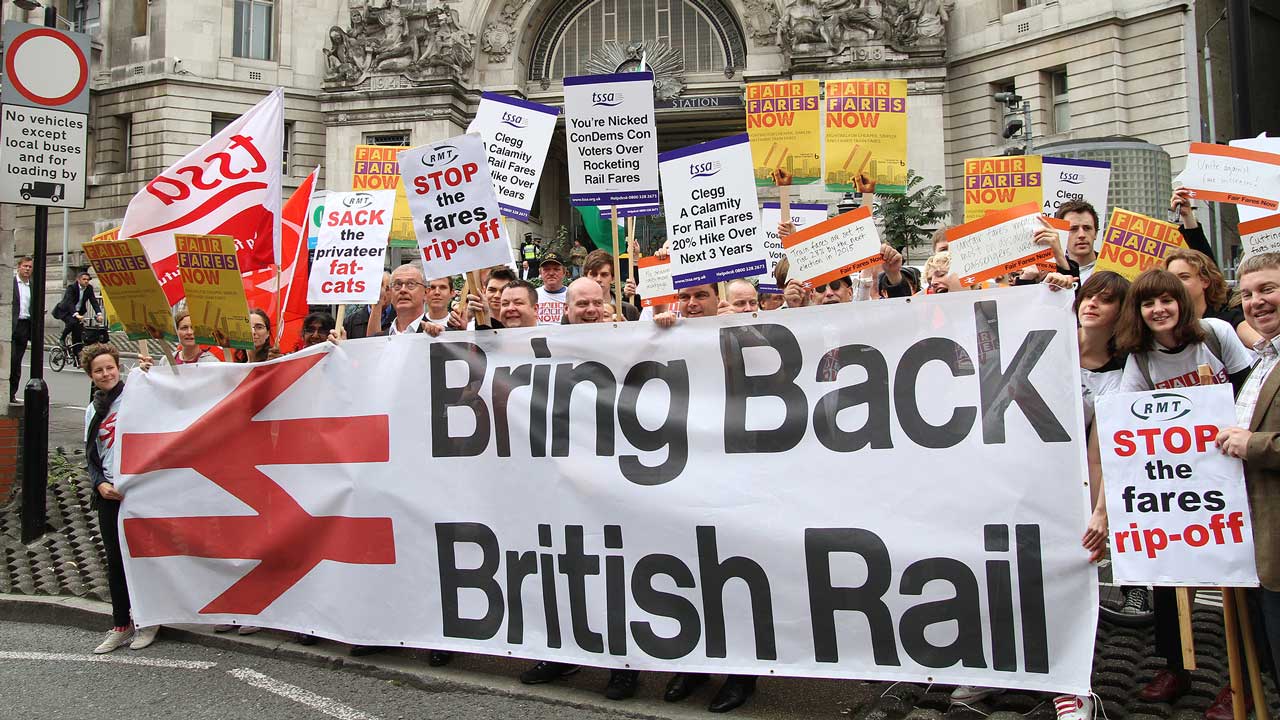
Bring Back British Rail


David Cameron’s cabinet reshuffle dominated the news over the past week – at least, until it was totally overshadowed by world events in Gaza and Ukraine. But the punditry and speculation about who is up and who is down, who succeeded in clawing their way into Cameron’s inner circle and who was excommunicated to the fringes, generally lacked a certain something. Call it relevance.

Beware of anyone offering a neatly packaged, coherent analysis of David Cameron’s cabinet reshuffle so early in its aftermath. There’s a lot of ready made narratives out there – Ken Clarke’s departure heralding the death of the big beasts, the timely promotion of women to the cabinet, the opportunistic promotion of women to the cabinet, the misogynist promotion of women to the cabinet, the triumph of social conservatives, the social conservative purge and the elevation of arch-eurosceptics, to name just a few. The only thing uniting these narratives is that they are quite contradictory, and that they are already out of date.

If you insist on looking for a consistent theme in the Cabinet reshuffle in place of the dull reality (a series of largely independent political calculations by a cautious government), it is not the glaring fact that this was a political reshuffle – paging Captain Obvious – but that it was such a defensive political reshuffle in the run-up to the general election.

With less than a year left of the current coalition government, there was really no point in having a reshuffle at all, from a policy perspective. Little real governing will be done with the coalition partners both manoeuvring to define themselves against each other and take credit for past accomplishments, meaning the only real work left to be done is the cementing and locking down of reforms that have already been made. For all intents and purposes, we are now entering a lame duck session of Parliament.

Given this fact, the most sensible thing for David Cameron to have done – both to achieve the goals of cementing existing government policies and publicly standing behind them – would have been to not have a Cabinet reshuffle at all. But resoluteness and steadfastness was not on David Cameron’s list of priorities. In far too many cases, the personnel changes suggested an apology for successful conservative policy and right-wing thinking in general.

The plain truth is that the conservative agenda – enacted properly and with consideration – works. Privatisation works, welfare reform works (as Fraser Nelson forcefully argued last week), conservative education reform works. Though we should rightly acknowledge and mitigate the negative side effects of weaning people off government aid – and be blunt that these are often counted in terms of human suffering – conservatives should stand unapologetically behind their record, and the ideology which underpins it.

But just when the Conservative Party should be standing up for its beliefs and accomplishments, the coalition government seems more eager to run away from them, to excuse them in the context of “tough decisions to pull the country out of recession”, or to reveal their fear by preventing the proper scrutiny of opposing ideas.

Take the Commons vote to allow the Office for Budgetary Responsibility to audit and pass judgement on Labour Party budget proposals. A confident Tory party that stood behind its accusations of thoughtless left-wing spendthriftery would welcome the harsh spotlight of a non-partisan body like the OBR being shone on official Opposition proposals, but instead the Conservatives made it known (with dubious reasoning) that they were against the proposal.

(It should be noted that in the United States, the equivalent Congressional Budget Office scrutinises draft legislation submitted by both Republicans and Democrats, which further helps to cement its reputation as a non-partisan body).

Look also at the question of railway renationalisation. Pushing an even greater proportion of the British economy into the dead hands of the state is generally a terrible idea, but reflexive Tory opposition to what Ed Miliband and Labour are proposing is counterproductive. Firstly, it glosses over some of the legitimate flaws in the way that the rail privatisation was carried out, and the way in which the privatised railway system is structured. Ignoring legitimate criticism is never the path to good future governance. But secondly, it suggests a lack of confidence in the Tories’ own ideology. If the private sector is so darn efficient and dynamic, what worry should private firms have if the bloated, inefficient state tries to bid for their train franchises, when surely they would lose every single time?

And in the most high profile case of conservative reshuffle apologetics, Michael Gove – one of the few Conservative ministers to successfully enact genuinely bold conservative reforms – was moved away from the Department of Education and demoted to the position of Chief Whip (those arguing that it was not a demotion should compare the salaries of the two roles).

Alarmingly, much of the reaction to Gove’s departure suggested that he was moved on not because his reforms had failed, but because he hadn’t flattered people with enough platitudes while successfully enacting them. The truth about Mr Gove can be discerned by parsing the reaction of Russell Hobby, general secretary of the National Association of Head Teachers. The Telegraph reports Hobby’s view:

“Michael Gove had a radical and sincere vision for transforming education but he often failed to bring the profession with him.

“His diagnosis was frequently astute but his prescriptions were hard to swallow. It is now time to rebuild trust and confidence between government and teachers so that improvements can endure.”

Translated, this means that Gove’s ideas and reforms were quite sound, but he rubbed too many powerful special interests up the wrong way in the course of implementing them. With his removal by Cameron, good policymaking was subordinated to public sector union ego-stroking.

The unions clearly felt that Michael Gove did not respect them – time and time again, in interview after interview with cheerful teachers, this was the constant refrain. After the dust settles, perhaps people will start asking when the pride of the teachers unions and the egos of individual teachers became more important than implementing the best possible education policy for Britain’s children.

At the recent Margaret Thatcher Conference on Liberty, organised by the Centre for Policy Studies think tank, former Australian prime minister John Howard made an important observation. Reflecting on his three successive election victories, Howard said: “The worst way to try to win office is to pretend you’re not too different from your opponents.”

If David Cameron and the Conservative Party are to succeed in their audacious goal of winning an outright majority in the 2015 general election, the path to victory does not lie in pretending to be Ed Miliband’s mollycoddling Labour Party with a small added dose of fiscal realism. If people want a fiscally irresponsible government pledging obsequious servitude to the public sector unions and buying into their pretence of representing the public interest, they will vote for the real thing, not a pale imitation. The Conservative Party must stand behind their limited successful reforms, and promise to double down if they are re-elected to government in 2015.

With the general election less than ten months away, this is no time for small government conservatives to falter.

Demand The Alternative – The People’s Assembly’s Struggle Against Austerity And/Or Reality

Peoples Assembly No More Austerity

Semi-Partisan Sam will be covering the national demonstration held by The People’s Assembly in London today, entitled “No More Austerity: Demand The Alternative”.

The timing of the protest is somewhat strange, given the fact that we are less than one year away from the 2015 general election and the end of the current coalition government responsible for the “cuts”. Most of the “austerity” policies have already taken full effect and could not be immediately reversed even if David Cameron (and Ed Miliband, who has pledged to stick to the current government’s spending plans should Labour win in 2015) were to witness the crowds at Trafalgar Square and have a sudden change of heart.

In that sense, just like the Judean People’s Front in Monty Python’s Life of Brian, the demonstrators gathering outside BBC Broadcasting House tomorrow afternoon will be engaged in a struggle with reality rather than against a policy that they have any hope of altering in the near future.

One glance at the list of supporters and attendees reveals that the protesters hail from a variety of backgrounds and have a range of different interests at stake, though they are united in their opposition to any government cuts of any kind and for any reason. The People’s Assembly founding statement declares they “support every genuine movement and action taken against any and all of the cuts”.

The lack of nuance in this statement is interesting – centrists and those on the right may be curious to delve inside the minds of people who sincerely believe that the state should only ever grow larger and do more for people, and that any interruption of this trajectory automatically equates to wanton cruelty on the part of callous people with no hearts.

Semi-Partisan Sam hopes to have just this opportunity, and to report back not just on what is drawing people out onto the streets in protest, but also on what their ideal alternative version of Britain looks like.

It’s a question worth asking, because despite Ed Miliband’s manifold weaknesses as leader of the Labour Party, there is a real chance that he could enter Number 10 Downing Street as prime minister in 2015 – and he is entirely sympathetic to the People’s Assembly aims, dovetailing as they do so nicely with his own “new politics” of brutal tax hikes and renationalisation.

Hopefully the answer – and the mysterious “alternative to austerity” being demanded – will be revealed at The People’s Assembly Struggle against Austerity Reality in London later today. Celebrity guest Russell Brand certainly thinks so:

“The People’s Assembly will bring down any government that doesn’t end austerity. Austerity means keeping all the money among people who have loads of it. This is the biggest problem we face today, all other problems radiate from this toxic swindle. We can organise a fairer, more just society than they can, these demonstrations are the start, it will be a right laugh.”

So there you have it. There’s a fixed amount of money in the world, and all that’s needed is to have a “right laugh” together, toss around a few ideas, redistribute the cash a bit and everything will be just fine. It will be like the evil Tories never existed.


Stay tuned to @SamHooper on Twitter for live-tweets from 1PM onwards (London time), and to this blog for discussion and analysis of the demonstration after the fact.

Clarence Darrow vs The Rotten Soul Of Today’s Labour Movement

Kevin Spacey Clarence Darrow 2


What would the famous labour lawyer and anti-death penalty advocate Clarence Darrow say to the late RMT union leader Bob Crow if the two men were to meet in Heaven?

The mental image of their fictional meeting would not leave my mind after I watched Kevin Spacey’s remarkable portrayal of the former unfold in the eponymous one-man play Clarence Darrow at London’s Old Vic Theatre on Friday.

The production – which is well reviewed here, here and here, and in which an elderly Darrow looks back on the many victories and tribulations of his long legal career – gave considerable attention to Darrow’s union activism through his defence of the American Railway Union leader Eugene Debs in the 1894 Pullman Strike, and of the McNamara brothers charged with dynamiting the Los Angeles Times building in 1910, among other famous episodes.

But watching Kevin Spacey portray Clarence Darrow is to see an impassioned and eloquent defence of the rights and dignity of working people that today’s current and recently departed left wing political and union leaders could never hope to equal.

Witnessing the spirit and passion of Clarence Darrow flicker to life on a London stage made it starkly apparent just how close the modern labour movement is to purposelessness and death in the Age of Miliband.

While Darrow in full rhetorical flight could have convinced Ronald Reagan or Margaret Thatcher themselves of the need to concern themselves with the welfare and aspirations of the mother and father working minimum wage jobs on zero hour contracts, today’s left-wing figureheads come across as whiny, self-entitled and spitefully partisan by comparison.

Here are the stirring words of Clarence Darrow in an address to the inmates of Cook County Jail in 1902, the theme of which would be taken up by Ed Miliband and the Labour party in a bold reassertion of conviction politics were today’s labour movement not so politically calculating and intellectually inert:

To take all the coal in the United States and raise the price two dollars or three dollars when there is no need of it, and thus kills thousands of babies and send thousands of people to the poorhouse and tens of thousands to jail, as is done every year in the United States — this is a greater crime than all the people in our jails ever committed, but the law does not punish it. Why? Because the fellows who control the earth make the laws. If you and I had the making of the laws, the first thing we would do would be to punish the fellow who gets control of the earth. Nature put this coal in the ground for me as well as for them and nature made the prairies up here to raise wheat for me as well as for them, and then the great railroad companies came along and fenced it up.

How relevant to today, given the present Labour Party’s focus on the “cost of living crisis” and its apparent determination to freeze consumer energy bills.

But here instead is Ed Miliband warning us of the supposedly mortal threat to the unions posed by David Cameron’s Conservative-led coalition government, in a typically unmemorable speech to the 2013 TUC conference:

We have a Prime Minister who writes you and your members off. Who doesn’t just write you off, but oozes contempt for you from every pore. What does he say about you? He says the trade union movement is a “threat to our economy”. Back to the enemy within.

Six and a half million people in Britain. Who teach our children. Who look after the sick. Who care for the elderly. Who build our homes. Who keep our shops open morning, noon and night. They’re not the enemy within. They’re the people who make Britain what it is.

How dare he? How dare he insult people – members of trade unions – as he does?

Terrible speechwriting aside, Miliband’s suggestion that David Cameron spends his every waking hour plotting against the trade union movement like a modern-day Iago is patently absurd. While the Conservative Party – as one would expect – raises objections to various union policies and rhetoric and their self-interested leadership, you will search in vain to find any evidence of the prime minister “oozing contempt”.

Ed Miliband (in his halting, aggrieved and ineffectual way) and others try hard to continue the life-and-death struggle narrative laid out by Darrow a century earlier, but the fact that their comments are aimed at a modern British audience – even the poorest of whom likely own smartphones, personal computers and enjoy access to universal healthcare via the NHS – renders them ridiculous.

Where Darrow wore his heart on his sleeve and walked the walk of labour advocacy – foregoing a more lucrative career in order to oppose his old railroad bosses who were oppressing their workers – today’s leaders such as Miliband and his union counterparts often hail from the same metropolitan middle and upper-middle classes who form the middle management and ranks of senior civil servants for whom so many working Brits toil. And what’s more, Labour politicians and the management class now talk and sound alike.

Whereas Clarence Darrow stood firmly for worker’s rights without lapsing into sentimental and unworkable socialism, the response of the likes of Ed Miliband, Len McCluskey and Mark Serwotka to our present pale shadow of real austerity has been snarling and misleading hyperbole about the Conservatives “hating” the poor and taking an obscene delight in their suffering.

(It is conveniently forgotten by these anti-Tory crusaders that the suffering was largely created by a gradual bipartisan expansion of the state, and by making so many British people dependent on the government for one thing or another that any retrenchment of spending now has a widespread, painful effect that would not be the case if the government didn’t try to do so much.)

The victories won by organised labour in Clarence Darrow’s day saved lives and liberated millions of people from what William Beveridge would later describe as the five “Giant Evils” in society: want, disease, ignorance, squalor and idleness. And they are immortalised in rights and traditions which endure to this day, such as the annual May Day march and rally in London, and the Labor Day federal holiday in America.

The victories won by the left wing establishment of today (and the debauched, rudderless trades union to whom they are captive) are comparatively petty and trivial, and each passing ‘victory’ incrementally serves either to perpetuate inefficient public sector service delivery or entrench benefits for union members at the expense of the ranks of the budding entrepreneur class, the self employed, the underemployed and the jobless.

The union men of Darrow’s America (and their British counterparts) would be horrified to witness the tanned, bloated, self-satisfied swagger of men like Bob Crow, who delighted in tormenting other ordinary working people with their undemocratic strikes in order to preserve the gold-plated salary and benefits of, say, a tube driver on the London Underground who gets paid well over twice as much as a newly trained Private fighting for his or her country in the British Army.

So how would Clarence Darrow feel upon meeting the likes of Bob Crow?

One can only imagine, but in fairness, it is not unreasonable to think Darrow would first feel immense satisfaction and relief that the causes for which he fought have come to fruition and done so much good, not just in the United States but throughout the Western world.

His heart might swell to know that not only have child labour and the exploitative company towns of his day been cast into history, but that the strength of public sentiment stands firmly against multinational companies who try to take undue advantage of lower standards and regulations in other parts of the world – although there is undeniably still much work to be done.

But a man of such conviction as Clarence Darrow would also likely recoil at the nanny-state socialism, self-entitled smugness and the bitter, envious rhetoric of people like Bob Crow and today’s labour movement leaders, who have casually sauntered in his hard-fought footsteps across what is now much easier political terrain.

And a final bold prediction: A century from now, in the year 2114 – no matter how much the current generation of labour leaders try to portray themselves as intrepid generals locked in an ongoing epic battle for the rights of the downtrodden and the dignity of man – nobody will spend hours queueing for return tickets to a play honouring the life’s work of the likes Ed Miliband, Bob Crow or others of their calibre.

Truly great women and men like Clarence Darrow fought and won ninety percent of the battle before today’s privileged, metropolitan, self-appointed guardians of the common man ever picked up a protest placard or stumbled into their first Labour Students Society meeting.


Clarence Darrow finishes its run at The Old Vic Theatre tonight. Kevin Spacey also portrayed Clarence Darrow in a PBS biopic movie of the same name, the climactic speech of which is shown above.


If you enjoyed reading this article, please take a second to LIKE or SHARE it on social media using the buttons below. Help to spread the word and continue the debate.

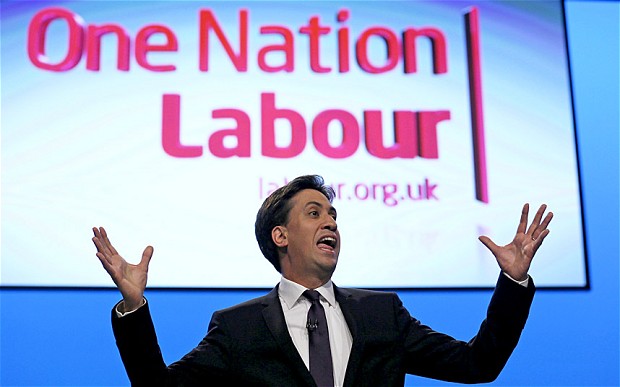
One Nation – The Intellectual Bankruptcy Of The Labour Party

Ed Miliband Labour One Nation


Today’s events, far more so than the weekend’s unimpressive election results and murmurings of panic-tinged dissent from the shadow cabinet, represent a low point for Ed Miliband, the Labour Party and for left-wing thinking in Britain.

For today was the day when, irritated by yet another press question about his continuing inability to connect with voters and asked to sum up his political outlook and ambition in a single word, Ed Miliband offered two words instead, and inadvertently revealed the yawning gulf where ideas, policies and conviction should be sparking together with a general election less than a year away.

Responding to a perfectly innocuous – yet increasingly urgent – question that can be effectively paraphrased as “What makes you tick, and why should anyone vote Labour in 2015 and install you as Prime Minister?”, Ed Miliband’s response had all the resonance of a broken drum (ruptured through repeated banging):


In other words, Ed Miliband’s all-singing, all-dancing pitch to the electorate was this incisive, eternally quotable piece of oratory:

“One Nation. One Nation is an idea about how you bring every person in the country to make their contribution, and how you can change Britain. And that’s what I’m about. And that’s what I’m about for Britain. And I think it shows that Labour is a party that is reaching out to people across our country, and that Labour has the answers. But in the end, the question is does our country succeed with a few people at the top doing well, or does it succeed when actually ordinary people are supported? And that is the big question for Britain. And actually I believe that will be the big question for Britain in the next eleven months.”

One Nation. Forget the dull repetition of meaningless phrases that makes Ed Miliband sound like a skipping record. Forget the petulant innumeracy of his answer. This wasted opportunity to stake out a purpose, a reason for his leadership of the Labour Party, belies a more serious deficit – an intellectual deficit making its disturbing presence felt within the highest ranks of the Labour Party and the left-wing opposition in general.

Ed Miliband managed to speak one hundred and fourteen words without saying anything at all, but let us go line-by-line anyway:

“Bringing every person in the country to make their contribution”. Okay, so there are shades of JFK’s “Ask Not” inaugural address – albeit JFK on a heavy dose of Valium and sleeping pills – in what Ed is saying here. But the idea of drawing on patriotic or civic duty to contribute is squashed no sooner than it is suggested, as Miliband reverts to classic Labour language about what people can expect to get out of their government (“succeed when actually ordinary people are supported”).

“Labour is a party that is reaching out to people across our country”. All the people, that is, except for those who voted UKIP in last week’s election, who are viewed by the party as either out-and-out racists or gullible fools who were seduced by Nigel Farage’s party and need to be shouted at increasingly loudly until they come to see the error of their ways. Dan Hodges was right to warn that Labour is retreating toward an unwinnable 35% per cent strategy.

 “Does our country succeed with a few people at the top doing well?”. The question is rhetorical and the answer obvious, but what Labour intends to do remains unexplored. Is this all about income redistribution, or soak-the-rich taxes that punish high earners regardless of the net effect on the Treasury? Are we closer to the ideal of “One Nation” if we slide back into recession but manage to reduce the inequality gap on our descent down the ranks of economic powers, or has Ed Miliband outsmarted Thomas Piketty and stumbled upon a way for those who earn a living selling their labour to catch up with the capital-owners while growing the economy as a whole?

And that’s it. A request for a one-word answer spawned a two-word brand name, an incomprehensible definition by way of follow-up and more questions than Ed Miliband seems likely to answer between now and election day 2015.

The concern is not that this complete lack of original ideas or strongly-held convictions will necessarily damage Labour in the 2015 general election campaign. Rather, the growing fear must be that Labour could be returned to power despite this ideological and policy vacuum where ideas and core beliefs are supposed to reside.

Sure, there will be a manifesto written, launched with great fanfare and disseminated for all to see, resplendent with glossy pictures and catchy quotes. No doubt it will have a seemingly-profound title: “One Nation”? “Making Your Contribution”? “Reaching Out Across Britain”? All of the key words and hackneyed phrases from Ed Miliband’s response today will have their place.

But what is the next level of detail? How will Labour, under Ed Miliband’s leadership, actually enable everyone to make ‘their contribution’ (and overcome any obstacles to doing so which currently stand in their way), ‘support’ ordinary people and reach out to those who are no longer politically engaged?

Politicians can talk all they like about the inspirational stuff – though apparently Ed Miliband cannot even do this with any degree of competence – but at some point they have to come down to Earth and get specific. The big picture has to be broken down into achievable segments, each supported by their own policies – tax cuts, spending increases, organisational change, diplomatic manoeuvres, whatever the case may be. And in turn, these various policies and initiatives have to be coherent and link back to the high-level stuff clearly and unambiguously.

The real danger with Ed Miliband’s “One Nation” gamble is that it is so vague as to be essentially useless – it does not naturally inspire any real tangible policies that could bring it about, and likewise any policies ultimately announced by Labour will be difficult to link back to the overarching message.

Basically, it’s the Big Society on steroids. Or rather, more Valium.

But at least David Cameron’s Big Society, if not wildly popular and ultimately discarded, was a coherent idea. David Cameron could stand in front of a Big Society poster and talk about the need for government retrenchment at a time of economic recession and budget deficits, and the consequent impetus for civil society, once unburdened of awkward regulations and red tape, to step into the breach and pick up the slack. None of these things ever actually happened, which only goes to show that even a well supported, easily explainable governing philosophy does not guarantee success – but it was a start, something to prevent David Cameron’s segments of the 2010 television debates being filled with awkward dead air.

Ed Miliband does not even have this security blanket. His big idea doesn’t mean anything, and can’t be explained without sending a room full of prospective voters from Essex to sleep. No one expects a full manifesto at this early stage, but where Labour does have policies (or people working on policies), too often they are pulling in opposing directions, as Dan Hodges points out:

Labour has never really had a core political strategy in the classic sense of the word. Instead, half a dozen disparate strategies have been allowed to evolve, all of them pulling in mutually destructive directions.

John Cruddas, Miliband’s policy guru, is working on a classic Blue Labour policy agenda, designed to reach out to soft Tories. At the same time his leader is pursuing a bright yellow metropolitan liberal agenda, one that aligns most closely with his personal liberal metropolitan worldview.

Bashing the evil Tories and their stupid Liberal Democrat sidekicks may have worked for the first few years of the coalition government – indeed, shouting about the heartless Conservatives and stoking up some old-fashioned class warfare helped Ed Miliband to steady the ship as Labour adjusted to life in opposition for the first time in thirteen years.

But at some point you have to present an alternative. And even if you’re not quite ready to come out with the details of your alternative offering to the electorate one year out from the general election, people shouldn’t be left grasping at straws for the first hint of what you want to do.

What does “One Nation” mean? At the moment – absolutely nothing. Which actually makes it the perfect slogan for the Labour Party under Ed Miliband.

The Day We Fight Back

thedaywefightback


Sometimes help comes from the most unlikely places. That was certainly the case today when Ed Miliband used his speech at the Hugo Young memorial lecture to call for major changes to the oversight of Britain’s intelligence and security agencies.

The Guardian reports:

A major overhaul of the oversight of Britain’s intelligence agencies, which could lead to an opposition politician chairing parliament’s intelligence and security committee and reform of the intelligence commissioners, needs to be introduced, Ed Miliband has said.

The Labour leader praised Barack Obama for starting an “important debate” in the US – after the White House appointed a panel in the wake of the Edward Snowden leaks – and called for a similar debate in Britain.

In some of his most extensive comments on the NSA leaks, Miliband told a Guardian audience that reforming the oversight of GCHQ, MI5 and MI6 was “definitely” part of his campaign to challenge “unaccountable power”.

Though the details remain sketchy, it appears that Miliband envisions quite a far-reaching review, looking not just at the methods used by the security services but also the degree to which the agencies are funded, the scope of their responsibilities and the granting of a more formal role in oversight to the main opposition party:

Miliband made clear that his challenge to “unaccountable power” would include Britain’s intelligence agencies as he said that reform should focus on two areas. These are parliament’s all party intelligence and security committee, which is always chaired by a senior MP from the governing party, and the commissioners who oversee the intelligence agencies.

The Labour leader said: “I already believe, and this is what my Labour colleagues have been saying, that there are clearly changes that are going to need to be made in relation to the intelligence and security committee and the oversight it provides.

“That is everything from the resources they have at their disposal, who chairs the committee and whether it should be somebody from the government party or the opposition party, their power to compel witnesses – a range of issues.

While this may warm the heart of many a weary libertarian, it must be noted that Miliband has barely scratched the surface in terms of confronting the growth of the British national security apparatus – after all, even miracles have their limits.

Miliband praises US President Barack Obama for starting what he calls an “important debate” but neglects to mention that Obama would have quite happily allowed the NSA to continue to violate the privacy of US and world citizens in secrecy and in perpetuity, and that he is actively seeking to extradite the person who really started the debate – Edward Snowden – back to America to face charges of treason. Thus restated in the proper context, Obama’s carefully cultivated philosopher-king image begins to lose some of its sheen, as does Miliband’s boyish admiration of him.

It should also be noted that Miliband sees the answer to concerns about privacy and civil liberties very much in terms of incremental changes to the existing framework, and certainly not in creating cast-iron rules about powers that the government should rightly have and those which should be reserved by the people.  In particular, he sees the fact of ministerial oversight and sign-off of interception requests by the security agencies as a good thing and a solid check on power, rather than the rubber stamp that it really is:

On the ministerial oversight of interception, he said: “It is worth saying also that there is in this country … ministerial sign off when intercept and so on takes place. That is a very, very important safeguard. I do believe the intelligence services do important work. But I absolutely endorse the idea that there are important issues of liberty and liberty is an important part of Labour’s agenda.”

Perhaps Miliband (or indeed David Cameron or Theresa May) would care to set out a scenario – any scenario at all – where the British intelligence services might approach the government to get sign-off for a communication intercept on a surveillance target and actually be rebuffed by a skeptical minister. It simply would never happen.

Elected politicians, weighing the likely fallout of two different courses of action, are almost always going to follow the path that chips away at civil liberties by approving the intercept request rather than defending privacy and denying the request on grounds of insufficient evidence, and later being implicated in a security failure. Decisions on the authorisation of communications intercepts should rest with the judiciary, not the executive.

It is certainly true that public opinion in Britain has not swelled with outrage at the revelations of NSA and GCHQ collaboration in collecting and viewing private communications data with no reason for suspicion and no warrant.

And so Miliband’s contribution to the British debate on privacy and (remarkably) constraints on the power of the state – a very muted, anaemic debate compared to that now taking place in many other countries – is welcome, and very important. In America, politicians from both main parties and of all temperaments have spoken out in condemnation of secret government surveillance, raising public awareness and, in some cases, making continued support for these draconian surveillance measures an electoral liability. Meanwhile, the British political establishment has largely closed ranks in defence of the national security complex, and against the people.

berniesandersNSA

Contrast this quote from the independent Vermont Senator, Bernie Sanders, with Prime Minister David Cameron’s dismissive and aloof response to concerns about the practices of MI5, MI6 and GCHQ:

“We have very good rules in this country. If a telephone call is going to be listened in to, that has to be signed off by the Home Secretary personally. There are very good safeguards in place,” Cameron told ITV’s The Agenda. “You get asked, ‘What are the rules’? I’m satisfied we have pretty strong safeguards. I thought part of the reaction to the The Guardian story was – big surprise, spies learn to spy…it’s to help keep us safe.”

Does the fact that Ed Miliband took the first tentative step in support of civil liberties and dared to suggest the state should not be all-powerful over us mean that the torch has been passed to a new generation of leaders on the issue? Of course not. Miliband seems to place his complete faith in the power of the state to accomplish a whole range of other matters relating to the personal and private lives of the British people, and it is far from certain a this early stage that he is not simply using his Hugo Young lecture to score a few cheap political points with no intention of pursuing the matter any further.

But for perhaps the first time in his senior political career, Miliband spoke out in favour of the private citizen over the government, when the issue of government surveillance has been met with nothing more than dismissal and condescension by Number 10 Downing Street and the rest of the government. And for that action, he must be given some credit.

Today, February 11th 2014, has been labelled The Day We Fight Back against mass surveillance. Numerous websites are carrying links to the organisation, which is supported by more than 360 organisations in 70 countries, and which plans to petition lawmakers in these countries to take action on the serious issue of government surveillance and constitutional overreach.

The Day We Fight Back has been well-marked in the United States, with many prominent politicians adding their voices to the chorus of protest. In the UK, on the other hand, there has been a deadly silence. The focus of the British news media and the political class remains fixed on the issues of flooding in southern England, with elected politicians falling over themselves to be seen in photo opportunities surveying the damage and taking decisive action. Taking any kind of action in support of our right to privacy and freedom from government oversight is far down the list of priorities, where it even features at all.

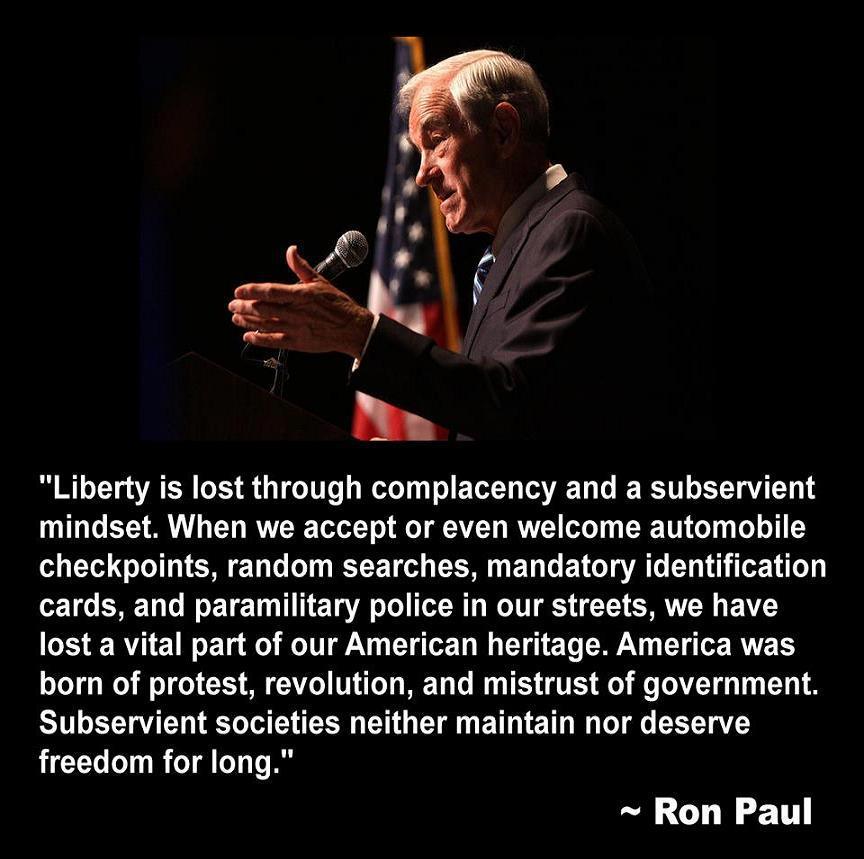
Former Texas Congressman Ron Paul is not right about everything, but his warning about the loss of liberty, echoing Franklin, is pertinent and timeless:

ronpaulwarning

People in Britain who truly appreciate the importance of the right to privacy and the need to place constraints of any kind on government seem to be few and far between, and consequently we must look for allies in unlikely corners.

Ed Miliband’s is certainly the very unlikeliest of corners. But perhaps the Labour leader’s taking a stand for civil liberties will shame others – those who should have been holding this issue aloft all along, and warning of the dangers of an omniscient, omnipotent government – into finally doing the same.


Concerned readers can visit The Day We Fight Back website and add their name to a petition here.