Semi-Partisan 2013 Budget Drinking Game

If, like me, you plan to watch Chancellor of the Exchequer George Osborne present the UK coalition government’s 2013 budget to Parliament today, you might like to use this handy tool to pass the time. You can treat it as either a bingo card or a drinking game, depending on how pessimistic you feel about the budget contents…

The Semi-Partisan 2013 Budget Game

30 minutes until showtime. Enjoy!

If you do not already do so, please consider following me on Twitter @SamHooper.

Happy Budget Day!

Cracking Down On The Black Economy

The Minister of the Bleeding Obvious states the bleeding obvious in this story from The Telegraph.

Treasury minister David Gauke informs us that it is “morally wrong” to pay tradesmen (plumbers, builders, electricians etc.) with cash in hand, as this makes it easier for them to evade VAT or income tax. Aside from the fact that every cabinet member from Cameron on downwards needs to quit the moral preaching (why can’t you just say “illegal” or “wrong”?), his basic point is right. Until he goes on to say: “Getting a discount with your plumber by paying cash in hand is something that is a big cost to the Revenue and means others have to pay more in tax”.

Seriously, Mr. Gauke? You expect us to believe that the black economy makes our taxes higher? You would tax us just as much as you already do even if you could get your hands on this missing slice of revenue – you would just find new ways to fritter it away on pointless, undeserving goals and beneficiaries. So let’s not pretend that the cash-in-hand job that your local plumber does on the sly is the one thing standing between us and an actual competitive tax code.

You must think we’re all really dumb.

The End Of America As We Know It? Hardly.

Andrew Sullivan posts an excellent retort to Mitt Romney’s fear mongering that the United States is about to make a binary flip from being a free enterprise nation to having a “government-run economy”, based on this illuminating chart:

As you will note, the line indicating growth in corporate profits (in billions of dollars) obstinately refuses to go in the direction that it would need to point in order to signify the government-led smothering of the private sector that Romney wants us to believe is currently taking place.

The Republican presidential candidate has been giving speeches bemoaning the notion that President Obama doesn’t understand capitalism or the free enterprise system, and that this ignorance is leading Obama to implement policies that are harming the economic recovery. Romney has advanced this line of attack frequently, most recently at a campaign event in St. Louis, Missouri, though to be fair, he seems willing to ascribe Obama’s supposed failures to ignorance rather than malice:

I do not believe this has been done with evil intent or ill will. But for a family watching their house being sold at foreclosure, or the family that is forced to spend their kid’s college savings just to make ends meet, the results are just as devastating.

Oh wait, perhaps not:

I will not be that President of deception and doubt. I will lead us to a better place.

Then, of course, comes the obligatory lie about Obamacare, the Affordable Healthcare act:

Today, government at all levels consumes 37 percent of the total economy or G.D.P. If Obamacare is allowed to stand, government will reach half of the American economy. And through the increasing controls government has imposed on industries like energy, financial services and automobiles, it will soon effectively control the majority of our economic activity.

This line only works if you are ill-informed enough to actually believe that Obamacare effectively appropriates and nationalises the entire US healthcare industry, bringing it under government ownership as opposed to just regulating the industry to a higher degree and increasing the customer base of the insurance companies through the individual mandate. So it’s basically a big fat lie, though Romney is clever enough to choose his words carefully, stating “government will reach half of the American economy”, a quite meaningless phrase, but one that deliberately and incorrectly suggests ownership and control of half of the US economy without actually putting him on the record as having said so.

And finally, the crux of Romney’s argument:

One must ask whether we will still be a free enterprise nation and whether we will still have economic freedom. America is on the cusp of having a government-run economy. President Obama is transforming America into something very different than the land of the free and the land of opportunity.

We know where that transformation leads. There are other nations that have chosen that path. It leads to chronic high unemployment, crushing debt, and stagnant wages.

I don’t want to transform America; I want to restore the values of economic freedom.

This is what really irritates me about the Romney argument, this idea that there is a binary choice between “free enterprise” and “government-run”, that America has always dwelt on the free enterprise side of the line and that Obama wants an old-school socialist planned economy. It is borne out of the total allergy to nuance or shades of grey currently affecting the Republican party, and is one of the main reasons why I cannot bring myself to support them at the moment.

Of course there is no such binary choice. What percentage of GDP would have to be consumed by government spending for “free enterprise” to officially be declared dead according to the Romney definition? 37%, the current figure? 50% + 1? Something else? All conservatives – myself included – want to see government spending account for as small a proportion of GDP as possible, and most would agree that the current level – in Britain as well as in America – is too high. But the size of government has expanded under both parties, and though Obama may be guilty of failing to reverse the trend, he has at least slowed the rate of increase in the size of government, when the stimulus measures are factored out. For Mitt Romney to suggest that the US is teetering on the brink of becoming a planned economy under Obama when government spending accounts for 37% of GDP is not only the worst type of scaremongering, it also ignores the significant contribution that his own party made to the problem.

And as for this narrative about Obama seeking to “transform” America, to turn it into something unrecognisable from before – while it may be the only narrative that Romney can hope to ride to the White House in November, it is also untrue. Obama is a centre-left politician implementing mostly centre-left policies, some of which would actually have enjoyed a measure of support among Republicans if they had been proposed by a President Bush, Cheney or McCain. But for Romney to get out the vote, he must convince his supporters of something patently untrue, that Obama is a radical, a dangerous subversive trying to alter the fabric of America.

I’m an economic conservative, I believe in a small state and limited government involvement in private markets. But given the choice between someone on the centre left who is making an honest effort along Keynesian lines to solve the economic difficulties facing America and someone on the right who screams “socialism!” where none exists, and who remains in denial about his own side’s complicity in the downturn and the detrimental effect that his policy proposals would have on the recovery, I have to hold my nose and support the centre left guy.

Which is a shame, because it would be nice to have a genuine choice in 2012.

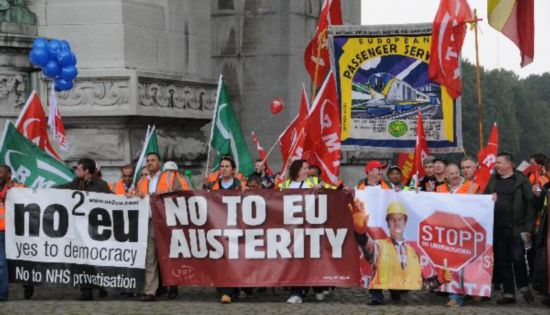
On Austerity, Learning The Wrong Lessons From Europe

Europe Austerity 2


As the US presidential election draws closer and the political debate rumbles on, I find myself becoming increasingly frustrated by those voices on both the left and the right, who seek to hold up the example of “Europe” (that homogenised, cohesive whole) as Exhibit A in an attempt to win their economic policy argument.

I am talking about the ongoing “austerity/stimulus debate” – whether America should make drastic and immediate cuts to public spending in order to tackle large government budget deficits, or whether even higher levels of government spending are required in the short term to spur economic growth, before deficit-tackling measures are undertaken at some point in the future.

When talking about these issues, both Democrats and Republicans are playing fast and loose with the truth, and doing the American people (at least those who have already tuned in to the election-year political coverage) a disservice in the process.

On the left, it is fashionable to point at Europe and exclaim that austerity policies are not working because “Europe” has drastically scaled back government spending, and yet is experiencing either a very tepid recovery or an outright double-dip recession. A typical example, from The Washington Post:

Europeans are rebelling against austerity. That’s the read on Sunday’s elections in Greece and France. But why do voters loathe austerity? Perhaps because, as economists have found, efforts to rein in budget deficits can take a wrenching toll on living standards, especially in a recession.

In a recent paper for the International Monetary Fund, Laurence Ball, Daniel Leigh and Prakash Loungani looked at 173 episodes of fiscal austerity over the past 30 years. These were countries that, for one reason or another, cut spending and/or raised taxes to shrink their budget deficits. And the results were typically painful: Austerity, the IMF paper found, “lowers incomes in the short term, with wage-earners taking more of a hit than others; it also raises unemployment, particularly long-term unemployment.”

The left-leaning media across the pond is also keen to seize on this narrative, as the following opinion piece from The Guardian deftly demonstrates:

Third, the president should make it clear he won’t allow government spending cuts to take precedence over job creation. He won’t follow Europe into an austerity trap of slower growth and higher unemployment. While he understands the need to reduce the nation’s long-term budget deficit, he should commit to vetoing any spending cuts until the unemployment rate in the US is down to 5%. Instead, he should commit to further job-creating investments in the nation’s crumbling infrastructure – pot-holed roads, unsafe bridges, inadequate pipelines, woefully-strained public transportation, and outmoded ports.

Finally, Obama should make sure Americans understand the link between America’s fragile recovery and widening inequality. As long as so much of the nation’s disposable income and wealth goes to the top, the vast middle class lacks the purchasing power to fire up the economy. That’s why the so-called “Buffett rule” he has proposed – setting a minimum tax rate for millionaires – needs to be seen as just a first step toward ensuring that the gains from growth are more widely shared. He should vow to do more in his second term.

Such an economic strategy – forcing banks to help distressed homeowners, stopping oil speculation, boosting spending until unemployment drops to 5%, and fighting to ensure economic gains are widely shared – is critical to jobs and growth. It’s the mirror image of Europe’s failed austerity policies.

These arguments do not stand up to scrutiny for several reasons, many of which are well articulated in this piece from Forbes:

The trouble with Europe’s post-crisis budgets, then, isn’t so much that they’ve increased taxes. It’s that they haven’t meaningfully cut spending. “Following years of large spending increases,” Veronique de Rugy explains, “Spain, the United Kingdom, France, and Greece — countries widely cited for adopting austerity measures — haven’t significantly reduced spending since 2008.” De Rugy points to data that shows those countries “still spend more than pre-recession levels,” with France and Britain making no cuts, and Italy increasing spending in 2011 “more than the previous reduction” between 2009 and 2010. Without significant, substantial cuts, tax increases alone don’t amount to austerity. Yglesias is correct that tax hikes can contribute to austerity. What tax hikes cannot do, however, is be austerity. Tax hikes are neither necessary nor sufficient for an austerity program.

Inconsistent though it may be with the liberal worldview in the US, this is very true. Government spending, by many measures, is actually higher than pre-recession levels in Britain and other countries. The so-called “austerity” that everyone is wailing about is nothing more than a reduction in the rate of increase in government spending. Furthermore, as anyone living in Britain can easily attest, many of the “austerity” measures have been tax increases, and not spending cuts – which also does little to support the liberal view that draconian spending cuts have stymied an economic recovery.

Also missing from the left-wing take on austerity is an understanding of the fact that, unlike the US, European economies grappling with anaemic growth or double-dip recession do not have the good fortune to be underpinned by the world’s primary reserve currency. It is much easier to enact a large scale stimulus programme while retaining the confidence of the global bond markets if your currency is the US dollar, a fact that is glossed over by many people, including some in the Obama administration who hold up Europe as a cautionary tale of what happens if you fail to meet economic downturn with government stimulus.

The Washington Post reports:

“The situation in Europe is slowing things down,” Obama told donors at the New Amsterdam Theatre. At the home of hedge fund executive Marc Lasry, Obama said that Romney and congressional Republicans favored an austerity plan that would “drastically shrink government,” hurting job growth and middle-income Americans.

“That is fundamentally different from our experience in growing this economy and creating jobs,” Obama said.

Where Obama was subtle, not drawing a direct line between Europe’s approach and Romney, Clinton was not.

The former president said Republicans were adopting “the European economy policy.”

As a European watching the American political debate unfolding, it frustrates me to see such sweeping statements and generalisations being made about other countries, and seeing their actions and policy stances mischaracterised without even the pretence of trying to understand them – and this applies to both sides of the political aisle. I also fear that it does not do much to dispel the false but common notion that most Americans are insular and lacking any real understanding of the world beyond their borders.

This stereotype, where true, is unfortunate enough to the extent that it applies to the general population, but even more concerning when it manifests itself in current and would-be future political office holders.

What Exactly Is Your Fair Share?

Tax Fair Share Flat Tax


As every British taxpayer knows, this week the coalition Conservative/Liberal Democrat government will announce its budget for the coming fiscal year. And as usual, there is much speculation about what bold, eye-catching new initiatives will be announced, which favoured groups will receive the best and most insulting handouts (10p per week increase for those on the state pension, anyone?) and which of our cherished vices such as smoking or drinking will be slapped with the biggest tax increases to raise money to pay for it all.

But probably the biggest pre-budget story at the moment concerns the speculation that the government is poised to repeal the last Labour government’s spiteful, punitive, ugly and counterproductive 50% top marginal rate of income tax which they imposed just before being booted from office, either eliminating it entirely in a stroke or reducing it to 45% as the first step of a phased elimination.

Cue much indignation, huffing and puffing from the British left, who talk all the time of the importance of “the wealthy” or “the rich” paying “their fair share”.

Their fair share. What exactly does this phrase mean? It is grotesquely overused in British political and fiscal discussions at the moment, by both left and right. It is used by the left as an attack – “taking benefits and tax credits from hard working people while never asking the rich to pay their fair share!”-  and by the right as a defence – “ensuring that we are all in this together, and that those who can afford the most pay their fair share”.

So what is fairness when it comes to tax policy?

You could argue that since we all live in the same country and benefit from the same infrastructure, public services and national defence, the total bill for government spending should be divided equally between all people of a working age in this country. We can all avail ourselves of the public schools, the National Health Service and the roads in this country, so we should all pay the same toward their continued existence. So what if you’re on minimum wage and your tax bill for the year is greater than your income? Well, everyone has to pay their fair share, so better get a second, third and fourth job if you want to pay your tax bill and still eat. Otherwise it’s not fair to everyone else.

You could argue that some people use certain public services a lot more than others, and that aside from the national umbrella of national defence it is not fair to make any two people pay the same amount if they use different services, and that the best thing to do is to abolish the majority of taxes and move toward a pay-per-use scheme. So what if you’re on minimum wage and you don’t have the money you need to see the doctor? Too bad, you’ll have to make your own arthritis medicine yourself out of pressed flowers and tree bark.

You could accept that those who have been financially successful and/or fortunate should shoulder a greater burden of government spending in real terms, but that to ask them to pay a larger proportion of their incomes just because they are rich is offensive and unfair, and in this case you would support a flat tax system, where everybody pays the same rate. Everyone then gets access to the public services that they need, and everyone pays the same percentage of his or her income to support those services. Perfectly fair, no?

Alternatively, you could accept the premise that those with greater incomes should pay a higher proportion of that income in tax, in addition to paying more purely in real terms. And that’s pretty much the system we have in place here and pretty much everywhere else in the western world, a stepped, progressive tax system. If you earn little to no money you pay little to no tax either in real terms or as a percentage, and as your income grows, so does your tax liability. A lot of people think that this is fair.

My point is that each of these solutions can be described on one way or another as being “fair”. The word doesn’t really mean anything on its own, it is only given meaning through the context in which it is used, which is entirely based on your political beliefs. But in British political discourse it is always used to mean, in some general fuzzy way, that “other”, “richer” people more prosperous than us than us should pay more to cover all the bills. It is used lazily to impart a pious aura of nobility to demands for what are already significant transfers of wealth from the rich to the poor in this country at best, or counterproductive and demotivational daylight robbery at worst.

Under the present tax code in Britain, if you earn more than £150,00o in income in a given year, each additional pound you earn above that level to infinity is taxed at 50%. The income you earned between about £40,000 and £149,999 was taxed at 40%. And this doesn’t include the other huge tax-in-all-but-name, National Insurance, which means that many people earning much over £70,000 pay marginal tax rates greater than half of each additional pound that they earn. A yearly salary of £70,000 may sound like – and be – a lot of money, but if you are a family on a single income with several children, living in the South East, you’re not exactly the Monopoly Man. What’s fair about asking for more than half of that person’s hard-earned pay rise in additional tax contributions?

In order to win Liberal Democrat approval to cut the top rate of income tax down from the punishingly high 50% level, the Conservatives will doubtless have to make a number of concessions. Some of these may yet be sensible, such as moves to shift the burden of tax away from earned income (i.e. more ‘productive’ money) and more toward unearned income and wealth. This would help to ensure that income is reinvested in the economy, though whether it is the role of government to meddle in this way is not entirely clear. Some of the other concessions will doubtless take the form of yet more envious, baseless pokes at the rich. It is probably worth the government’s while taking most of these jabs in good humour in order to ensure the repeal of one of the highest marginal tax rates in the western world, a huge dampener on British competitiveness.

But whether the top rate drops down to 45% or back to 40% where it has been since Margaret Thatcher’s day, prepare for a lot of noise from the left and a lot of opportunistic point-scoring from the Labour Party. Be assured that these talking points have already been written and are waiting to be deployed as soon as George Osborne stands up at the despatch box in the House of Commons to read his statement. We will hear that he cares only about looking after his rich friends and is not concentrating on doing anything for the poor (because, of course, the government can only ever have one priority at a time, the rich OR the poor, and a policy that ostensibly benefits the rich could never also benefit the economy as a whole, and therefore everyone who works in it – and no, I’m not talking about “trickle-down economics”). We will see every rhetorical trick under the sun being deployed to convince the population that now is the wrong time to be focusing on “the wealthy few” when “the hard-working majority” are suffering. So expect all of this, and more. But regardless of the merit of these individual arguments, they all miss the point by a country mile.

Are there a myriad of loopholes in the current tax code that need to be closed? Absolutely.

Do further efforts need to be made to clamp down on tax fraud, and make tax avoidance more difficult? Sure.

Do we need to look again at tax rules for non-domiciled individuals, in terms of their income and property taxes? Almost certainly.

So let’s press for the government to include such measures in the upcoming budget.

But please, let us separate these issues – and the plight of the multi-millionaires and billionaires and bankers and premier league footballers that we hear about in the newspapers – from the doctor or accountant who maybe earns £200,000 a year and who now doesn’t want to take on that extra patient or new client because she is worn out, working hard trying to get ahead and to pay her “fair share” to an insatiable country.