George Osborne’s Last Straw vs My Back

George Osborne is receiving a lot of stick for his last-minute decision to postpone the planned 3p/litre increase in fuel tax left intact in his most recent, politically disastrous budget. Most recently he has been accused of cowardice for sending an unprepared junior minister – Economic Secretary Chloe Smith – to defend the government’s short notice U-turn on the BBC’s flagship ‘Newsnight’ programme.

Reports The Telegraph:

Chloe Smith last night strugged to answer questions about the decision to postpone the 3p rise in petrol duty.

After she refused to say when she found out about it or how it will be funded, the Economic Secretary was accused of being “incompetent” by Jeremy Paxman, the BBC’s Newsnight interviewer.

Mr Paxman also asked her whether she ever woke up and thought: “My God, what am I going to be told today?”

I think that we can now safely add political incompetence to the list of charges being levelled against Mr. Osborne in the wake of this all-too-avoidable mess up.

This is supposed to be a Conservative-led, tax-cutting government. It was bad enough that the 3p/litre increase in fuel duty was allowed to remain in George Osborne’s most recent budget in the first place, but the fact that it’s postponement was only announced yesterday, and that senior ministers had no prior notice whatsoever is an almost unforgivable act of political stupidity, for which David Cameron was predictably savaged during Prime Minister’s Questions today.

But more concerning to me even than the incompetent way that this – and almost every single other political decision of any significance recently – has been handled by the government is the fact that the Conservatives are boasting about their policy U-turn and rather petulantly demanding praise for their actions.

Take this typical tweet from Robert Halfon MP:

“In Welsh questions said to Minister that stoppage of August fuel tax rise means £16 million injected into Welsh economy”

I despair, I really do. I thought that it was only in the dystopian, nightmarish land that was Gordon Brown’s Britain that cancelling a planned tax increase could be said in any way to be injecting cash into the economy. How is making the decision to not do something monumentally stupid and increase a key tax that would punish many already-squeezed households in any way an injection of cash into the economy? At best it could very charitably be called a preservation of the status quo, or the maintenance of steady-state, though given the economic uncertainty created by arbitrary and last-minute changes of key fiscal policy such as this, even that assessment is doubtful.

This is almost as bad as the risible time when a desperate Gordon Brown and Peter Mandelson tried to claim that the Conservatives’ election manifesto promise to cancel the planned increase in employers’ National Insurance tax contributions would “take millions of pounds out of the economy”, as though the state were the ‘real economy’ and not the other way around.

I’m done with all this, I really am. I actively campaigned for the Conservative Party at the last general election in 2010. I delivered leaflets, probably annoyed my friends on Facebook and Twitter with my political posts, and talked to countless people on the high street. And for my efforts, and those of all the many people who did far more than me to try to end Labour’s grip on power in this country, all we get is a government with a broken political radar, one which betrays core conservative principles and apparently one which pouts and expects praise and candy for doing precisely the things that it should be doing without any outside pressure from their political base, such as not raising taxes on squeezed households during a recession.

Michael Gove for PM, as soon as possible. Anyone else with me?

In Praise of David Laws

David Laws


Yesterday I recently read some of the most refreshing words on economic policy to have been uttered by a British politician in recent months, and they came not from a Conservative but from a Liberal Democrat MP.

In an interview with the Sunday Telegraph, David Laws, briefly Chief Secretary to the Treasury but now a lowly backbencher, made the case for reduced tax rates, deeper (but more wisely targeted) cuts in public spending and reform of the public sector:

… Mr Laws said the share of the economy accounted for by the state was “out of kilter” with the amount of tax the public were willing to pay.

Only spending on health, education and pensions should not fall as a share of GDP, the MP said.

The former chief secretary to the Treasury’s views will alarm many Lib Dems who have opposed the Coalition’s spending cuts. However,

Mr Laws argues that cutting state spending would be in keeping with the founding fathers of the Liberal Party.

“Even after the existing fiscal consolidations, state spending will account for some 40 per cent of GDP, a figure that would have shocked not only Adam Smith, William Gladstone, and John Stuart Mill, but also John Maynard Keynes and David Lloyd George,” he says.

“The implication of the state spending 40 per cent of national income is that there is likely to be too much resource misallocation and too much waste and inefficiency.”

Too much resource misallocation and too much waste and inefficiency. Yes!

I have found it irritating beyond measure to see minister after government minister talk about the need to reduce the ridiculous proportion of national output accounted for by government spending as a sad necessity resulting from the economic recession rather than as something desirable as an end in itself. When critics accuse the Conservative-led coalition government of using the recession as a trojan horse to impose ideologically-inspired reductions in the size of the state, I actually wish that they had the impetus to do just that – but this accusation greatly overestimates the political savvy and core convictions of the current Conservative Party leadership and instead, government spending continues to increase in real terms, and no big-name Tories are speaking out in favour of a leaner public sector.

David Laws (together with other likeminded libertarian-leaning types such as Michael Gove MP) is one of the few politicians to actually come out and make the case that the British public sector has grown far too large and bloated, and that reducing its size is both necessary and worthy, not just because of the present economic difficulties but because it is the right thing to do.

But why do we only hear this call for a  from a backbench Liberal Democrat MP and not from a frontbencher in the Conservative party, who should hold these views just as dearly? Why isn’t David Cameron acting as head cheerleader for shrinking government and making the case that important services can still be provided – often to a higher standard – when the government does not have ownership of them? Where is George Osborne, and where are the urgently-needed supply-side reforms so glaringly missing from his last Budget?

In short, why did I campaign for and help the Conservative Party fight the last general election, when it has fallen to a Liberal Democrat to make the case for a small, lean state and for economic liberty?

On Austerity, Learning The Wrong Lessons From Europe

Europe Austerity 2


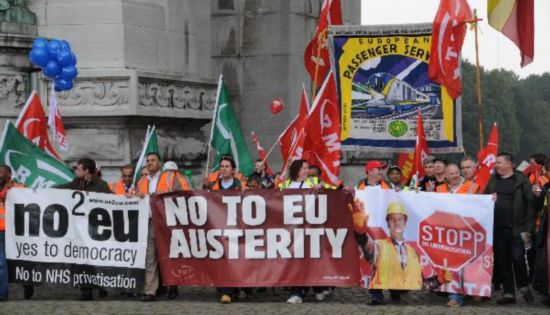
As the US presidential election draws closer and the political debate rumbles on, I find myself becoming increasingly frustrated by those voices on both the left and the right, who seek to hold up the example of “Europe” (that homogenised, cohesive whole) as Exhibit A in an attempt to win their economic policy argument.

I am talking about the ongoing “austerity/stimulus debate” – whether America should make drastic and immediate cuts to public spending in order to tackle large government budget deficits, or whether even higher levels of government spending are required in the short term to spur economic growth, before deficit-tackling measures are undertaken at some point in the future.

When talking about these issues, both Democrats and Republicans are playing fast and loose with the truth, and doing the American people (at least those who have already tuned in to the election-year political coverage) a disservice in the process.

On the left, it is fashionable to point at Europe and exclaim that austerity policies are not working because “Europe” has drastically scaled back government spending, and yet is experiencing either a very tepid recovery or an outright double-dip recession. A typical example, from The Washington Post:

Europeans are rebelling against austerity. That’s the read on Sunday’s elections in Greece and France. But why do voters loathe austerity? Perhaps because, as economists have found, efforts to rein in budget deficits can take a wrenching toll on living standards, especially in a recession.

In a recent paper for the International Monetary Fund, Laurence Ball, Daniel Leigh and Prakash Loungani looked at 173 episodes of fiscal austerity over the past 30 years. These were countries that, for one reason or another, cut spending and/or raised taxes to shrink their budget deficits. And the results were typically painful: Austerity, the IMF paper found, “lowers incomes in the short term, with wage-earners taking more of a hit than others; it also raises unemployment, particularly long-term unemployment.”

The left-leaning media across the pond is also keen to seize on this narrative, as the following opinion piece from The Guardian deftly demonstrates:

Third, the president should make it clear he won’t allow government spending cuts to take precedence over job creation. He won’t follow Europe into an austerity trap of slower growth and higher unemployment. While he understands the need to reduce the nation’s long-term budget deficit, he should commit to vetoing any spending cuts until the unemployment rate in the US is down to 5%. Instead, he should commit to further job-creating investments in the nation’s crumbling infrastructure – pot-holed roads, unsafe bridges, inadequate pipelines, woefully-strained public transportation, and outmoded ports.

Finally, Obama should make sure Americans understand the link between America’s fragile recovery and widening inequality. As long as so much of the nation’s disposable income and wealth goes to the top, the vast middle class lacks the purchasing power to fire up the economy. That’s why the so-called “Buffett rule” he has proposed – setting a minimum tax rate for millionaires – needs to be seen as just a first step toward ensuring that the gains from growth are more widely shared. He should vow to do more in his second term.

Such an economic strategy – forcing banks to help distressed homeowners, stopping oil speculation, boosting spending until unemployment drops to 5%, and fighting to ensure economic gains are widely shared – is critical to jobs and growth. It’s the mirror image of Europe’s failed austerity policies.

These arguments do not stand up to scrutiny for several reasons, many of which are well articulated in this piece from Forbes:

The trouble with Europe’s post-crisis budgets, then, isn’t so much that they’ve increased taxes. It’s that they haven’t meaningfully cut spending. “Following years of large spending increases,” Veronique de Rugy explains, “Spain, the United Kingdom, France, and Greece — countries widely cited for adopting austerity measures — haven’t significantly reduced spending since 2008.” De Rugy points to data that shows those countries “still spend more than pre-recession levels,” with France and Britain making no cuts, and Italy increasing spending in 2011 “more than the previous reduction” between 2009 and 2010. Without significant, substantial cuts, tax increases alone don’t amount to austerity. Yglesias is correct that tax hikes can contribute to austerity. What tax hikes cannot do, however, is be austerity. Tax hikes are neither necessary nor sufficient for an austerity program.

Inconsistent though it may be with the liberal worldview in the US, this is very true. Government spending, by many measures, is actually higher than pre-recession levels in Britain and other countries. The so-called “austerity” that everyone is wailing about is nothing more than a reduction in the rate of increase in government spending. Furthermore, as anyone living in Britain can easily attest, many of the “austerity” measures have been tax increases, and not spending cuts – which also does little to support the liberal view that draconian spending cuts have stymied an economic recovery.

Also missing from the left-wing take on austerity is an understanding of the fact that, unlike the US, European economies grappling with anaemic growth or double-dip recession do not have the good fortune to be underpinned by the world’s primary reserve currency. It is much easier to enact a large scale stimulus programme while retaining the confidence of the global bond markets if your currency is the US dollar, a fact that is glossed over by many people, including some in the Obama administration who hold up Europe as a cautionary tale of what happens if you fail to meet economic downturn with government stimulus.

The Washington Post reports:

“The situation in Europe is slowing things down,” Obama told donors at the New Amsterdam Theatre. At the home of hedge fund executive Marc Lasry, Obama said that Romney and congressional Republicans favored an austerity plan that would “drastically shrink government,” hurting job growth and middle-income Americans.

“That is fundamentally different from our experience in growing this economy and creating jobs,” Obama said.

Where Obama was subtle, not drawing a direct line between Europe’s approach and Romney, Clinton was not.

The former president said Republicans were adopting “the European economy policy.”

As a European watching the American political debate unfolding, it frustrates me to see such sweeping statements and generalisations being made about other countries, and seeing their actions and policy stances mischaracterised without even the pretence of trying to understand them – and this applies to both sides of the political aisle. I also fear that it does not do much to dispel the false but common notion that most Americans are insular and lacking any real understanding of the world beyond their borders.

This stereotype, where true, is unfortunate enough to the extent that it applies to the general population, but even more concerning when it manifests itself in current and would-be future political office holders.

Obama The Socialist

Barack Obama - Socialist - Socialism


Who knew: Apparently I would make a passable journalist, and could be well respected and remunerated for doing so. I know this because after I read Paul Roderick Gregory’s article in Forbes, “Is It Within Bounds To Ask: Is Obama A Socialist?” I did two things: I reminded myself of the definition of socialism using two readily available sources (I was smart and used two independent sources just in case one of them was leading me astray), and I cross-checked this definition against the policy positions set out on Barack Obama’s website.

Paul Roderick Gregory, who “journalists” for a living, did neither of these things; he is professionally negligent and apparently just whipped open his laptop and started typing. Either that, or he is professionally negligent and knows the information to be found on these websites very well, but thinks that all of his readers are idiots who are incapable or unlikely of doing the same. Now which could it be?

I am going to leave aside the semantic arguments about the meaning of the word “socialism” that Gregory employs in his companion piece “Is President Obama Truly A Socialist“, but basically Gregory holds his hands up and pleads that he doesn’t mean the traditional definition of socialism. No, he just means “socialism” as practiced by continental Europeans with their welfare states. Of course, this disclaimer is buried very deep within the article, so that the full impact of conflating Obama’s political philosophy with socialism is felt immediately, while the clarification is given only after the statement has had sufficient time to establish itself as fact:

By “socialist,” I do not mean a Lenin, Castro, or Mao, but whether Obama falls within the mainstream of contemporary socialism as represented, for example, by Germany’s Social Democrats, French Socialists, or Spain’s socialist-workers party?

By this criterion, yes, Obama is a socialist.

If Gregory wanted to make this more nuanced argument (still wrong, in my opinion) – that Obama’s policies are closely aligned to European social democracy – then he could go ahead and do so. But he has no interest in doing that. The only reason he even includes this tortured disclaimer is to clear the ground so that he can land his rhetorical punch on Obama, and label him a “socialist”.

From the stirring conclusion to the original article:

The upcoming November election offers American voters a choice that is starker than they understand. Obama brings to the table a deep distrust of free enterprise and a belief in government as the solution to most problems. Romney offers a vision of faith in private enterprise and a distrust of government intervention. Obama will disguise his views with “fair share” slogans and weak protestations of faith in private enterprise.

This is actually the closest that Gregory comes to cogency in either piece. I come from a centre-right perspective and do sometimes think that Obama is heavy-handed in his administration’s oversight of the free market. Interfering with private companies such as Boeing when they come to make decisions on where to locate their production, for example, strikes me as bullying and control-freakish. But I have never felt as though Obama was secretly yearning to nationalise Boeing and create a state-owned aerospace and defence company.

On the flip side, many of Romney’s contemporaries in industry are only too quick and happy to run to the government when it suits their needs, perhaps to ask for bailouts, favourable trading terms or tax loopholes, or to bring down the regulators on a rival that is becoming rather too successful. Hardly unheard-of.

Why am I even bothering to quote this trash? Only because it is emblematic and typical of the lazy type of charges that are levelled against Obama by some on the right. By calling out Gregory now, I free myself from the obligation do the same thing every time another right wing talking head repeats the same “Obama-Socialist” line on Fox News, or in a newspaper column.

So, Paul Roderick Gregory, the unfortunate person who I picked on to embody every die-hard tea partier and overenthusiastic Republican who is tempted to get carried away with the old rhetoric when disagreeing with President Obama’s economic policies: is it “within bounds to ask: is Obama a socialist?”

Sure, it’s within bounds. It’s just really, really dumb.

I had no idea that the bar for becoming a published Forbes contributor was set so low.