Don’t Let Politics Ruin Thanksgiving

family-argument-thanksgiving-election-donald-trump-politics

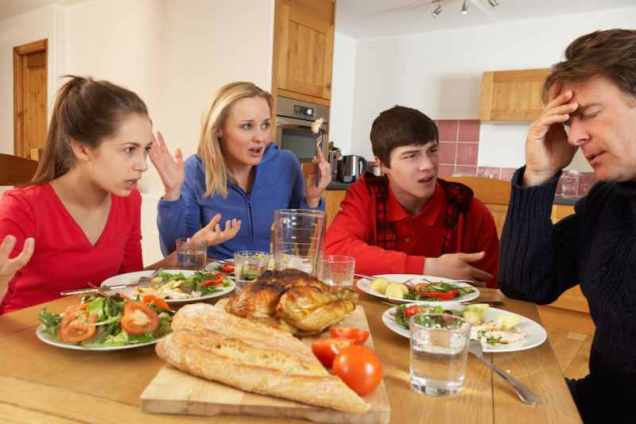
The holiday season approaches, and politically divided families gear up to fight the presidential election all over again

As Americans prepare to celebrate the Thanksgiving holiday come face-to-face with distant family members who committed the crime of voting for the wrong candidate on November 8, the National Review looks back to a more innocent age when cynical politicians did not attempt to divide families along partisan lines or turn every last social occasion into a teachable moment in favour of their own pet causes.

Jim Geraghty writes:

The idea that Thanksgiving is now a massive, stressful, unavoidable occasion to litigate our national debate about party and philosophy over family dinner represents the insufferable hyper-politicization of American life. Some of this may reflect growing cultural differences, partisanship, communities segregating themselves along ideological lines, and so on. But there’s an unavoidable fact that only recently have we been subjected to political leaders explicitly calling for these holiday arguments.

Back in 2013, Michelle Obama wrote on the site of the White House’s political arm, Organizing for Action, that, “as you spend time with loved ones this holiday season, be sure to talk with them about what health-care reform can mean to them.”

Then in 2014, Mike Bloomberg’s anti-gun group, Mayors Against Illegal Guns, offered a placemat entitled “Talking Turkey About Guns.”

In 2015, White House Press Secretary Josh Earnest concurred, suggesting that families should discuss why members of Congress are too afraid of the NRA to pass a gun-control bill: “As people are sitting around the Thanksgiving table talking about these issues – as they should and I’m sure they all will across the country – I hope that is a question that will be raised and asked by members around the table.”

This year we get “How to Talk to Your Family About Planned Parenthood This Thanksgiving.” Pass the gravy, and let me tell you more about the organization’s commitment to STD testing.

What is wrong with these people? Since when is it a national obligation to subject your relatives to the conversational equivalent of push-polling? Everybody’s gotten together to express thanks, say a little prayer, maybe drop off some canned goods at the soup kitchen, watch a parade and some football, eat way too much, and scoff at the lunatics camped out on shopping-center sidewalks in anticipation of Black Friday. If a family wants the main course to turn into The McLaughlin Group, it will happen naturally. We don’t need government officials and interest groups to coach us on our dinner conversations.

More importantly, there’s a lot more to our relatives than their voting histories and political perspectives.

Take a good look around the table this Thanksgiving. Even when your family members drive you crazy, you’re lucky to have them. You’ll miss them when they’re gone, and they’ll miss you when you’re gone. Do you really want to spend Thanksgiving arguing with them about their vote, or the fairness of the electoral college, or Trump’s latest Tweet, or what the cast of Hamilton did? Must we say every thought that pops into our heads? Is it really so impossibly hard to find things to admire in our relatives beyond their political beliefs?

My American family has not been immune to the online partisan warfare, with several colourful and highly passive-aggressive Facebook conversations unfolding in the days immediately before and after the US election and Donald Trump’s remarkable victory.

We are not all assembling together in Texas for Thanksgiving, but will be doing so at Christmas, when we will be confronted by the same problem. And while the New York Times would have us print out and follow a tedious 19-point checklist walking us through the process of talking to our relatives about contentious political issues while maintaining an atmosphere of mutual respect, we know an unrealistic proposition when we see one.

Our current working solution: to hang a basket outside the house with a sign instructing people to “Please leave your political opinions inside this basket before you enter, and collect them when you leave”.


pop-art-donald-trump-2

Support Semi-Partisan Politics with a one-time or recurring donation:

Agree with this article? Violently disagree? Scroll down to leave a comment.

Follow Semi-Partisan Politics on TwitterFacebook and Medium.

Jonah Goldberg On Conservatism In The Age of Donald Trump

Jonah Goldberg says it best when describing the existential danger facing American conservatism in the Age of Trump.

On Trump’s unearned reputation as a happy warrior against political correctness:

This is just flatly not true. I also don’t believe it is true that Trump is appealing to minorities based upon their status as citizens, it’s not in his rhetoric, it’s not what he says; nor do I think he gives a rat’s patoot about the Constitution, which he thinks has twelve articles. He is just making it up as he goes along, riding a populist wave.

[..] This idea that Donald Trump is against political correctness is just a fiction. He’s against being held accountable to people to political correctness for himself but he is delighted to use the exact same bullying tropes of political correctness against other people. He’s done it against me when he tried to get me fired from National Review, saying I was insulting to women and that I have to apologise or resign or be fired because I was so insulting to women. What did I do that was so insulting to women? I said that Donald Trump is staying up late into the night like a teenage girl, tweeting. Which was A, accurate, and B, accurate.

During the primaries when Jeb Bush had a completely understandable and forgivable gaffe about women’s health issues, for weeks Donald Trump was talking about how horrible Jeb Bush was on women’s issues, playing these politically correct cards. He’s a nearest weapon to hand arguer in all things because he does have no philosophy, he has no intellectual grounding whatsoever, and I understand saying “well, we don’t need any more intellectuals, what did intellectuals get us, look at Woodrow Wilson, look at Barack Obama”, I get all that.

But Donald Trump is not a practitioner or a believer in American exceptionalism. He’s rejected the term outright, explicitly, more than once, nor does he represent what we mean by American exceptionalism. His core values, as he says over and over again, are strength and winning. Getting him to talk about the Constitution is like getting my daughter to eat brussel sprouts. I mean, she’ll do it, but it’s not a pretty picture and she tries to get it over with as quickly as possible.

Interestingly, Jonah Goldberg seems to broadly agree with my assessment of the first presidential debate, awarding Hillary Clinton the win, but not by a massive degree:

I thought Trump lost the debate, but not overwhelmingly. He was clearly the winner of the first 30 minutes or so, and if he’d stayed that guy for the full 90 it would have been a hugely consequential rout. But then, Hillary implemented “Bait Trump Protocol Alpha-1,” when she brought up how he got his start with a $14 million loan from his father. (She got the details wrong, but it doesn’t matter. When you’re baiting fish or Trumpzilla, the lure doesn’t have to be real, it just has to be shiny. In fact, getting the bait just slightly wrong makes it even more irresistible, because we all have a natural instinct to correct falsehoods aimed at us, and Trump more than most.)

So Trump bit the shiny thing, and for the rest of the night, plodding, dull Hillary Clinton led Trump around the stage like a matador with a red cape. And, four days later, Trump is still charging around like an enraged bull. At first I thought Clinton’s use of Alicia Machado was odd. There are so many Trump victims out there, why use one with such a weird past? But that’s what was so brilliant about it. If Machado were a nun, it’d be harder for Trump to attack. But Trump thinks he can win this one on the merits and so he won’t let go of it. He didn’t learn the lesson of his feud with the Khan family: The only way to win such fights is to not engage in them at all. The debate wasn’t a disaster but how he handled the post-debate spin was, and continues to be.

If Trump could stay on message, if he could be a disciplined candidate, I think he’d be ten points ahead by now. But realistically, this is no different from saying if he could control anything metal with his mind, he would be Magneto.

In the immediate aftermath of the debate (at 4AM UK Time, with no opportunity for reflection or benchmarking against the reaction of others) I wrote:

Clinton did become more effective during the final 30 minutes, which her campaign will be very relieved about. And did she manage to rile Donald Trump? Yes – but no more than the country is used to seeing after his tussles with Jeb Bush, Marco Rubio or Ted Cruz.

[..] My gut says that this was a victory for Hillary Clinton on points, but a score draw in terms of public reception. Time will soon tell.

All but the most extreme Trump partisans have indeed admitted a Clinton victory on points, substance and tone. And once again, Donald Trump is crowdsourcing advice for how he should tackle the upcoming second debate at Washington University in St. Louis – advice which he will surely reject again, whether it comes from his army of supporters or his despairing, demoralised campaign team.

American conservatives who have chosen to collaborate with Donald Trump have hitched their wagon to the wrong train – in victory or defeat, he will lead them nowhere good.


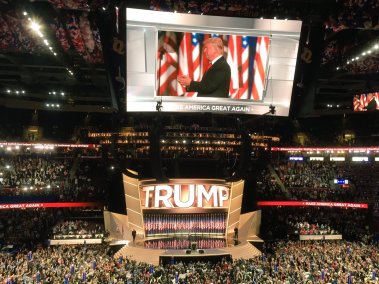
Donald Trump - RNC - Republican National Convention - Cleveland - Nomination - 2

Support Semi-Partisan Politics with a one-time or recurring donation:

Agree with this article? Violently disagree? Scroll down to leave a comment.

Follow Semi-Partisan Politics on TwitterFacebook and Medium.

REFERENDUM DAY: The Last Word

The last word

I wanted to write one last great exhortation encouraging people to vote Leave today – a grand summary bringing together all of the compelling reason to reject the miserabilist, pessimistic, soul-sickeningly unambitious case put forward by the Remain campaign and embrace instead the possibility of real democratic renewal which can only come about with a Leave vote.

But someone has already made the closing argument much better than I ever could. And they did so before I was even born, in 1975 at the time of our last referendum on whether to remain part of the European Economic Community.

If you read this blog, you already know my thoughts on the EU referendum. And if you follow the work of The Leave Alliance you know the type of Brexiteer that I am.I will not restate all of these arguments now. I will leave you instead with the words of the late Peter Shore MP, a man whose politics could hardly be more different to my own, but whose understanding of and commitment to British democracy is second to none.

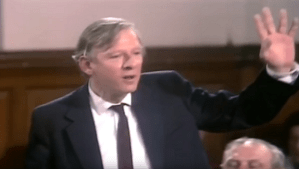
Speaking at a 1975 EU referendum debate at the Oxford Union, Peter Shore MP concluded his remarks with this devastating critique of Britain’s accession negotiation – all of which can be applied to David Cameron’s failed renegotiation – followed by a stirring rejection of the EU’s antidemocratic, supranational form of government in general:

I say to you this is not a treaty which in any way is a fair and equal treaty. It was not negotiated, it was accepted. Not one word, not a comma, let alone a clause, let alone a paragraph of the Rome Treaty – not one comma has been altered in order to meet the perfectly legitimate and serious differences that exist between Britain and the Common Market.

And now the experience itself – three and a half years ago, when they were urging us to go in. Oh, what a campaign it was. “You’ve got to get in to get on” was the slogan of that day. Five or six pounds a week better off for Britain, if we could only get in to the common market. All the goodies were read out – Donald Stokes of Leyland buying one-page advertisements saying all we need is a great domestic market of 250 million, and we will sweep Europe!

[..] When you add to that the burdens I mentioned a moment ago, and we are under great threat, we are in peril at the present time, and the country must know it.

Therefore now what do they say? What is the message that comes now? No longer to tell the British people about the goodies that lie there. No longer that – that won’t wash, will it? Because the evidence will no longer support it. So the message, the message that comes up is fear, fear, fear.

Fear because you won’t have any food. Fear of unemployment. Fear that we’ve somehow been so reduced as a country that we can no longer, as it were, totter about in the world independent as a nation. And a constant attrition of our morale, a constant attempt to tell us that what we have – and what we have is not only our own achievement but what generations of Englishmen have helped us to achieve – is not worth a damn, the kind of laughter that greeted the early references that I made that what was involved was the transfer of the whole of our democratic system to others. Not a damn.

Well I tell you what we now have to face in Britain, what the whole argument is about now that the fraud and the promise has been exposed. What it’s about is basically the morale and the self-confidence of our people. We can shape our future. We are 55 million people. If you look around the world today – I listened to Gough Whitlam and his 14 million Australians, and he trades heavily with Japan, I’m very fond of the Australians – but do you think he’s going to enter into a relationship with Japan where he gives Japan the right to make the laws in Australia? Do you think Canada, 22 million of them, and to the south a great and friendly nation, yes they are, but do you think Canada is going to allow its laws to be written by the 200 million people in some union in America? No, no, of course not. The whole thing is an absurdity.

And therefore I urge you, I urge you to reject it, I urge you to say no to this motion, and I urge the whole British country to say no on Thursday in the referendum.

All of this beautiful prose – a relic from a bygone age when political speeches didn’t make one want to jump out of the window to escape the boredom – was delivered while a stony-faced Edward Heath looked on, chastened.

God willing, today we will have the opportunity to chasten our current prime minister David Cameron – a man who has conducted himself in many ways like a lame Ted Heath tribute act – by ignoring his pro-EU campaign of lies, distortions and intimidation.

I can say no better than Peter Shore. But please – if you have not already done so, go to your polling station and vote for democracy, vote for Britain, vote to leave the European Union.


Polling Station - Voter Apathy - Voter Disengagement - General Election 2015

Peter Shore MP - Oxford Union - EU Referendum - 1975 - Brexit

European Union - United Kingdom - Britain - Flags

Agree with this article? Violently disagree? Scroll down to leave a comment.

Follow Semi-Partisan Politics on TwitterFacebook and Medium.

EU Referendum Live-Blog: Cameron v Farage, But Not Really

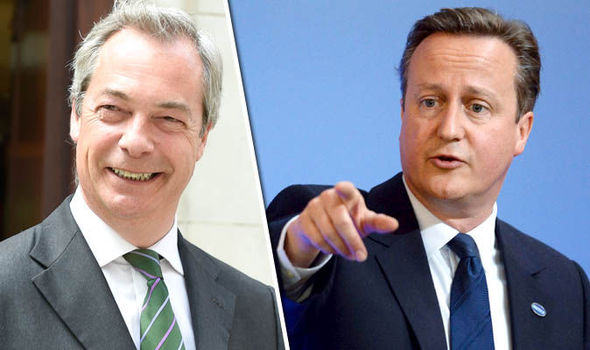
David Cameron - Nigel Farage - Debate - ITV - EU Referendum - Brexit - Remain

Semi-Partisan Politics: EU Referendum Live Blog – Cameron vs Farage (but not really)

#ITVEUref

21:57

And that’s it. Cameron off the hook, with no major hits landed on him.

Combative and effective as usual from Nigel Farage, but nothing new to suggest a recalibration to reach the essential 50%+1 on Referendum Day. Once again Farage will have pleased his supporters and disgusted his detractors.

What an utterly pointless “debate”, and what a useless format. I sincerely doubt that anybody in the country learned a single new thing from watching that “showdown”. Generally weak audience questions served little purpose other than to tee up the usual soundbites we are tired of hearing from Vote Leave and Stronger In.

Weak moderation too – Julie Etchingham seemed to be imposing rules and time limits which existed solely in her head, and which often ended up cutting through some of the more eloquent and discursive points on each side.

All in all, this was yet another example of the media’s shameful, shallow coverage of the EU referendum – and the glibness and alarming lack of depth of those who lead us.

21:56

Polished, passionate and utterly vacuous.

21:54

David Cameron, directly asked by an audience member whether he is “finished” regardless of the result of the EU referendum, waffles and talks about anything and everything else.

But it is very hard to see Cameron continuing. This is a supposedly conservative prime minister who gladly, joyfully shares a platform with Labour and Green Party politicians campaigning for an outcome which most party members detest. There is no love for Cameron, who will go down in history as a second-rate version of Ted Heath.

21:53

More scepticism about David Cameron’s assertion that Brexit means “quitting”:

21:49

Good point by audience member. Hardly anyone can name their MEP. Because the European Parliament is a chamber representing a demos which does not exist. There is no European demos. Hardly anybody feels European first and foremost, above their national or regional identity. And yet the EU seeks to acquire all of the trappings and powers of statehood. Shouldn’t that be setting off alarm bells?

21:48

Contra Cameron, “quitting” is staying in the EU and giving up on the ability of the fifth largest economy and second (by some rankings) military power to influence world events.

21:47

True democracy is about whether you can fire the people in charge if they start to do a bad job or if the people want a change.

The British people can’t fire the people who run the EU. There is no democracy.

21:44

No, Cameron. We will not be like a country with our faced pressed against the glass while the EU makes key decisions on trade. On the contrary, by leaving the EU we will regain our voice, our seat and our vote at the true global top tables which set key regulations and standards – organisations like UNECE, the IMO, ILO, Codex Alimentarius and many others.

These are the true originators of much regulation today, and for as long as we are in the EU with the Commission acting as middleman, we have a limited voice and a diluted influence in shaping these regulations – even ones which could obliterate entire British industries at the stroke of a pen.

Here’s why the EU is no longer the “top table” for trade – and why David Cameron was just deceiving the audience.

21:41

Ooh, it’s NHS time. Everybody genuflect to our National Religion.

If you are basing your decision on whether Britain should leave or remain in the European union solely or primarily on the NHS, then you are doing it wrong.

21:40

I’m glad someone brought up Little England. Because it is the Remainers – with their declinist, pessimistic view of Britain – who have low horizons. Those who want Britain to be an independent country, fully participating in the true global top tables for trade (hint: not the EU) are the ones with bold, global aspirations.

21:38

Yes, David Cameron is doing his creepy “passion” thing again, in place of actually standing for things and leading:

https://twitter.com/elashton/status/740280699270365184

21:35

Audience member takes David Cameron to task for his fraudulent renegotiation. Everything Cameron is saying now is false – the “agreement” he reached was negotiated with EU leaders acting in their capacity as heads of state and government. Many of them will soon no longer be in power. The EU is in no way obligated to honour the pitiful commitments in that agreement.

21:32

Immediately David Cameron pivots to talking about the single market, not the EU.

But leaving the single market is not on the ballot paper – we can (and almost certainly would, in the event of a Leave vote) leave the political institution of the EU while maintaining access to the single market – the so called interim EFTA/EEA or Norway Option. Adopting this plan immediately negates every single pessimistic, fearmongering argument put forward by the Remain campaign, which is why they are so desperate to slander or dismiss it.

21:31

David Cameron’s turn.

Good first question from the audience. 6 months ago Cameron was saying that Britain could thrive outside the EU, yet now he says it would mean economic Armageddon.

Was the prime minister lying then, or is he lying now?

21:27

Well, that was Farage. A typically assured performance. Ukippers will be happy. Liberal leavers like this blog and members of The Leave Alliance less so, for obvious reasons – Farage doubled down on all of the illiberal and protectionist arguments while doing nothing to reach those not already convinced that Brexit is the way to go.

In terms of moving the needle of public opinion, Nigel Farage certainly hasn’t done himself any harm. But it has made it harder for those of us arguing for a more progressive case for Brexit to do our work.

21:25

Moderator of this referendum is worse than useless so far. Staying silent when she should guide the debate, cutting across when actual interesting points are being made.

21:24

Audience member rightly notes that there are many separate means of cooperation between EU countries independent of the EU. Brexit doesn’t mean severing ourselves from the continent of Europe or from schemes like Europol. By freeing ourselves from the EU’s political union we restore our democracy and are able to choose the areas and nature of our cooperation.

21:23

Waving a passport around is not going to get us from 40-45% of the vote to the 50%+1 the Leave side needs to win the referendum. People who get misty eyed about blue passports are already going to turn out and vote to leave. We need to reach undecideds with a comprehensive, safe offering, showing them that it is possible to leave the EU while minimising economic risks.

21:21

I’m not the only one to note the markedly poor quality of questions coming from the audience so far. Roland Smith (author of the Liberal Case for Leave) sees it too:

21:19

Farage is a natural performer. One can only wonder what an asset he could have been to the Leave campaign had he only updated his 1990s-era euroscepticism and embraced a more progressive (or small-L liberal) case for Brexit.

21:16

Audience member with an utterly fatuous question about the Leave campaign supposedly whipping up anti-black fervour. As a mixed race person (not that it should matter), this is complete hogwash. Disagree with UKIP all you want (and I disagree with them on plenty), but disagree with their stance on immigration all you want, but fatuous, blanket assertions that their immigration stance is racist or “legitimises racism” is flat out false. And in fact it is this effort to slander euroscepticism and worries about immigration with the charge of racism that creates further resentment.

21:15

Oh, Justin Welby accuses Nigel Farage of legitimising racism, eh? The Archbishop of Canterbury might do better to look at the gaping hole in the public discourse where a rational, intellectual and moral Christian case for the European Union should be.

Shockingly, it doesn’t exist.

21:13

The good thing about Nigel Farage is that he doesn’t feel the need to flatter audience members, agree with them and accept their assumptions and premises. I think that some people do admire that, even if they disagree with him. Contrast it with David Cameron’s doubtless oleaginous performance once he takes the stage.

21:10

Every moment Nigel Farage spends talking about tariffs is time he could be spending reassuring wavering Brits that we can leave the EU’s political union while maintaining our access to the single market.

21:09

Tremulous audience member worried about Britain being “punished” if we vote to leave the EU. This takes us back nicely to the Remain side’s cognitive dissonance about whether the EU is a friendly club of countries who get together to knit and braid each other’s hair, or an abusive relationship where we will be beaten up if we try to leave. The Remain camp really do need to make up their minds…

21:08

Oh dear – the first appearance of “they need us more than we need them”. Farage is rightly being taken to task by an audience member for this point.

Far too much talking over one another going on already – Farage, audience members, the moderator.

21:06

Fair point from Farage – there is a marked difference between people in current positions of power in government and NGOs who tend to side with Remain, and those now out of power, who are more likely to back Leave. Something about the freedom of being able to speak one’s true mind seems to make people more likely to support Britain’s independence from the EU. Funny, that…

21:03

Okay, here’s Nigel Farage. The man who arguably did more than anyone else to secure this referendum, but failed to produce a plan for actually leaving the EU.

21:00

Well, here it is. The debate that is not a debate, because David Cameron doesn’t dare actually engage anyone in debate these days.

I’m far from certain that this event will be worth live-blogging, but it will be practice for the Semi-Partisan Politics live-blog of the referendum count and results on 23/24 June.


More about The Leave Alliance here.

More about Flexcit here.

The EU Referendum blog here.

 

European Union - United Kingdom - Britain - Flags

Top Image: ITV

Agree with this article? Violently disagree? Scroll down to leave a comment.

Follow Semi-Partisan Politics on TwitterFacebook and Medium.

Republicans Are In No Position To Mock The Democratic Party Primary Debates

https://www.youtube.com/watch?v=dYFPaU0581Y

In his Morning Briefing email today, the National Review’s Jim Geraghty disparaged last night’s latest Democratic Party primary debate between Hillary Clinton and Bernie Sanders with these words:

‘Yeah, There Was Another Democratic Debate.’ (Stifles Yawn)

Thursday night’s Democratic debate in Brooklyn basically amounted to Bernie Sanders’s repeating all of his familiar attacks against Hillary and her insisting they’re baseless; and her charging that he doesn’t know what he’s talking about, at which point he would counter-charge, “THE GREED AND THE RECKLESSNESS AND ILLEGAL BEHAVIOR OF WALL STREET BROUGHT THIS COUNTRY INTO THE WORST ECONOMIC DOWNTURN” — sorry for the all caps, it’s the only way to accurately capture the volume of Sanders’ high dudgeon voice — “SINCE THE GREAT RECESSSION OF THE THIRTIES, WHEN MILLIONS OF PEOPLE LOST THEIR JOBS AND THEIR HOMES AND THEIR LIFE SAVINGS, YOU’VE GOT A BUNCH OF FRAUDULENT OPERATORS AND THEY’VE GOT TO BE BROKEN UP!”

Below are a couple of highlights, to the extent there were any:

Clinton, last night, defending her judgment: “President Obama trusted my judgment enough to ask me to be secretary of State for the United States.”

Yeah, that line may work really well in a Democratic primary, but you can apply the same “hey, if Obama picked me, I must know what I’m doing” argument to former HHS secretary Kathleen Sebelius, VA secretary Eric Shinseki, short-lived Secretary of Defense Chuck Hagel, all of those wealthy donor ambassadors who knew nothing about the countries where they would represent the U.S . . .

Hillary Clinton: “It may be inconvenient, but it’s always important to get the facts straight. I stood up against the behaviors of the banks when I was a senator.

I called them out on their mortgage behavior. I also was very willing to speak out against some of the special privileges they had under the tax code.”

Bernie Sanders: “Secretary Clinton called them out. Oh my goodness, they must have been really crushed by this. And was that before or after you received huge sums of money by giving speaking engagements? So they must have been very, very upset by what you did.”

I’m sorry, does a political debate no longer count as interesting or exciting unless a deranged mob of populist Republicans are flinging feces at each other or comparing the size of their junk?

Are Sanders and Clinton repeating themselves a lot? Yes – as someone who is deluged by campaign emails and briefings from both sides, that much cannot be denied. But at least the things that they are saying actually matter. They relate to foreign policy, trade policy, crime and punishment, campaign finance and the influence of Wall Street.

The argument in the GOP primary has devolved into little more than pledges to revoke ObamaCare faster than the other (“I’ll abolish ObamaCare by executive order at the beginning of my inaugural address!”) and competing visions for exactly how high the wall should be between the United States and Mexico.

Debates on both sides probably shed a lot more heat than light, but anyone who has watched a few of these things in the 2016 cycle would have to admit that more of substance has been learned on the Democratic side than the Republican side this time round – with the same going for 2012 too, when the Republicans treated us to Michelle Bachmann and Herman Cain.

There is a group – and I can’t say how large it is, but I know it exists from my time living in America – of liberty-minded conservatives out there who are thoroughly disgusted with the Democrats’ record in office and the general direction of the country, but who will stay home or hold their nose and vote for Hillary Clinton before they see Donald Trump or even Ted Cruz in the White House.

(And to those Trump supporters who protest, I would simply say that fighting back at the establishment and sticking it to the man does not have to mean vocally supporting torture and eroding the constitution. In fact, as Britain’s Nigel Farage discovered, it is actually better when the establishment come at you equally hard for holding mostly reasonable position, as their desperation to kill the challenge to their power is then exposed for what it is).

Though I am not yet a US citizen, if I had voted in the 2008 election I would have voted without hesitation for Barack Obama over the John McCain / Sarah Palin freak show. Many others did the same. So forget trying to attract massive new demographic groups to the side of the Republican Party – maybe the GOP should focus more on simply not alienating those people who will reliably vote for any serious-minded conservative, but who are constantly chased away from the party by the carnival of idiots who keep making it to the primary debates.

You can sneer that it is cultural snobbishness at work (and a bit of it is – though not the majority), but it goes deeper than that. And the good news is that the Republican Party will soon have another chance to reinvent itself for a new era as they spend another presidential term in dreary opposition. Hopefully they will not repeat the mistake of 2008, and actually have serious discussion this time about who they want in the party and who they want out, and whether they want to appeal to the better angels or the darkest fears and prejudices of those who are invited to remain.

That process can begin soon. But in the meantime, let’s not get cocky about the Democratic Party primary process, which has seen left-wing politicians with substantially different worldviews tearing chunks out of each other on policy and substance – which is precisely what should happen.

That is the debate that the GOP should have been having this election cycle were they still a functioning party, and were they not now being forced to pay in a lump for every cynical act of alarmism, obstructionism and posturing they have taken since the inauguration of Barack Obama.


Donald Trump - Make America Great Again

Agree with this article? Violently disagree? Scroll down to leave a comment.

Follow Semi-Partisan Politics on TwitterFacebook and Medium.