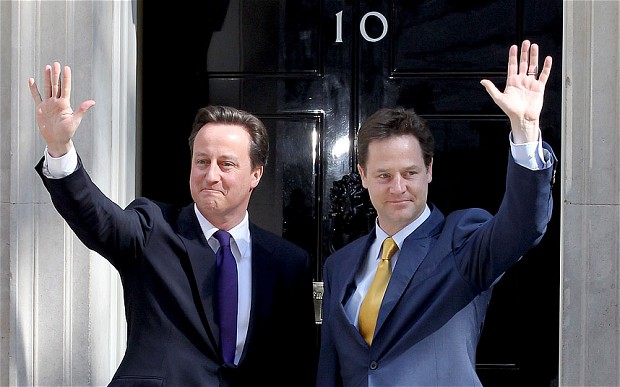
As the 2015 general election campaign grinds past the halfway point with none of the main party leaders doing or saying anything remotely interesting or inspiring – choosing only to shriek about the chaos and carnage that their opponents would do in government – people are starting to ask: where is the passion?
The Spectator’s Fraser Nelson and James Forsyth pick up on this supposed lack of “passion” in politics in their recent interview with David Cameron, conducted as the Prime Minister hurtles around Britain failing to electrify voters with talk of his Long Term Economic Plan and doomsday scenarios about a Labour-SNP government.
Interestingly, Cameron appears totally bemused that his coalition government’s technocratic, risk-averse management of the country from 2010-2015 has failed to win him legions of adoring fans:
The Prime Minister is aware of the criticism and finds it ‘frustrating’. ‘I feel I have worked my socks off for the last ten years to get to this point,’ he says. ‘I feel we are on the brink of something amazing in our country. If I don’t succeed on 7 May I will be furious more for my country — but furious for myself.’ He says this quietly, not crossly, as if he has been confronting his own political mortality. ‘We have done so much to get so far — I do not want to pull back now.’ And then, a promise to do better: ‘If I need to do more to communicate that I will.’
What he is trying to communicate in the final fortnight of the campaign is that Britain’s recovery has been extraordinary, but that it didn’t happen by accident. And that if people want the recovery to continue, they’ll have to vote Conservative. He is writing the speech he’ll give that day, with ‘jobs’ scribbled as the first bullet point. He has created them at a faster rate than any prime minister in history, which he puts down to tax cuts and welfare reform. So he is travelling to Yorkshire to sell ‘an extremely positive plan to transform the education of young people in our country, to keep going with this welfare revolution’.
He accepts that the revolutionary character of his government is not widely appreciated. ‘I think it is very undersold in many ways,’ he says. He doesn’t say by whom. He later refers to the government’s ‘quiet revolution: pro-work, pro-saving, pro-enterprise’.
Revolutionary character? The coalition government came into power promising an economic recovery and the elimination of Britain’s vast budget deficit. It achieved the former but failed spectacularly to eliminate the deficit, reducing it only by a third (now changed to a “half”, thanks to the disingenuous use of different metrics). The Labour Party would have likely done far worse, but this is beside the point – a stable economy should be a hygiene factor, the absolute base in terms of expectations of a “revolutionary” government.


 Semi-Partisan Politics