Je Suis Tory Scum

Tory Scum - Left Wing Hatred

The hysterical left will always call conservatives “Tory scum” and hate us with a blind, unthinking rage. It’s time to stop cowering at their attacks and apologising for our values

As 2015 draws to an end, we still have four and a half more years of David Cameron’s wishy-washy, ideologically rootless, Conservative In Name Only government to look forward to, followed by a general election which will almost certainly deliver another five years of blandness.

For small government conservatives and libertarians, this continual betrayal of principle is bad enough. But as an added insult, it also means four more years of being spat on and called “Tory scum” by demented far-left types who view David Cameron and George Osborne’s half-hearted attempts to pare back the state as the modern-day equivalent of Nazi war crimes, and who have no reservations in publicly saying so. Not very appealing.

That’s why the time has come for conservatives of all stripes to finally seize back the word “Tory” from the haters and reclaim it with pride, rather than meekly and apologetically crawling around and apologising for our values – values which saved this country from decline and irrelevance three decades ago, and can do so again if only we fully unleash them.

In that spirit, Tony Parsons’ article from earlier this year in GQ magazine – in which he “came out” as a reluctant member of the Tory Scum collective – is a great opening salvo in the fight back against the hysterical Left.

In his article, entitled “Why I’ve Become Tory Scum”, Tony Parsons calls out the Labour Party and other forces on the Left for the sanctimonious nature of their campaigning during the general election, and their utter inability to empathise with their opponents – or even entertain the thought that those who oppose them might be doing so from a position of legitimate, morally valid disagreement.

Parsons points out:

The general election was decided not by shy Tories but by us reluctant Conservatives. The millions like me who saw nothing but catastrophe in Labour’s addiction to high taxes and big spending, their loathing of success, the way they could use a word like “mansion” with a straight face and, above all, that endless pious prattle about the NHS – as though the British have no other identity but as a sickly, enfeebled, diseased people in need of having our bottoms wiped by the state from dawn till dusk. 

Sadly, Parsons may be right about the British as an enfeebled and dependent people in thrall to the NHS, judging by the current exercise in mass virtue-signalling underway to make this awful song Christmas no. 1 in the charts.

But the truth is that David Cameron’s government is very much an unremarkable continuation of New Labour. Far from being a son of Thatcher, Cameron and his leadership team are very much the heirs to Blair, and would bear comparison with many centre-left governments around the world. The Conservative Party, even under Thatcher, has in many respects always been to the left of even the Democratic Party in the United States, and certainly is so now.

Of course, you would not think that the Conservatives were in any way moderate, judging by the hysteria among many vocal parts of the Left, who present David Cameron’s steady-as-she-goes paternalism and tentative deficit reduction as some kind of outrageous economic shock treatment combined with “human rights” abuses worthy of the Nazis.

Tony Parsons ponders why this is so:

Why are those of us who believe in a different economic model – one where aspiration is encouraged, where the state gets out of your way and doesn’t spend money it doesn’t have – morally reprehensible? Exactly why are we scum? History suggests that, when presented with the chance to vote for socialism the British people always run as fast as we can in the opposite direction. It doesn’t make us bad people. But the left have lost the argument and are reduced to shrieking abuse.

But then the hysterical far left have always talked about conservatives thus, and they always will. Parsons recognises this as he writes:

The loud left are as pertinent to modern Britain as blacksmiths. No wonder their protests are increasingly ugly. They react with furious disbelief at the result of a democratic election. They rave about balancing the nation’s books as if it was like drowning kittens in a sack. They scream in our faces about their own compassion while bandying around epithets like “scum” and “filth” with the vicious abandon of Nazis talking about Jews.

Since the abuse will never end, clearly there is nothing to be gained from running from it any longer. Nor is there anything to be gained by continually apologising for core conservative principles – free individuals and strong families, fiscal conservatism and a prohibitive national defence – as the current Conservative leadership sadly continues to do.

What British conservatism and libertarianism really need is their own version of Jeremy Corbyn – someone who unapologetically sticks to their principles, refusing to water them down for political expediency, and who seeks to lead and persuade rather than conform to the results of the latest opinion poll or focus group.

Or to use a West Wing analogy, British conservatism needs a Matthew Santos-like figure, someone willing to proudly wear the “Tory” label just like Santos refused to apologise for being a liberal in the famous presidential debate episode:


Speaking up for American liberalism in a way that one can only wish David Cameron or George Osborne would do for small government conservatism, Santos says to his Republican opponent:

What did liberals do that was so offensive to the liberal party? I’ll tell you what they did. Liberals got women the right to vote. Liberals got African-Americans the right to vote. Liberals created social security and lifted millions of elderly people out of poverty. Liberals ended segregation. Liberals passed the Civil Rights Act, Voting Rights Act. Liberals created Medicare. Liberals passed the Clean Air Act, Clean Water Act. What did conservatives do? They opposed every single one of those things. Every one.

So when you try to hurl that label at my feet – liberal – as if it were something to be ashamed of, something dirty, something to run away from, it won’t work, Senator. Because I will pick up that label and I will wear it as a badge of honour.

Of course it is almost unimaginable for a conservative to ever talk this way, with such passion, partly because we tend not to make such grand claims for ourselves in reshaping the world or forcibly changing human nature in pursuance of our goals. It is not in our nature to brag about our accomplishments, because the biggest accomplishment a conservative can aim for in government is to get out of the way and help remove obstacles from others so that they might reach their full potential.

But more than this, British conservatives since Margaret Thatcher have had precious little to brag about. Locked out of office under thirteen years of New Labour, the Conservative Party which emerged under David Cameron has made so many compromises with triangulating, Blairite centrism that there are almost no genuinely conservative policy victories or changes in the country which we can claim.

What are we supposed to brag about? Remember when the Tories stood up to the growing climate of intolerance toward freedom of expression, and formally codified a British citizen’s right to free speech? We can’t say that because it didn’t happen. Indeed, under Theresa May Britain is becoming an even more authoritarian police state than it was before, with human beings languishing in our prisons simply for saying, singing, or tweeting the “wrong” thing.

Remember when George Osborne struck a blow for fiscal conservatism, rallied the country with his argument that it was morally obscene for government to spend more on debt repayments than education or the military, and achieved a real budget surplus in order to finally begin paying down the national debt? We can’t say that either, because although Osborne is happy for the public and lazy journalists to believe that the Tories are “paying down Britain’s debts”, in reality the government is doing no such thing.

Conservative supporters truly have the worst of both worlds at present. We are attacked by the furious Left for an ideologically-motivated attack on the state and its poorest dependants, while in reality almost zero real conservative reform is being enacted. We are stuck with the leftist abuse, but have absolutely nothing positive to show for it.

As this blog asked when Jeremy Corbyn was on the cusp of winning the Labour leadership contest, finally giving one of Britain’s two main parties a leader who demonstrably believed in something more than the acquisition and keeping of power:

If David Cameron’s Conservative Party was voted out of office today, what will future historians and political commentators say about this government fifty years from now? What will be the Cameron / Osborne legacy? What edifices of stone, statute and policy will remain standing as testament to their time in office? Try to picture it clearly.

Are you happy with what you see?

No real conservative should be happy with what they see right now. Assuming that the political pendulum will at some point swing back in favour of the Labour Party, we conservatives have almost nothing to show after five years of David Cameron other than a half-finished job clearing the budget deficit. We have a reanimated Ted Heath sitting in Downing Street, not a worthy heir to Margaret Thatcher.

But just as the American Tea Party lay conspicuously dormant for the many years of fiscal profligacy and budget-busting spending under the George W. Bush administration only to miraculously awaken when a man named Barack Hussein Obama won the presidency, so the hysterical British Left are now shrieking bloody murder over a set of very pedestrian, middle-of-the-road centrist policies being enacted by the Conservative Party after having airily ignored the very same governing philosophy when the now-hated Blairites were in charge.

As conservatives, we realise there is no point in launching a futile battle against human nature or the instinct of many on the Left to demonise that which they do not or cannot understand. They will continue to call us “Tory Scum” and we have no control over that.

But we do have the power to take back ownership of the label “Tory” and refuse to see it as an insult.

We do have the power to point out that there is nothing virtuous or compassionate about throwing more money at unreformed healthcare and welfare systems, or spreading the wealth around so much that wealth creation is destroyed or driven overseas.

We do have the power to proclaim the importance of fiscal conservatism, not out of some wonkish obsession with balancing the books but because running up further government debt today is a blatant act of intergenerational theft, living at the expense of our children and grandchildren. And because as we have seen with other countries, excessive national debt can become a foreign policy and national security issue too.

We do have the power to point out to anyone who will listen that the modern Left love to parade their virtue and ideological purity but have apparently given up on coming up with alternative policies of their own, and to demand that Labour produce some costed tax and spending plans rather than simply railing against the inhumanity of the Evil Tories.

We do have the power to point out the many ways in which David Cameron’s pitiful excuse for a Conservative government ignores or betrays real conservative values, and to declare “not in my name”.

We do have the power to say “Oui, Je Suis Tory Scum – and I wish that our prime minister was a real conservative too, rather than a reheated Blairite with an ominous, socialist plan for every stage of our lives“.

The Left are not going to change, so we had better get used to the spitting, the vandalism, and the overwrought, emotional and short-termist way in which they discuss public policy.

But we can change. We can stop lying down and taking it every time a virtue-signalling lefty pontificates on welfare without offering a plan of their own, or seeks to win an argument on healthcare by stoking the public’s idolatry of the NHS.

We can stop fighting on the Left’s terms.

And who knows, if small government conservatives and libertarians actually succeed in getting off the back foot for the first time since Margaret Thatcher left 10 Downing Street, we might even manage to salvage something from David Cameron’s woeful premiership.
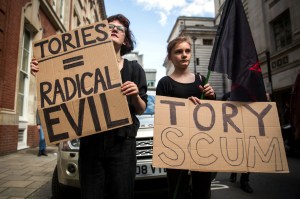
Bankers Toffs And Tory Scum - General Election 2015 - London Protests - Downing Street

Agree with this article? Violently disagree? Scroll down to leave a comment.

Follow Semi-Partisan Politics on TwitterFacebook and Medium.

Jeremy Corbyn, Owen Jones And The Thin-Skinned Labour Commentariat

Dan Hodges - Owen Jones - Labour Party

A campaigning journalist or opinion writer must write according to their conscience, without a second thought for whether it helps or hurts their own party in the short term

Owen Jones is angry that his attempts to make sympathetic, reasoned critiques of Jeremy Corbyn’s Labour Party are attracting the same levels of vitriol and hatred that those of us on the Right experience every day.

In his Guardian column yesterday, Jones complains:

I have several criticisms of the Labour leadership, held in good faith and constructive in approach. Because I want the left to succeed – otherwise, what’s the point? The need to build coalitions of middle- and low-income people; to reach out beyond the converted; to have a credible, coherent economic alternative; to rebut smears of being hostile to the country; and so on.

But when voiced, the right will use these as evidence that “even the left is losing faith”. Some on the left will see such suggestions and criticisms as playing into the hands of an aggressive media campaign regarding anything but blind loyalty as treachery. The isolated sympathetic commentators end up almost duty-bound to stay in line.

Such is the unrelenting nature of the media attack, any balanced discussion of the Corbyn leadership risks being shut down. That the media can be so dominated by one opinion – and so aggressive about it – is a damning indictment of the so-called free press. I’m an opinion writer: my opinions appear in the opinion section. But the media is swollen with opinion writers, and in too many cases their work ends up in the news section. A constructive critique of the Labour leadership is still needed for its own sake if nothing else. It is, however, an almost impossible task.

Meanwhile, Dan Hodges – a commentator with absolutely no concern about the potential impact of his words on the short term prospects of the Labour Party – has cancelled his direct debit and cut up his membership card (again) in no small part because of the vicious response to his opinions from the Corbynite Left.

In announcing his decision to quit Labour again, Hodges writes:

I’m done. Yesterday I cancelled my direct debit to the Labour Party. “Why don’t you just sod off and join the Tories”, Jeremy Corbyn’s supporters regularly ask anyone who dares to challenge their rancid world view.

I won’t be joining the Tories. But I am sodding off.

What’s a left wing polemicist to do if they find themselves disagreeing with the direction of the Labour Party in the Age of Corbyn?

It’s funny. Many of us on the right are well used to being called Evil Tories or labelled as heartless, uncaring monsters utterly lacking in all compassion – not because we don’t want to help the poor and disadvantaged, but simply because we don’t believe that endless, uncapped government spending is the best solution.

We are used to mainstream media outlets – heck, even the current Chancellor of the Exchequer himself – unquestioningly accepting and repeating the notion that conservatism is only about helping the wealthy, rather than the many. And when we are not being actively spat on or jostled in the street because of our political opinions, we are still used to being reviled, and our ideas not given a fair shake. And as a result, we have developed superior reasoning abilities, reserves of fortitude and patience, and very thick skins.

The left-wing commentariat utterly lack these qualities. For years they have marinated in the sanctimonious belief that their side has a monopoly on truth, compassion and decency. And since Labour lost power in 2010, it has been the easiest job in the world for them to sit on the sidelines throwing stones at the Conservative government.

(I’ll make an exception here for Dan Hodges, who correctly called Ed Miliband’s vacillating uselessness from the very beginning, and correctly predicted that he would lead the party to electoral ruin. And for his Cassandra-like efforts, he is now a pariah figure in the party he loves, with the small consolation of being David Cameron’s favourite columnist).

But to say that the left wing commentariat have had trouble adapting to the new reality under the leadership of Jeremy Corbyn is a huge understatement. Because now, more than ever, the Labour Party has devolved into warring factions and bitter rivalries. And all of them – MPs, writers and activists alike – are now treating each other with the same contempt and raw hatred that they previously reserved for “Tory Scum” like me.

And it turns out that the Left can dish it out, but can’t take it.

Owen Jones in particular seems to be struggling with the fact that writing critically about tactical errors by the Corbyn leadership is not generating a warmer and more receptive response:

I have several criticisms of the Labour leadership, held in good faith and constructive in approach. Because I want the left to succeed – otherwise, what’s the point? The need to build coalitions of middle- and low-income people; to reach out beyond the converted; to have a credible, coherent economic alternative; to rebut smears of being hostile to the country; and so on.

But when voiced, the right will use these as evidence that “even the left is losing faith”. Some on the left will see such suggestions and criticisms as playing into the hands of an aggressive media campaign regarding anything but blind loyalty as treachery. The isolated sympathetic commentators end up almost duty-bound to stay in line.

And when Dan Hodges found himself implacably opposed to the current direction of his party – with his anti-Corbyn positions being received even more coolly than his tirades against Ed Miliband – he simply upped and left.

One might suggest that Owen Jones & company could learn a thing or two from this site. I’m a natural conservative supporter, though I reluctantly voted UKIP in 2015 out of frustration with the pro-EU consensus, in solidarity with good people like Douglas Carswell who went out on a limb in pursuance of their ideals, and because my local constituency fielded a dithering left-wing Wet Tory candidate. And I made clear that the Conservative Party did not deserve my vote because in every important area – national sovereignty, rolling back the state, fiscal policy, civil liberties and more – they were quite simply not behaving like a conservative party.

This blog is the exact right-wing mirror image of left-wing commentators like Dan Hodges: a natural supporter of my party, but with complete contempt for the current leadership (Cameron and Osborne) and a strong desire to see the Tories move in a more conservatarian direction. Dan Hodges can’t bring himself to remain within the Labour Party while its leadership refuses to countenance military action against the middle age barbarians of ISIS. I can’t bring myself to give money to the Tories so long as their leadership remains slavishly pro-EU and believes that the British people can be distracted from the gradual loss of their sovereignty and democracy by manufactured “table-thumping rows” and a sham renegotiation with Brussels. Or when they field a Conservative In Name Only parliamentary candidate who rails against the “bedroom tax” and thinks that we should do away with our independent nuclear deterrent.

I get a lot of stick for my views. I’m universally hated by the Left (and recently discovered a Tumblr page full of foul-mouthed invective about yours truly), and can hardly get deeply involved in Conservative politics when I disagree so fundamentally and vehemently with the centrist wet rag of a leader who just delivered a resounding general election victory only in the total absence of a viable Labour prime minister in waiting.

But that’s my lot in life, and I accept it. I’ve been called every name under the sun on Facebook and Twitter, earned the opprobrium of friends and acquaintances, and written lots of mean things about my own party, taking them to task for their failure to advance conservative policies while in power. But the one thing I have never done is pull a punch or moderate a sincerely held opinion because of the friends I might lose or the immediate electoral damage I might do to the political party I used to call home.

Love him or hate him, Jeremy Corbyn remained a Labour Party member through all of the long wilderness years of Blairism, years which must have seemed to Corbyn like an unbearable compromise with flawed Tory-lite policies. Ridicule and obscurity were his crosses to bear, and he bore them patiently until quite unexpectedly his fortunes changed.

For many of the left-wing commentariat, however, just a few short months out of power and favour within the Labour movement is apparently already taking a psychological toll on people more used to calling the Tories “evil” and sitting back to soak up the lazy applause than being tarred with the same brush and called Red Tories themselves.

I have no sympathy for any of them. Jeremy Corbyn sits atop the Labour Party because of the wretched job that the centrists and their establishment buddies did in making a convincing public case for moderate Labour. And on the flip side, I accept my share of blame for the Conservative Party’s current directionless, centrist malaise – I should have done more and worked harder in my own small way to keep the party true to Thatcher’s legacy, and fought harder against the Cameron project. Sadly I only began writing in 2012, when it was far too late anyway.

But if nothing else, perhaps now that major and influential left-wing commentators like Owen Jones have been on the receiving end of the same kind of foaming-at-the-mouth left wing demagoguery that libertarians and conservatives receive every day, they will refrain from indulging in it themselves.

Of course, that would require that they stop feeling sorry for themselves long enough to recognise the pattern staring them in the face.

Jeremy Corbyn - Paris Attacks - Terrorism - Appeasement

Agree with this article? Violently disagree? Scroll down to leave a comment.

Follow Semi-Partisan Politics on TwitterFacebook and Medium.

David Cameron’s Abominable Plan To Neuter The House of Lords

House of Lords reform - chamber

Britain’s unwritten constitution is not David Cameron’s plaything, or a convenient omission to be taken advantage of by opportunistic politicians who want to sidestep proper scrutiny

What do do when the British system of democracy fails to ensure a smooth and easy ride for each and every government bill or personal initiative of the prime minister?

Why, simply change the rules of the game, and meddle with the constitution so the only answer that anyone can give is an enthusiastic “yes!”.

This is essentially what David Cameron is now proposing to do, with some of the most nakedly autocratic changes to our legislature in recent memory.

The FT reports:

David Cameron has been secretly drawing up a plan to bypass an increasingly hostile anti-Tory majority in the House of Lords, which is threatening to wreak havoc with his legislative plans.

The UK prime minister will use the recent bust-up with the Lords on tax-credit reform as a chance to neuter the powers of the upper house.

Lord Strathclyde, the Tory grandee charged by Mr Cameron with reviewing the role of peers, is set to propose this month that the Lords should lose its veto over delegated or “secondary” legislation, such as the measure implementing tax-credit cuts.

Once that veto is removed, Mr Cameron is expected to step up his government’s increasing use of delegated legislation — also known as statutory instruments — to ram contentious measures through the upper house.

A typically arrogant move, as befits our current prime minister. But the worst comes in the form of this sneering, boastful threat from an unnamed senior Tory:

“If the House of Commons insisted, that would be it,” said one senior Tory.

“The House of Lords has to tread carefully,” he added. “If they don’t accept this proposal, we could stop them having any say at all on secondary legislation. That’s a big bazooka.”

In other words, the upper chamber of our national legislature should exist only to serve as an ermine-clad rubber stamp to the will of the prime minister. Sure, Cameron is happy to let the Lords poke around and pontificate on minor legislation of no real importance, just to give the appearance of a well-functioning and accountable system. But when it comes to the big ticket items involving finance, foreign or military affairs, the House of Lords should remain about as weak and toothless as its average, septuagenarian member.

In their outrage at being thwarted on tax credits and defied with regard to the voting age in the EU referendum, the government appears to have forgotten that scrutinising hasty legislation, thinking independently of the House of Commons and checking the “elected dictatorship” of the executive is exactly what an upper legislative chamber is supposed to do. If the composition of the upper house exactly mirrored that of the lower house, and voted in exactly the same way, there would be no point to its existence. This friction and tension between the two institutions forms one of the key checks and balances in our democracy – it is not something to be casually tossed aside whenever the government of the day finds its preferred pathway blocked.

There’s a dangerous chicken and egg dynamic at play when it comes to the House of Lords. The fact that the Lords are not democratically elected effectively gives cover to authoritarian governments who want to impose their will on the country unchecked. “None of these people were elected, while we just won the last general election”, governments can say. “Therefore we should be allowed to overrule or bypass the Lords in order to do the will of the people”.

But this also creates a powerful incentive to delay attempts to make the Lords more democratic, because to do so would add legitimacy to the body and make it much harder to steamroller ill-considered legislation past reasonable scrutiny and on to the statute books. The last attempt at positive House of Lords reform stalled early on during the coalition government of 2010-2015, after the Liberal Democrat initiative was blocked by a group of recalcitrant Tory MPs, and there will certainly be no further attempt now that the Conservatives govern alone.

It is certainly hard to argue that today’s House of Lords – made up of unelected grandees, failed MPs, influential party donors and the intolerable Lords Spiritual – should have the right to delay or veto government legislation. The current system is by definition undemocratic. But shamefully, David Cameron’s answer is not to make the House of Lords a powerful and democratically legitimate upper chamber, as he should, but rather to use the current state of the Lords as a convenient argument to help his government avoid much-needed scrutiny.

As this blog has been arguing for three years now, Britain urgently needs a full constitutional convention so that the weighty questions of how we govern ourselves and where power resides can be tackled, resolved and formalised in a document.

Equality for the four home nations in terms of devolved power. A fresh look at pushing power down to the lowest possible level, preferably the individual. Empowering cities, counties and regions (building on George Osborne’s Northern Powerhouse, but going much further). More elected mayors. Term limits for politicians and ministers. A pre-determined order of prime ministerial succession, so that the leader of our country is not chosen behind closed doors in the event that the unthinkable happens. House of Lords reform. House of Commons reform. Electronic voting in parliament to save vast amounts of valuable time. Perhaps splitting the executive from the legislature, so that MPs can concentrate on their jobs without being distracted by attempts to climb the greasy pole. All of these ideas and more should be on the table, with a view to fixing ancient democratic deficits while preserving all of the best of that which makes Britain great.

But what we have at the moment is piecemeal constitutional reform on demand – not with a view to promoting democracy or ensuring a well governed country, but simply in order to solve whatever problem happens to be confronting the government of the day. This is no way for politicians to govern, and it is no way to run a modern nation state.

Unfortunately, issues of governance and constitutional reform rarely bring people out onto the streets in protest, despite being of far more long term consequence to us all than relatively trifling matters like NHS junior doctors pay, HS2 or tax credits. But all concerned citizens should fight David Cameron’s latest lazy attempt at constitutional reform on the fly with every weapon at their disposal.

First we must stop the damage already being done. But that is not enough. It is not enough to stop David Cameron’s government from inflicting further vandalism on Britain’s constitution. The time has come to take a more holistic view of these matters, instead of the myopic, short-termist approach which thinks only in terms of immediate political advantage.

Serving MPs and ministers are obviously the last people who can be expected to give fair and impartial input to these decisions, though there is obviously a wealth of experience and knowledge held by current parliamentarians which must absolutely be harnessed. So we need to go directly to the people, however much the elites may recoil at the thought.

No more piecemeal reform. Britain doesn’t need any more opportunistic constitutional tricks. There may be little appetite for it – particularly when other current issues seem to loom larger, and when any discussion about who we are as a country provokes more awkward silences than expressions of patriotism – but we need real reform, through a full constitutional convention of the United Kingdom.

The longer we wait to drag Britain’s patchwork constitutional settlement half way to meeting the people, the less democratic – and more ungovernable – our country will become.

House of Lords reform 2

Agree with this article? Violently disagree? Scroll down to leave a comment.

Follow Semi-Partisan Politics on TwitterFacebook and Medium.

The Daily Smackdown: David Cameron’s Transparent EU Posturing

David Cameron - Angela Merkel - Francois Hollande - EU Renegotiation - Brexit

David Cameron has no respect for our intelligence if he thinks we will be fooled by claims that he is seriously considering campaigning for Brexit

Like this blog, the Times instantly saw through the prime minister’s latest desperate, amateurish attempt at brinksmanship and the dissemination of information by an often credulous media.

When David Cameron’s allies leaked that the prime minister was seriously considering recommending a Leave vote in the referendum if his renegotiation continues to be “theatrically spurned” by his EU partners, the story seemed too transparently false to be true. And it is.

The Times commented:

“It is patently clear that [David Cameron] cannot and will not become the man who tossed aside Britain’s EU membership. The hints from his allies that he might do so were a desperate negotiating tactic that has rightly backfired. This sort of melodrama is more likely to make negotiating partners giggle than give way.”

Absolutely. Every one of Cameron’s actions since he reluctantly promised the referendum as a too-little-too-late anti-UKIP defence has reeked of his desperate desire to keep Britain in the European Union at all costs.

As this blog pointed out yesterday:

Anybody with even one foot rooted in reality should be able to tell that this latest court gossip is nothing but spin. Having (unsurprisingly) gotten nowhere with his renegotiation efforts thus far, David Cameron needs to appear tough and resolute for the home audience. After all, it is pretty embarrassing that the leader of a global power and the world’s fifth largest economy has achieved precisely nothing, despite having embarked on a well-publicised begging tour of Europe. When begging and pleading with the Czechs for permission to change UK welfare rules yields no fruit, some kind of strong public stance is essential to preserve any kind of dignity.

The prime minister has never been able to force the words “Brexit” or any other specific phrase about Britain leaving the EU from his lips, and only on rare occasions has he even alluded to the fact that “nothing is off the table” if he judges the results of his renegotiation to be unsatisfactory.

Of course, since Cameron went into the British renegotiation carrying no demands at all – a point worth emphasising, and well made by Richard North at eureferendum.com – he is hardly likely to find his own efforts wanting. Who, given the chance to mark their own homework, would give themselves an F?

And when it comes to nothing being off the table in the event of failure, it remains easier to imagine the prime minister succumbing to a tearful, foot-stamping tantrum on live television than it is to picture David Cameron addressing the nation and declaring that Britain’s national interest would be better served by being outside the European Union.

EU Democracy - Brexit

Agree with this article? Violently disagree? Scroll down to leave a comment.

Follow Semi-Partisan Politics on TwitterFacebook and Medium.

Just Build The Damn Runway

heathrow-airport-third-runway-aviation-policy

This article was first published at Conservatives for Liberty

Build the third runway at Heathrow airport. And a fourth. Build new runways at London’s Gatwick and Stansted airports too. And then build a helipad directly on top of the homes and gardens of all the selfish, hand-wringing, growth-averse NIMBY naysayers who think that their decision to live by an airport gives them veto rights over Britain’s economic future

Chicago’s O’Hare international airport has seven runways. Count ’em. Seven. Five of these runways run east-west and the other two run diagonally. So long as your aircraft possesses an engine and wheels, there is almost certainly a runway at O’Hare suitable for landing without the need to circle in a never-ending holding pattern before eventually lining up for approach and touching down an hour after actually arriving above the city.

You can fly in and out of Chicago quickly, efficiently and cheaply because generations of local political leaders – for all their many other faults – have understood that aviation provides a huge boost to the economy, and that a city which makes access and connection quick and convenient for all types of traveller will surely reap the economic rewards.

Nine hours away in London, this common-sense attitude is sorely lacking. Despite the fact that no new full-length runway has been constructed in London or the south-east of England since the 1940s – when we were still digging ourselves out of the rubble of the Blitz – Britain is wasting time, energy and precious economic opportunities debating whether or not to increase airport capacity at any one of several implausible choices in south-eastern England beside the obvious option of committing to London’s Heathrow Airport, the largest and most popular.

Anyone thinking that the release of the Airports Commission report by Sir Howard Davies (summary: we should probably expand Heathrow, but Gatwick will do in a pinch) would bring this debate to a timely end were deluding themselves. David Cameron’s shrewd political radar is matched only by his lack of political courage – the Tories are terrified of angering neighbouring voters by giving the green light for more noise pollution and traffic congestion around Heathrow.

Worse still, although the Tories are hardly seen as a party of tree-hugging eco warriors their likely candidate to replace Boris “Island” Johnson as Mayor of London, Zac Goldsmith, is also dead set against the idea of expanding Heathrow despite the overwhelming logic behind committing to the major hub airport.

The never-ending question of whether or not to do the obvious and expand Heathrow airport is typical of Britain’s ridiculous approach to important decisions about critical national infrastructure. First we deny the existence of a problem or need. Then we delude ourselves that we have plenty of time to consider the issue from all angles, while better governed countries leapfrog us left, right and centre. Then we establish a time-wasting commission which seeks – in that peculiarly British way – to avoid angering anyone, while actually enraging everyone with its equivocation. And finally, twenty years later, we come to a tortuous decision – at which point anything we reluctantly build is woefully inadequate to current demand.

Not content with fighting the expansion of Heathrow airport tooth and nail, others are opening a new front in the war on aviation with a sanctimonious new attack on frequent fliers, who many left-wingers see not as vital contributors to global business and tourism but rather as parasitic city-hoppers guilty of overconsumption and leaving deadly trails of CO2 in their wake.

Looking wistfully back at the time when an Icelandic volcano eruption grounded flights between Europe and America, the Guardian opines:

The loss of the global economy’s airborne arteries could have been a death knell for business. But, the world didn’t end and people adapted astonishingly quickly in ways that had other environmental benefits.

There was an upward spike in the use of video-conferencing facilities saving business travellers time, money and fatigue […]

What’s more, stranded people turned to each other for help. The Swedish carpool movement spread its horizons, setting up a new Facebook group called Carpool Europe to share cars and rides. Twitter came into its own with hashtags like #putmeup and #getmehome.

You know when else the British people came together to make the best of a bad situation and relied on the kindness of strangers to get by? The Blitz. But no-one is proposing that we invite the Luftwaffe back for a second crack at carpet-bombing our major cities, because although disruptive and traumatic events do force us to come up with inventive ways to survive and keep the wheels turning, it would usually be far better if the negative situation occurred at all.

This is especially true of self-inflicted economic wounds like the proposed frequent flyer tax or the stubborn failure to expand and upgrade key national infrastructure out of genuine (or cynical) concern for the environment. If we continue to starve London of connections to the expanding markets of countries like China, the world will not end. But we will be overtaken by other, better governed European countries and we will all be immeasurably poorer in the long term.

There are times when we absolutely should put the conservation of our planet and natural environment at the forefront of government decision making and planning. But there are also times when our commitment to human progress and building a more prosperous society full of material abundance should be our single-minded goal. The tedious, seemingly never-ending debate about whether or not to build one solitary new runway in Britain falls firmly into the second category.

When formulating government policy or making critical decisions about our national infrastructure, we should subject our thought processes to one key test: does the proposal look to the past or the future? And if the proposal looks to the past – making use of outdated technology, serving a saturated market or simply mollifying people who are scared of progress and change – we should kill it in the crib.

For example, we should not be rushing to build new coal-fired power stations to meet our future energy needs, no matter what spurious claims ‘clean coal’ may make for itself. Rather, we should invest heavily in nuclear power and renewables (home grown where possible) to ensure Britain’s long-term energy independence and national security interests.

Local interests and feelings are important, but there are times when we must think and act as one country, with important national needs and challenges to be faced together. And yes, sometimes this will mean bulldozing over the objections of those blinkered, parsimonious campaigners who seem to find an objection to just about any form of pleasure or economic activity.

Air travel is great. It takes rich tourists from wealthy countries and brings them to poorer countries where they boost the local economy with their money. It keeps the wheels of business turning, from the CEO flying from New York to London for a meeting, the office worker commuting to Berlin every week for a project, to doctors and scientists gathering for international conferences.

Air travel bridges the distance between our towns and cities and helps knit the planet together through a web of far-flung family members, friendships and business relationships. And in doing so, the aviation industry helps to foster trust and understanding, bridging cultural divides and doing more to affirm our common humanity than any third-sector institution or political movement.

And yet we seem intent on attacking aviation, thwarting its growth and choking the life out of the industry with punishing airport taxes and insurmountable barriers to expansion. And for what? So that human beings can creep meekly across the surface of the planet, apologising for our very existence and ostentatiously offsetting the carbon dioxide we emit whenever we open our mouths?

When it comes to coal, by all means let Britain keep it in the ground and in the twentieth century, where it belongs. Regulate the life out of the fracking industry too, if you must, so long as you are willing to explain to the unemployed man why your environmentalist convictions should trump his right to work.

But for heaven’s sake, let’s not continue to suppress Britain’s aviation industry – which is so important and contributes so much – just to burnish our green credentials.

Conservatives for Liberty Logo

This article was first published at Conservatives for Liberty

Agree with this article? Violently disagree? Scroll down to leave a comment.

Follow Semi-Partisan Politics on TwitterFacebook and Medium.