The Conservative Party Fiddles While Momentum Aggressively Courts Tory Voters

Jacob Rees-Mogg - Moggmentum - Conservative Party - Tory Leadership

Momentum and other leftist groups supportive of Jeremy Corbyn are using new tactics to aggressively court Tory voters. Meanwhile, lacking a compelling vision of its own, the rootless and enfeebled Conservative Party has no response

We may be in the depths of summer silly season, but it is rapidly becoming evident that the forces of the Left are using their time productively while complacent Conservatives sun themselves on generally undeserved vacations.

This week in particular there has been a flurry of activity from the Corbynite wing of the Labour Party, with Owen Jones launching a “decapitation strategy” targeted at vulnerable (and in some cases very high profile) Tory ministers and MPs defending greatly reduced majorities. At the same time, the grassroots campaign group Momentum is trialling new voter outreach tactics lifted from the Bernie Sanders campaign, aimed at getting dissatisfied voters unimpressed with the performance of Theresa May’s government to give socialism a second look.

Emma Bean at LabourList crows:

Owen Jones is joining forces with pro-Corbyn campaigning group Momentum in a push to seize the seats of several current and former Tory cabinet ministers.

The new Unseat campaign will target Boris Johnson, Amber Rudd, Justine Greening and Phillip Davies, all of whom saw their majorities slashed in the general election. Another MP, Stephen Crabb, who has been linked to an organisation which claims that homosexuality and bisexuality can be “cured”, will also face Momentum’s efforts on the doorstep.

The group seeks to create a series of “Portillo moments”, a reference to the unseating of the Tory defence secretary in the 1997 Labour landslide victory.

The Hastings seat of Rudd, the home secretary, was held by Labour as recently as 2010.

While Momentum are currently so swaggeringly confident in their shiny new US-style voter outreach strategy that they bragged about it to the New Statesman:

Momentum’s approach to canvassing, inspired by the Bernie Sanders campaign in the US, attempts to create a deeper engagement between the activists and the members of the public they are speaking to. The message at the training session was ambitious – even the staunchest Tory can be convinced to vote for Labour.

Momentum’s approach to canvassing, inspired by the Bernie Sanders campaign in the US, attempts to create a deeper engagement between the activists and the members of the public they are speaking to. The message at the training session was ambitious – even the staunchest Tory can be convinced to vote for Labour.

Canterbury’s swing to Labour this summer is a case in point. A previous Tory stronghold, the constituency swung to Labour by more than nine percentage points, and was won by Labour’s Rosie Duffield with 45 per cent of the vote.

One workshop attendee who canvassed in Canterbury believes this swing was because Momentum “went to every house” and that even those who seemed hostile to Momentum “still wanted to talk politics with them”.

After the result of the snap election, with Theresa May’s plans for Tory domination in tatters, Momentum announced plans to continue to campaign as though there was another snap election on the horizon. Activists and canvassers have descended on  Boris Johnson’s Uxbridge and South Ruislip seat as recently as three weeks after the snap election, supported by notable Labour party figures such as Sir Keir Starmer MP and Shadow Foreign Secretary Emily Thornberry. While May has clung onto power over the summer break, the continued political turbulence adds a sense of urgency to the training session.

Ambition. A sense of urgency. Most Conservatives have probably forgotten how those sensations feel. Apparently at the end of one Momentum activist training session in Euston, all of the attendees were added to a Slack group so that they could better coordinate through the instant messaging app – even the older Momentum members who were a bit dubious about technology. What we have here is a hard left socialist group given strategic rocket boosters through the accumulated lessons of the Howard Dean and Barack Obama campaigns.

Meanwhile, what do the Tories have to show for themselves? How has the party which carries the torch (or should that be the tree) for conservative politics been spending its downtime this summer?

One might have thought that having guided her party to such catastrophic near-defeat, Theresa May would be keen to make amends by cancelling any holiday plans and visibly knuckling down, devoting every spare moment to damage control, overseeing Brexit negotiations and coming up with a conservative strategy that doesn’t involve cross-dressing in Labour’s hand-me-down clothes.

But no – the prime minister has been off hiking in Italy, where the only headline she generated in the domestic press occurred when she led guests at her five-star hotel in a rousing rendition of the British national anthem.

Disaster is staring the Conservatives in the face, but they are either too busy sipping limoncello in Italy (the prime minister), plotting their pathetic and utterly indistinguishable future leadership bids (the MPs) or having Jacob Rees-Mogg’s face tattooed onto their left buttocks (the activists) to notice the peril. The shock general election result in June should have been a wake-up call, but instead the Tories have immediately lapsed back into complacency, apparently content to be in a minority government propped up by the DUP with Jeremy Corbyn’s hard-Left Labour Party breathing down their necks.

If British conservatism (and the UK’s political system) were healthy right now, as opposed to being on life support, then this summer would have seen a wellspring of new ideas bubbling up from all quarters – promising backbench MPs, radical think tanks, grassroots conservative movements unwilling to allow the captain who already crashed the ship once to continue to set the course. But conservatism, like our political system as a whole, is not healthy, and we have seen no such ideas, no such developments.

The Conservative Party still cannot decide what it wants to be. “But wait for the party conference!”, I hear you shout. Don’t get your hopes up. Do you really think that anything positive, anything remotely useful in the small government conservative mould is going to emerge out of the Tory autumn conference in Manchester? This conference will be devoted to two things: trying to shore up Theresa May’s failed premiership, and providing a platform for a lot of chest-thumping idiocy about Brexit. There will be no bold new vision for British conservatism in the 21st century because there are no bold new thinkers. There are barely any thinkers at all, and what few there are remain consigned to the backbenches (Kwasi Kwarteng, James Cleverly) while mediocrities continue to hog the limelight.

And what of the Conservative Party’s hopeless performance with the youth vote? Has any action been taken to learn the lessons from the 2016 general election, or counter-strategies developed to rebut Jeremy Corbyn’s ludicrous false promises? Does any action look likely to be taken?

Immediately after the general election disaster I wrote:

In some ways, Jeremy Corbyn seems like a most implausible politician to court the youth vote – an old, grey haired career politician with absolutely zero interest in doing anything fashionable, sartorially or politically. But my god, he is an authentic conviction politician. And if your average voter hates overgroomed, telegenic bland politico-bots then young people clearly hate them even more. Canned soundbites don’t work on social media-savvy young people, if they work on anyone. And yet the Conservatives went into battle – largely thanks to the “genius” Lynton Crosby – with an arsenal made up almost exclusively of glib, canned soundbites in place of anything remotely authentic.

Not that authenticity alone is enough. Right wing politics are clearly hugely toxic to many young people, who would sooner die than consider voting Conservative, let alone admitting any conservative leanings to their social circle. The Tories are too closely associated with grey, uninspiring “austerity”, even though austerity is largely a myth. The Tory brand, fair or unfair, is still toxic to many people. And the parties of the left have perfectly tapped into the consumerist politics of Me Me Me by promising to firehose endless sums of money into the gaping, insatiable mouth of Britain’s public services.

It seems painfully apparent to me that we need a prominent, national vessel for the development and promotion conservative policies (and personalities) separate from the Conservative Party, which simply can no longer be trusted to make the case for its own worldview.

And as I emphasised in another piece, the same point applies to policy:

Theresa May’s team seemingly forgot that people don’t become more conservative as they get older automatically or without some prompting, and that if the Tories continually screw somebody over through their formative years, young adulthood and early middle age then they won’t magically become Tory voters when they get their first grey hair. People become more conservative as they get older because historically, sensible government policy has allowed them to become greater and greater stakeholders in society, largely through property and equity ownership. Cut off millions of young people from this ladder to prosperity and security, and the conveyor belt which gradually moves people from political Left to Right as they age will come grinding to a halt.

And on strategy:

We particularly need to work closely with conservative organisations in the United States, which face a similar uphill struggle in overcoming a historic disinterest in the youth vote but which are now starting to have some success, generated in part by their opposition to the illiberal Cult of Social Justice and Identity Politics sweeping American university campuses, with its disregard for freedom of speech and toxic obsession with the politics of victimhood.

We should be sharing best practice back and forth with American conservative organisations as to how to build strong redoubts for conservatism in overwhelmingly leftist places, so that conservatism isn’t washed away altogether. Frankly, British conservatism is in such a parlous state that we need their help. And then, once things have stabilised, we can look to reclaim some of the ground we have lost among young voters.

It looks like Momentum and the Left took this idea and ran with it, and are already benefiting from adopting their new strategy. What a pity that the message has been so roundly ignored by its actual intended audience.

Conservatism decline and a slide toward irrelevance is not inevitable, but preventing it will take hard work and a capacity for self-criticism. We all dropped the ball in 2016; we all need to do better. But it is no good pushing harder in precisely the same direction, or shouting the same slogans even louder than before. “Strong and stable” doesn’t work when much of the population is dissatisfied and wants change. And at a time when many voters responded warmly to Jeremy Corbyn’s conviction politics of the Left, confounding all expectations, the Conservatives must regrow some convictions of their own.

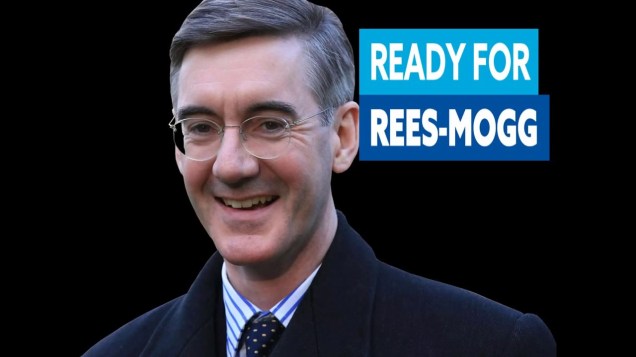
Yet a plurality of Tories either don’t care about the crisis we face, or are simply deny its existence. They think that slapping a new coat of paint on the same rusty old banger will convince voters already tiring of seven years of Conservative government that they are buying a shiny new Tesla rather than a wobbly old Reliant Robbin. They bizarrely think that Moggmentum is the cure, or simply sticking with a failed prime minister who should never have ascended to the top job in the first place.

No, no, no. The Conservative Party needs to stop squabbling about personalities and which interchangeable Cabinet nonentity is best placed to succeed Theresa May, and decide what it actually stands for. And any conservative groups, think tanks and private individuals with an ounce of vision and charisma need to step up and push the party in the right direction, just as John Hoskyns and Norman Strauss did with their Stepping Stones Report in 1977, planting the seed of the Thatcherite recovery.

The Tories cannot make an informed decision about who should be their next leader without first deciding what kind of party they want to be – a limp and apologetic outfit which grovels and apologises for its limited principles, trying to make itself look as much like the Labour Party as possible, or a virile and ambitious party with transformative instincts, belief in individual liberty and the zeal to roll back the administrative state.

The Conservative Party conference opens in Manchester on Sunday 1st October. And rather than painting a false picture of unity, let’s actually have it out once and for all. And if a few unremarkable political careers end up getting caught up in the crossfire, so much the better. We need to clean house in terms of leadership, but more importantly in terms of ideology and basic principles.

At present, Theresa May and her rootless Tories are effectively in office but not in power. And if they do not take swift and dramatic action in the face of a resurgent leftist movement, the office could also slip away, sooner than they think.


 

Conservative Party Logo - Torch Liberty - Tree

Momentum Logo - Labour Party - Jeremy Corbyn

Support Semi-Partisan Politics with a one-time or recurring donation:

Agree with this article? Violently disagree? Scroll down to leave a comment.

Follow Semi-Partisan Politics on TwitterFacebook and Medium.

Centrism Is The New Extremism

Owen Jones - Brexit - Hardline Remainers - Extremism

For many years, the most angry and bitter invective in our political discourse hailed from the far Left and Right. But now it is the supposedly rational and pragmatic centrists who are becoming unhinged and increasingly uncivilised.

Like the stopped clock which still tells the correct time twice a day, once in awhile Owen Jones has a passing moment of clarity and perception and utters a statement with which a normal person can actually agree.

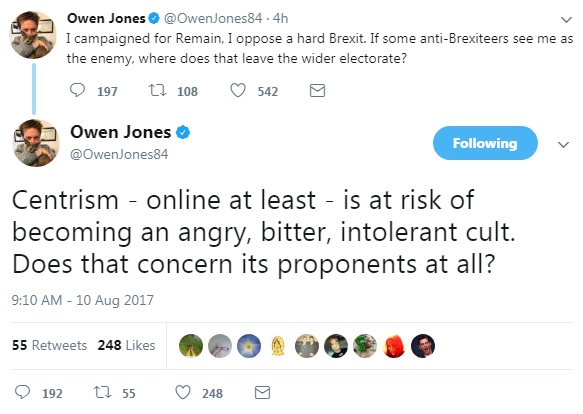
Today is one of those days. Noting that he is taking increasing amounts of flak not from hard Brexiteers but from hardcore ideological Remainers, Owen Jones noted on Twitter that “centrism – online at least – is at risk of becoming an angry, bitter, intolerant cult. Does that concern its proponents at all?”

Jones follows up by noting that “a certain type of Hard Remainer online have become angry, bitter, intolerant, and determined to root out the impure on their own side”:

Slow hand clap.

Jones isn’t wrong, and while one might legitimately question whether he is the best person to be accusing others of being angry and bitter, he makes a fair point – there is a very real and growing rage building among the pro-EU centre-left, a rage which is spilling over and causing people to say all manner of outlandish things.

In the immediate aftermath of the EU referendum there was a sort of stunned silence from the Remain camp. Many arch-Remainers were also the same establishment centre-left figures who found themselves banished to the margins of the Labour Party by the Jeremy Corbyn ascendancy back in 2015. To be cast from power and influence within their own party and then to feel Britain’s EU membership – which has become emblematic of their perception of themselves and the country as enlightened, progressive internationalists – slip through their fingers only a year later was more than many centrists could bear. At first.

But it did not take long for shock to turn into anger and defiant resolve. Harnessing huge amounts of denial (“the referendum was only advisory”, “the Leave campaign had a monopoly on lies and so the result should be invalidated”) many centre-leftists, realising that their entire worldview was not only under attack but on the verge of defeat, stirred themselves into action.

We saw this with the court case brought by Gina Miller, in which the Supreme Court ultimately ruled that Parliament must have a say on the final Brexit deal negotiate by the government. We saw it too in the flourishing of groups and social media accounts dedicated not to making the best of Brexit now that the country had voted for it, but rather trying to overrule that vote and remain in the EU at all costs.

I noted this phenomenon myself a few weeks ago, admitting that we Brexiteers had underestimated the ability of the pro-EU, centrist establishment to launch a reactionary hissy fit several orders of magnitude bigger than the anti-establishment backlashes which led to Brexit in Britain and President Trump in America:

Perhaps we should have seen it coming. Effectively overruling the establishment’s carefully laid out plan for our lives was always going to generate a huge backlash, from powerful and well-connected people with the ability to make traditional grassroots anti-establishment backlashes look like a cake sale at the Women’s Institute.

Perhaps we forgot this fact because we Brexiteers and defenders of nation state democracy were so used to being part of a backlash ourselves – the backlash against the establishment – that we didn’t give enough credence to the fact that globalists, disinterested “citizens of the world” and other assorted types are equally as invested in their worldview as we are in ours, and in a far stronger position to defend it from attack.

And now that they have experienced repudiation at the ballot box, the establishment’s ability to turn howls of outrage into a full-on filibuster of democratically-made decisions is stronger than many of us planned for.

We are definitely witnessing an ossifying or hardening of positions among many Remainers. Before the EU referendum last year, some of these people could occasionally be found admitting that the European Union was not perfect and urgently needed reform, and even that membership had some downsides (even if outweighed by the positives).

You won’t find arch-Remainers talking like this in the press or on social media any more. Now that the prospect of Brexit looms, the EU is perfect and irreproachable, and Brexiteers aren’t just misguided but actively evil for casting Britain into the abyss. (Well, to be fair, many hardcore Remainers always asserted that Brexiteers were evil racists, but they now do so with increased frequency and venom).

The Guardian recently published a piece by Will Hutton, who declared that Brexit is “our generation’s Dunkirk”, as though tactical retreat in the midst of an existential world war is in any way comparable to the peaceful, diplomatically negotiated departure from a supranational political union.

In a spittle-flecked fury, Hutton wails:

Last week, Labour peer Lord Adonis compared leaving the EU as a mistake analogous to appeasement. He is right. Brexiters Davis, Fox and Johnson are from the same anti-modern, delusional world view that produced the strategic foreign policy mistakes of the 1930s and the emasculation of the mixed-economy, state-led approach that underpinned the economic success of 1931-50.

Then, at least, we had underlying strengths, representing the opposite of their philosophy, upon which to fall back on. Brexit is our generation’s Dunkirk, but with no flotilla of small boats and no underlying economic strength to come to the rescue. It’s just defeat.

Now this blog has no time for Liam Fox or Boris Johnson, but even if Theresa May’s government drops the ball completely on Brexit the economic ramifications (bad though they may be) will still fall several degrees short of colossal military failure and impending invasion. To compare Brexit to Dunkirk or to Chamberlain’s policy of appeasement is wild hyperbole of the first order.

But this is what you now have to look and sound like to be accepted into the Remainer / centrist tribe – at least on social media, where nuance and restraint have never been in great supply. Just as the Cult of Social Justice and Identity Politics doles out “victimhood points” and social status depending on the number of ways that a person can describe themselves as oppressed, the Cult of the EU demands ever more flamboyant declarations of love for the European, furious denunciations of those who disagree and pledges of extreme measures to be taken to stop Brexit at all costs. Because being pro-EU is bound up so tightly in the centrist psyche, Brexit is making many establishment centrists behave like any other identity group that feels under attack, blindly lashing out and playing the role of the victim.

And so in many ways it was inevitable that arch-Remainers would be suspicious of the likes of Owen Jones, and seek to publicly denounce him. Back in 2015, when the EU was turning the screws on Greece and effectively subverting Greek democracy, Jones came close to openly advocating for Brexit. Of course, like many others (most notably Ian Dunt, who had virtually nothing good to say about the European Union until he realised that the EU referendum could boost his profile if only he switched sides) Jones eventually returned to the fold, taking the wishful thinking Varoufakis position that we should remain in the EU in order to reform it.

But like all extremist movements, the hardcore ideological Remainers have long memories and no statute of limitations when it comes to heresy. Owen Jones once expressed doubts about Our Beloved EU, Fount of All Good Things. And he compounded this thoughtcrime by accepting the reality of Brexit rather than raging against it, even penning a lengthy account entitled “Why I’m a remainer who accepts the EU referendum result”. Therefore he must be punished and cast out. As Jones notes, “the Hard Remainers want to overturn the EU referendum and regard the likes of me as traitors and impure for wanting a soft Brexit instead.”

The centrists of old – back when they were free and easy, on the ascendancy, certain that their basic worldview was coming to fruition and would perpetuate itself forever – had a reasonable degree of tolerance for differing opinions. That’s why the likes of Ken Clarke could fit (ideologically at least) under the same political umbrella as someone like Tony Blair, Yvette Cooper or Chuka Umunna. A few honest differences on a few political points were expected and allowed, since everybody was pulling in the same basic direction. But no longer. Cast out of power, hardcore centrists increasingly use a person’s attitude toward Brexit as an acid test to determine whether they are Good or Bad.

Where will this end? Well, certain excitable centrist MPs and their media cheerleaders seem to be itching to set up a new political party, first with the sole objective of stopping Brexit and remaining in the European Union, and once that deed is accomplished to turn into some kind of new centrist party, a shelter from Theresa May’s authoritarianism and Jeremy Corbyn’s unabashed socialism.

I wrote an entire blog post yesterday about why this idea is idiotic and will never come to fruition. But what would such a party look like, if the normal constraints of British electoral politics were magically removed and a new “centrist” party formed?

By definition it would be full of extremists – the kind of people whose fanatical devotion to the European Union is such that it overrides their previous party loyalties and makes them willing to jump into bed with other people who might have quite different ideas about the optimal size and function of the state, spending priorities, social issues or a million and one other policies.

Such a party would be full of EU-worshipping zealots who would pay any price and bear any burden to thwart Brexit – ironic, since many of them complain about so-called Brexit extremism. But more than that, it would be full of deluded souls who think that if only Brexit can be stopped, everything would just go back to how it was before David Cameron called the referendum; that the anti-establishment backlash which helped to deliver Brexit would simply melt away as people shrugged their shoulders and accepted being overruled by their social betters.

This is delusional. The reason that Blairite and Cameronite centrism lies discarded in the gutter right now is because its most ardent practitioners were content with a system which rewarded people like themselves while leaving millions of others in dead-end jobs or left on the welfare trash heap with little realistic prospect for self-betterment – and because they were openly, snarlingly contemptuous of anybody who dared point this out or raise an objection. Centrism is discredited because it inspired successive British governments to effectively outsource whole swathes of governance and policymaking to the European Union, with MPs and ministers enjoying the trappings of power despite having vested many of their responsibilities in a supranational government even less accountable or responsive to the popular will than Westminster.

A new political party (or government) full of centrist extremists, bitter and vengeful at having been temporarily dethroned, would immediately seek to roll Britain back to 2015 (or 2010, depending on whether they are centre-left or centre-right extremists). But the British people have moved on. A majority want to get on with Brexit even if they voted to Remain in the referendum. They want to move forward, not backward.

But despite being totally impractical and doomed to failure, expect to hear more talk of a new, dedicated anti-Brexit party. Expect to hear more overwrought headlines and tweets comparing Brexit to such and such atrocity or genocide. The rage continues to grow among the dispossessed centrists, and they have a vastly bigger platform to air their grievances than those on the ideological Left or Right.

You see, these people have never lost before. They are accustomed to winning, and do not know how to behave in the face of defeat. Since 1997, whichever party was in power, Labour or Conservative, the centrists’ worldview inched ever closer to fruition. And if that consensus failed to deliver for millions of Britons – those at the sharp end of globalisation or those who simply care a lot about democracy and constitutional matters – then so be it. They got theirs, and that’s all that mattered.

Thank goodness that this cosy centrist consensus has finally been broken, and that these arrogant, selfish and overrated people will have to take their failed and discredited ideology to battle in the political arena along with the rest of us, rather than continuing to win by default.


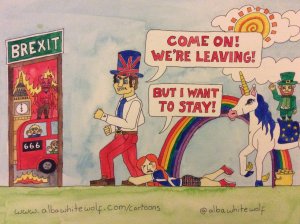
madaleina-kay-european-union-brexit-cartoons-unicorns-and-leprachauns-2

Support Semi-Partisan Politics with a one-time or recurring donation:

Agree with this article? Violently disagree? Scroll down to leave a comment.

Follow Semi-Partisan Politics on TwitterFacebook and Medium.

Peter Hitchens Demands A Real Conservative Alternative To Jeremy Corbyn

Margaret Thatcher hologram

The current cast of characters jockeying to replace Theresa May are almost as underwhelming as the prime minister herself. British conservatives of all shades need to have a full and open debate about how best to move the Conservative Party and the country forward, and then find a future leader with the charisma to take on Jeremy Corbyn in the battle for hearts and minds

Exactly two years ago, I wrote a rather despairing piece asking “Where is the Conservative Party’s Jeremy Corbyn?” Now Peter Hitchens is rightly asking the same question, having long ago despaired at the direction of the Conservative Party and its accommodation with Blairite, centrist managerialism.

Back in August 2015 I wrote:

I want a standard bearer for the Right who actually makes me feel excited, not resigned, when I enter the polling booth. I don’t necessarily expect that person to be elected by a landslide on the first attempt, and to immediately implement their entire agenda in full. But neither do I expect – as presently happens – all of the soul-sapping compromising and watering-down of core principle to take place before the candidate even gets their name on the ballot paper.

Jeremy Corbyn has not done all of his compromising upfront – he is proud of his beliefs, and does not seek to apologise for them. And he doesn’t talk and answer questions as though he is responding to the twitches of a focus group’s instant polling dial. That’s why he is surging in the polls. That’s why previously dejected Labour activists who support Corbyn are suddenly walking a little taller again. That, I think, is why Owen Jones is walking round with such an infuriatingly wide smile on his face at the moment.

It cannot remain this way if we are to be successful in advancing the cause of smaller government and greater individual freedom and autonomy. We cannot allow the Left to monopolise inspiration and ambition, however far-fetched, while we conservatives occupy and embody the dull, managerial, technocratic and remote politics of austerity.

And conservatives will never win a real mandate for change so long as we are content to be the party of last resort, the failsafe option voters pick when all of the other choices are too wacky or offensive to contemplate.

I concluded by asking:

If David Cameron’s Conservative Party was voted out of office today, what will future historians and political commentators say about this government fifty years from now? What will be the Cameron / Osborne legacy? What edifices of stone, statute and policy will remain standing as testament to their time in office? Try to picture it clearly.

Are you happy with what you see?

Substitute Theresa May’s name for David Cameron’s, and pose the same question to yourself. Is the answer any clearer or more satisfactory than it was two years ago?

Clearly not. And now Peter Hitchens has arrived at the same conclusion, writing in the Mail on Sunday:

If (like me) you have attended any of Mr Corbyn’s overflowing campaign meetings, you will have seen the hunger – among the under-30s and the over-50s especially – for principled, grown-up politics instead of public relations pap.

Mr Corbyn reminds mature people of the days when the big parties really differed. He impresses the young because he doesn’t patronise them, and obviously believes what he says. This desire for real politics isn’t just confined to the Left. Ken Livingstone is right to call Mr Corbyn Labour’s Nigel Farage. Ukip appeals to a similar impulse.

Millions are weary of being smarmed and lied to by people who actually are not that competent or impressive, and who have been picked because they look good on TV rather than because they have ideas or character.

Indeed, ideas or character are a disadvantage. Anything resembling a clear opinion is seized upon by the media’s inquisitors, and turned in to a ‘gaffe’ or an outrage.

Actually, I dislike many of Mr Corbyn’s opinions – his belief in egalitarianism and high taxation, his enthusiasm for comprehensive schools, his readiness to talk to terrorists and his support for the EU. Oddly enough, these are all policies he shares with the Tory Party.

But I like the honest way he states them, compared with the Tories’ slippery pretence of being what they’re not.

I have indeed attended one of Jeremy Corbyn’s massive rallies, in which the Labour leader (then fighting to cling on to leadership of the party in the face of a challenge from the hapless Owen Smith) managed to pack out the vast Kilburn State theatre in North London with excited and motivated activists of every age. It was quite a remarkable sight to behold, with energy levels more like those you would see in a hard-fought US presidential primary than a dour Labour Party leadership contest.

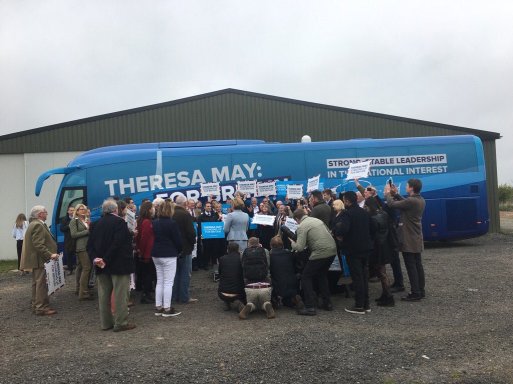
Contrast this with the pathetically phony photo opportunities orchestrated by Theresa May’s hapless 2017 general election campaign, with a small huddle of telegenic young activists, clearly bussed in from London, holding up professionally printed placards in front of the Tory campaign bus while the prime minister grated her way through that godawful “strong and stable” stump speech. There was no authentic grassroots enthusiasm for May or her policies, to the extent that CCHQ was terrified to allow the prime minister to get into any kind of unscripted interaction with the public, let alone a televised debate.

Theresa May - conservatives - campaign rally crowd


There may well be an appropriate time for dull managerialism and “steady as she goes” leadership, but Britain in 2017 is not it. Obviously Brexit must be handled with skill and sensitivity (not that the government has shown either of these attributes), but in every other respect Britain requires radical solutions to deep-seated problems rather than Theresa May’s brand of denial and incompetence. Whether it’s low productivity, education, the housing crisis, a failing nationalised healthcare system, dangerously pared-down national defence or a society fractured by toxic identity politics, this is a time for bold and unapologetically conservative solutions. But instead we have a weak prime minister at the head of an incoherent government, terrified of proclaiming conservative principles and desperate to move closer to the Labour Party on nearly every issue.

Hitchens goes on to describe what he sees as the ideal future Conservative leader:

My hope, most unlikely to be realised, is that a patriotic, conservative and Christian equivalent of Mr Corbyn will emerge to take him on, and will demonstrate, by his or her strength of conviction, that there is an even greater demand for that cause than there is for old-fashioned leftism. In any case, I think any thoughtful British person should be at least a little pleased to see the PR men and the special advisers and the backstairs-crawlers of British politics so wonderfully wrong-footed by a bearded old bicyclist.

Patriotic and conservative would be a good start, but I don’t think that this is specific enough. Theresa May, for example, ticks all three of Peter Hitchens’ boxes (one can make a valid argument that May represents a serious thread of conservative thought) yet is completely and utterly unequal to the role of prime minister, ideologically and temperamentally.

And as far as being Christian is concerned, Theresa May is a practicing Christian and famously the daughter of a vicar, and yet she has shown no real impulse to halt the suppression of legitimate religious expression where it comes into conflict with the free speech-averse forces of social justice and identity politics, for example. What, then, is the point of cheerleading for a Christian prime minister when they fail to defend religious freedom when in office? I would much rather have a prime minister who is secular-liberal when it comes to religion, eager to separate church (and faith) from state as far as possible while simultaneously protecting the right of British citizens to worship freely.

When it comes to choosing the ideal future Conservative prime minister, I maintain that the Tories could do far worse than select somebody who fits the profile I set out shortly before the disastrous general election back in June:

Ex armed forces (of either gender), mid to senior rank, with an illustrious overseas deployment history. Someone who exudes unapologetic patriotism yet never lapses into cheap jingoism, and whose commitment to defence, national security and veterans affairs is beyond question.

Followed up by a successful later career, possibly in the third sector or the arts but better still in the private sector, having founded a stonking great big corporation that also gives back to the community by employing ex-offenders or partnering with charities to do meaningful work in society.

A solid and consistent record (at least dating to the start of the EU referendum campaign) on Brexit, able to tell a compelling story about how Brexit – properly done – can be good for our democracy and at least neutral on the economic front.

A person who believes that until somebody comes up with a viable alternative to (or augmentation of) the democratic nation state, this institution remains the best method yet devised of ordering human affairs, and that consequently we should not needlessly undermine and vandalise it by vesting power in antidemocratic supranational organisations or pretending that we can sidle our way into a post-patriotic world by stealth rather than with the consent of the people.

Somebody who will not bargain away our civil liberties chasing the chimera of absolute security from terrorists and madmen – particularly while refusing to face down radical Islamism as an ideology to be confronted and defeated – but who will also stand up to expansionist, nonsensical definitions of human rights and an identity politics / political correctness agenda that values hurt feelings more than freedom of expression.

Somebody with the articulateness, gravitas, sincerity and quickness of thought capable of doing the near impossible in 2017: single-handedly turning the tide away from the vapid, broken politics of me, me, me. Somebody willing to ask – as John F. Kennedy once did – not what our country can do for us, but what we can do for our country. Somebody who dares to call us to a higher purpose than merely living in a country with “good public services”, deifying “Our NHS” and having the goddamn trains run on time.

Somebody who chooses for us to go to the moon (or rather its current day equivalent in terms of spectacular human achievement) “and do the other things, not because they are easy, but because they are hard, because that goal will serve to organize and measure the best of our energies and skills” (John F Kennedy).

Doubtless my idea of the ideal conservative prime minister and Peter Hitchens’ conception will differ somewhat – Hitchens is more socially conservative than I, while I see myself as more of a conservatarian with pragmatic, tempered libertarian instincts.

But these differences of opinion only make it all the more important that we have a full and open debate about the future of conservatism, and what kind of leader would be best placed to move the conservative movement and the country forward. And far better that this conversation first take place in the abstract, as a discussion of principles and ideology, so it does not immediately descend into personality-based infighting and jockeying for position among Theresa May’s likely successors.

And at the risk of sounding like a broken record, it is also vitally important that conservatives (I deliberately speak of small-C conservatives rather than the often toxic and inept Conservative Party) find a way to re-engage with a youth vote that the Tories have been shamefully quick to write off and cede to the parties of the Left. This abandonment of the youth vote is absolutely untenable going forward, and is yet another reason why the next Tory leader needs to have sufficient charisma and authenticity to cut through anti-conservative prejudices among young people that have often been baked into their consciences since they first became politically aware.

Until the Conservatives figure out who and what they actually want to be, both Peter Hitchens and I are likely to remain underwhelmed and disappointed. An urgent reckoning needs to take place in order to answer this question: Has seven years of Cameron/Osborne/May-style accommodation with centrist Blairism delivered any real tangible improvement to the trajectory of Britain, or are we largely treading water? And if the latter, is the solution to move even further to the left, as Theresa May and her political spirit animal Nick Timothy seem to want, or is it wiser and better to bring real conservative values to bear on 21st century problems?

As far as I am concerned, the choice is self-evidently clear. The Tories can stubbornly cling to their current philosophy and hope at best to remain in office but not in power for a few more years as they desperately scamper after the Labour Party in their march to the hard left, or they can renew themselves, stop apologising for their conservatism and start enacting it instead.

But in the meantime, let’s start the debate.


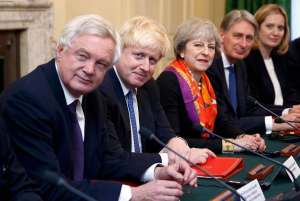
Theresa May cabinet - Tory conservative leadership

Top Image: NewsThump

Support Semi-Partisan Politics with a one-time or recurring donation:

Agree with this article? Violently disagree? Scroll down to leave a comment.

Follow Semi-Partisan Politics on TwitterFacebook and Medium.

Are We Finally Witnessing The End Of Bland, Centrist Politics?

Jeremy Corbyn - Glastonbury crowds

Donald Trump, Jeremy Corbyn, Brexit… People want meaning in their lives and a purpose in their politics that dry, centrist managerialism cannot hope to provide

This, by Ted Yarbrough, is very perceptive:

Man does not live by bread alone. Though a religious statement by Jesus from the Gospel of Matthew I think that statement has never been more true- especially seen in geopolitics.

We humans have never been materially wealthier.  Yes, some people still live in abject poverty and many people don’t like that others have more money than them, but by historical standards we should be thanking our lucky stars each day for our blessings. We live longer than ever before and can communicate with people throughout the world at an instant. Yet, as especially seen in politics, many people are angry. Populists are rising on both right and left. Those in positions of power ie “establishment” people in the media, government etc are extremely perplexed. How could, for example, the people not want to send that nasty man Trump a message with some bright young man who checks all the boxes like Jon Ossoff? [referring to the Democrats’ failed attempt to take Georgia’s sixth congressional district in the recent special election]

I think the people shocked by the return of ideology miss one big point about humans. We are not animals, we don’t just like to be fed and wag our tail. We believe in justice, we dream dreams, we are not content because, yes often we are spoiled, but we want to believe in something. We want to be something bigger than ourselves- it’s why humans suffer enormously to go to Mt. Everest and the south pole and the moon- we want to do things because they are great. It is why people are constantly searching for the meaning of life and worshipping God (or gods). We want to change the world because we recognize the imperfections in it. We will not be content.

In politics, that means people are growing sick of “centrists” ie technocrats who don’t inspire the people but expect to govern because they are supposedly the best qualified for the job. Centrists are shocked to see the rise of nationalists and free-marketers and socialists and Islamists, but really they shouldn’t be. Those ideologies offer people something to believe in, a better world to dream of and fight for, rather than a shallow world of pop music, materials possessions and politics made occasionally spicy with some virtue signalling identity politics thrown in. People now, like our ancestors of old, want to battle over ideas. To work towards finding truth.

This blog has been screaming for years now that centrist politics is leading us nowhere good, entrenching privileges for those set up to gain from the current system while doing nothing to help those – particularly those at the sharp end of globalisation – who do not benefit from the post-patriotic, post nation state world that the elites are building without meaningful democratic consent.

But even I did not predict the degree to which the establishment’s insistence on clinging on to their bland, centrist model of governance would lead to disruptions to the political order on the level of Donald Trump, Brexit or Jeremy Corbyn’s takeover of the Labour Party (and nearly the country).

Some of these disruptions are welcome – Brexit is a great achievement, even if many of the benefits end up being lost through abysmal execution by the political class, while Jeremy Corbyn’s Jeckyll and Hyde leadership of the Labour Party reminds us both how ideology can reinvigorate a political movement but also just how far the party has drifted from the interests of working people. And others of these disruptions – cough, Donald Trump – are unwelcome and have almost zero upside.

But more such populist disruptions are almost inevitable until the political class realises that people want more from their politics than a ruling class of bland, superficial technocrats who promise nothing more than the smooth administration of the status quo. Jeremy Corbyn, for all of his faults, at least promises a radical reordering of society – one made all the more appealing by the fact that the Conservatives long ago ceased to make a bold, unapologetic case for free markets, individual freedom and a less suffocating state.

Nearly two years ago, this blog asked where is the Conservative Party’s own Jeremy Corbyn? Where is the small-C conservative version of the politician who dares to proclaim an unrepentantly neo-Thatcherite worldview, instead of pretending (a la Cameron, Osborne, Hammond and May) that “austerity” and fiscal restraint are a sad necessity brought about by recession rather than an innately good thing in and of themselves?

Theresa May led the Conservative Party to near-defeat in the general election this month because she never even attempted to take on Jeremy Corbyn in the battle of ideologies. And while conservatives were never likely to walk away with the lion’s share of the youth vote, shamefully allowing Jeremy Corbyn to be the only one to present the emerging generation of new voters with anything like a positive inspirational message made damn certain that the majority of them voted Labour.

Yarbrough’s conclusion is stark:

With that being said, if the centrist parties do not start treating people as humans who dream dreams, and offer a compelling hope for people, the people of the world will continue to be more polarized and radicalized. And if there is no hope more and more false prophets will emerge to fill the vacuum.

One of my favourite television shows is the twelve-part HBO series “From The Earth To The Moon”, executive produced by Tom Hanks, recounting the complete history of NASA’s Apollo Program which culminated in six manned missions to the surface of the moon. I like it because it represents, to me, a time when humanity stood for more than “reducing inequality”, deifying public services and promising to make the trains run on time. A time when our desire for achievement, like our plans for human spaceflight, aspired to something more than low-earth orbit.

The theme music at the start of each episode begins with JFK’s speech at Rice University in which Kennedy says “We choose to go to the moon in this decade and do the other things, not because they are easy, but because they are hard, because that goal will serve to organize and measure the best of our energies and skills, because that challenge is one that we are willing to accept, one we are unwilling to postpone, and one which we intend to win.”

Of course the 1960s and 70s were tumultuous decades with many of their own very real challenges – the very real threat posed by Soviet Communism, for one, and the ongoing struggle for civil rights. But how much worse would this era have been if there were no unifying objectives around which people could come together?

In our increasingly secular age, religion is no longer a unifying force within nations. Art stepped up briefly as a replacement, but our art and culture has become increasingly debased too. And so people, being spiritual beings, increasingly vest their faith in their political worldview, which has had two principle effects – toxifying our political discourse and making people more susceptible to the “false prophets” of which Yarbrough warns.

Professor David Hillel Gelernter once said in an interview:

The readiest replacement nowadays for lost traditional religion is political ideology. But a citizen with faith in a political position, instead of rational belief, is a potential disaster for democracy. A religious believer can rarely be argued out of his faith in any ordinary conversational give-and-take. His personality is more likely to be wrapped up with his religion than with any mere political program. When a person’s religion is attacked, he’s more likely to take it personally and dislike (or even hate) the attacker than he is in the case of mere political attacks or arguments. Thus, the collapse of traditional religion within important parts of the population is one cause of our increasingly poisoned politics.

We see this all the time in our political discourse. This is the Cult of Social Justice and Identity Politics writ large. This is the result of our ridiculous, overwrought obsession with inequality, even as living standards for nearly everybody continue to improve and we all benefit from technologies and inventions which were unthinkable half a century ago.

And if failed centrism really is leading to “radicalisation” by unscrupulous false prophets (and I don’t much like the use of that word outside of its applicability to terrorism, particularly because the Left is now eagerly using it to smear conservatives on any pretext, suggesting that newspapers like the Sun and Daily Mail are somehow “radicalising” the ignorant white working classes) then it becomes all the more important for our main political parties offer visions of their own which amount to more than technocracy and navel-gazing obsession with public services.

For a long time I thought that people actually liked the politics of Me Me Me, and that our craven politicians were simply responding to public demand with their endless manifesto bribes. But perhaps I was wrong. Though Jeremy Corbyn certainly offered a record-breaking basket of electoral bribes in the Labour Party manifesto, people also seem to have responded to him because of what he represents. In other words, Corbyn’s increasing viability amounts to more than the sum of the various bribes in the 2017 manifesto, even the student loans pledge.

The Conservatives, therefore, cannot afford to leave the ideological field open for Jeremy Corbyn to occupy on his own. The Tories need to do much better than mount their usual snivelling defence of fiscal restraint, couched in the craven acceptance of leftist frames of reference, and actually come up with an alternative vision of Britain worth voting for.

Theresa May isn’t going to do that, and neither are any of the dismal individuals tipped by the Westminster media as being most likely to replace her. So, who will come and save the Conservative Party from themselves, and save the country from Corbynism in the process?


Jeremy Corbyn - Glastonbury stage

Support Semi-Partisan Politics with a one-time or recurring donation:

Agree with this article? Violently disagree? Scroll down to leave a comment.

Follow Semi-Partisan Politics on TwitterFacebook and Medium.

British Conservatives And The Youth Vote, Ctd.

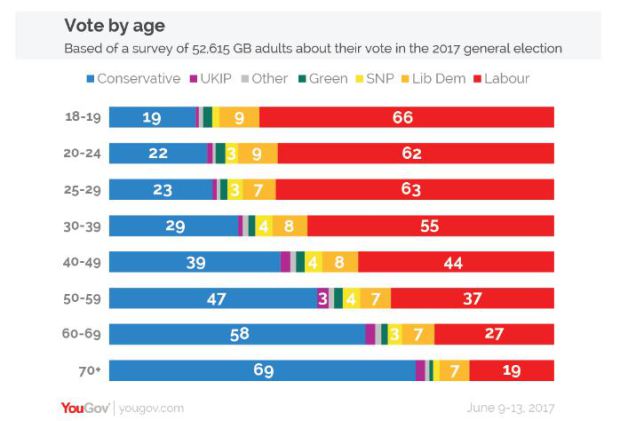
YouGov vote by age chart - general election 2017

Through their arrogance and sheer incompetence, the Tories have turned an entire generation away from conservative politics. But the solution is not to go marching off to the socialist Left

It doesn’t have to be like this.

It doesn’t have to be the case that people under 30 years of age vote so overwhelmingly for the parties of the Left, predominantly the Labour Party, while the Conservatives manage to sweep up barely a fifth of the youth vote.

The Tories have shot themselves in the foot by failing to court the youth vote or even speak to their concerns, the result of unbridled arrogance and sheer political incompetence. But the situation is not irreversible, if the right action is taken quickly. Unfortunately, the Tories – hopeless keepers of the conservative flame – look set to learn all of the wrong lessons.

I discussed this on my election night live blog and then again in this separate piece, but since that time several other commentators have jumped into the fray with their own takes, and it’s worth seeing what they have to say.

Former cabinet minister (sacked by Theresa May in her Weakness Reshuffle) and Harlow MP Robert Halfon won a lot of plaudits before the election for being one of few Tories to understand the need to reach out once more to the aspirational working class, and again after the election for criticising the Tories’ lack of vision going into the campaign.

From the Guardian:

Robert Halfon, who lost his frontbench role as minister for skills on Tuesday, said the Conservative party was “on death row” and had failed to offer a positive vision to voters.

The Harlow MP was scathing about the election campaign in which the prime minister lost her Commons majority, saying the Tories did not have a message to rival Labour’s promise to stand up “for the many not the few”.

Writing in the Sun, he said: “The Conservative party is on death row. Unless we reform our values, our membership offering and our party infrastructure, we face defeat at the next election – and potentially years of opposition.

“If we don’t change it wouldn’t matter if we had Alexander the Great or the Archangel Gabriel as leader. We face the wilderness.”

In an attack aimed at the Tory hierarchy – and campaign guru Sir Lynton Crosby – Halfon said: “Our election campaign portrayed us as a party devoid of values. ‘Strong and stable’ is hardly a battle cry. I cannot remember a time in the campaign when the Conservatives attempted to explain what we are really about: the party of the ladder, of aspiration and of opportunity.

“We let ourselves be perceived primarily as the party of ‘austerity’, failing entirely to campaign on our record of a strong economy or strong employment.

“Virtually nothing was said on the NHS or schools or the caring professions that work within them. Instead we created fear among pensioners, and threatened to take away school meals, handing a gift to our opponents. Is it any wonder that the Conservatives did not get a majority?”

Yes and no. Halfon is absolutely right to criticise the Tory campaign for its lack of a positive vision of any kind, let alone a coherent, recognisably conservative vision. But the specific targets of Halfon’s ire are all wrong. To follow his advice, the Tories should have engaged in a race with the Labour Party to shower praise and money on an unreformed NHS, wittered on endlessly about public services and exacerbated Britain’s corrosive culture of universal benefits, where everyone becomes accustomed to receiving handouts from the state regardless of their wealth or individual circumstances (see free school meals, the winter fuel allowance, child benefit and so on).

At least the Cameron/Osborne government, ideologically woolly as it was, made a token strike against universal benefits culture with their child benefit cap. Robert Halfon now sees support for giving benefits to people who don’t need them as the price of political survival. If this is true then there may as well not be a Conservative Party at all, because the Labour socialists will have won the war.

Here’s Nicholas Mazzei, writing in Conservative Home:

“Yeah I did; he was gonna write off my student loan. Come on!”

These were the words of a 25-year-old voter who text me early this morning, who had always voted Conservative and, up until the campaign began 5 weeks ago, was anti-Corbyn.

If you want to understand why the youth vote surged for Corbyn, I want you to read that line and look at the offer the Conservatives have made to the youth of Britain from our own manifesto. From this 25-year old’s own words, “the Conservatives have done nothing to reach out to those under-35”.

Now while most us would agree that the promises of wiping out debts and free university education by Labour were dangerous, unaffordable policies, we need to remember that the youth of the UK have been lumped with endless debts, rising costs in homes and education, and lower potential of earnings.

Much like in the US election, where voters turned out for Trump’s pro-employment message, youth voters in the UK turned out for a party which actually addressed their concerns.

Again, the problem is accurately diagnosed. The suite of Conservative Party policies, such as they were, did very little to even acknowledge the concerns of young people in a cosmetic way, let alone meaningfully address them. The Tories had no plan to encourage the building of sufficient houses to tackle the housing crisis because the status quo works just fine for their older core vote, thankyouverymuch. They remain obstinately committed to the most stubbornly self-harming form of Brexit possible, for absolutely no good reason, when most young people are sceptical of Brexit altogether.

And as icing on the cake, Theresa May and her lacklustre team preached a parsimonious message of fiscal restraint as a regrettable necessity – willingly accepting Labour’s framing of the economic debate! – rather than even attempting to sing the virtues of freedom, liberty and a smaller state dedicated to helping people in real need rather than a large state parcelling out insufficient morsels of assistance to everybody regardless of need.

Theresa May’s team seemingly forgot that people don’t become more conservative as they get older automatically or without some prompting, and that if the Tories continually screw somebody over through their formative years, young adulthood and early middle age then they won’t magically become Tory voters when they get their first grey hair. People become more conservative as they get older because historically, sensible government policy has allowed them to become greater and greater stakeholders in society, largely through property and equity ownership. Cut off millions of young people from this ladder to prosperity and security, and the conveyor belt which gradually moves people from political Left to Right as they age will come grinding to a halt. We see this in the YouGov poll. where the Tories now only overtake Labour among those aged over 50.

But while Mazzei effectively diagnoses the problem, his solutions also seem to involve lurching to the Left:

The UK has the highest average tuition fees in the world, second only to the USA (which is at around £5300 a year compared to £6,000 in the UK). We cannot lump all this debt on to young people. Education in general needs more investment and should be protected at all costs.

No. Why should somebody without a university degree subsidise the education (and future higher earning potential) of somebody who wants a free degree? While tuition fees at some American schools are horrendously expensive and poor value for money, UK fees are much cheaper, to the extent that they still often do not even cover the full cost of tuition. They are by no means outrageous, and those unwilling to make the investment in themselves are under no obligation to attend university. If anything, the presence of tuition fees clamps down on the number of pointless degrees in non-subjects being taken by students. Lower or remove tuition fees and we will likely see an explosion in gender studies and other pointless social justice-related pseudo-courses.

The unnamed government minister who spoke scathingly to the Telegraph about the Tory election campaign hits closer to the truth:

The Conservative Party has become “too shallow” and needs a “re-invigoration of political thought” that can draw young people to the party, a minister has said.

The MP warned that the Tory election campaign had relied on “poxy little slogans” to attract the youth vote and failed to counter Jeremy Corbyn’s offer of “free money” in the form of state-funded university tuition and other hand-outs.

The minister told The Telegraph: “You’ve got to persuade a new generation of people of what’s what. We never even tried, so Corbyn just came in and basically bribed people to vote for him with other people’s money that doesn’t even exist.”

[..] The minister said: “It’s all about political education and argument. The problem with the whole campaign is that it was about politics and politicians. “Everything is too shallow. Politicians have all got their experience but they lose if they forget to re-educate a new generation. You’ve got to persuade a new generation of people of what’s what.

“This is about political persuasion and think tanks and all that stuff.”

Another MP said the party had failed to properly engage younger votes on social media, where many users were instead targeted with videos attacking Mr Corbyn.

“Frankly the party has done very, very little to engage with young people,” he said. “We have made no real effort to garner support, even on social media, which is where everybody gets their news and views these days.

Yes, a thousand times yes. The case for conservatism has to keep being made for each new generation. The very presence of Jeremy Corbyn as the leader of the Labour Party should have been a huge wake-up call to the Tories that defunct, failed ideologies do not simply slink away to die once they are exposed and defeated.

Margaret Thatcher’s government may have rescued Britain from 1970s decline, but this was before the living memory of half the electorate. Two generations have come since the Winter of Discontent, with many in the millennial generation probably unable to even explain what it was, or how the failed socialist post-war consensus brought Britain to the brink of irreversible decline.

Thus we now have a generation of young people who take relative material abundance, peace and security for granted rather than appreciating that capitalism is the source of our prosperity, not a drain on it. A pampered generation who simply don’t realise that British and Western values need to be cherished and defended (as the Second World War and Cold War taught older generations).

Ross Clark makes the same point in The Spectator:

The under 35s have never been exposed to the negative images of socialism that were familiar to older generations. Growing up in the 1970s and 1980s, to my age group socialism was inescapably associated with the failures of the Soviet bloc: it conjured images of queuing half a day for a cabbage, putting your name down on a long waiting list for the prize of a choking, belching Trabant – and of getting shot if you tried to escape. To my generation, capitalism was synonymous with freedom. But I am not sure that holds for a generation who see only large, tax-dodging corporations and bankers who wrecked the economy yet carried on skimming off vast bonuses.

Neither, when reading of Jeremy Corbyn’s renationalisation plans, do the under-35s have memories of nationalised industries in Britain in the 1970s. They don’t recall the three day week, the Winter of Discontent, dirty, late trains, or realise that the chaos on Southern Railway was once symptomatic of labour relations in huge swaths of nationalised industry. All they see are over-priced trains run by private companies which have ruthlessly exploited the private monopolies which they were granted in this, the most botched of the privatisations.

The Corbynite Left (and even Labour centrists) have been incredibly adept at presenting what are really regulatory failures or corrupt crony corporatism as failures of capitalism itself, which – as shown by the willingness of young people to vote for politicians like Bernie Sanders, Jean-Luc Melenchon and Jeremy Corbyn – has led many young people to demand that we throw the baby out with the bathwater. They sit and angrily Tweet about the evils of capitalism using handheld computing devices that only capitalism made possible, and nobody in British conservative politics seemingly has the balls to point out the absurdity to them.

The anonymous government minister is absolutely right to point out that Conservatives have an existential duty to “persuade a new generation of people of what’s what”, that showering public services with endless money and taking back state control of industry would have already happened if repeated lessons from history did not show that this approach simply never works.

The minister is right too when he says “this is about political persuasion and think tanks and all that stuff”. Yes it is. But you won’t reach young people with think tanks and white papers, and it is becoming increasingly obvious that the toxic Tory brand will not persuade them of the merits of conservatism either. That’s why we need strong new independent grassroots organisations to emerge, to promote the idea of freedom, self-sufficiency and a smaller, better-targeted state as an inherently good thing in and of itself, rather than a regretful response to recession.

As I wrote the other day:

For reasons of branding and basic administrative competence, any future small-C conservative movement hoping to gain traction with young people must be distinct from the Conservative Party, free of that residual toxicity and free to criticise the Tory party in government and in opposition when it proposes policies which either betray core values or threaten the interests of young people. A British CPAC and Young Brits for Liberty-style organisation could nurture talent of its own, outside the corrupting, nepotistic influence of the Conservative Party hierarchy, and would greatly increase their collective clout by helping or withholding support from future Tory election campaigns and individual candidacies based on policy, not party loyalty.

It is only through outside groups like this that the image of conservatism stands a chance of being rehabilitated among young people. It is only through a British version of CPAC or YAF that young conservative or agnostic students at university stand a chance against being steamrollered by the fashionable left-wing identity politics which are almost de rigeur for social acceptance and advancement.

[..] We need a strong external repository for conservative principle, capable of engaging with young people who have been continually taught that leftist progressivism = forward-thinking “compassion” while liberty, independence and self-sufficiency from government are evidence of greed and moral failure.

We particularly need to work closely with conservative organisations in the United States, which face a similar uphill struggle in overcoming a historic disinterest in the youth vote but which are now starting to have some success, generated in part by their opposition to the illiberal Cult of Social Justice and Identity Politics sweeping American university campuses, with its disregard for freedom of speech and toxic obsession with the politics of victimhood.

We should be sharing best practice back and forth with American conservative organisations as to how to build strong redoubts for conservatism in overwhelmingly leftist places, so that conservatism isn’t washed away altogether. Frankly, British conservatism is in such a parlous state that we need their help. And then, once things have stabilised, we can look to reclaim some of the ground we have lost among young voters.

Skot Covert, Co-Chairman of the College Republican National Committee in the United States, offered this advice for a young conservative revival in the United States:

Due to an extended absence on the right’s part, winning the youth vote won’t be easy and it certainly won’t happen overnight.  However, when the GOP communicates our policy positions in culturally relevant terms in the right mediums, we see progress.  This means understanding how and where young voters communicate and having a discussion on the issues most important to them.

I believe it’s also critical to understand that there is no one-size-fits-all approach to winning young voters.  My generation is diverse and vibrant.  We thrive on uniqueness and self-definition and instinctively reject the notion that we should “go with the flow”.  Crafting an effective youth outreach strategy must be developed around this understanding.

This is certainly true. People crave authenticity in a politician – somebody willing to speak extemporaneously and answer straight questions honestly without first running them through a focus group or a Comms Team. Young people especially, it seems, like an optimistic, forward-looking message rather than lashings of grim tidings delivered by a malfunctioning, cautious android like Theresa May. Who knew? That’s why young people preferred socialist firebrand Bernie Sanders to calculating, establishment Hillary Clinton. That’s why Americans elected Donald Trump as their next president.

But there is no reason why these qualities of openness and relatability cannot be vested in a politician who doesn’t hail from the hard left or the populist pseudo-right. There is no reason why a liberty-minded Conservative MP could not similarly enthuse young people with a message of individual liberty, economic freedom and the advantages (rather than the costs) of restraining the state.

Anoosh Chakelian explains in the New Statesman just how Jeremy Corbyn and Corbyn-supporting outside groups used this quality of authenticity to their advantage:

Jeremy Corbyn’s campaign focused heavily on young people – a key manifesto pledge being to scrap tuition fees. His campaign style – rallies across the country, and fewer stage-managed speeches and press conferences than Theresa May – also appealed more to this demographic.

In addition, Labour had viral news on its side. As BuzzFeed reported, pro-Corbyn articles by “alt-left” sites were shared on an enormous scale on social media. I hear that nearly 25 per cent of UK Facebook users watched a Momentum video on the website in the penultimate week of campaigning. This is a particularly effective way of reaching young people, and inspiring them to vote – something the Tories weren’t as good at.

But who in the current Conservative Party hierarchy is remotely equipped for this task? Boris Johnson is probably the most charismatic of the senior Tories, but even he could never pack a large 2000-seat theatre for a political rally the way that Jeremy Corbyn can. And of course Boris Johnson is something of a charlatan, with sky-high negative ratings and absolutely no fixed political compass.

The cold hard truth is that the Tories don’t have anybody who can match Jeremy Corbyn for charisma right now – and how depressing that is. The best we can hope for is to give some of the better backbenchers (I keep banging on about Kwasi Kwarteng and James Cleverly) some ministerial experience to groom them for a few years down the road, but rather than looking to the future, Theresa May seems to have decided to keep her cabinet stuffed full of bland non-entities with her latest reshuffle. In her infinite wisdom.

That’s why we cannot rely on the Conservative Party to save conservatism from itself. The Tory party is corrupt, inbred, nepotistic, dysfunctional and ideologically bankrupt. Right now they are seriously considering skipping after Jeremy Corbyn on a fun political jaunt even further to the hard Left. Yes, somehow the Tories squandered the opportunity to use Corbyn’s rise to move the Overton Window of British politics further to the right, and instead are doing all they can to help him shift it to the left. These people are incompetent clowns who cannot be trusted to walk with scissors, let alone safeguard the ideology and worldview which we depend on to keep us prosperous and free.

We need outside groups to pick up the burden so shamefully dropped by Theresa May and her dysfunctional party. Student organisations, business organisations, bloggers, the works. The Tory Party as it currently stands will never persuade any more young people to vote Conservative. We need outside organisations with legitimacy and untainted reputations to make the positive case for conservative, pro-market values, and then pressure the Tories to hold the line rather than fight every battle on Labour’s terms.

I repeat: do not look to the Conservative Party to successfully engineer an improvement in the youth vote. The Tories are not going to make things any easier for themselves when it comes to youth outreach, and given the level of competence exhibited by CCHQ they have the potential to make things a whole lot worse.

We few young small-C conservatives need to pick up the slack ourselves.


Jeremy Corbyn - youth vote - t shirt

Support Semi-Partisan Politics with a one-time or recurring donation:

Agree with this article? Violently disagree? Scroll down to leave a comment.

Follow Semi-Partisan Politics on TwitterFacebook and Medium.