A Move Toward Transparency On Tax

Image from ConservativeHome.com


It may be a small, mostly cosmetic change, but for once it is a change that small government and libertarian-leaning conservatives can really get behind.

Ben Gummer MP, who has made tax transparency a major focus of his parliamentary career, is today proposing that National Insurance be renamed the “earnings tax”.

The Telegraph reports:

National Insurance, a 100-year old charge on employers and employees, will be renamed “earnings tax”, the Chancellor has signalled.

The change, which will be proposed in legislation to be published on Tuesday, is the first step towards merging income tax with National Insurance.

Ben Gummer MP, a rising star Tory backbencher who has been campaigning on tax transparency, will propose the change in a Commons Bill on Tuesday.

On the face of it, perhaps nothing to get too excited about. After all, nothing is being done here to address the punishingly high rates or the legacy of fiscal drag that has seen people on relatively standard incomes being taxed at the top rate.

But Gummer’s proposal is significant because it is the first step toward the government finally and explicitly admitting the obvious – that National Insurance is a second income tax in all but name. The money collected is vast, all goes into the same pot, and is in no way strictly reserved for specific purposes as the “insurance” moniker suggests.

At the present time, Ed Miliband and Ed Balls are able to rail against the Conservative/Liberal Democrat government and accuse them of enacting “massive tax cuts” for the rich – by which they mean reversing half of Gordon Brown’s gargantuan tax increase – and keep a straight face while doing so.

Using the innocuous term “50p” tax which evokes the small sum of fifty pence rather than the cold reality – half of each additional pound earned, for top band taxpayers – is bad enough. But high tax advocates such as those in the Labour Party are also aided by the fact that discussion of income tax alone does not come close to recognising the full tax burden.

The Telegraph shows the full extent of this second income tax:

National Insurance rakes in billions every year for the Treasury. Anyone who is employed and earns between £149 and £797 a week pays 12 per cent of their income in National Insurance. A further 2 per cent is paid on all earnings over that level.

It is doubtful whether, if asked, most people would correctly identify the top rate of tax as being 59% – a staggeringly high level that immediately makes Britain’s anaemic economic growth statistics much more understandable.

Therefore, from a fiscally responsible and small government-advocating stance, anything that helps the public consciousness to start to recognise income tax and national insurance as nothing but two sides of the same coin can only be a good thing.

ConservativeHome also recognises the importance of this seemingly small proposal:

There’s a fundamental, sound principle here – which has been championed by the TaxPayers’ Alliance among others.

It is clearly unfair and immoral for taxpayers to be misled about the level and function of taxation. National Insurance is income tax in disguise, but many people still think it actually pays into a pot for their own social security.

Hopefully the Chancellor will listen to Gummer, and it will be a step on the road to merging NI with Income Tax altogether.

Indeed, merging NI (or whatever name it ultimately goes by) and Income Tax should be the end goal. Just as Ben Gummer successfully campaigned for taxpayers to receive a yearly statement showing exactly how their tax contributions were split up to fund the operations of government

The proposal will doubtless meet with strong resistance, primarily from those on the left who continue to support high taxation and high spending with such fervour that they almost seem to be an end in themselves. It is not in the interests of such people for the public to have full visibility of the amount of tax they pay – the more confusing it is, the more easily their distortions and rhetorical sleights of hand about the tax burden are believed and accepted.

ConservativeHome also notes this fact:

There’s a test for Labour here, too. They will instinctively dislike the idea, given that it will make it harder for future governments to raise taxes by stealth. But Ed Miliband rails against opaque, complex and misleading charging by companies as a rip-off which harms consumers – surely they should hold the taxman to the same principles?

Surely they should hold the taxman to the principle of transparency, perhaps, but inevitably in practice they do not – a century of experience tells us so.

While transgressions by the private sector are immediately jumped on, the failures and mistakes of the public sector are excused or overlooked time and time again, and are then counter-intuitively used as justification for increasing spending and expanding the public sector even more. Private sector failure and opacity, in other words, is punished while public sector opacity is encouraged and rewarded.

Transparency is the ultimate antidote to the big tax/big spending status quo, and to the policies of those who continue to view fiscal policy as a tool for punishing success. Britain needs Ben Gummer’s medicine, and the government should now give tax transparency its full-throated support.

The Church’s Embarrassing Welfare Intervention

jobcentre

If you want to start playing in the big leagues, you first have to do the necessary preparation – no ifs or buts – unless comprehensive defeat and embarrassment are an acceptable outcome.

But with each additional intervention in the growing row over the coalition government’s welfare reforms, it becomes increasingly clear that the Church (first as represented by the Catholic Archbishop of Westminster and now a large group of Anglican bishops) did not do its homework or due diligence before plunging into the complex welfare policy debate. Worse still, people are starting to notice.

As government indignation grows following the Church’s public accusation of dismantling the social safety net, the Telegraph sardonically notes:

Unlike Jesus, the Treasury cannot work miracles when it comes to funding the welfare budget.

This zinger is just the prelude to a more comprehensive rebuttal of Archbishop Vincent Nichol’s accusation that the Conservative/Liberal Democrat coalition government has deliberately and completely destroyed the social safety net for poor and vulnerable Britons. Charlotte Leslie, Conservative MP for Bristol North West, is not having any of it:

Much as we would like it to be otherwise, politics and the treasury are bound by the prosaic principles of miracle-free finance. Christ may be able to produce endless amounts from a couple of loaves of bread and a tin of sardines, but to date, neither the Treasury, nor, must if be said, the Church of England, managed to replicate this, and it seems unwise at best to base a welfare policy upon such a proviso.

Given that is the case, the Bishops’ criticisms would have carried more weight if they had accompanied their foray into welfare policy with some kind of hint as to how they might secure the future of our nation’s low borrowing rates, and continue with a one-third deficit reduction plan, (which of course is essential if we are to have any chance in spending enough on welfare) whilst doing better in helping the poorest. This would have been an extremely welcome contribution to a dreadfully difficult challenge.

By not doing so, they cheapen the essential point they are making about how we care for our vulnerable, in the long term.

This is sadly very accurate, and closely echoes what this blog said on the matter only yesterday:

For all of the noise generated in the wake of the Archbishop’s interview we are no closer to understanding what the Church would prefer to see in place of the coalition government’s reforms.

How much stronger would Archbishop Nichols’ intervention have been if he had proposed something radical to replace Iain Duncan Smith’s incremental reforms? Some might argue that it is not the Church’s place to propose new policy, but if an organisation as large and respected as the Catholic Church disagrees with current government policy on welfare, it would only benefit the country if they made public their best thinking as to how to move forward with reform given the current economic constraints.

The Catholic Church is deeply embedded in communities throughout the entire United Kingdom. What if they were to use that proximity and understanding to propose some better reforms, rather than engaging in fruitless hand-wringing from the sidelines?

It is also heartening to see a Conservative MP taking the church to task for belatedly weighing in on the welfare debate only now, in the year 2014, and for directing their admonition only at the coalition government and not at failed policies of the previous Labour government who laid the groundwork for so much of the human suffering that is now taking place. Leslie writes:

Finally, if such an unprecedented attack was going to be made, the Bishops would have had more credibility if they had acknowledged some basic truths: That food-bank use increased ten-fold under the last Labour Government. That the Labour Government was so worried about the image that food-banks would create, that it prevented Job Centres from referring needy individuals to them (that’s got to rate pretty badly on the New Testament test) and that that the increase in food-banks will also partly be due to this added referral rate.

The facts are that we have a dreadfully difficult task: to bring the country back into economic health so that we are able to continue to support a welfare state whilst at the same time reducing what is simply an unmanageably large current welfare bill.

While it is true that the buck stops with the government of the day in terms of specific policies, anyone wanting to be taken seriously when speaking about welfare should be able to demonstrate an awareness of the political reality going back before 2010, to a time when the last Labour government made so many more people dependent on government benefits or tax credits, and vulnerable to necessary cuts in public spending. Pretending that everything was fine until 2010, and that the fault lies with the people attempting to clean up Britain’s ruined public finances rather than those who brought them to ruin in the first place, is either evidence of extreme left wing partisanship or a very simplistic and immature understanding of welfare policy in general.

This is a time for serious debate, and as this blog has already stated, an intervention from the Church was both important and timely. Unfortunately, the intervention that the Church provided was not the one that the seriousness of the subject deserved. Hyperbolic talk about the destruction of the social safety net is not becoming to a serious organisation, and is more at home in one of Ed Miliband’s talking points than coming from the mouths of consecrated bishops.

A real, worthwhile intervention from the bishops would have acknowledged the competing demands for limited financial resources when it comes to government spending, and would have acknowledged the various faults and missteps that led us to the current place as well as chiding those who are currently trying to dig us out of the hole. It might have brought up the fact that politicians of all parties are doing the country a disservice by focusing only on welfare but ignoring pensions and the retirement age when it comes to tackling deficit reduction. A statement on the continued wisdom of universal benefits, the pros and cons of means testing or the extent to which the burden of spending cuts should be re-calibrated between the young and old in our country – all of these would have been welcome interjections.

What we got instead was alarmist, hyperbolic talk about the end of the social safety net from a group of men who appear to have only tuned in to the debate this month, and received most of their information in that time from Labour Party HQ.

The Church diminishes herself by making such blatantly one-sided forays into national policy debate. Faith groups are  capable of making a much more mature and valuable contribution to the national conversation, and the British public deserves the best of their efforts, not the dregs.

The Government Must Be Smart, Not Vindictive On Welfare

dwp

The Conservative/Liberal Democrat coalition government is already waging a war on two fronts when it comes to welfare reform, with the combined forces of the Catholic and Anglican churches having just taken up one flank and Ed Miliband’s Labour Party menacing from the other. Given this state of affairs, some people might reasonably believe that they had bitten off about as much as they could chew, having now taken on God in addition to David Miliband’s politically fratricidal brother. But apparently not this government.

Already under fire for paying insufficient regard to the suffering of those living on welfare, the Department for Work and Pensions is now plotting to charge people for appealing the rejection or cancellation of their benefits claims. The policy is packaged together with a number of others which collectively manage to do very little to solve a real welfare or fiscal-related issue while sounding very tough and decisive.

The Guardian reports:

Critics said the proposal, contained in an internal Department for Work and Pensions document leaked to the Guardian, would hit some of the poorest people in Britain, who have been left with little or no income.

In the document about the department’s internal finances, officials say the “introduction of a charge for people making appeals against [DWP] decisions to social security tribunals” would raise money.

Other ideas include selling off child support debt to “the private sector to collect”, though civil servants remark that the government would be unlikely to raise more than 5-7p in the pound from the £1.4bn currently owed to the DWP. The department currently collects arrears.

It is depressing indeed to see the government obsessing over the smallest and most insignificant line items in the budget whilst ignoring the parade of elephants in the room. Why look at the billions upon billions of pounds that can (and must) be saved by means-testing pensions and increasing the retirement age when one can look very busy and important (but much less politically brave) saving scraps of money here and there by implementing a pay-as-you-go benefit appeal process?

Of course it would save money to charge people for appealing their adverse benefit claim decisions – by definition, most benefit claimants don’t have much money to splash around taking the government to court. And the only precedent in existence for charging for this kind of appeal would see claimants having to pay in the order of £250 to have their case heard:

Last year the Ministry of Justice (MoJ) which sets policy in the area, brought in charges for employment tribunals of up to £250 to lodge a claim, depending on the kind of case being brought. The union Unison asked judges to review the policy, saying the number of claims had dropped by more than half after fees were introduced. High court judges declared the policy lawful this month.

This smacks of government simply hoping to bully and intimidate people into not pursuing legitimate claims. If a short term claimant for Jobseekers’ Allowance is denied their claim, it will hardly be worth their while appealing the decision, no matter how egregiously wrong it may have been. If the claimant can reasonably expect to return to work within a month, the value of the benefit claim in question would barely cover the cost of making the appeal. At best (if the application was approved on appeal) the claimant would break even, and it would be as though they had done nothing at all. And at worst (if the rejection was upheld) the claimant would be £250 in the red.

With the claimant’s potential options so skewed against them, it would create an enormous incentive for the authorities to reject as many applications as possible out of hand, knowing that only a small fraction would likely make it to appeal. The government might accomplish its goal of drastically reducing the welfare rolls, but at what price?

Regardless of whether the majority of decisions end up being upheld or overturned, making people with no money pay to appeal decisions can only hurt some of the poorest people in Britain.

Those people who are generally supportive of the coalition government’s attempts to tackle the ongoing British budget deficit and make meaningful reforms to the welfare system can only be immensely frustrated by this development. The introduction of the Universal Credit and other associated reforms are proving contentious enough, and their implementation has been beset with difficulty. The government has not successfully implemented a new IT system on time or on budget since the days of 5.25 inch floppy disks, and this track record shows no sign of imminent improvement.

The scale of the task already underway was challenging enough, and faced enough opposition, so why was there such an urgent need to make its progress even more treacherous? True, the plans only came to public knowledge because an internal document was leaked, but at some point these proposals would have seen the light of day and been formally announced. When was the government saving this kick-the-poor-while-they’re-down announcement for? One year before the general election? Six months? Just before the start of the official campaign, as a surefire way to help Ed Miliband win back power for Labour?

Now is the time when the coalition government needs to circle the wagons around welfare reforms that are coming under increasing attack from the Labour Party and the more hand-wringing, less cerebral ranks of the church.

Finding out, instead, that the DWP has essentially been writing another six months worth of unfavourable headlines for the government in The Guardian and The Daily Mirror was not the decisive response that welfare reform proponents were looking for.

When David Cameron and Iain Duncan Smith have finished giving the bishops remedial lessons in economics and social policy, they would also do well to bring the DWP to heel. Self-inflicted wounds of this kind are not helping to advance their agenda.

The Church vs Welfare Reform

The Archbishop of Westminster, Cardinal-designate Vincent Nichols, has inserted the Catholic church squarely into the centre of the debate about welfare reform and deficit reduction.

The accusations that he makes are serious, and are directed squarely at the current Conservative/Liberal Democrat coalition government – namely, that the social safety net has been ripped up in the period following the 2010 general election:


The Telegraph reports on their interview with the Archbishop which launched the story into the news cycle:

Britain’s most senior Roman Catholic cleric has accused the Coalition of leaving increasing numbers of people facing “hunger and destitution”.

Cardinal-designate Vincent Nichols, the Archbishop of Westminster, said that while the need to reduce spending on benefits is widely accepted, the Government’s reforms have now destroyed even the “basic safety net”.

Archbishop Nichols, the leader of the Catholic Church in England and Wales, said the welfare system had also become increasingly “punitive”, often leaving people with nothing for days on end if they fail even to fill a form in correctly.

He said it was “a disgrace” that this was possible in a country as rich as Britain.

The Guardian follows up with a report detailing the extent to which Archbishop Nichols has been ‘inundated’ with messages of support:

In his Telegraph interview, published on Saturday, Nichols accused ministers of tearing apart the safety net that protects people from hunger and destitution. He said since he made those comments he had been “inundated with accounts from people … saying there are indeed many cases where people are left without benefits, without any support, for sometimes weeks on end”.

The criticism has clearly rankled the government, and not just the Work & Pensions Secretary, Iain Duncan Smith (himself a practicing Roman Catholic). Indeed, the rebuke was such that David Cameron himself felt the need to respond to the church’s criticism. Writing in The Telegraph, Cameron made a convincing argument in support of his government’s welfare reform:

For me the moral case for welfare reform is every bit as important as making the numbers add up: building a country where people aren’t trapped in a cycle of dependency but are able to get on, stand on their own two feet and build a better life for themselves and their family.

Let’s be clear about the welfare system we inherited. It was a system where in too many cases people were paid more to be on benefits than to be in work. A system where people could claim unlimited amounts of housing benefit – in London there were people claiming truly astonishing sums of £60,000, £70,000, £80,000 a year. A system where hundreds of thousands of people were put on Incapacity Benefit and never reassessed, essentially taken off the books and forgotten about. None of these things is defensible. And it is right both economically – and morally – to change them.

The founders of our welfare system believed in the principle of responsibility – and so do we. As I said on the steps of Downing Street on my first night as Prime Minister, “those who can should, those who can’t we will always help”. Those who can’t work will be always supported, but those who can work have the responsibility to do so. The welfare system should never take that responsibility away.

In all of this, one gets the sense that the two sides are talking at cross purposes with one another. The government is eager to stress the need to work pay for the majority, while the Church is more keen to focus on any potential iniquities in marginal cases, stemming from welfare reform. And while these marginal cases often deserve full attention and consideration, there is never any real acceptance by the Church that the welfare system requires fixing of any kind in the first place. For all of the noise generated in the wake of the Archbishop’s interview we are no closer to understanding what the Church would prefer to see in place of the coalition government’s reforms.

How much stronger would Archbishop Nichols’ intervention have been if he had proposed something radical to replace Iain Duncan Smith’s incremental reforms? Some might argue that it is not the Church’s place to propose new policy, but if an organisation as large and respected as the Catholic Church disagrees with current government policy on welfare, it would only benefit the country if they made public their best thinking as to how to move forward with reform given the current economic constraints.

The Catholic Church is deeply embedded in communities throughout the entire United Kingdom. What if they were to use that proximity and understanding to propose some better reforms, rather than engaging in fruitless hand-wringing from the sidelines?

vincentnichols


If the Church feels that it is the right time to make a contribution to the debate about welfare spending, then this should be welcomed and taken seriously. But it becomes harder to do so when the intervention is so piecemeal and one-sided in nature, failing to look at the historical context of the welfare problem or proposing alternatives when specific policies are to be attacked. The Church has a responsibility to pay attention to the debate from the start and to at least attempt to gain an understanding for the reasoning behind government policy, and not just to repeat Labour Party talking points.

A sense of missed opportunity now pervades the coverage of the entire debate.

It is certainly the case that living on standard benefits – Jobseeker’s Allowance or Employment Support Allowance – is practically impossible in many parts of the country, particularly for those who unexpectedly fall on hard times and who are unable to trim their expenditures with the same brutal speed at which their income evaporates. This is worthy of discussion, and sensible changes could be made along lines previously suggested on this blog.

It is also true that new measures recently put in place can make benefit claimants subject to sanctions for failing to comply with what are sometimes confusing and arbitrary procedures. This too could have been discussed seriously and in detail. Nichols goes so far as to call this a ‘disgrace’:

[Archbishop Vincent Nichols] said the welfare system had also become increasingly “punitive”, often leaving people with nothing for days on end if they fail even to fill a form in correctly.

He said it was “a disgrace” that this was possible in a country as rich as Britain.

While it is true that such sanctions do exist, what is missing from Nichols’ interview is any acknowledgement of the problem that the sanctions exist to counter – the number of claimants who do (or did) not make sufficient efforts to find new employment. If it is the Church’s position that those who do not make reasonable efforts to find work should never be penalised for their inaction, this is something that should be explicitly admitted.

In short, it is all well and good to attack the impact of austerity on welfare recipients here and now in 2014, but one wonders where was the Church’s criticism when Gordon Brown and the Labour Party made so many millions more people dependent on state assistance and more vulnerable to the cuts in government spending which would always have been inevitable in the event of recession?

There is a strong sense – at least from Archbishop Nichols’ first intervention in the debate – that the strategy of the Church will be to attack the people now trying to fix the budgetary mess left by the last government, and to accuse them of cruelty and neglect, while turning a blind eye toward the misguided politics and personalities of the people who did so much to make the poorest Britons more vulnerable and dependent on the state.

It will be a shame if the Labour Party really is to get a free pass in this debate, as the Conservatives are not the only ones who stand to benefit from the guidance and prompting toward social justice potentially offered by the Catholic Church. In the past, too many from the Labour Party have been content to parade around loudly talking about how compassionate they are (and that the other side is heartless by virtue of their lack of faith in government provision by default), and so are given a free pass when their badly conceived ideas inevitably go wrong during implementation.

On this, though, the Cardinal-elect is absolutely right:

He concluded: “The moral challenge roots back to the principle that we have to regard and treat every single person with respect. That’s one of the great geniuses of Pope Francis – that he manages in his gestures to show that respect to even the most unlovely of people.”

Absolutely. And where the welfare system or the austerity programme is helping rather than hindering this effort, it is absolutely right to point it out. It is all too easy to begin reducing human lives and human suffering to statistics, to black and white numbers on a  pre-budget report or a policy paper, and if nothing else, Archbishop Nichols did service to the debate by pointing this out and giving voice to some of the unheard suffering.

But if there is a war on poor people currently underway in Britain, it has been waged just as much by those on the ‘compassionate’ left who sought to make more and more people dependent on government benefits and tax credits as it has been by the new coalition government which had the unenviable task of repairing the economic damage wrought by thirteen years of Labour rule. If the Conservatives are to be blamed for undermining the social safety net, why should Labour escape censure for vastly overfilling it in the first place, causing the weight of the full net to threaten the buoyancy of the whole ship?

One cannot help but feel that the voice of the church – a serious and valued voice in our national debate – would have a lot more credibility on the topic of if, when they spoke, they gave the slightest indication that they had been paying equal attention to the plight of welfare recipients before David Cameron entered 10 Downing Street.

Where Are The Women In British Politics?

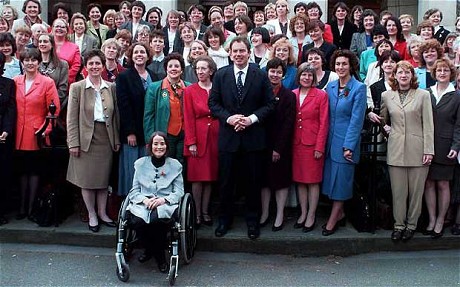
Blair Babes women British politics


The conventional wisdom holds that Ed Miliband managed to land a serious blow on David Cameron at this week’s Prime Minister’s Questions, exposing the Tory leader and his party for their chronic shortage of women in leadership positions and the key offices of state. Miliband makes a good point – an abysmal 4 out of 22 cabinet ministers in the coalition government are women, and only one of those, Theresa May at the Home Office, occupies a position that really matters (Culture, Northern Ireland and International Development, the other ministries headed by women, are either irrelevant or decidedly junior-league). That simply is not good enough, and David Cameron has just cause to feel ashamed.

The Guardian makes the case:

[David Cameron] was taunted about the Conservatives’ “women problem” by Ed Miliband in the same week it emerged several prominent women have recently been sacked from government jobs and Anne McIntosh, a high-profile female Tory MP, was deselected by her local association.

The Labour leader also claimed a prominent businesswoman, who is the wife of a Tory donor, had been greeted by Cameron with the remark: “Where’s your husband?”

He then accused the coalition of failing women across the UK by allowing the pay gap between men and women to widen for the first time in five years.

“You promised to modernise your party, but you are going backwards. You run your government like the old boys’ network – that’s why you are failing women across your party and across the country,” Miliband said.

And the initial exchange between the two leaders at Prime Minister’s Question Time can be seen here:


Less reported is the fact that the Labour Party has a record on promoting women every bit as appalling as do the Conservatives, as Dan Hodges correctly observes in his Telegraph column:

Women still aren’t allowed to hold senior positions in the Labour party. The three major political briefs are Prime Minister/Leader, Chancellor and Foreign Secretary. Apart from a short period during the fag end of Tony Blair’s administration when Margaret Beckett was placed in charge of the Foreign Office, and 14 weeks when Yvette Cooper oversaw the shadow post under Ed Miliband, none of those offices have been held by women. The Labour party has been in existence for 114 years. And during that time – under Labour – a woman has held or shadowed one of three major offices of state for a period of 14 months.

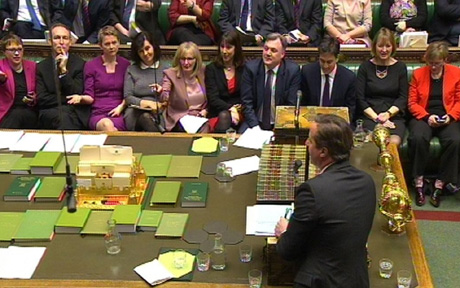
Fourteen months. And yet you would not think that Labour was sitting on such a poor record when Ed Miliband stood preening at the dispatch box in the Commons on Wednesday. One could have been forgiven for thinking that women made up a statistically and politically perfect 51% of Labour seats in Parliament and in the shadow cabinet, particularly given the rather unusual concentration of the Labour Party’s female talent on the front bench alongside their leader:

When PMQs started, several people commented on the fact that a number of Labour’s women shadow cabinet members were artificially concertinaed together close to Miliband. The reason they did that was because if they hadn’t done that they wouldn’t have been in camera shot. And that’s because there’s a convention that people sit alongside their leader based on seniority.

If something about the picture below strikes you as odd – don’t worry. There is indeed something different about the Labour front bench at PMQs this week – namely, a lot more women clustered on either side of Eds Miliband and Balls than is usually the case. It is hard to determine which is worse – Ed Miliband’s disingenuous photo opportunity, or the willingness of a number of female Labour MPs to go along with it by essentially allowing themselves to be used as props by their leadership.

Not your standard distribution.


A less-reported fact amid the furore is that all four women cabinet ministers in the coalition government are Conservative MPs, which rather begs the question of how the Liberal Democrats have managed to fly under the radar and avoid being called out for their own shameful inability to recognise and promote female talent within their own ranks. But somehow the party of Lord Rennard seems to be scoring a free pass on their own institutional sexism for the time being – at least as far as Ed Miliband’s focus is concerned.

The lack of women in senior positions in all political parties is a real problem, one which Miliband does little to debate or address by trading barbs with the Prime Minister. Some advocate all-woman shortlists as a solution to the problem, and of course the Labour Party has adopted this particular approach. This blog disagrees with it – firstly on the grounds that it robs local constituencies of the opportunity to select from the widest possible pool of talent when choosing who they want to represent them in Parliament, and secondly because if we must tolerate reverse discrimination as a necessary evil to help put right historic wrongs (and I’m far from convinced that we should), it should be done at the earliest stage possible and certainly not at the point of parliamentary candidate selection.

But while we may condemn Miliband’s posturing on the subject and question his methods, we must also acknowledge that at least the Labour Party under Ed Miliband is engaged in a bona fide effort to increase the number of women in their parliamentary party. There is a lot of rueful head-shaking from the Conservatives at the conspicuous lack of women in theirs, but not much action of any kind at all.

Four women out of twenty-two cabinet members in the British government, in the year 2014. This is a national scandal, far more serious than localised spats about the deselection or resignation of individual constituency MPs, or accusations of politicising quango appointments. This is about the integrity of our democracy and our desire to be a more practically and visibly meritocratic country.

The Conservatives, the party of Margaret Thatcher, should be leading the charge on anything to do with meritocracy. The fact that they are not currently doing so is alarming.