As the 2015 general election campaign grinds past the halfway point with none of the main party leaders doing or saying anything remotely interesting or inspiring – choosing only to shriek about the chaos and carnage that their opponents would do in government – people are starting to ask: where is the passion?
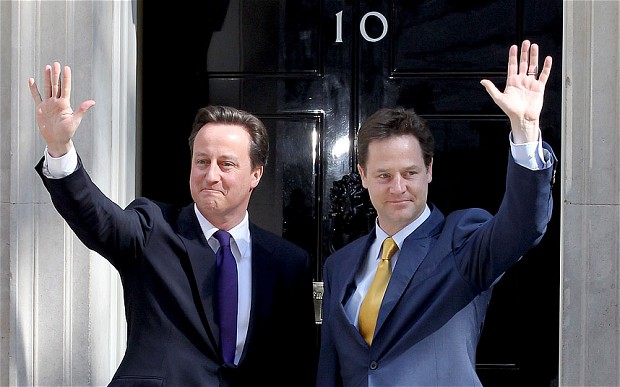
Interestingly, Cameron appears totally bemused that his coalition government’s technocratic, risk-averse management of the country from 2010-2015 has failed to win him legions of adoring fans:
The Prime Minister is aware of the criticism and finds it ‘frustrating’. ‘I feel I have worked my socks off for the last ten years to get to this point,’ he says. ‘I feel we are on the brink of something amazing in our country. If I don’t succeed on 7 May I will be furious more for my country — but furious for myself.’ He says this quietly, not crossly, as if he has been confronting his own political mortality. ‘We have done so much to get so far — I do not want to pull back now.’ And then, a promise to do better: ‘If I need to do more to communicate that I will.’
What he is trying to communicate in the final fortnight of the campaign is that Britain’s recovery has been extraordinary, but that it didn’t happen by accident. And that if people want the recovery to continue, they’ll have to vote Conservative. He is writing the speech he’ll give that day, with ‘jobs’ scribbled as the first bullet point. He has created them at a faster rate than any prime minister in history, which he puts down to tax cuts and welfare reform. So he is travelling to Yorkshire to sell ‘an extremely positive plan to transform the education of young people in our country, to keep going with this welfare revolution’.
He accepts that the revolutionary character of his government is not widely appreciated. ‘I think it is very undersold in many ways,’ he says. He doesn’t say by whom. He later refers to the government’s ‘quiet revolution: pro-work, pro-saving, pro-enterprise’.
Revolutionary character? The coalition government came into power promising an economic recovery and the elimination of Britain’s vast budget deficit. It achieved the former but failed spectacularly to eliminate the deficit, reducing it only by a third (now changed to a “half”, thanks to the disingenuous use of different metrics). The Labour Party would have likely done far worse, but this is beside the point – a stable economy should be a hygiene factor, the absolute base in terms of expectations of a “revolutionary” government.
The public and media reaction to the recent death of Margaret Thatcher has played out in exactly the way that I and probably everyone else in the nation had been predicting for the past decade.
The former prime minister was lionised in the right-wing press, and indeed by myself, as someone who quite literally saved the country, halting and then dramatically reversing what was considered by many to be a slow and inevitable national decline.
She was remembered as a “divisive” leader by the left-leaning media, some of whom grudgingly acknowledged the necessity of many of the economic policies which Thatcher brought about, while others chose to set reality aside and focus exclusively on the negative aspects of her time in office.
And finally, of course, everyone got huffy with everyone else for not responding to Baroness Thatcher’s death by their own personal definition of the “appropriate” way.
Of course it is fitting that we recognise and remind people of the enormous positive contribution – the most significant of any post war politician – that Thatcher made to the United Kingdom, and to the world. But we would be doing ourselves an intellectual injustice, and helping to ensure that the next visionary British conservative leader (whoever he or she may be) will also be labelled as “divisive” and hated by many, if we do not understand the lingering bitterness which led to speeches such as this one, made by the Labour Member of Parliament for Hampstead & Kilburn (London), my local MP Glenda Jackson:
Harsh and bitter words, borne of harsh and bitter experiences. But were the people who lost and suffered the most from 1979-1990 really let down by the prime minister, or by someone or something else?
I would argue that it was not the prime minister herself who failed Thatcherism’s biggest losers, but by the long line of political leaders in Britain heading back to the end of the Second World War and the subsequent post-war settlement, which brought about the nationalisation of industry and the freedom from competition that allowed so much of the British economy to atrophy and wither over time, gradually becoming less and less sustainable and competitive with each passing year, until only the harsh but necessary medicine of Thatcherism was able to save the country, at a much higher social cost than might otherwise have been the case.
We can see an excellent modern-day example of this exact argument being made by the highly popular Republican governor of the state of New Jersey, Chris Christie:
Replace the phrase “unfunded pension obligations” with “state-owned industries” in this speech and you have an eloquent defence of Thatcherism that you can deliver in a single minute. Christie explains that he understands the anger and frustration of the people in his state who are materially losing out in terms of stagnating wages for public sector jobs, trimmed pensions for retired state workers, and a host of other measures that the governor considered harsh but necessary in order to put New Jersey on a sound and sustainable financial footing, but that his policies are necessary because none of his predecessors had the political courage or common decency to level with the electorate about the problems that lay ahead, and the changes and sacrifices that would have to be made.
In Britain, those who lost out the most tended to work in inefficient, state-owned industries such as coal mining or car production, where Britain simply did not have a competitive advantage. They had effectively been lied to, and shielded from competition, by nearly all of the political leaders in Britain since the end of the Second World War. Just as generations of New Jersey politicians had promised their public sector workers generous pension and benefit entitlements that they knew would become unsustainable over time, so generations of British politicians promised the population here that heavy industry, state-owned monopolies and industrial relations tilted in favour of union bosses were sustainable in the long-term.
Could and should more have been done to support people who lost their livelihoods as the Thatcher reforms took effect across the country. Absolutely. And we need to ensure that when a future conservative leader makes the next set of necessary reforms (the urgent rationalisation and shrinking of the public sector in Britain) that adequate support is given to people in terms of new job placement and new skills training. There are parts of the United Kingdom where over 50% of employment comes from the public sector, a ridiculously high number – people busily providing and receiving government services to and from each other, and only half of the workforce engaged in private sector activities that generate value and wealth. But as we move away from this failed model, it is not morally acceptable, or politically viable, to rationalise the public sector without providing the necessary transitional support. We can, for example, have no more communities decimated – though the British public must also play their part by increasing our notoriously low labour flexibility and being willing to relocate for work.
Margaret Thatcher achieved much during her time in office. Lord knows that in today’s age of focus groups, granular polling of every single issue and the obsession with following public opinion, we need a leader who is a true conviction politician, and who persuades people to their cause rather than slavishly seeking positive headlines in The Sun or The Daily Mail.
But while conservatives such as myself celebrate the extraordinary legacy of Margaret Thatcher, we need to be sure that we formulate and advocate policies that avoid her pitfalls as well as emulate her great victories.
In the course of the 20th century, it fell to two prime ministers to save the United Kingdom – Churchill in wartime, and Thatcher in peacetime. Our nation has suffered an irreparable loss today with the passing of Baroness Thatcher. May she rest in peace.
And I would just like to remember some words of St. Francis of Assisi which I think are really just particularly apt at the moment. ‘Where there is discord, may we bring harmony. Where there is error, may we bring truth. Where there is doubt, may we bring faith. And where there is despair, may we bring hope’ …
Margaret Thatcher, 13 October 1925 – 8 April 2013.


 Semi-Partisan Politics