Nonexistent Shared Christian Values Are No Justification For The EU’s Existence

Francis Campbell - Reimagining Europe

The latest feeble Christian case for remaining in the EU: “Let’s forge a meaningful common European identity based on the fluffiest and least well defined parts of our faith!”

More hand-wringing waffle from the Reimagining Europe blog, this time from regular contributor and former British diplomat Francis Campbell:

Whatever the outcome of the UK referendum in June, there will be equally important questions for EU leaders in the years ahead. The process of Britain’s renegotiation has led many to consider their own national identity and how it fits within the identity of the European Union. With a rising tide of Euroscepticism in countries across the continent, the challenge for Europe’s leaders is to instil a sense of European values which enhance rather than threaten national and regional identities.

Right-o. The challenge apparently is not to question whether the decision to unite the countries of Europe under a single supra-national government was a smart idea in the first place. No, the challenge is simply to do a quick PR job, to “instil a sense of European values” and force the restive people of Europe to come to terms with this government that has been designed for them, without their input or their permission.

Campbell at no point questions the wisdom of the project to establish a supranational government of Europe in the first place, taking its existence and benefits as a given despite the current referendum offering a once-in-a-generation opportunity to question old assumptions and break out of stale ways of thinking.

But Campbell has no interest in doing any of this – he is concerned that the EU try to “build bridges” with its citizens, even though the EU project was largely created behind their backs and without their permission. Saying that the EU needs to build bridges with those it has the nerve to call its citizens is like saying that a robber should be polite and avoid leaving a mess while they ransack your house – when the real issue, of course, is that they have no business walking off with your DVD player in the first place.

We are then treated to more of the same woolly, vague and undefined hand-wringing ecumenism which sadly typifies too much of the church’s response to the EU referendum debate. Campbell writes:

In such a context the EU’s task of building bridges between citizens is a daunting one. But perhaps there is an opportunity in the current crisis for EU member states to identify common interests and shared values in among the obvious cultural differences across Europe.

One powerful shared value that is missing from the negotiation tables in Brussels is religion. Faith plays a huge part in the lives of many millions of EU citizens, yet it has been all but barred from the political arena. Whether they profess to have a faith or not, political leaders should look to religion for inspiration when forging the future identity of the EU.

Christianity is arguably something that is common to all European member states and a potential value or source of identity around which they could unite. But how do we reconcile that sense of shared identity and history with those of other faiths or none?

Catholicism, and indeed all major faiths, teaches us to believe in the intrinsic dignity of every human person. If we can look beyond our differences and guard our national interests less jealously, every EU citizen has shared values and a common identity and a commitment to live within and promote a shared pluralist space.

Okay, but how does that translate into the necessity for a powerful and activist supra-national government to sit above the nation states, claiming exclusive competency in a wide array of areas to speak and act on behalf of a group of people as diverse as Brits, Germans, Poles and Greeks?

The answer, of course, is that it doesn’t. Campbell’s background is in the Foreign Office – including a number of postings to the European Union – so he of all people should understand at least the basic history of how and why the EU came to be and took its present form. Is such a complex and inherently antidemocratic structure in any way necessary to express whatever limited sense of European-ness which may exist in our hearts and minds? Of course not, and Campbell knows it. The only reason you create an organisation with institutions mirroring those of a nation state and staffed with people who constantly agitate for more power and competencies is because you ultimately want the new organisation to be an independent actor on the world stage, replacing the nation states from which it was built.

Of course we all share a common humanity, that much is self-evident. But the sheer disingenuousness required to make the huge leap between all of us believing in the dignity of human life and all of us wanting or needing to be governed by the same common set of institutions in Brussels is simply staggering. And hardly Christian.

Trying to shoehorn Christianity in to fill the spiritual and democratic void at the heart of the European Union also brazenly overlooks the rapid growth of secularism, particularly in Western Europe. If Campbell is seriously suggesting that the EU base its social law on the values of the Roman Catholic Church, as would no doubt be popular in much of Poland, how does he think it will go down in France, Germany and Britain?

And if we attempt to base European values partly on other assertively growing faiths (i.e. Islam), what will then be the consequences for fundamental rights such as freedom of speech? And if this isn’t what Campbell means, then what exactly is his suggestion, than more hand-wringing, morally relativist waffle from the Christian Left?

Pete North hammers this point home in a recent blog post on European disunion:

We are persistently told that Eastern European countries are just chomping at the bit for Western liberalism and that is the justification for root and branch social reforms at the behest of the EU. Anyone who objects is clearly regressive in their eyes. Except the problem with EU foreign policy is that EU elites speak only to other political elites who tell them what they want to hear.

But as with the UK the metropolitan view is somewhat different to the provincial view which is seldom ever heard. It’s all very well demanding sweeping reforms but this rather forgets the lessons we learned in the UK. All economic and social reform has casualties and too much too soon creates resentment that lasts generations. That is why the Tories still can’t win seats in parts of Yorkshire and the North East.

Now apply that same revolutionary industrial reform to Poland and Ukraine while demanding social reforms that do not sit well with the catholic population. Attitudes are nearly thirty years behind in some regions. Try being an unmarried mum in rural Poland. Even today there are still objections in Ireland to reforms to abortion laws. That goes double for Eastern Europe.

So Francis Campbell’s bright idea to base our perpetually missing common European identity on Christianity or religion is clearly a dud. As the Anglican church has discovered, there is such wide and irreconcilable difference between its own traditionalist and progressive wings that some people find themselves unable to remain part of the same congregation or communion. And that’s just one branch of Christianity! How, then, is forming the kind of robust, multi-layered identity required to legitimise a powerful supranational government going to be possible merely by reeling off a few bland pronouncements about Christian “values” and the dignity of human life?

In short, this is exactly the kind of desperately small, unimaginative thinking which is responsible for so much of Britain’s current democratic malaise. When presented with an historic opportunity to look again at European and global systems of governance and regulation, all that Francis Campbell can do is propose minor tweaks to the status quo – tweaks which in his heart of hearts he must realise are empty words which will make no discernible impact in bridging the gap between an increasingly powerful, unloved European Union and the citizens of its member states.

And this is why Brexit must be more than an event – it must be just part of a larger process of democratic renewal and reform of our governance. There is precisely zero point in reclaiming powers and competencies from Brussels through Brexit if we are only to give them back to a government and Foreign Office staffed by rent-a-bureaucrats, who have the “vision” only to ploddingly execute the instructions placed in front of them, and will probably end up giving power away again to someone else in exchange for a few magic beans.

Francis Campbell, like too many other prominent Christian EU apologists, begins from the lazy and unsupported starting point that the European Union is inherently good, virtuous and necessary, without so much as examining its history or asking why similar structures have not developed in other part of the world. The brain then only truly engages when considering how the people might be better made to realise all of the wonderful good being done on their behalf, at which point we get lots of flowery language about shared Christian values but no intellectual meat on the bones. And the analysis is worthless anyway, because the initial assumptions were flawed from the start – the EU is not inherently good, virtuous or necessary.

So still we wait for that most elusive of things – a structured, intellectual Christian case for the European Union, and for Britain remaining in the EU. Many have stepped forward to try, but none (to my knowledge) have yet succeeded. Some have made themselves look quite silly in the process.

And time is running out.


Christianity - Europe - EU - Brexit

Top Image: Times Higher Education

Agree with this article? Violently disagree? Scroll down to leave a comment.

Follow Semi-Partisan Politics on TwitterFacebook and Medium.

Where Is The Serious Christian Case For Remaining In The European Union?

Bishops - Catholic Church - Church of England - Brexit - EU Referendum - European Union

Friendship, cooperation and overblown claims about the EU keeping the peace in Europe do not amount to robust Christian arguments for staying shackled to the European Union

When the Church of England-sponsored Reimagining Europe blog launched last year, I was vaguely hopeful that it might lead to some fruitful discussion about the real Christian case for or against Brexit. Not just the kind of woolly left-wing platitudes which many bishops excel at delivering, but a real granular theological case for why Britain should either remain in the European Union or vote Leave to regain our independence.

Fast forward seven months and the promise of Reimagining Europe remains largely unfulfilled. The only really decent arguments have been those guest posts from Adrian Hilton of the Archbishop Cranmer blog, which have effectively demolished the laziest of the Christian cases for staying in the EU. There have been a few other decent commentaries and a large number of hand-wringing prevarications, but as far as I can tell not one unambiguously argued Christian case for Remain.

This recent blog entry by Guy Brandon is typical of the output in this regard:

At the same time, placing national identity above our identity in Christ should raise a warning flag. Our own legal system might be underpinned by biblical foundations and Christian heritage, but it is not God-given. Sovereignty should not be absolutised, whether the issue is approached from a practical or spiritual direction.

The question mirrors, on the national scale, our view of our own personal autonomy. To what extent do we see ourselves as the architects of our own destiny? We all make personal compromises in the interests of living together. As Freud remarked, ‘civilisation is built on the renunciation of instinct’. For the Christian, there is the added dimension that we have been purchased by Christ’s death (1 Corinthians 6:19-20) and are free – not to do anything we choose, but to ‘serve one another in love’ (Galatians 5:13-15)

So, should we give up a degree of national autonomy in the interests of the common good? As ever, the question is not cut-and-dried. There may be benefits we enjoy, such as guarantees around freedom of religion, which we would no longer have if we withdrew from the EU. Christians might contemplate the risks of withdrawing from such protections, as well as the attractions of being masters of our own destiny.

Immediately there are red flags that this is not a serious analysis, or even reflection.

For a start, the author takes it as a given that the European Union is the “common good”, against which national autonomy is perpetually placed in opposition. But why the European Union (with its dogmatic insistence on representing 28 countries with a single voice of compromise) is in the common good is never explained – and not just in this piece. Over and over again in Christian ruminations on the European Union, the most fundamental europhile assumptions are accepted as Gospel. Of course the European Union represents the common good.

Then we get the old workhorse about the EU guaranteeing freedom of religion, which is problematic in a number of ways. Firstly, it is profoundly antidemocratic in claiming that the British people should have rights imposed on them by others. Of course we should all have freedom of (and from) religion, but we the British people should establish and maintain this right for ourselves – ideally through a written constitution.

The same goes for workers’ rights, which are forever held up by the Remain camp as a scaremongering warning that if we leave the EU, it will be back to seven day working weeks and young children going up the chimneys to earn their keep. Why are so many self-professed Christians so happy for our most fundamental rights to be imposed on us from above, rather than arising organically as the democratic expression of our own hearts and minds?

Christianity - Europe - EU - Brexit - 3


The Catholic Herald’s recent review of church attitudes toward the EU also reveals an excess of woolly thinking at the top:

Cardinal Nichols is also fervently pro-EU, but his support for it has a less Roman flavour. He is, as I remember from his days as general secretary of the Bishops’ Conference, a man who works through committees and relishes bureaucratic procedure.

His politics bear the stamp of his Liverpudlian upbringing. He favours public expenditure over private enterprise; his speeches employ the vocabulary of the state sector. It’s hard to think of a bishop less in sympathy with Eton-educated Catholic Tory Brexiteers such as Charles Moore and Jacob Rees-Mogg.

The Nichols philosophy embraces the dirigism of Brussels; in this he is typical of the moderate British Left, which changed its mind about the Common Market after Jacques Delors persuaded it that Europe was an indispensable ally against “free-market fundamentalism”.

One suspects that Cardinal Nichols would admire the modus operandi of the European Union even if it had no association with the Church. The same could be said of many bishops of England and Wales.

This instinct to remain in the EU is borne out of fear of change and bureaucratic preference, which are understandable human emotions but about as far as one can get from being sound justification for continuing with the current mode of supranational European government.

As this blog recently concluded:

As a Catholic eurosceptic, it is frustrating to witness so many fellow Christians accepting the pro-EU, pro-Remain position almost by default, without actually engaging their brains or making considered reference to their faith. I’m no theologian myself, but I’ve read my Bible and I know that the New Testament offers little by way of clear instruction or even guidance as to how any entities larger than individuals and faith groups should organise or govern themselves, while much of the Old Testament reads as a “how not to do statecraft” manual.

If we restrict ourselves then to the teachings of Jesus, from where do Christian EU apologists draw their inspiration? The EU is not a democratic entity, nor is it likely to become one any time soon. What is so Christian about defending an organisation which insulates a continent’s leaders from the practical and political consequences of their rule? What is so Christian about sticking one’s fingers in one’s ears and loudly repeating the mantra “the EU is about peace and cooperation, the EU is about peace and cooperation”, while ignoring the known history of European political union and disregarding the fact that fruitful inter-governmental cooperation could take place just as well outside the EU’s supra-national structure?

[..]

Regrettably, I have come to the conclusion that much of the Christian case for Remain rests either on a lazy “agree with the Left by default” mindset, or the desire to virtue-signal generally “progressive” values across the board. I will be happy to be proven wrong, and to be presented with a serious Christian case for the EU based on the argument that staying part of a supranational political union unreplicated in any other part of the world is 1) what Jesus would do, or 2) what is best for Christians in Europe. But I’m not holding out much hope.

And if that’s what this is really about – cheering on the EU because it signals that one holds the “correct” progressive opinions in other areas – then they picked a really lousy time to do it. Our politics is suffering a crisis of legitimacy, and yet many in the Church have taken the decision to cheer on the one entity which best represents the interests of a narrow European elite overriding the interests of ordinary people.

In short, I have yet to see a Christian case for Remain that consists of anything other than woolly, tenuous and unsubstantiated assertions that the EU equals being friendly and co-operating with our neighbours (which, unlike the countries of every other continent in the world, can for some reason only be accomplished in Europe through a supra-national government), and that if we vote to Leave we will essentially be voting for war and the stripping away of religious freedom.

Well I’m sorry, but that facile level of argument is not good enough. I’m still waiting for serious theologians or senior figures in the Church hierarchy to put forward one good reason why Jesus would favour Britain’s participation in a remote and antidemocratic-by-design government of Europe.

If staying in the EU is so goshdarn godly, let’s hear why, without recourse to the fluffy, prevaricating jargon about ecumenism and friendship which Christian EU apologists tend to deploy like chaff to distract us from the paucity of their argument. And let them explain too why they are so desperate for continued political union in Europe, yet utterly blasé about the fact that Asia, Australasia and the Americas get by just fine without such a union.

There is a fight for self-determination and democracy underway right now, and far too many voices within the church are coming down on entirely the wrong side. Those who stay silent or openly advocate for Remain will justifiably find themselves on the hook and personally implicated in every future crisis which befalls the EU, and will bear some responsibility for each incremental unit of economic and political suffering experienced by Britain as a continent glued together by unwanted, inflexible political union slowly begins to rip itself apart.

The clock is ticking, and there is little time left for Christian Remainers to defend or amend their position before they go on to face the judgement of history.


Christianity - Europe - EU - Brexit

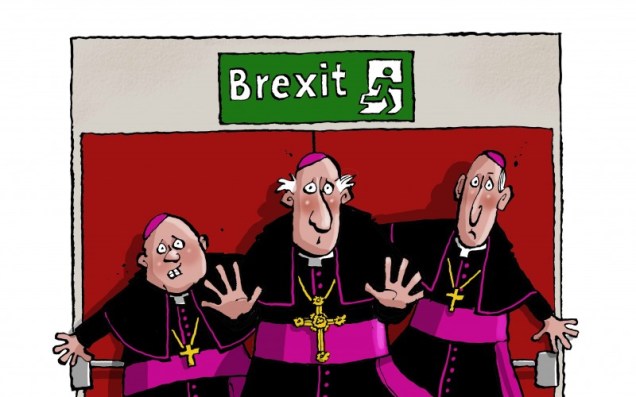
Top Cartoon: Christian Adams, Catholic Herald

Agree with this article? Violently disagree? Scroll down to leave a comment.

Follow Semi-Partisan Politics on TwitterFacebook and Medium.

The Feeble Christian Case For Remaining In The European Union

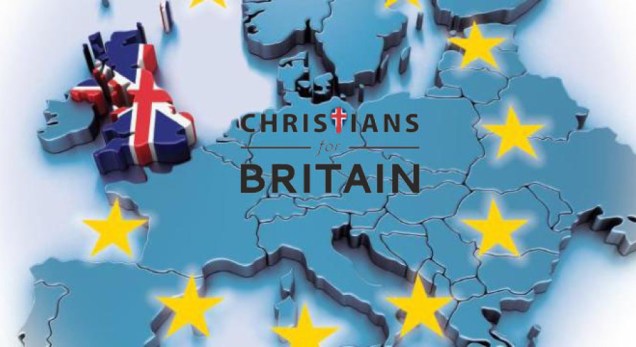
Christians for Britain

Nobody has yet made a convincing Christian case for the EU. That should tell us something.

If nothing else, the Church of England’s Reimagining Europe blog has served to highlight – with a few very worthy exceptions – the exceedingly low quality of Christian thinking when it comes to the EU referendum question, and Britain’s place in the world more broadly.

The latest dismal example is a case in point, in which Andrew Gready (chaplain to the Anglican Church in the Hague) bemoans the fact that nobody is making a more positive case for staying in the EU:

Although there are certainly problems with the European Union (no one is seeking to gloss over these), the Dutch are at least able to see some of the positive benefits that belonging to a bigger whole has brought. It seems that they hoped that the debate in the UK would be more positive, more constructive than it has been. A number of people have said ‘Surely they can talk about the benefits of belonging, rather than just saying we are not sure what is going to happen, so let’s stay where we are!’

I think there is a real hope that the vote to Remain will actually be a positive statement of intent, rather than a negative one of fear and uncertainty. We will have to wait and see!

Newsflash, Gready – Britain is and will always remain part of a “bigger whole” whether we remain in the European Union or not. The European Union is a political construct, and a very recent and unproven one at that. It is not interchangeable with the continent of Europe, and it has no democratic legitimacy when it arrogantly claims to speak and act on behalf of the many diverse European peoples. There is a positive case for Brexit based on leaving euro-parochialism behind and engaging more fully in the world, and pro-EU Christians participating in the debate should at least acknowledge this fact rather than arguing against the two-dimensional cartoon Ukipper they hold in their minds.

But this is the very low standard of debate we have sadly come to see from those who claim to represent the Christian perspective. At its core, their argument amounts to little more than “the EU is about friendship and peace and cooperation, and Jesus was in favour of all those things, so what’s not to like?”

Or as the founder of Christians for the EU, the Very Revd Michael Sadgrove, puts it:

“I think life is meant to be lived together in partnerships and collaboration. To walk away from an institution that was set up to pursue those ideals is a big mistake.

“Link that with the Genesis principle that it is not good for a man or a woman to be alone. The EU is very much not perfect, but the essential ideal and aim is still valuable. The world needs nation states to be grouped together in alliances that will be good for the human race.”

Because partnership and collaboration is only possible through political union, of course. The sheer superficiality of this thinking is mind-boggling.

Seriously – boil down most of the pro EU articles over at Reimagining Europe and they amount to little more than that. You’ll hear endless variations on the theme that because we are all brothers and sisters in Christ, somehow it naturally follows that we should be united under the same supranational political umbrella – though curiously the Church of England never wastes its time clamouring for Asian countries to merge together, or for Canada, Mexico and the United States to institute a shared parliament.

Ben Ryan of Theos does a good job of summarising the many-layered complexity of Europe:

Yes, Europe is a Christian continent. But it’s not only a Christian continent, and that’s important to note. It’s a Christian continent, but it is also a ‘Greek’ continent, it is also a democratic continent; which is to say that the space that we call ‘Europe’ is not really a geographical thing. There is no border of Europe, geographically speaking. There are islands off the coast, there is no clear Eastern border.

Instead, what defines the border of the space that we call Europe is a cultural and intellectual thing. It is a space which is defined by what has come before; it is defined by Christianity, and by Greek philosophy, and by a number of other cultural and intellectual movements. So, it’s a mistake to think we are actually a real continent. There is no such thing as a ‘geographical Europe’, it can only really be seen as an intellectual space.

Sadly, many within the Church deliberately ignore these awkward facts, and have convinced themselves that pressing ahead with a uniquely 20th century vision of uniting the diverse under a single supranational government is a wise and moral thing to do – democracy be damned. And they do damn democracy through their actions, because what little organic desire and impetus for European political union there is always comes from the political elites, and not the ordinary people.

As a Catholic eurosceptic, it is frustrating to witness so many fellow Christians accepting the pro-EU, pro-Remain position almost by default, without actually engaging their brains or making considered reference to their faith. I’m no theologian myself, but I’ve read my Bible and I know that the New Testament offers little by way of clear instruction or even guidance as to how any entities larger than individuals and faith groups should organise or govern themselves, while much of the Old Testament reads as a “how not to do statecraft” manual.

If we restrict ourselves then to the teachings of Jesus, from where do Christian EU apologists draw their inspiration? The EU is not a democratic entity, nor is it likely to become one any time soon. What is so Christian about defending an organisation which insulates a continent’s leaders from the practical and political consequences of their rule? What is so Christian about sticking one’s fingers in one’s ears and loudly repeating the mantra “the EU is about peace and cooperation, the EU is about peace and cooperation”, while ignoring the known history of European political union and disregarding the fact that fruitful inter-governmental cooperation could take place just as well outside the EU’s supra-national structure?

Canon Giles Fraser, founder of Christians for Britain, gets it:

“If the Tower of Babel teaches us anything, it is, when man tries to control too much and usurp the power of God then God disperses them,” he said. “Government that is centralised tends towards corruption: that is the history of human nature.

“The biblical pattern is not always for agglomeration of power. God also divides in order that powers would be controlled.”

As I say, I’m no theologian. But I’ve been on the lookout for a more substantial Christian case for the European Union which is not based on wilful ignorance or wishful thinking about the EU’s true nature, and so far I have come up short. Meanwhile, Brexit offers at least the chance of democratic renewal in Britain, potentially giving people (including the faithful) greater control over their lives and communities.

Regrettably, I have come to the conclusion that much of the Christian case for Remain rests either on a lazy “agree with the Left by default” mindset, or the desire to virtue-signal generally “progressive” values across the board. I will be happy to be proven wrong, and to be presented with a serious Christian case for the EU based on the argument that staying part of a supranational political union unreplicated in any other part of the world is 1) what Jesus would do, or 2) what is best for Christians in Europe. But I’m not holding out much hope.

And if that’s what this is really about – cheering on the EU because it signals that one holds the “correct” progressive opinions in other areas – then they picked a really lousy time to do it. Our politics is suffering a crisis of legitimacy, and yet many in the Church have taken the decision to cheer on the one entity which best represents the interests of a narrow European elite overriding the interests of ordinary people.

For the Church as a whole, the consequences of coming down on the wrong side of this issue – or at least failing to come down convincingly on the right side – could be profound. One way or another, now or twenty years down the line, Brexit is coming. And when it does, many leading authority figures within the church will have placed themselves firmly on the side of governing elites rather than the people who fill their emptying pews.

This should be provoking a great degree introspection and self-reflection from Britain’s most high profile Christian leaders. So far, one gets the distinct impression that it is not.


Christianity - Europe - EU - Brexit

Agree with this article? Violently disagree? Scroll down to leave a comment.

Follow Semi-Partisan Politics on TwitterFacebook and Medium.

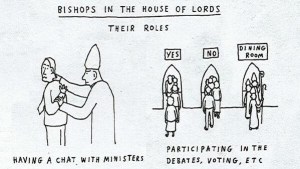
The Bishop And The Brexit Debate

christianity-europe-eu-brexit-3.jpg

Apparently, Brexit constitutes a “nightmare scenario” for the Bishop of Guildford. No surprise, coming from an established church with such a dubious record on democracy

Should bishops in the Church of England (or indeed the leaders of any other religious denomination) be free to speak their minds on the subject of Brexit and in advising their flocks how to vote in the coming EU referendum?

Of course they should. To suggest otherwise would be an unconscionable encroachment on religious liberty – the only exception being the intolerable Lords Spiritual whose anachronistic and unwelcome presence in the House of Lords makes Britain, like Iran, a technical theocracy.

But while non-political bishops have every right to express an opinion on Brexit, so we have the right to criticise their thinking on the subject, which tends to be woolly at best, and arrogant with a twist of elitism at worst.

King of the woolly thinkers is the Bishop of Guildford, who shared this recent gem on Twitter:

Adrian Hilton of Archbishop Cranmer dissects the Bishop of Guildford’s europhile ramblings over at Reimagining Europe:

So we read that the Brexit “nightmare” would be “very sad” because it would mark a return to “competing nationalisms” and “very dangerous times”. The EU has been “integral in delivering seven decades of peace and economic security”.We must resist the “widespread rise of populism” because “we are European” and “have nothing to fear or to lose if we remain so”. The Bishop of Leeds, Nick Baines, wants a ‘Third Way’, but that isn’t on the ballot paper. And the Bishop of Willesden, Pete Broadbent, aims directly for the Tories, but this isn’t a general election. As you see, it’s all impeccable political neutrality with rigorous episcopal impartiality.

The laity and other clergy will, of course, make up their own minds, but what manner of neutrality is it when CofE comms tells the media that the institution is neither for remaining nor leaving, while many in the House of Bishops preach the Gospel of Remain? Would a bishop ever tweet that his (or her) “nightmare” would be to wake up to a Corbyn premiership? What guilt does the prospect of voting for the Bishops’ (it probably is plural) Brexit “nightmare scenario” inculcate in the spiritually-discerning democratic intellect of the laity and subordinate clergy?

And here is the crux:

Some say we’d be poorer; others that the cost of holidays would rise; still others that our power stations would go dark and terrorism would increase. There is equal expert opinion to the contrary in every case, and it’s hardly four-horsemen-of-the-apocalypse stuff, is it? The matter of whether our national destiny is to be bound in perpetuity to an anti-democratic United States of Europe which is creeping, ratchet-like, toward continent-wide assimilation and uniformity cannot simply be distilled to short-term economic interests or security scaremongering.

I can understand Bishop Andrew’s desire to sustain a political union which is ostensibly based on sound Christian principles such as subsidiarity and solidarity. But, as Philip Booth has shown, the EU is antithetical to the very concept of localism, notwithstanding the letter of Maastricht. And I feel sure that the Greeks, Spanish, Italians and Portuguese might balk at assertions that the EU project is any longer concerned with fraternal solidarity, mutuality and social harmony.

This isn’t an organic social contract for diversity, liberty and limited state power, but a fabricated mechanism for the enforcement of national assimilation. When you’re locked – seemingly irrevocably – into a model of “economic governance” which hinders growth, destroys jobs, increases poverty, and leads mothers to abandon their children on the streets and fathers to commit suicide, I have to put to Bishop Andrew that his Brexit “nightmare scenario” would be welcomed by millions of Greeks as a dream of Grexit bliss.

The bishops’ willingness to swallow pro-EU talking points and then arrogantly sound off in public about how the EU has “kept the peace” and “delivered prosperity” is not just intellectually lazy. I would charge that it is a failure in their duty of pastoral care to all Christians in their flock, to accuse those who want Britain to leave the EU of trying to bring about a “nightmare scenario”.

Since when did believing in national democracy and sovereignty based at the level of a commonly understood demos represent a “nightmare” for the Church of England? Since when did the concept of self-determination (as opposed to slavishly following a pre-determined path toward unwanted European political integration set in motion decades ago) become unwelcome? And why is the Church willing to wring its hands and worry about human rights abuses and dictatorship abroad, but turn a blind eye when the rights of its own fellow citizens to determine the course of their own future is suppressed by Brussels?

At its root, the pro-European instincts of many bishops seem to rest in a desperate, stubborn insistence in seeing the world – and the European Union – as they would like it to be, rather than how it actually is. As Hilton suggests, the idea of the bad aspects of nationalism being eroded and replaced by shared European values of a vaguely left-wing bent of “subsidiarity and solidarity” is all well and good. But there is no European demos, and the relentless march toward further integration in the absence of a shared feeling of European-ness above national identity will only compound the simmering resentment.

The Church of England would clearly love nothing so much as to operate in a world where the nation state was consigned to the history books, and where we are primarily governed at a European level – no doubt as a stepping stone toward one world government. And they are entitled to that worldview, premature and perverse though it is.

But the Church and her bishops should at least show some embarrassment and contrition at the fact that by casting any concern for democracy aside and throwing their lot in with the European Union, they are helping to impose an elitist vision of a politically united Europe which more people vehemently oppose than have been scared and bullied by the Remain campaign into meekly supporting.

It is not the job of any Christian (least of all me) to judge another’s adherence to and practising of their faith, and so I will pass no comment on whether Andrew Watson’s gnawing fear that the British people might vote for self-government makes him a bad Christian.

But I will say without hesitation or apology that it does make him a bad citizen, a weak example of a community leader and an emblem of everything that is wrong with the established church’s continued role in the political life of our country.


Church of England - Church and State - Parliament - Lords Spiritual - Cartoon - 2

Bottom Image: Abbreviated cartoon by Dave Walker

Agree with this article? Violently disagree? Scroll down to leave a comment.

Follow Semi-Partisan Politics on TwitterFacebook and Medium.

The Daily Toast: The Christian Case For Brexit, And Against The EU

Christianity - Europe - EU - Brexit - 3

There’s nothing Christian – or in any way moral – about throwing away our hard-won democracy in the drooling pursuit of European political union

Adrian Hilton of the excellent Archbishop Cranmer blog has a very noteworthy piece in Reimagining Europe, making the rare (but very welcome) argument against the European Union from a Christian perspective.

Hilton writes:

Unlike many politicians and most bishops and other circulating elites, I don’t equate historic Europe with the political civic empire called the EU, and it seems that my desire for UK secession from this artificial construct makes me ‘un-Christian’.

How welcome these words are. The lazy but insidious notion that the continent of Europe and the political construct known as the European Union are one and the same thing is hugely damaging yet near-universally held. People worry about “leaving Europe” as if by leaving one particular (very expensive) geopolitical club, Britain would literally be levering herself away from the continent of Europe, walling ourselves off in Fortress Britain, when this is clearly not the case.

But the lazy belief that British membership of the European Union is somehow as logical and essential as our geographical location within the continent of Europe is widespread, and so it is unsurprising to see it mindlessly repeated by the Church of England.

The same goes for the risible idea that leaving the EU would be to cease any kind of friendship or cooperation with the other countries of Europe, another argument commonly deployed by europhiles, as Hilton recounts:

“So we stop working with our neighbours; finding common ground; influencing for good – not my idea of Christian,” [Lord Deben] tweeted to me a few weeks ago. Like Jeremy Corbyn, it seems, I’m locked into an otiose 1970s view of the world. Everything has changed, and I just haven’t realised that sovereign nations can no longer work effectively with their neighbours on matters such as trade, taxation and regulation: “Most big international decisions (are) made between EU and US,” Lord Deben asserted, before needling: “Why do you want Britain excluded?”

You see how the caricature goes? The EU is ‘top table’ (though it really isn’t, but that’s another blog post), and Christians who favour UK-EU secession become isolationist, xenophobic, un-(anti?)-Christian ‘little Englanders’. He didn’t say ‘fruitcakes, loonies and closet racists’, but he might as well have done. My ‘idea of Christian’ is self-evidently blinded by nationalistic bigotry and naively fomenting apocalypse. No matter how much you try to reason back with gracious statistics, humble facts and philosophical insights, the inference is clear and crushing: there is no place in the Church of the Enlightenment for those who identify with the narrow, sectarian parochialism of a national democratic polity. No informed, intelligent or discerning Christian could possibly be so spiritually witless or theologically illiterate as to advocate withdrawal from the EU.

But of course there is nothing Christian about allowing the United Kingdom – our flawed but essentially decent democracy – to be subsumed into an explicitly political supranational union which is the peculiar, flawed vision of founding fathers who – unlike their American predecessors – are largely unknown and unloved, because their elitist vision for technocratic governance so utterly fails to resonate in the hearts of Europe’s citizens.

Neither is there anything “moral” or Christian about divesting ourselves of judicial, legislative and executive sovereignty, only to slowly and stealthily transfer and pool those powers into an entity with which most of us feel absolutely no heartfelt love, affiliation or loyalty.

Or as Hilton so eloquently puts it:

I support the Leave campaign not because I desire economic isolation or social exclusion from the Continent, but to extricate the UK from the unaccountable elitist pursuit of unending politico-economic integration at the expense of democracy, accountability and liberty, which, to me, are perfectly sound biblical principles.

Ask a europhile how these principles are to be preserved in a European Union of relentless, unapologetic political integration and you will be met with a very long silence.

Ask a europhile how they plan to preserve democracy when they undermine the nation state at every turn, and give its powers to a supranational organisation which commands no feeling of affinity, and you will get tumbleweeds. Because they have no answer. Either they have not thought the issue through, or – far more frightening – they have thought about the ramifications for our democracy, but simply don’t care.

Hilton concludes:

We, the governed, ask ‘Who governs?’, and the answer is lost in a pathology of bureaucracy and unfathomable institutional structures which seem purposely designed to convey a façade of democracy while shielding the executive elite government from the inconvenience of elections. We are governed by a wealthy, supranational, technocratic oligarchy, and no popular vote can remove them or change the direction of policy. This might fulfil Lord Deben’s apprehension of righteous government, and I am sensible to the fellow-feelings of European humanity in its unanimous yearning to eradicate civil strife and internecine war. But all I see are disparate peoples desperate for the restoration of national identity against the failures of forced continental integration.

UKIP. Front National. The Danish People’s Party. Jobbik. The Freedom Party. Finns. All across Europe, eurosceptic parties – some mainstream, some more extreme and less pleasant – are flourishing because of a growing number of citizens who have had enough of enforced European political unity and remote government-by-technocrat, and who would much rather that meaningful power returned from Brussels to the level where they feel a sense of belonging – be that their region, province or country.

Too often – at least in Britain, with the media’s patronising and dismissive coverage of UKIP leading up to the European and general elections – we explain away these populist movements, or belittle their support base by suggesting that they are all economically left-behind losers or curtain-twitching village racists.

And it’s partly true, only not as an insult. If you are a well paid professional in rude financial health you can better afford to be a consumer rather than a thinking citizen. You can use your vote to signal your virtue (anyone but UKIP!) or advance your lazily thought out utopian daydreams, with little fear of the consequences. But those of our fellow citizens on the sharp edge of globalisation – those whose livelihoods are impacted by deindustrialisation, new technology, outsourcing and the information economy – tend to see things differently.

This doesn’t mean that we should adopt every nativist, protectionist policy that comes along – because barriers to trade are never the right answer. But it does mean that we should acknowledge that the eurosceptic parties of the Right and the Left are at least asking some important questions that the mainstream parties, trapped in their centrist consensus groupthink, have consistently failed to do.

And too often the Church has sided with the establishment, reflecting the voice of the political class and the prosperous middle class rather than the informed citizenry or the imperilled working class. Worse still, it has done so while shamelessly dressing itself in the robes of enlightened internationalism, progressivism and virtue.

If nothing else, it is encouraging to see that thanks to the likes of Adrian Hilton, they will no longer be allowed to do so unchallenged.

More semi-partisan commentary on Re-imagining Europe here and here.

Christianity - Europe - EU - Brexit

Agree with this article? Violently disagree? Scroll down to leave a comment.

Follow Semi-Partisan Politics on TwitterFacebook and Medium.