“Every time you silence somebody you make yourself a prisoner of your own action, because you deny yourself the right to hear something.”
The late Christopher Hitchens, addressing an audience on the ever-important subject of freedom of speech.
“Every time you silence somebody you make yourself a prisoner of your own action, because you deny yourself the right to hear something.”
The late Christopher Hitchens, addressing an audience on the ever-important subject of freedom of speech.

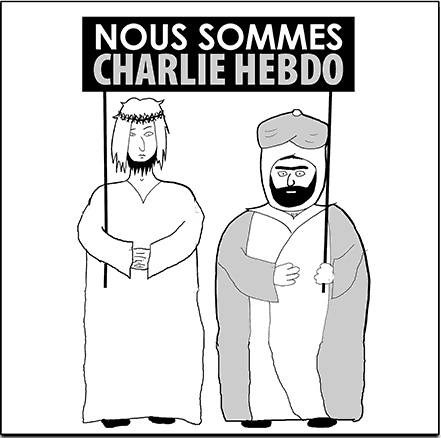
And so 2015 begins as 2014 ended – with another murderous terrorist attack on a western city, this time targeting journalists, cartoonists and satirists at the offices of the magazine Charlie Hebdo. For too many people, bereaved family and friends of the twelve victims, this will not be a happy new year.
Having been ill since the start of the year, your blogger was late to hear of the grotesque carnival of violence that played out in Paris on the morning of 7 January. Since that terrible moment, others have already offered moving and stirring words in response, far better than I. But the purported reasons for the targeting of Charlie Hebdo make it important for this blog to take a stand against the noxious idea that the mere act of depicting anybody, religious or otherwise, should be cause for the the huge amount of offence-taking, consternation and hand-wringing that it still is in the year 2015.
The following are therefore a selection of columns and responses that are informing this blog’s thinking at present, and then some closing thoughts.


One special word has been trending heavily in the British media over the past week, but you are unlikely to have seen it spelled out in print or on screen. Like the character Lord Voldemort from the Harry Potter series, prevailing opinion and political correctness (albeit of the most well-intentioned kind) decree that it shall not be uttered, but only alluded to or heavily disguised for fear of the harm that it may do in its raw form.
Lord Voldemort burst back into the British news this time when popular television host, columnist and author Jeremy Clarkson (of Top Gear fame) had to plead for his job after being caught uttering the word while reciting a rhyme. Such was the frenzied speculation over whether Clarkson had indeed said the word that the Daily Mirror, in possession of the video clip, hired forensic audio experts to analyse the soundtrack in an attempt to decipher the contentious mumbled phrase. In the event, Clarkson apologised as he has never apologised before (rightly so), and lives to offend another day.
But as usually happens when making policy based on political correctness and overwhelming fear of public opprobrium rather than sound reason, the application tends to be panicked, sporadic and contradictory. So it was that after the A-list Jeremy Clarkson was let off the hook with a ‘final warning’ from the BBC and allowed to keep his position despite actually saying the word out loud with his own mouth, the decidedly C-list David Lowe, a provincial radio DJ, was peremptorily asked by the Corporation to resign for unwittingly playing a song containing the same word.
(BBC policy apparently decrees that as you move up the fame hierarchy you can earn the right to skate closer to explicitly saying the word in public without being fired. If the BBC’s top ten stars banded together and offered up their annual vacation allowance and overtime, presumably they could sing the word in the style of a four-part Bach fugue at the start of the Nine O’Clock News.)
What is more concerning than a BBC television star’s casual utterance of the word or the network’s inconsistent treatment of those who fall foul of the complex web of unwritten rules that govern its use, though, is the craven way that the media, almost without exception, voluntarily choose to censor themselves when reporting these stories. Somewhere along the way it was decided that not only is it wrong to say the word in anger (quite rightly – no decent person should), neither is it okay to write or speak the word in the course of a dispassionate news broadcast. And so news consumers are patronised with that childish and awkward compromise, the N-word.
Make no mistake: the word-that-shall-not-be-named is a hateful thing. It brings forth horrible echoes of enslavement, beatings, lynchings and repression, the worst that humanity can do to its own kind. And within some people’s living memory it evokes painful recollections of segregation, discrimination, bullying, voter disenfranchisement and domestic terrorism. But driving the word out of the public discourse completely cannot undo any of these wrongs – the main effect is only to spare us from having to face up to the brutal connotations that come along with it. We may claim to disguise the word for fear of causing offence, but it is just as much an evasion to spare ourselves from feeling discomfort.
The comedian and great observer of human nature, Louis CK, captures this evasion-disguised-as-concern perfectly in his stand-up HBO special comedy routine, “Chewed Up”:
Everybody has different words that offend them, different things that they hear that they get offended by… To me, the thing that offends me the most, is every time that I hear “the N-word.” Not “nigger” by the way. I mean “the N-word.” Literally, whenever a white lady on CNN with nice hair says, “The N-word,” that’s just white people getting away with saying “nigger,” that’s all that is. They found a way to say “nigger.” “N-word!” It’s bullshit ’cause when you say “the N-word” you put the word “nigger” in the listener’s head. That’s what saying a word is. You say “the N-word” and I go “Oh, she means ‘nigger’.” You’re making me say it in my head! Why don’t you fuckin’ say it instead and take responsibility, with the shitty words you wanna say.
CK is right inasmuch as that journalists are not really letting themselves off the hook by referring to the ‘N-word’ rather than its expanded form. Since journalists are effectively planting the word in peoples heads when they refer to the ‘N Word’ in a story, all that refusing to spell or speak the word out in full does is imbue that specific arrangement of letters with some nonexistent, mythical power that must be feared and respected.
The media’s unwritten policy would be slightly more understandable if it applied equally to other racially derogatory terms, but this is not the case. When three football supporters were charged with racial aggravation for chanting the word “yid” at two football matches, the BBC reported on the story and included the word “yid” in the headline. And several years ago BBC Four broadcast a documentary entitled “Kike Like Me”, in which the film maker “goes on a personal journey to find out what it means to be Jewish in the modern world”. But no matter how clinical or non-aggressive the context may be, the word occupies an exalted place among the racial slurs requiring it alone to be diluted before publication.
Yes, the word ‘nigger’ is about as deeply unpleasant a word as can be said. Used as a derogatory term, it has an abiding power to hurt – your blogger speaks from occasional painful experience on the receiving end. But because the word is so hateful, let those in the business of reporting the news show the word’s use in anger to be the outrageous and insensitive thing that it is – by repeating it, straight-faced and in all of it’s ugliness, not by sugar-coating it in the form of a child’s euphemism.
If, in the year 2014, someone in a position of prominence still decides to use the word ‘nigger’ in a derogatory or throwaway manner, we shouldn’t report it euphemistically as though we were embarrassed children tattling about a schoolyard transgression or other act of naughtiness to a teacher – “he said the F-word, she said the C-word!” – we should report it with the honest and brutal simplicity that the facts dictate.
This isn’t school. We are all grown-ups here. So let’s reflect that in our journalism, and put the N-word to bed.

As the world’s attention remains fixed on Ukraine, less attention is paid to the final nails being hammered into the coffin containing the corpse of Russia’s free and independent press. And while the annexation of Crimea and the west’s shamefully half-hearted response (slapping sanctions on a mere handful of Russian officials and exempting Vladimir Putin and his closest confidantes) certainly deserve their column inches, journalistic independence and free speech finally died in Russia, without a shot being fired. It is only right that we acknowledge this backward step, too.
A couple of excellent columns published over the past weekend aimed to do exactly that – Julia Ioffe writing at the New Republic and David Remick at The New Yorker. Both articles come highly recommended and paint a compelling, sad story.
In his piece, Remnick mourns the backwards steps under Putin which have now erased each and every gain made for freedom of expression under the Gorbachev glasnost era, with particular reference to the Russian government’s recent interference with popular news site Lenta.ru:
In recent years, when Russian liberals have tried to sound optimistic, they have invariably said, Well, at least they haven’t cracked down on the Internet the way the Chinese have. Lenta.ru is one Web site, not the entire Russian-language Web, to be sure, but today’s firing is still an important and ominous step. Lenta.ru was getting more than thirteen million unique visitors a month, and was far more direct and critically minded than anything on state television or in most print publications. Some staff writers and editors have said that they will leave rather than work with [new editor] Goreslavsky. They have no doubt that responsibility for today’s firing lay with Putin and his circle.
Seventy-nine staffers at Lenta.ru issued a statement of angry protest, reading, “Over the past couple of years, the space of free journalism in Russia has dramatically decreased. Some publications are directly controlled by the Kremlin, others through curators, and others by editors who fear losing their jobs. Some media outlets have been closed and others will be closed in the coming months. The problem is not that we have nowhere to run. The problem is that you have nothing more to read.”
Remnick notes that in today’s world and with modern technology, the domestic Russian media can be bought, manipulated and coerced very easily by Putin, with no need for recourse to any of the Soviet-era’s more heavy-handed techniques:
In each individual case, the degree of censorship and pressure is hardly Stalinist in degree. Putin’s media strategy is more sophisticated than that. (The book-publishing industry has remained quite free and unchanged in recent years.) The sophistication of it is that Putin exerts just enough control (blacklisting certain known dissident voices from state television, for example), and punishes just enough of his opponents, to set markers—boundaries of the permissible. Sometimes those boundaries are crossed, but a general tone has been set.
This is precisely the problem, and perhaps the reason why the assault on the Russian free press is getting much less attention than it deserves. In the modern age, the sheer number of cable television channels, newspapers and online news sites can easily give the impression of a vibrant, raucous and effective media, easily reflecting the views of the entire population and holding the leadership to account. However, because of concentration of ownership and endemic corruption, the appearance diversity or independence is merely an illusion – everyone toes the party line.
Julia Ioffe’s New Republic piece sees even more danger, with Russia’s authoritarian attempts to control speech and thought now reaching the internet:
Yesterday, the Kremlin went full-China on the Internet, the holy of holies of the Russian opposition. Using some flimsy legal pretexts, it banned access to various oppositional news sites, to the website of Moscow’s biggest radio station, and to the blog of Alexey Navalny, who is currently under house arrest. Last week, the owner of Dozhd announced that, due to the clampdown, the channel is going to close in a couple months.
Within the span of a couple months, the Kremlin, by hook and by crook, has cleared all the media underbrush. There’s suddenly not much left of the independent media, even of what little of it there was left after Putin’s first two terms at the wheel.
Some of the personal anecdotes recounted by Julia Ioffe are even more disturbing:
Then came the day a Moscow acquaintance announced on Facebook that her daughter, a first-grader, came home from school in a panic because the teacher had told the class that America was about to invade Russia. But then television host and attack dog Dmitry Kiselev went after the “radicals” in Kiev in a special broadcast dedicated to Ukraine, saying that the transfer of Crimea to the Ukrainian Soviet Republic in 1954 was “a historical crime” and blaming the dissolution of Yugoslavia on the West. “What is Yugoslavia now? A pimple on the body of Europe.”
The Russian Writer’s Union then felt the need to write an open letter to the Kremlin throwing their wholehearted support behind Russia’s annexation of Crimea:
… the Russian Writers’ Union, which is as Soviet as it sounds, declared that, “in these worrying times, when the fate not only of Russia and Ukraine, but of all European civilization, is being decided, we want to express our support of your firm and responsible position.” They also blamed “the destructive forces of the West.”
Whatever one might think of the press in the United Kingdom or United States, one cannot imagine them banding together like this to explicitly praise the leader. It is certainly true that President George W. Bush received ridiculous levels of hagiography and unquestioningly supportive coverage from the western press in the run-up to the second Iraq war, the profession as a whole did not feel the need to pledge their fealty with one voice. And though they were largely banished from the main networks, there was strong and vocal opposition. Not so in Russia today.
If there is any glimmer of hope to be had in this sorry situation, it is the fact that a sizeable number of Russians – despite their almost total erasing from the domestic news – have grown heartily sick of their country’s backward slide, and are making their views known as best they can.
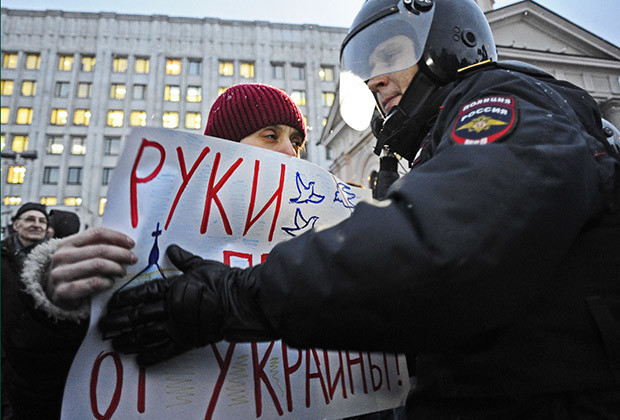
The BBC reports that up to 50,000 people attended a pro-Democracy “Hands Off Ukraine” rally in central Moscow. And apparently caught off guard, Putin’s regime did not thwart the march, and mustered only 15,000 of their own supporters in a counter-demonstration:
Earlier in Moscow, tens of thousands rallied against Russia’s actions in Ukraine, the biggest such protest in two years. As many as 50,000 attended the rally, with protesters shouting: “Hands off Ukraine.”
One man told the BBC he felt Russia was turning back to the days of Soviet dictator Joseph Stalin.
Nearby, some 15,000 supporters of President Vladimir Putin came out to support the Crimean referendum. Many of them wore identical red outfits and carried Russian and Soviet flags.
But displays such as this are likely to become far fewer as the number of truly – or even partially – independent news outlets willing to provide a non-Kremlin perspective on the world dwindles to nothing.
Regrettably, the paranoid propagandists at the Kremlin are now also being encouraged to a degree by some in the west. The usually-admirable Ron Paul, for example, clearly shows the limitations of applying libertarian philosophy to its ultimate limits, and of citing moral equivalency between Russian meddling in Ukraine and unauthorised Western invasions to argue that the West has no legitimate basis to condemn Russia’s actions. Because the United States and Britain did wrong in the past, goes this argument, Russia must be allowed to do wrong now:
Paul said Crimeans should be allowed to break away from Kiev.
“I think everyone should have right to express themselves,” he said. “It is messy, that is for sure, because two big governments are very much involved in trying to tell the Ukranians what to do.”
However he said Russia had a more justifiable basis for being involved in Crimea than the US, and no government should prevent locals on the peninsula from determining their future.
This deference toward Russia maintaining a geopolitical sphere of influence whereby it is allowed to meddle and assert special interests in the politics of its neighbours would be slightly more defensible coming from Ron Paul if he did not castigate the United States for doing the same thing when it comes to influencing America’s Latin American neighbours:
PAUL: Well, I think free trade is the answer. Free trade is an answer to a lot of conflicts around the world, so I’m always promoting free trade. And you might add Cuba, too. I think we would be a lot better off trading with Cuba.
But as far as us having an obligation, a military or a financial obligation to go down and dictate to them what government they should have, I don’t like that idea. I would try to set a standard here where countries would want to emulate us. Unfortunately, sometimes we slip up on our standards and we go around the world and we try to force ourselves on others.
If free trade and an absence of foreign meddling is truly the stance favoured by Ron Paul he should be vigorously denouncing the aggressive actions taken by Russia, not seeking to justify them by finding tenuous comparisons in recent US and western foreign policy. Ukraine had a clear choice – closer engagement with the European Union or re-embracing Russia. Until Vladimir Putin began interfering in Ukraine’s internal politics and encouraging President Yanukovych to abandon the EU deal in exchange for sweeteners from Russia, Ukraine leant towards Europe. The EU may have its imperfections, but it represents a much more liberal option than anything Putin’s Russia represents, and if anyone has subverted the will of the Ukrainian people and deserves Ron Paul’s disapproval today it is Vladimir Putin.
And while Ron Paul has led from the front in the important public debate about the nature and extent of the US surveillance state, and any curtailments on free speech in America, there is no acknowledgement from him of the grave and far more routine impositions on free speech that take place in Russia. That’s not to say that every criticism of America needs to be counterbalanced with a corresponding flaw in the rest of the world, but it is certainly the case that jumping into the debate on Ukraine without acknowledging this elephant in the room significantly detracts from his argument.
When it comes to counterarguments and balance in media coverage, Russia makes America and Britain’s own tribulations look like nothing by comparison. And while it is unfortunate that some people – particular those from the left/libertarian part of the spectrum – have felt the need to use the Ukrainian crisis as an “I told you so” moment or to burnish their own non-interventionist credentials, this is nothing more than posturing for a domestic audience. It does nothing to help the people of Ukraine or Russia.
While it is Ukraine that is currently being deprived of its territory in Crimea, the usurping Russians are also being robbed. Their loss, taking place with far less comment, is that of their independent press and free speech. And without a free domestic press to even go through the motions of scrutinising Vladimir Putin’s leadership, today’s Russia – in full paranoid, expansionist, Soviet-nostalgic mode – is not going to stop at Ukraine.

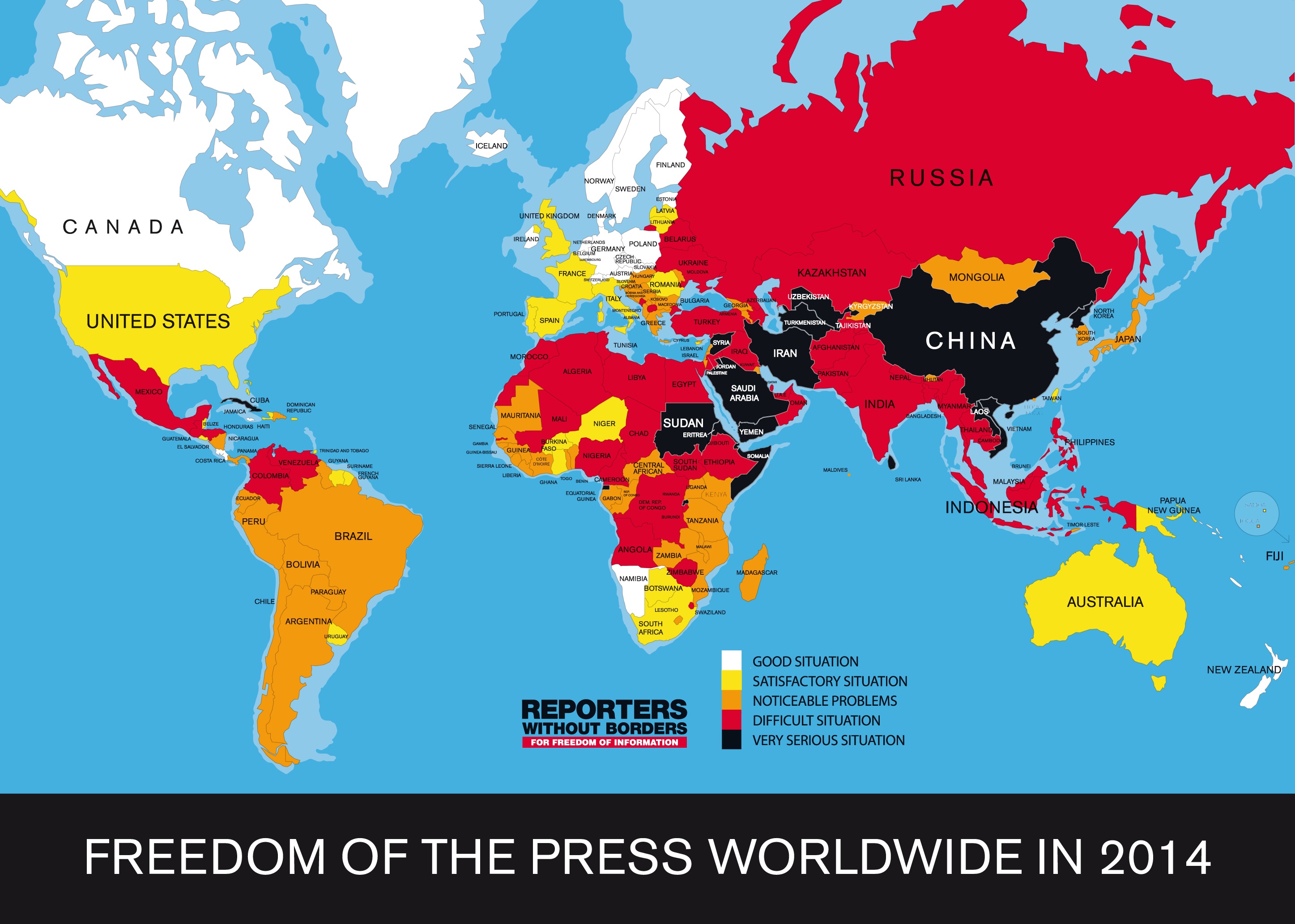
The United Kingdom has fallen from 29th to 33rd in the world in the World Press Freedoms Index 2014.
The report, compiled annually by Reporters Without Borders (RSF) is scrupulous in methodology and incorporates both qualitative and quantitative data. And for a country like Britain, which likes nothing more than to strut around the world proclaiming its comparative virtues, it makes for some dismal reading.
RSF’s summary of Britain is dominated by the British government’s chilling and bullying treatment of the Guardian newspaper as it sought to suppress the publication of information based on the NSA leaks by Edward Snowden, as well as the fallout from the Leveson Enquiry into the press behaviour and the prospect for further stultifying regulation of the industry:
In the United Kingdom, the government sent officials to The Guardian’s basement to supervise destruction of the newspaper’s computer hard disks containing information from whistleblower Edward Snowden about the practices of GCHQ, Britain’s signals intelligence agency. Shortly thereafter, the partner of Glenn Greenwald, the former Guardian star reporter who had worked closely with Snowden, was held at Heathrow Airport for nine hours under the Terrorism Act. By identifying journalism with terrorism with such disturbing ease, the UK authorities are following one of the most widespread practices of authoritarian regimes. Against this backdrop, civil society could only be alarmed by a Royal Charter for regulating the press. Adopted in response to the outcry about the News of the World tabloid’s scandalous phone hacking, its impact on freedom of information in the UK will be assessed in the next index.
Britain isn’t always called out by name, but there can be little doubt which European country was the intended target of this particularly barbed comment:
These developments showed that, while freedom of information has an excellent legal framework and is exercised in a relatively satisfactory manner overall in the European Union, it is put to a severe test in some member countries including those that most pride themselves on respecting civil liberties.
How true this is. Britain has long been (and has long considered itself) a stalwart defender of free speech, but the recent thuggish attempt to use anti-terrorism laws to detain a relative of a journalist and to threaten a national newspaper with closure unless it destroyed information which had the potential to embarrass the government are more worthy of Vladimir Putin’s Russia than the land of Magna Carta.
The New York Times, on the other hand, looks at the same report and seems to take succour from it, which is very surprising given the fact that their journalists have worked so closely with their beleaguered colleagues at The Guardian.
Their editorial board is celebrating the 50th anniversary of the landmark New York Times vs. Sullivan case, which set the bar for winning libel or defamation claims much higher than in Europe and thus created a bulwark protecting press freedom in the United States. This excerpt from the majority opinion in that case should be mandatory reading for all British politicians and those involved in public life, who are often all too keen to clamp down on free speech at the first sign of discord:
The Supreme Court voted unanimously to overturn that verdict. The country’s founders believed, Justice William Brennan Jr. wrote, quoting an earlier decision, “that public discussion is a political duty, and that this should be a fundamental principle of the American government.” Such discussion, he added, must be “uninhibited, robust, and wide-open,” and “may well include vehement, caustic, and sometimes unpleasantly sharp attacks on government and public officials.”
While the New York Times is absolutely right to recall and celebrate this landmark victory – libel laws in many other countries, especially Britain, are far too plaintiff-friendly – they seem all too willing to ignore the negative actions that have chipped away at this victory in the intervening half century, the various acts of craven self-censorship or collusion with imperial government overreach or the undermining of factfinding by the ongoing war on whistleblowers.
This selective amnesia leads to the following self-congratulatory pronouncement by the Times editorial board:
Still, American press freedoms rank among the broadest in the world. Citizens and media organizations in countries from China to India to Britain do not enjoy the same protections. In many parts of the world, journalists are censored, harassed, imprisoned and worse, simply for doing their jobs and challenging or criticizing government officials. In this area of the law, at least, the United States remains a laudable example.
The only problem with this statement? The United States ranks thirteen places behind the United Kingdom, at 46th in the world.
Fortunately for the New York Times and the reputation of the American press, the RSF world press freedom index does not take quality of journalism into account, only the ability of the journalist to practice their trade freely – otherwise they could have found themselves docked another few positions for that howler of an America-must-be-best presumption.
The truth is that neither Britain or America have anything to be proud of faced with this latest report. In an ideal world, David Cameron and Barack Obama would be held to account and hauled over the coals for presiding over such a poor performance. A backbench MP looking to bolster his or her civil liberties credentials could do worse than to ask the prime minister to defend or account for his government’s performance on press freedom at Prime Minister’s Questions this coming Wednesday.
But regrettably, a place in the mid-low 30s ranking is exactly where David Cameron, Barack Obama and many of those in power in Britain and America want their respective countries to sit. It allows for a press that is boisterous and noisy in all of the areas that don’t really matter (and so showing every outward appearance of being free), but that meekly tows the line when it comes to critical issues such as national security, civil liberties and holding those in power to account for their actions.
We in Britain or America may not think of countries such as Finland, Norway, Luxembourg or Liechtenstein as shining role models to emulate, if indeed we ever think about them at all. But in some key aspects, it is they who now carry the torch for freedom of speech and the free press, not the traditional Anglo-American partnership who held it aloft so dutifully for so long.

 Semi-Partisan Politics