The Official Leave Campaign’s Dismal Half Term Report Card

Report Card - Brexit Campaign - EU Referendum - Vote Leave

While many Brexiteers may be in line for a gold star for trying hard, the official Vote Leave campaign and its major spokespeople are coasting for a big fat F when it comes to execution

With little more than a month to go until voting in the EU referendum, it is worthwhile for Leavers and Brexiteers to pause, take stock of where we are and conduct a candid review of our strengths and weaknesses – what is working, and what is actively setting back the cause of independence from the European Union.

This blog post is not such a detailed report – though some other intrepid Brexiteer may well wish to create one, as a matter of historical record if nothing else. For in truth one does not need to dive deep into the poll numbers or aggregated political analysis to see that the Leave campaign is not only on course to lose the EU referendum, but is actively doubling down on those behaviours and activities which make defeat more likely.

For evidence, one has only to regard this crowing article in the New Statesman, in which Glenis Willmott gloats about the overly-emotional, rank amateurism of the country’s most prominent voices for Brexit.

One can almost hear the glee in her heart as Willmott writes:

They needed a new argument, a positive, forward-looking vision for what they see as the future of Britain… but they realised they didn’t have one so reverted to WWII and Hitler. Having lost all arguments on the economy, Vote Leave’s Boris Johnson raised the spectre of Hitler, talking about superstates and “historical parallels” between the EU and Nazi Germany. And they’re accusing the Remain campaign of being fearmongers?

They’ve complained about the terms of the debate. They’ve accused broadcasters of conspiring with the government. They’ve said journalists would be punished, and called for civil servants to be sacked. They’ve said they’ll disrupt pro-EU meetings and target pro-EU businesses. At every stage they’ve attacked individuals or organisations and not their arguments. And now they’ve invoked Godwin’s Law by comparing their opponents to Hitler.

Their tactics are the textbook definition of the increasingly desperate behaviour of the losing side in a debate.

Willmott concludes:

It’s what happens when you’ve given up on convincing the undecideds and care only about firing up die-hard Eurosceptics, praying for a low-turnout poll, which Vote Leave privately admits is their strategy. Having lost the argument on the economy, they’re now following step-by-step the UKIP guide to politics: attack foreigners, bash immigrants and peddle conspiracy theories of continental plots to take over Britain, likening Brussels of today to Berlin of yesteryear. It would be laughable if it wasn’t so serious.

And who can disagree with her? People expect some kind of positive message if they are to vote for a campaign – it can’t all be doom and gloom. And while the Remain campaign are certainly no strangers to scaremongering, they do at least take time to waffle on about their vague, fictionally pleasant European Union, a naive vision of a loose association of countries coming together on a super voluntary basis to fight crime, trade with one another and enshrine rights for working people.

Never mind that this idealised vision of the European Union is complete nonsense (and it is). People believe it because Vote Leave are too busy shouting about building a new hospital on every street corner with the money we supposedly save from leaving the EU that they almost totally neglect to pick apart Stronger In’s incredibly superficial and deceptive sales pitch.

It does, therefore, strongly appear as though Vote Leave have given up on winning the new support of anybody without a long-held antipathy toward the EU, choosing to focus instead on firing up the base and praying for a low turnout. Sadly, this almost never works. Brexiteers fired up on lashings of anti-immigration, “they need us more than we need them” rhetoric can still only vote once, just like everyone else. A fervent minority is still a referendum-losing minority.

Worse still, when they aren’t ranting about building hospitals on top of hospitals on top of hospitals in their utopian post-Brexit Britain, Vote Leave and other eurosceptic big beasts love nothing more than to prance around playing the role of the aggrieved victim. Despite having known for a long time that the prime minister is an unrepentant europhile and that the Cameron/Osborne “renegotiation” was nothing more than a deceptive piece of theatre, the brightest stars in the eurosceptic firmament somehow neglected to come up with a countervailing strategy besides running weeping to the media, sobbing about how unfair it all is.

Mary Ellen Synon puts it very well over at her excellent new Brexit blog:

This kind of complaint is worse than useless, it is embarrassing.

Anyone over the age of six who squeals, ‘He’s not playing fair!’ is absurd.

Of course Cameron is not playing fair. Of course he has been involved in secret dealings with big business. He is a politician who intends to win, and he has form for exactly this kind of behaviour.

I therefore have no time for Tories such as the MP Jacob Rees-Mogg who is reported today to be ‘furious’ over Cameron’s secret FTSE dealings.

Rees-Mogg told the Bruges Group in London that Cameron’s secret Remain dealings with the big corporations while he still worked to make people believe he might support Britain leaving the EU was ‘a scandal of the highest order.’ He said it appeared Parliament had been misled by Cameron.

Yet Rees-Mogg is a member of a party that was happy to go on backing Cameron even after he betrayed his ‘cast-iron guarantee’ to give the British people a referendum on the Lisbon Treaty.

That betrayal was in 2009. Cameron was a weasel then; he is a weasel now. It is no good for Leave campaigners such as Rees-Mogg to act as if they have only just realised it.

Quite. While it is not unreasonable to remark on the levels of deceit and lack of principle emanating from the Conservative Party leadership – pity the day when we come to accept it as unremarkable, or even virtuous – there is no point building a national referendum campaign around the fact. Besides the fact that momentum matters in elections and moping around weeping that you got a raw deal is like a big neon sign declaring that the momentum is with the other side, we are back to the fact that the Leave campaign does not have a compelling vision of an alternative Britain outside the EU.

And Vote Leave failed to come up with an alternative vision for Britain because that would mean having some kind of plan for Brexit. And they long ago decided that their unrepentant lack of a Brexit plan was somehow going to be their greatest selling point.

As Synon concludes:

The Leave campaign needs to stop whining that the campaign is ‘unfair,’ because of course it is.

However, Cameron is winning this referendum not because he is slippery, he is winning it because the official Leave campaign has described no clear, safe path out of the EU for the voters.

In other words, Cameron is not winning this campaign. The Leave campaign is losing it by being unthinking, uninformed, and unorganised.

This much is true: Cameron is not winning, but rather the Leave campaign is losing. And while the pro-EU side may have the advantage, at least this is not based on the great skill of the Remain campaign. David Cameron and his motley crew are coasting by using the advantage of their bully pulpit and the public’s natural hesitancy to depart from the status quo as their chief weapons. Even most Remainers would likely concede, under pressure, that Cameron achieved no meaningful concessions in his renegotiation, and that they cannot say with certainty what the EU will look like in five, ten or twenty years’ time, for example.

Right now this is enough, because Vote Leave have decided to fritter away their time and resources making ridiculous promises, playing the victim and invoking Godwin’s Law. Thus the Remain campaign is winning by default. But their numbers are potentially soft – people are sticking with Remain only because Boris Johnson doesn’t look like the type of man who can tie his shoes unaided, and because the avalanche of establishment opinion (organisations with no mandate to care about democracy but with strong interests in maintaining short term economic stability) coming down on the side of staying in the EU.

Realistically, there is no chance now that Vote Leave will significantly change their tactics, or suddenly embrace Flexcit and the EFTA/EEA model as a stepping stone out of political union. That ship has sailed. The only hope is that the Remain campaign’s principle strength – the overwhelming support of the establishment – may yet become its biggest weakness. And this could well happen.

Right now, Stronger In can point to a cast of thousands of the great and the good who have all lined up to tell the British people that the EU is wonderful, that Cameron negotiated a brilliant new deal and that exiting political union would lead to economic (and even military) armageddon. But what if this stops acting in their favour? These are febrile, uncertain times where little is certain except for the fact that those in positions of authority are distrusted and despised as almost never before. So what if the British political establishment, Barack ObamaChristine Lagarde, David Cameron and his CEO buddies all singing from the same hymn sheet begins to seem more like a stitch-up than wise counsel? What if their unanimity becomes more like a criticality accident of sanctimonious, self-interested elites clubbing together for their own gain rather than the sober, high-minded intervention they like to imagine?

Returning to the half term report card analogy, right now it is fair to say that the official Leave campaign has failed every single piece of coursework they have been set so far. This is not good. But fortunately, fifty percent of the total class grade is based on the end of term exam, and here we have an opportunity to make up some distance. We are never going to get an A and win by a landslide, but a concerted effort in the right direction and a hefty dose of luck* could yet bring us to 50% +1, which is all we need.

So do not despair, fellow Brexiteers. A pathway to victory still exists, albeit one which is heavily dependent on luck, or “events, my dear boy, events“. Fighting the EU referendum with Vote Leave in the driving seat is like being partnered with the class idiot for an important assignment – we are going to have to do all the leg work while they thrash around attention-seeking and disrupting everyone else. It will be difficult, but it can be done. Just buckle down, hope that the shining ones at Vote Leave towers manage to keep a lid on their worst excesses, and then pray for some kind of game-changing event to shake up the board.

This thing isn’t over until it’s over.


*mostly involving Vote Leave sitting out a few rounds and letting the adults take a turn.

 

European Union - United Kingdom - Britain - Flags

Agree with this article? Violently disagree? Scroll down to leave a comment.

Follow Semi-Partisan Politics on TwitterFacebook and Medium.

The Only Thing Paul Mason Hates More Than The EU Is Democratically Chosen Conservative Government

Paul Mason - 2

Paul Mason, enemy of democracy

“Postcapitalism” author and former Channel 4 economics editor Paul Mason is a truly nasty piece of work. For proof, one need only look at his latest sickening column in the Guardian, in which he diligently catalogues all of the European Union’s faults and inherent anti-democratic tendencies before going on to say that he can’t possibly support Brexit when the Tories are in charge, because doing so might mean that some awful right-wing people get to implement policies democratically chosen by the British electorate.

Mason begins well enough, albeit with a predictably left-wing slant:

The leftwing case for Brexit is strategic and clear. The EU is not – and cannot become – a democracy. Instead, it provides the most hospitable ecosystem in the developed world for rentier monopoly corporations, tax-dodging elites and organised crime. It has an executive so powerful it could crush the leftwing government of Greece; a legislature so weak that it cannot effectively determine laws or control its own civil service. A judiciary that, in the Laval and Viking judgments, subordinated workers’ right to strike to an employer’s right do business freely.

Its central bank is committed, by treaty, to favour deflation and stagnation over growth. State aid to stricken industries is prohibited. The austerity we deride in Britain as a political choice is, in fact, written into the EU treaty as a non-negotiable obligation. So are the economic principles of the Thatcher era. A Corbyn-led Labour government would have to implement its manifesto in defiance of EU law.

And the situation is getting worse. Europe’s leaders still do not know whether they will let Greece go bankrupt in June; they still have no workable plan to distribute the refugees Germany accepted last summer, and having signed a morally bankrupt deal with Turkey to return the refugees, there is now the prospect of that deal’s collapse. That means, if the reported demand by an unnamed Belgian minister to “push back or sink” migrant boats in the Aegean is activated, the hands of every citizen of the EU will be metaphorically on the tiller of the ship that does it. You may argue that Britain treats migrants just as badly. The difference is that in Britain I can replace the government, whereas in the EU, I cannot.

This is fair and accurate criticism of the EU. Mason rightly senses the unaccountable nature of the supranational government in Brussels, and hones in on the key point – that the EU is antidemocratic because we have absolutely no way of removing its leaders if we wish to do so.

Unfortunately, it then quickly begins to go off the rails, as Mason’s snarling anti-democratic authoritarian streak surges to the foreground:

Now here’s the practical reason to ignore it. In two words: Boris Johnson. The conservative right could have conducted the leave campaign on the issues of democracy, rule of law and UK sovereignty, leaving the economics to the outcome of a subsequent election. Instead, Johnson and the Tory right are seeking a mandate via the referendum for a return to full-blown Thatcherism: less employment regulation, lower wages, fewer constraints on business. If Britain votes Brexit, then Johnson and Gove stand ready to seize control of the Tory party and turn Britain into a neoliberal fantasy island.

They will have two years in which to shape the post-Brexit economy. Worse, the Tories will be free to use the sudden disappearance of our rights as EU citizens to reshape the UK’s de facto constitution. The man who destroyed state control of education and the man who shovelled acres of free land into the hands of London developers will get to determine the new balance of power between the citizen and the state. So even for those who support the leftwing case for Brexit, it is sensible to argue: not now. The time to confront Europe over a leftwing agenda is when you have a Labour government, and the EU is resisting it.

Waah, waah, waah. In other words, Paul Mason fully appreciates that the European Union is hopelessly undemocratic and utterly unreformable, but he refuses to either campaign or vote for Brexit because reclaiming democracy for Britain might mean that we then go on to do the “wrong” thing with our new-found freedom.

Britain’s parliamentary system of government is not a shocking new reality. Our present system of mini “elected dictatorships” spanning the length of a parliamentary term is how Britain has always been governed in living memory. And unfortunately for Paul Mason, our electoral system produced a Conservative majority government one year ago. You can argue that most people did not vote for the Conservative Party. True. But if we don’t like the system by which our governments are chosen, it is within our power to change it. Indeed we had just such an opportunity back in 2011, and decided to stick with the status quo.

So when Paul Mason frets that a Brexit under the Tories might lead to two years of “neoliberal fantasy” government, what he actually means is that Britain might be led by the government which we only recently elected together. He is fretting that an anti-democratic impediment to Conservative rule in the form of Brussels might be removed, and that the government might then seek to fulfil its manifesto outside the constraint of the EU’s political union. He is effectively presenting democracy as the scary thing to be avoided, and the European Union as the “least worst option”, one step better than democratically chosen conservative government.

Mason then goes on to make it worse:

All this suggests that those of us who want Brexit in order to reimpose democracy, promote social justice and subordinate companies to the rule of law should bide our time.

And there’s the problem, right there. Paul Mason doesn’t support an eventual Brexit because he believes in democracy or the importance of British sovereignty. He wants Brexit only as a means to imposing his own radical left-wing policies and “social justice” values on the country. When the people look likely to support these concepts at the ballot box, he chafes at the democratic impediments thrown up by the European Union barring their implementation. But when the people spurn his left wing fantasyland and choose a conservative government, suddenly Brussels becomes his best friend, his bulwark against the people he views as “closet Nazis”.

Behold the face of the Mason/Corbynite Left. This is a movement which, to their credit, has no natural love for the European Union, often seeing it for what it is, but who have shamefully taught themselves to accept Britain’s EU membership as the price which must be paid in order to successfully “lock out” conservative viewpoints and policies.

This is a movement chock full of people who love nothing more than to prance around screeching about how wonderfully tolerant and accepting they are, right up until the moment they encounter somebody with a different political philosophy, at which point any previous lip service paid to the importance of democracy or even free speech goes straight out the window.

It’s hard to say  which is worse – the fact that Paul Mason harbours these seething anti-democratic sentiments in the first place, or the fact that he is so shameless that he openly admits his desire to thwart the general election result by forming a temporary alliance with the hated European Union, swinging around to support Brexit only when the prospect of giving democracy back to Britain seems likely to deliver the kind of government he wants.

One thing is for certain, though – Paul Mason is no man of the people, and no friend at all of democracy.


European Union - United Kingdom - Britain - Flags

Top Image: Guardian

Support Semi-Partisan Politics with a one-time or recurring donation:

Agree with this article? Violently disagree? Scroll down to leave a comment.

Follow Semi-Partisan Politics on TwitterFacebook and Medium.

Brexit For Grown Ups

Eurosceptic but tempted to vote Remain because of the Boris Johnson / Faragist circus that is the official Leave campaign? There is a better Brexit campaign out there, and they have a comprehensive plan for safely leaving the European Union which does not rely on trumped up statistics or school playground insults

Are you a eurosceptic or undecided voter who is instinctively sceptical of the European Union, but put off by the bombast and rank amateurism of the official Leave campaign?

Perhaps you sense that there must be a better campaign out there somewhere, that the well worn record of Nigel Farage and the ranting of Boris Johnson – a man who had not even decided which side he was on until a couple of months ago – cannot possibly make then the best ambassadors for Brexit.

Perhaps you appreciate that most of us already know and understand the reasons why the EU is bad, and that what matters now is convincing a majority of our fellow citizens that there is a safe and non-disruptive way to leave the political construct of the EU while maintaining, even enhancing, our status as a global trading nation.

If this describes you, then you may get value out of this excellent TED-style talk by Dr. Richard North of the eureferendum.com blog. The video comes from a recent meeting of The Leave Alliance at the Royal Overseas League in London, and is a great visual exposition of the comprehensive plan for leaving the European Union known as Flexcit or the Market Solution.

Read The Market Solution pamphlet here.

Read Flexcit (the full-length plan) here.

It is vital for people to understand that the coming EU referendum is not like a general election, or even a by-election. We are not voting to elect the Vote Leave Party – thank heavens. That means that although Vote Leave often say some fantastical and frustrating things, and continue to spout statistics which don’t withstand the slightest scrutiny and end up helping the other side, fortunately it doesn’t matter because Vote Leave will not be in charge of the secession negotiations with the EU.

The idiots in Vote Leave do not speak for the whole Brexit movement, and their half baked plans for leaving (such as they exist) do not represent the political realities. In reality – when you take into account the inherent caution of the civil service and the composition of the Westminster parliament which would have to deal with a Brexit vote (more than 50% Remainers) – Britain would inevitably take the path of least resistance and exit to an off-the-shelf EFTA/EEA model (or a shadow version of the same) as a stepping stone, maintaining single market access but giving Britain the right of reservation, an emergency brake on immigration (like the one David Cameron failed to win) and a full seat on all world bodies once again.

This is why Remainers are desperate to falsely discount the EFTA/EEA model as something that Brexiteers either do not want or which would mysteriously be denied us – for it annihilates at a stroke every last one of their doom-laden warnings about economic apocalypse in the event of Brexit, while freeing us from the explicitly political union which they seem to love but dare not publicly say so. Adopting Flexcit (the Market Solution) leaves the Remain campaign with literally nothing besides their fear of change and love of having a supranational government increasingly do the hard work of governing.

For in truth, there is no cooperation between European countries which cannot flourish just as well – and often much better – outside the EU’s explicitly political, integrationist structure. Be it defence, international aid or the environment, inter-governmental cooperation can be far more effective than running everything through a set of institutions in Brussels which were designed not to foster effective governance, but to gradually sideline and undermine the various member states, creating immense resistance and resentment along the way.

If one reads the history of the EU, one quickly realises that the founding fathers never troubled to hide their intent, or the fact that two world wars made them see the nation state as the root of all evil, and the EU’s supranational government as the “cure”. This is not a conspiracy theory – you can read it in their own words. To think that Britain can stay in the club and not be swept along to the final destination is denialist fantasy.

As for staying “globally relevant”, this blog and my fellow writers in arms ceaselessly point out that most EU trade rules are actually set by global bodies like UNECE, Codex Alimentarius, the IMO and other organisations. The EU often does not come up with these rules and regulations, but merely passes them along to the member states, sometimes with unwelcome EU gold plating and tweaks which actually act as an impediment to global trade. The EU is certainly no longer the “top table,” as Remainers love to claim.

That is the future of trade and globalisation – global regulation. Being in the EU means that Britain surrenders our seat or vote on these bodies, must fight to be just one of 28 countries contributing to a common EU position, and has no right of reservation to say no to those regulations which could harm key industries or our national interest. Perversely, sometimes the EU, claiming competency and controlling the British vote, wields that vote against us in these global bodies. Brexit means we can rejoin the global regulatory environment as a full and active player, while remaining in the EU is quite literally giving up and conceding that Britain no longer has the ability or the will to govern ourselves.

But worst of all, voting to Remain because of understandable disillusionment with the mainstream Vote Leave campaign will doom us – quite unnecessarily – to a dismal future lived cowering behind the EU’s skirts while the opportunity to build a genuinely global trading and regulatory framework passes us by.

And for what? Nothing more than the pointless pursuit of a dusty, mid 20th century blueprint for a united Europe, dreamed up by old men scarred by the memory of two world wars and already out of date, long before it is fully realised.

Europe has moved on since VE day. And euroscepticism has moved on since the 1990s. Wanting Britain to leave the EU does not mean throwing your lot in with Nigel Farage, UKIP, Boris Johnson or anyone else, if you do not wish to do so. There is another way. There is a better Brexit campaign out there.

Take 30 minutes of your time to be an engaged citizen, and watch the video.

Then come join us.


The Leave Alliance - Flexcit

Support Semi-Partisan Politics with a one-time or recurring donation:

Agree with this article? Violently disagree? Scroll down to leave a comment.

Follow Semi-Partisan Politics on TwitterFacebook and Medium.

Universities UK And Scientists For EU, Selling Out Democracy And Academic Freedom In The Grubby Pursuit Of Cash

Universities for Europe

Pro-EU academic umbrella organisations like Scientists for EU and Universities for Europe are actively peddling myths and propaganda rather than dealing in ideas, in a heinous betrayal of their supposed professional ethics

The LSE’s BrexitVote blog is carrying a great rebuttal to the endless, whining, selfish demands from Scientists for EU and others that the British people should reject Brexit because leaving the EU might hinder some money from flowing unimpeded into the pockets of various grubby special interests.

Christopher Bickerton and Lee Jones, both university lecturers, write:

When scientists wail that their ‘lab would fall apart’ outside the EU, they reflect the lamentable, Not-In-My-Back-Yard attitude of many academics to the forthcoming referendum. Any critical argument about the EU, and indeed any political argument whatsoever, seems to fall by the wayside, deemed irrelevant by those thinking only of their present research activities. The referendum is not about anyone’s lab; it is about democracy. The consequences of EU membership or exit are so vast and wide-ranging that this is the most significant political decision that will occur in our lifetimes. It is too important to reduce to pounds and pence. We all have our own interests, but sometimes we should aim to look a bit further than that.

If you don’t like the immigration regime as it applies to students and academic staff, then campaign to change it. If you think that UK science is under-funded, making us overly reliant on EU money, then demand that government funds universities properly. If this idea that popular demands should translate into government policy seems unrealistic, it simply signifies how degraded our democracy has become after decades of EU membership.

If you want to stay in the EU, then campaign for it – honestly. Don’t hide behind dodgy statistics and present what is really a cultural and political preference as a matter of economic and scientific necessity.

Read the whole thing.

How refreshing – and how long overdue – it is to see this fightback occurring within academia. Too often, the people in our country who are supposed to be the most adept at thinking, the best equipped to understand abstract concepts and possessed of the best knowledge of history have in practice spurned all of these gifts and sung uncritical hymns of praise to the European Union, and looked at the most fundamental question to face our country in decades as a parsimonious question about how much money will flow into their coffers in the event of a Leave or Remain vote.

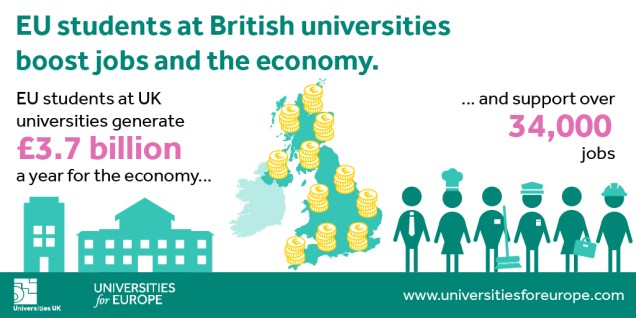
The dismal lack of vision or serious thought behind Scientists for EU and Universities for Europe is laid bare in the campaign poster shown at the top of this article, which trumpets the benefits to the British economy of European students studying here. Great. But are they seriously suggesting that these students would no longer come to Britain if we were to leave the political construct of the EU? Would all European students currently here be summarily deported, dragged from their halls of residence in the middle of the night by Home Office SWAT teams? Of course not. But those who claim to speak for scientists and universities are not above falsely implying that European students would automatically disappear from our shores in the event of Brexit.

We can rule out the idea that Universities for Europe are misinformed, and labouring under the misapprehension that something so apocalyptic might really occur – these are supposedly bright people, after all. So that leaves us with the rather distasteful truth – that they are actively lying and seeking to scare and deceive the British people, in order to defend what they see as a lucrative revenue stream of EU funding. In other words, not only have British universities abandoned the pursuit of truth, they are now enthusiastically peddling misinformation and propaganda. I hope they can sleep at night.

Of course, it is not only the academic establishment at fault for slavishly joining in the EU praise chorus – the same can be said of the entire Remain campaign from David Cameron and the government on downward. Neither feel comfortable talking about the big issues of democracy, accountability and national self-determination, which is why they constantly bring the focus back to tedious and unprovable economic arguments about pounds saved or GDP growth at risk.

Neither academia nor government can talk about Britain’s gradual absorption into a European political union in warm and enthusiastic terms, because to do so would be too immediately repellent to voters. And so unable to make the real positive case for the EU and for European federal union, instead we see this endless parade of risibly apocalyptic warnings about Brexit.

Which is a shame, because it would actually be quite nice to know whether our political and intellectual leaders believe that the top-down supra-national government of Europe is a good objective, or whether they are merely going along with it because of perceived short term social and financial advantage.

And if nothing else comes from this abysmally fought EU referendum, it would be nice to know whether our pro-European betters in Westminster and the academy are more stupid or greedy. Right now it seems quite finely balanced.


European Union - United Kingdom - Britain - Flags

Agree with this article? Violently disagree? Scroll down to leave a comment.

Follow Semi-Partisan Politics on TwitterFacebook and Medium.

Stronger Together? The Mighty European Union Is Dancing To The Tune Of A Petty, Minor League Tyrant

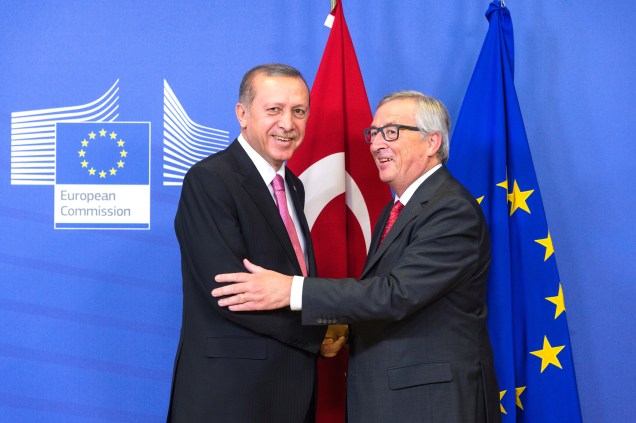
Greeting between Recep Tayyip Erdoğan, on the left, and Jean-Claude Juncker

The unedifying sight of European leaders falling over themselves to flatter and persuade the two-bit despot of Turkey to help solve a problem largely of their own making is damning proof that EU member states are definitively NOT stronger together

The most common refrain heard from Remainers and assorted EU apologists is that by pooling (read: surrendering) sovereignty with 27 other nations, we are “stronger together” and mysteriously greater than the sum of our collective parts – that something magical happens when Ireland, Britain, Slovakia and Croatia act through a supranational government based in Brussels which (for reasons they never explain) could not be achieved through friendly inter-governmental cooperation between sovereign countries.

This tiresome and unsupported claim is fatuous beyond words, and usually uttered by people who don’t understand the first thing about either the history of the European Union or how it operates, but who nonetheless cheer on the idea of European political integration in order to virtue-signal the fact that they hold the “correct” progressive  opinions to their equally vapid friends and peers.

And if you want proof that being part of a remorselessly politically integrating club of 28 diverse countries actually makes us the very opposite of “stronger together”, one need only look at how the European Union is being hoodwinked and bullied by that beady-eyed, egotistical, embryonic dictator from Turkey, president Recep Tayyip Erdogan.

Douglas Murray writes in the Spectator:

Recep Tayyip Erdogan, the Turkish president, has persuaded the EU to grant visa-free travel to his 75 million countrymen inside Europe’s passport-free Schengen area. In so doing, he has made more progress than any of his predecessors. Using a combination of intimidation, threats and blackmail, he has succeeded in opening wide the doors of Europe.

Erdogan’s success matters, because it says much about the EU — and the idea that it exerts ‘soft power’. This was the theory in 1999 when the EU declared Turkey to be ‘a candidate State, destined to join the Union’ so long as it fulfilled the standard criteria for membership. Its state should have ‘achieved stability of institutions guaranteeing democracy, the rule of law, human rights, respect for and protection of minorities’.

And it was all going so swimmingly. Oh, wait:

As Erdogan has worked out, however much Turkey fails to live up to the EU’s expectations, the EU’s attitude to Turkey is ‘ever onwards’. Its 2013 ‘Visa Liberalisation Dialogue’ set out 72 conditions on security, migration, public order, fundamental rights and readmission of irregular migrants that Turkey needed to achieve. Despite failing them, in November last year the EU and Turkey agreed that visa-free travel should start this October. All the time Turkey demanded more and faster.

As well they could. Because last year — after the German Chancellor opened the borders of Europe to anyone who could get here — the tables turned. Persuaded that every problem in the Middle East, Far East, North and Sub-Saharan Africa was Europe’s fault and Europe’s responsibility, millions duly came. And will again. Today, even the European Commission and Frau Merkel realise that in order to avert political catastrophe in Europe, they must bring the number of entrants down. Suddenly, as Erdogan himself said, ‘The European Union needs Turkey more than Turkey needs the European Union.’

So this is the European Union’s much-vaunted “soft power”. This is how forcing 28 separate countries – incidentally, countries which often lavish money on social programmes but completely neglect their own security and defence – to act through a single supranational government actually works in practice. How other nations must tremble when Europe speaks.

The supposed soft power of Brussels is supposed to be European political union’s chief advantage and a key foundation of the Remain campaign’s case for staying in the EU, yet on the most important of issues it is virtually non-existent, a paper tiger. Turkey’s president openly mocks and belittles EU leaders to their faces, even as they roll out the red carpet and treat him “like a prince” (in the word’s of the European Commission’s own pandering  President Juncker).

But as Tom Slater correctly points out in Spiked, the real fault is not with Turkey and Erdogan, thin-skinned, authoritarian despot though he is. The problem is with Europe and its profound crisis of values:

As for the migrant deal, it was EU incompetence that ceded Erdogan all of his leverage in the first place. Having chosen to ignore the fact that it had long lost control of its southern borders – not least because of some of its members’ cack-handed crusades in the Middle East and North Africa – the EU’s response to the refugee crisis was chaotic and can-kicking. The EU elite’s attempt to enforce migrant quotas on member states was a typically anti-democratic move. But it couldn’t even pull that off. The EU is as inept as it is tyrannical, meaning cutting a deal with Turkey became the only option.

The ground-shaking power of Turkey is the fantasy of a continent that doesn’t know what it is anymore. The more Europe drifts from its founding values, the more EU elites struggle to execute anything other than a photo-op, the more Erdogan, the ‘tall man’ of Ankara, grows in stature. Bashing Turkey can only distract us from this profound crisis.

But how can this be? How did this “profound crisis” come about? Forcing 28 separate countries under the suffocating umbrella of one supranational government with one collective presence on the world stage was supposed to amplify our voice. Hell, the EU’s most starry-eyed lovers even dream of Brussels rivalling and eventually supplanting the United States as the most consequential actor in world affairs. And yet here we are, failing in our negotiations with a pathetic little tin-pot dictator, throwing away billions of taxpayer euros in the hope of the slightest concession from Turkey, while the eurocrats are bested and humiliated at every turn.

This is what happens when the EU tries to prance around on the world stage as though it were a legitimate country, despite not having the one thing most fundamental to any nation state – a cohesive demos, a people with a shared European identity, let alone common interests. This is what happens when the conflicting priorities, fears, red lines and neuroses of 28 separate countries are forcibly mashed together – the result is a laughable compromise backed with the weakest of wills, easily picked apart by a half-competent negotiator.

Erdogan isn’t stupid. He knows that having eliminated internal borders, the EU’s Schengen area countries are desperate to stop the immigration crisis at (or at least near) source, and that consequently he holds all of the cards. Erdogan knows that the EU is hopelessly divided, with German chancellor Angela Merkel having made the grandiose and criminally irresponsible gesture of welcoming anybody with the means to enter Europe – seeking to expunge Germany’s past national guilt in a single stroke, knowing that hundreds of thousands more would be encouraged to come while other countries would end up footing much of the bill.

A Europe that was not intent on forcing itself against common sense and natural law to become a single political entity might be able to deal with the Syrian (and broader) refugee and economic migration crisis in a rational, productive way. A Europe based on inter-governmental cooperation rather than supra-national control might be able to hammer out a deal to accept more genuine refugees, share them equitably, take only the brightest and best of the economic migrants, and offer real assistance and solidarity to countries like Greece and Italy which bear the brunt of the crisis. But this is not the Europe we have. Once again, the stubborn desire for European political union is actively killing people.

So let’s hear it again from the Remainers and desperate EU apologists. Let them continue to lecture us about how the European Union “amplifies our voice” and enables us to “punch above our weight“. Let them tell us how Europe’s representative on the world stage, former Young Communist Federica Mogherini, is universally feared and respected, the modern day hybrid of Charlemagne and Henry Kissinger.

Let them continue to peddle the preposterous myth that little old France, Germany and Britain – two of them nuclear powers, and the other the world’s fourth largest economy – are helpless on their own and only worthy of sitting across the table from the mighty President Erdogan to seek his favour because they cower behind the EU’s skirts.

Let them tell us again how being in the European Union gives us the diplomatic clout that countries like Australia, Canada, Japan, India and Russia so effortlessly wield every day, but which pathetic little Britain would struggle to replicate on our own.

Go on. Tell us. Read the latest account of hundreds of migrants drowning in the Mediterranean Sea and tell us again just how star-spangled awesome the European Union is, and how successfully it helps us grapple with the most pressing challenges in today’s world.

Seriously. I’m all ears.


European Union - United Kingdom - Britain - Flags

Agree with this article? Violently disagree? Scroll down to leave a comment.

Follow Semi-Partisan Politics on TwitterFacebook and Medium.