Build the third runway at Heathrow airport. And a fourth. Build new runways at London’s Gatwick and Stansted airports too. And then build a helipad directly on top of the homes and gardens of all the selfish, hand-wringing, growth-averse, NIMBY-ish naysayers who think that their decision to live by an airport gives them veto rights over Britain’s economic future.
Chicago’s O’Hare international airport has seven runways. Count them. Seven. Five of these runways run east-west and the other two run diagonally. So long as your aircraft possesses an engine and wheels, there is almost certainly a runway at O’Hare suitable for landing without the need to circle the city in a never-ending holding pattern before finally lining up for approach and touching down an hour after actually arriving.
You can fly in and out of Chicago quickly, efficiently and cheaply because generations of local political leaders – for all their many other faults – have understood that aviation provides a huge boost to the economy, and that a city which makes access and connection quick and convenient for all types of traveller will surely reap the economic rewards.
Nine hours away in London, this common-sense attitude is sorely lacking. Despite the fact that no new full-length runway has been constructed in London or the south-east of England since the 1940s – when we were still digging ourselves out of the rubble of the Blitz – Britain is wasting time, energy and precious economic opportunities debating whether or not to increase airport capacity at any one of several implausible choices in south-eastern England beside the obvious option of committing to London’s Heathrow Airport, the largest and most popular.
Some have suggested that there are plans afoot to launch a “Keep Cameron” movement in the event that the Prime Minister fails to win the Conservatives an outright majority for two elections on the bounce, and fails to cobble together a workable coalition to keep the Tories in power. But this is extreme wishful thinking – David Cameron can barely muster the passion and commitment to conservatism to convince the British people he truly wants a second term, let alone that he has any bold new plans up his sleeve. If he struggles to show that he wants to remain Prime Minister after 7 May, he certainly will not want to return to the thankless job of being Leader of the Opposition.
To be fair to Boris Johnson, he makes a decent pitch for the job, better than most. An a new interview with The Spectator, Johnson was asked why people should vote Conservative, and gave this mini stump speech in reply:
‘If they want Britain to be a strong independent nation, if they want Britain to lead in Europe, if they want an economy which is dynamic and competitive and is based on the spirit of enterprise, then they should vote Conservative. If they believe in a culture of aspiration and achievement rather than scrounging and trying to pull people down, if they believe in levelling up rather than levelling down, they should vote Conservative. If they believe that it is wrong in principle to try to settle the problems of the economy by decapitating the tall poppies in society, they should vote Conservative.’
[…] ‘If they believe that the job of government is to nurture all the flowers in the flower beds rather than attacking some, then they should vote Conservative. That is the essential difference between us and Labour. Every single policy of Ed Miliband and his lot is precisely calibrated to divide society, to foster a sense of injury and injustice. We want to heal any sense of injury and injustice, to bring society together.’
Most of this is good stuff, red meat for true conservatives.
Almost everyone in the commentariat class seems to care, and to have a strong opinion about what is perhaps the most unsurprising revelation in British politics. But precisely why the rest of us should care about this revelation is not so self-evident. There’s obviously something in it for Boris Johnson: the opportunity to compete for the Conservative Party leadership in the event of a 2015 general election or 2017 EU referendum defeat. But what does a potential future Boris Johnson premiership offer the country that merits such a fevered round of speculation and media coverage?
Read any of the articles breathlessly speculating about David Cameron’s annoyance at being outmanoeuvred by Boris whilst on holiday, where the Mayor of London will make his stand as he searches for a constituency, or the pieces imagining the circumstances in which Boris might beat George Osborne and Theresa May to the leadership in the event of Cameron’s early demise, and you will learn everything you possibly need to know about The Decision. Everything, that is, except for why a Boris Johnson administration would be interesting, or different, or especially harmful or beneficial to Britain. But you can’t entirely blame the press corps for the oversight – if they are unable to answer these questions it is because the great man himself is just as uncertain of the answer, and has taken every opportunity to avoid revealing his vision.
Those people hailing Boris Johnson’s announcement should explain to the rest of us exactly what it is about their man that makes it worth getting excited about. Is it his bold, original policies on this or that? Because precious little has been written about the stark policy differences that distinguish the London mayor from the likes of David Cameron or George Osborne. Is it his approach to the electorate and politics in general? Because the Boris trademark down-to-earth, sometimes frank demeanour is nothing that UKIP’s Nigel Farage does not already offer. Or is it because of his years of executive experience managing the capital city of the world? Because the competencies needed to be a competent mayoral figurehead are not necessarily the same skills of tenacity, diplomacy and coalition-building needed to succeed as prime minister.
In one of the few tangible political divides where Boris Johnson has forcibly expressed an opinion, he has been wrong, and unabashedly part of the problem rather than the solution. At a time when airport capacity in southeast England is under pressure and London’s competitiveness impacted, the British government has done what it does best – handwringing, buck-passing and stalling for time with lengthy enquiries – and London’s mayor has campaigned against the obvious solution of expanding Heathrow airport in favour of a hare-brained scheme to close the UK’s largest airport and replace it with an entirely new facility in the Thames estuary. This blog has repeatedly explained the foolishness behind the mayor’s alternative vision.
Boris Johnson is also on manoeuvres to distinguish himself from Conservative Party orthodoxy on the thorny subject of Britain’s EU membership, but even here his newfound embrace of euroscepticism is riddled with disclaimers and lacks sincerity. It is particularly telling that when polled, over half of UKIP voters said that if Boris Johnson were to stand for the Conservatives on their local constituency, it would make no difference to their voting intentions. While eurosceptics and believers in nation state democracy should be pleased when any prominent Conservative politician commits to campaigning for a British EU secession in the event that renegotiations fail, in Johnson’s case it does not automatically make up for his previous equivocation and instinctive desire for Britain to remain inside the European Union.
In David Cameron and his coalition government, Britain already has a thoroughly conservative-lite leader, happy to talk the talk about fiscal responsibility and small government while carelessly treading the same uncompetitive, centrist and statist path as his predecessors. If the British electorate is to be asked to vote Conservative again, do they not deserve an upgrade from the Tories’ 2010 offering? Differences of image and style aside, it is very difficult to discern how Boris Johnson represents anything new, let alone an improvement on David Cameron.
And in a surprise twist, one of the few senior politicians (aside from Boris Johnson’s direct competitors for the Tory leadership) to see through the bumbling, affable persona is the usually hapless deputy prime minister, Nick Clegg:
“The thing about Boris Johnson is despite all the clumsiness and bumbliness he’s actually a really, really ambitious politician,” Mr Clegg said.
“He treats his political ambition like he treats his hair. He wants everybody to think he doesn’t really care, but he actually really, really does care.
“His tousled hair, his bumbliness, all that’s great. But behind all of that is someone who is absolutely fixated with his own political ambitions.”
The only thing missing from Nick Clegg’s timely critique is this blog’s concern that there might actually not be anything beneath the populist image and the driving ambition. It would be bitterly ironic if Britain’s next Conservative prime minister turned out to be the polar opposite of his most recent Labour predecessor in every area except for one – that they both shared a burning desire to reach Number 10 Downing Street, but had absolutely no idea what to do with the prize once they had it.
So why should we care that David Cameron’s former classmate has made official his plans to return to Parliament? The onus is still on Boris Johnson to convince us that it matters in the slightest.
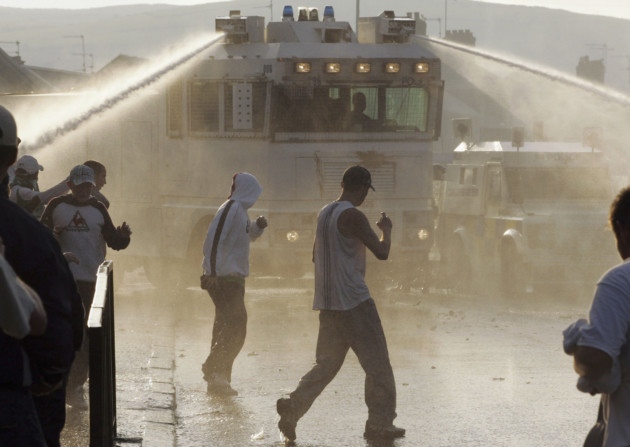
The sinister move by the Association of Chief Police Officers (or ACPO) to seek government approval for the purchase and use of water cannon as a means of crowd control on the British mainland was met with widespread alarm when the idea was first mooted in January.
Even more concerning now is the news that the Mayor of London, Boris Johnson, has unilaterally purchased three such devices from the German police in the presumptuous expectation that the Home Secretary will agree to ACPO’s request before Theresa May has had the opportunity to make her decision.
This blog noted at the time that the ACPO’s move was a transparent power play, that there were no serious concerns about impending violent protests in Britain and that even if there were a repeat of the 2011 riots, water cannon would be uniquely unhelpful to the police in containing the disorder:
So what is this really all about? One explanation could be that ACPO are politically agitating, and trying to send a message of their disapproval of coalition austerity policies to the public and their elected representatives, essentially saying “we told you that cutting government spending would lead to chaos and disorder and we were right; now we have to take the draconian step of procuring water cannon to prevent the country from sliding into anarchy”.
This is one plausible possibility – as we have seen only too recently with the Andrew Mitchell “plebgate” scandal, there are those in the police force with very hardened agendas who would stop at nothing to discredit or cast doubt on the performance of Conservative ministers.
But in truth, a more convincing explanation is that the police just really fancy having these new toys to scare and intimidate people, that they have decided that building good community relations with the public and doing the hard work of policing large scale events just isn’t worth the effort when they can just bully the public into cowed obedience much more easily.
And so it is. The coalition government’s ‘austerity’ policies have now been in effect for over three years, and have yet to provoke widespread public disorder of any significant kind, other than the usual antics of misbehaving students. Why then does ACPO believe that Britain is a smouldering tinder box about to erupt in an explosive delayed reaction to policies which are old news and have already taken effect?
The Guardian also condemns the Mayor of London’s actions in a stinging editorial, and calls on the Home Secretary to refuse ACPO’s request. This would have the double benefit of standing up for civil liberties and giving the mayor of London a slap in the face for presuming to anticipate her decision:
But this cannot be a matter for City Hall and Scotland Yard alone. The Met has a significance that extends beyond London. Westminster should have a say in what would be a profound decision affecting the rights of the UK citizen and the nature of British policing. The mayor will have his water cannon, but cannot use it without the approval of the home secretary. She should ensure it never leaves the depot.
The Guardian’s second point, that Boris Johnson’s move is of particular concern because the significance of the Metropolitan Police extends well beyond London, is also important. With some chief constables up and down the country agitating for water cannon of their own (though to their credit, some realise their lack of utility in policing normal protests), where the Met goes, others would be certain to follow.
The fact that Boris Johnson (in what he thinks is a conciliatory move) is publicly offering to demonstrate the water cannons supposed safety by being blasted by the newly-acquired water cannon himself is entirely meaningless, unless he intends to be hit directly with the maximum force that the Metropolitan Police will be permitted to use the machines. This is unlikely.
Johnson will almost certainly only submit himself to a light sprinkling from one of the machines at its lowest power setting, and then appear charming and even more bedraggled than usual in front of the television cameras, assuring us that he got a good soaking but is otherwise perfectly unharmed.
Others who have come face to face with the full power of water cannon have not been so fortunate as the Independent notes:
Dietrich Wagner, a German pensioner, remembers the exact moment he was knocked over by a water cannon, in Stuttgart in 2010. It felt as though he was being punched. He fell backwards, lost consciousness, and when he woke, blood was running down his face. “I couldn’t open my eyes,” he says. “I only saw black.”
The former engineer, who turns 70 this year and has had six operations on his eyes, is still almost completely blind. He is in London to warn Home Secretary Theresa May not to authorise the use of water cannons on the streets of mainland Britain.
But the devastating injuries sometimes inflicted by water cannon and the potentially chilling effect on the rights and willingness of people to assemble and protest are already known and much discussed.
Of equal concern is the fact that this draconian, illiberal and presumptuous step was taken by a politician with a fair chance of becoming the next leader of the Conservative Party, and therefore also a potential future prime minister. How will Boris Johnson’s unilateral move to acquire draconian new policing weapons in response to a nonexistent threat affect his already somewhat inexplicable popularity?
The simple fact is that Boris Johnson purchased the water cannon before approval for their use has been given by the Home Secretary. Either he is attempting to strong-arm the government into giving him what he wants in the belief that the Home Secretary will rubber-stamp his decision, in which case he has no respect for the democratic process and the deliberations of government, or he has made a huge gamble and is willing to potentially lose taxpayer money by investing in capital equipment that may not be authorised for use at all, in which case he has committed a major strategic blunder and is terrible guardian of the public purse.
Worse still, if this is about forcing his rival for the future leadership of the Conservative Party into making an illiberal and politically damaging decision that he can somehow later use against her, as is also being suggested, then he is also playing political games with the cherished civil liberties of our country.
None of these possibilities or their associated character traits are desirable in someone who has their sights set on the highest political office in Britain.
Iain Martin poses an excellent question to restive Conservative ministers and backbenchers currently jostling for position in a 2015 conservative leadership election that may very well never transpire – what would they do for the country if they actually got the job?
A very pertinent question. Watching the unseemly attempts of cabinet member after cabinet member manoeuvre for advantage and brief against perceived rivals provokes unpleasant flashbacks to the time when Gordon Brown finally had his way and muscled Tony Blair out of Number 10 Downing Street, only to become prime minister and realise that he had just fulfilled the extent of his ambition.
With more than a year to go until what will undoubtedly be a closely-fought election campaign, now is really not an appropriate time for self-interested ministers to be promoting their personal prospects at the expense of stable governance. And if they absolutely must indulge in such counterproductive, selfish shenanigans, they could at least give the public some semblance of a reason to believe that they offer a better alternative to David Cameron.
As Iain Martin points out, none of the would-be plotters have yet risen to this challenge:
Some people are positioning ahead of a potential vacancy and talking seriously in private about who the next Tory leader will be. So far it has all been very heavy on personalities and score-settling.
What we hear less of is ideas. What do those who want to succeed Cameron, if he loses, want to do with or for the country? This is, I know, a hopelessly naive question, although I never tire of asking it during a leadership race.
We already have a coalition government that stands for next to nothing. Blaming Labour for the country’s economic predicament and the state of the public finances may be correct, but it doesn’t amount to a platform for governing. And with little more than a year left in the lifetime of this parliament, we can expect precious little more in terms of radical or effective new policies. This mean that the electorate has to make up their minds based on what we can see today. So what is there?
Michael Gove’s education reforms spring to mind as something both tangible and in line with conservative principles, but aside from that, what else can the Tories point to? The period from 2010, when the United Kingdom finally escaped the Gordon Brown terror, has been characterised by retrenchment and burden-sharing and sacrifice-making and painful compromise at every turn. There has been almost nothing positive. Whether it is fiscal policy, defence policy, welfare reform (though credit to Iain Duncan Smith for at least trying), privacy or constitutional reform, it has been an exercise in damage limitation on all fronts.
If the conservatives were (heaven forfend) to elect Boris Johnson as their new leader, or Theresa May, or George Osborne or anyone else, what would they do differently? Why go through the trauma of ditching Cameron and choosing someone else who may be identical, or worse?
Iain Martin proposes a good set of questions, well worth asking, that could help distinguish one candidate from another and maybe tease out some real talent or independent thinking amidst a sea of caution and homogeneity. Making the valid point that voters will not warm to a new leader who only attained his or her position by virtue of being ‘next in line’, he issues the following challenge:
Eventually, the rest of us in the audience – taxpayers, the people who live here, Tories and non-Tories alike – might like to hear what applicants to be Conservative leader and trainee prime minister have in mind, other than stopping each other.
Here are his ten questions:
1) How can the country be more productive?
2) How can we maximise the advantages of globalisation without having to concrete over the whole of southern England to accommodate the millions more who want to be here?
3) Are our banks still too big and how do we get more competition to aid consumers and business?
4) Why is the tax system such a mess of conflicting incentives?
5) Is EU membership really compatible with being a self-governing nation state?
6) Is it even possible to be truly self-governing any longer in the age of the EU, big tech and giant corporates that operate across continents?
7) The Blair/Gove education reforms are up and running – how might they be built on?
8) What is the UK’s foreign policy?
9) What are the threats and how will we defend ourselves?
10) Can the UK be remade to give all its constituent parts, especially England, greater autonomy while still holding together the Union?
While it is absolutely right to challenge those seeking to be David Cameron’s successor to answer these questions, in reality it would be good for all politicians and party leaders to have a stab at addressing them, because these ten questions really form the basis of how we currently see ourselves as a country, and where we want to go from here.
Take the first question on productivity. This could lead to an interesting debate along any number of lines, including trade union reform, European Union membership status, working conditions for interns and apprentices, and more. Already we would see a divide between the mainstream Conservative party MPs who remain deeply eurosceptical, and the more Europhile fringe. Similarly, a contrast would be drawn between the mainstream anti-union position and those such as Robert Halfon MP who have been trying to reintroduce a trade union heritage to the party.
The tax system question is also one that urgently requires answering, not just to help search for the ideal future Tory leader but because the current tax code is such a mess. Some are quite keen to continue incentivising certain ‘good’ behaviours such as marriage through the tax code while others (one dares to hope) might argue for a radical stripping down and simplification of the system. While none of the potential candidates are likely to come out in support of a genuinely interesting idea such as a flat tax, we might see ideas about eliminating the myriad of tax credits in order to lower rates for everyone gain some traction.
Martin’s list is not perfect, and some of the questions are more philosophical than immediately useful. The brace of questions on the EU, for example, are the type of topic that one could imagine being debated at length over canapes at Davos or Bilderberg, but which are of no help in distinguishing future Tory leadership candidates. EU membership is clearly increasingly incompatible with being a self-governing nation state, and will remain that way for as long as the Treaty of Rome’s ‘ever closer union’ call continues to be advanced with no democratic mandate from the European people. And no Tory leader is ever likely to publicly surrender British policymaking to the forces of the EU, multinational business or big tech, no matter what compromises may take place in secret.
The questions on foreign policy and preparing to meet future threats are of extreme importance. While Russia’s annexation of Crimea and continued slide back toward authoritarian despotism is not about to herald a new age of big set-piece land wars in Europe, it will at least hopefully remind UK policymakers that the next unknown threat to the UK will by definition come from out of the blue. Having been chastened by that reminder, Tory leadership candidates might have some refreshing opinions on the size, strength and scope of our armed forces, perhaps with a view toward undoing some of the recent damage done.
The final question on remaking the UK to allow greater (and ideally equal) autonomy for all constituent nations of the United Kingdom, and the need to clearly set out those powers that belong at Westminster, those that belong with the home nations and those that should be devolved to local level is perhaps the most important of all. This blog has long advocated for answering this question by holding a UK constitutional convention to decide these matters once and for all. While this is an extremely unlikely prospect, it would be interesting to know the potential candidates’ thoughts on these matters.
But of course we will hear no opinions on any of these matters, because there are no Tory leadership candidates. And there are no Tory leadership candidates because there is no Tory leadership election on the cards.
The bottom line is this – there are a lot of important questions about the current state of our country and how best to move forward. Iain Martin has done a good service by listing some of these, and any politician who can disengage from the daily grind of politicking and governance for long enough to answer them would be making a valuable contribution to the debate.
But those Conservative ministers and prominent backbenchers inclined to look past the 2015 general election to burnish their leadership prospects while refusing to engage in real debate on the issues are just being opportunistic and cowardly, and do not deserve the air time or our attention.
Those who want to replace David Cameron as leader of the Conservative Party ought to try believing in and standing for something themselves – something other than their own selfish career advancement – before the jostling for position and knife-sharpening gets out of hand.







 Semi-Partisan Politics