Above is a screenshot taken from the Politics section of the BBC News website.
There are clear and clickable links leading to separate sections for Northern Irish politics, Welsh politics and Scottish politics. However, the largest nation within the United Kingdom is given the more cryptically condescending heading “Around England”, which cannot be clicked and which does not lead to its own dedicated section.
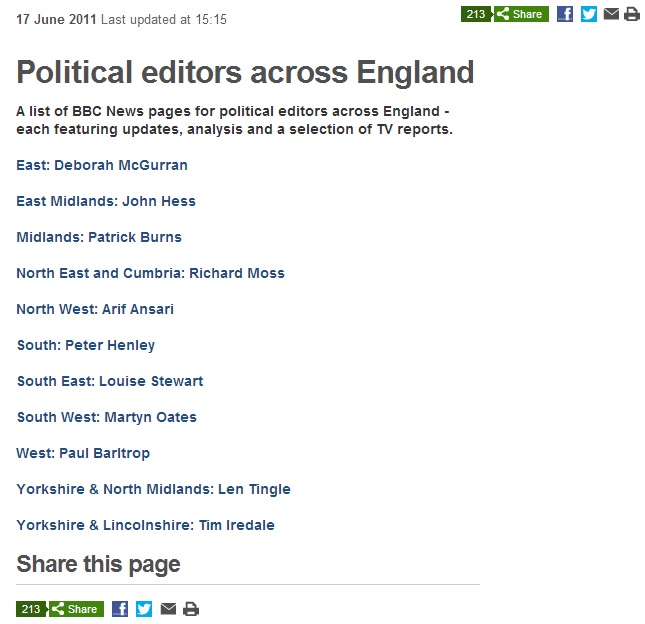
Furthermore, clicking on the obscure “Political analysis around England” link leads to the the following badly laid-out page listing the BBC’s English political editors by region (presumably outdated since it was last updated nearly three years ago):
Who made the decision to slice and dice our United Kingdom in this way when it comes to political coverage? Who decided on behalf of the British population that the Welsh, Scots and Northern Irish should see their politics primarily at a national level, while the English must be given news at a regional basis?
More importantly, is this discrepancy in political coverage a result of organisational efficiency (so that political editors cover “patches” roughly equal in population, for example) or is it for another, perhaps more sinister reason?
The answer, of course, is that the BBC’s way of splitting its political coverage is merely a reflection of the way that the political elite want us to see ourselves – with all of the home nations save England deserving of a degree of individual recognition and autonomy.
But this way of organising news coverage – and structuring our political system – does everyone a disservice. People living in Wales, Scotland or Northern Ireland are denied the chance to view or shape events in their respective nations from anything other than a macro level, while English residents are not given the chance to look at issues which affect England in particular.
At a time when the Scottish people have a referendum to determine their future participation in the United Kingdom, and issues of devolution of power are coming increasingly to the fore, why does the BBC persist with a political reporting structure that is fundamentally out of touch with the sentiment of the country?
On Wednesday 23rd April, England will celebrate – or at least observe – St. George’s Day. This blog would not be surprised if there was a significant popular backlash or uprising of English nationalist sentiment around this time, given the fact that so much of our leaders’ energies are currently taken up talking about how best to cater to the needs of Scotland while the West Lothian question remains – as ever – conspicuously unaddressed.
Of course, if a debate does bubble to the surface around this time, it could well be diffused into obscurity by the BBC’s eleven English regional political editors.
List your top three current threats to British national security and democracy.
What did you write down? Government electronic surveillance and public apathy toward the erosion of privacy? The government bullying a national newspaper into destroying its computers as a vengeful and intimidating act in response to the Edward Snowden leaks?
How about the government detaining relatives of journalists at the airport under risibly inappropriate anti-terrorism laws? Or maybe you cited Russia’s increasing assertiveness and Vladimir Putin’s apparent desire to reassemble the USSR? Islamic extremism and the threat of terrorism? Climate change? The Only Way Is Essex?
Not if you are Owen Jones, the ubiquitous, telegenic new face of left wing punditry and author of “Chavs: The Demonisation of the Working Class”. According to Jones, British democracy and journalism are most under threat from that evil right-wing juggernaut that extends into all of our homes – the BBC.
Jones has apparently had it with claims from the right of leftwing political bias at the BBC, and has responded with a whinnying, foot-stomping tantrum in The Guardian where he single-handedly attempts to redress the balance. As he sees it, the BBC has become a hotbed of right-wing propaganda, stacked with conservative personalities and pumping out unchallenged conservative viewpoints 24/7:
The truth is the BBC is stacked full of rightwingers. The chairman of the BBC Trust is Chris Patten, a former Conservative cabinet minister. The BBC’s political editor, Nick Robinson, was once chairman of the Young Conservatives. His former senior political producer, Thea Rogers, became George Osborne’s special advisor in 2012. Andrew Neil, the presenter of the BBC’s flagship political programmes Daily Politics and This Week, is chairman of the conservative Spectator magazine. His editor is Robbie Gibb, former chief of staff to the Tory Francis Maude. After the BBC’s economics editor Stephanie Flanders left for a £400,000-a-year job at that notorious leftwing hotbed, JP Morgan, she was replaced by its business editor Robert Peston.
How shocking that successful people (whom the BBC naturally looks to recruit for senior positions) have held strong political views or been allied with political parties in the past. What should happen instead, according to Jones, is that candidates for BBC positions are automatically rejected if they appear on the electoral roll, have voted in a past election or have ever expressed a political opinion on social media.
His outrage at the staffing of the BBC’s business and economics positions is particularly unreasonable. One might think that those who have worked in business and have a functional understanding of the financial industry are well placed to write or broadcast about it – assuming they are professional and operate under the same editorial policy as everyone else – given their expertise and links to the industry. But Jones seems shocked that the BBC didn’t select someone from Occupy Wall Street or Greenpeace to take on these high profile roles.
And it is not just the personalities that Owen takes issue with, but also the resulting coverage. When the global financial system teetered on the brink of disaster in 2008, Jones was apparently livid that the BBC interviewed so many people with knowledge of the industry who could explain to audiences what was happening. These people, despite being involved in the system and deeply impacted by what was happening, were not the right people to speak to, according to Owen Jones. He would have preferred more interviews with sleepy left-wing academics, aging hippies and assorted other people ready and willing to say variations on “I told you so”:
When the financial system went into meltdown, BBC interviews were dominated by City voices like stockbrokers and hedge fund managers, rather than critics of a sector that had plunged the country into disaster.
And at the end of his hit-piece, Jones makes his true intentions fully transparent. He has no interest in correcting this non-existent right wing bias at the BBC and restoring what he would see as some kind of non-partisan parity. No, he wants to transform the BBC into a fully-fledged mouthpiece of the left. It’s about giving conservatives a black eye for perceived past injustices using the BBC as a weapon, and he is willing to indulge in any amount of hyperbole or scaremongering to achieve this end:
For too long, the right has got away with weaving a fairytale of BBC leftwing bias. Until the left starts complaining – and loudly too – the BBC’s agenda will be shaped by supporters of government, big business, the free market and western foreign policy. That does not just subvert honest journalism: it undermines our democracy.
The Owen Jones phenomenon is not unique – whenever someone has a cause to promote (often a losing or flawed one, it seems) there are accusations and recriminations that the media has not jumped on the pro-whatever-the-idea-is bandwagon and given it unwavering support. Any and all instances of giving coverage to the opposing point of view is scrutinised, and any occasional discrepancies – which almost always even out over the long run when it comes to any issue or party – are held up as the “smoking gun” evidence of institutional bias.
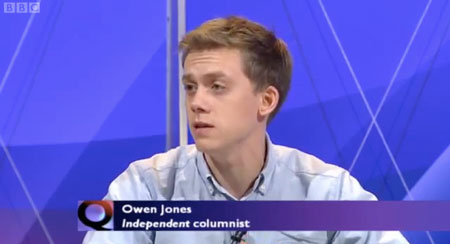
Owen Jones’ views being airbrushed and ignored on BBC television
If Owen Jones were to take a step back from his outrage and really consider the BBC’s media coverage, someone as intelligent as he seems to be will surely have to concede that he overstepped the mark with his criticisms. No, the BBC has not shared his stridently left-wing viewpoint on almost every issue – but nor can they. They have a charter to represent and produce content for the entire country, not just left-wing activists. And from the charter come strict editorial guidelines and policies, which are carried out diligently and in good faith by human beings working to a high standard but as prone to error as the rest of us.
All of us – left or right leaning – can point to instances where television and radio and online news output has left us feeling hard done by, or shouting at the screen, convinced that the buffoon they chose to represent our side of the argument is a stooge, deliberately undermining our own, perfectly logical beliefs. But that’s just the nature of having strong political opinions. And as concerned, active citizens we should put our efforts toward actively convincing people of the merits of our arguments, not running off to a non-existent referee for redress whenever we feel the other side came out on top.
Owen Jones has enjoyed considerable airtime across the British political media, and has had ample opportunity to set forth his own strong opinions in a very articulate, persuasive way. It was the BBC, which he now chooses to castigate, that gave him many of these opportunities as part of their news coverage.
To then accuse the BBC, who have done so much to help his own career as a left-wing ‘intellectual’ and pundit, of political and institutional bias, is more than a little rich.
For the first time ever, the person given the honour of conducting the Last Night of the Proms, that great British musical occasion, will be a woman. An exceptionally well qualified woman, Marin Alsop.
Yes, I’m biased. Alsop is a protege of one of my musical heroes, Leonard Bernstein. But she has also distinguished herself through her very well-received tenures with the Baltimore Symphony Orchestra, Royal Scottish National Orchestra and Bournemouth Symphony.
Female conductors are still an incredibly rare site on the podium, as the Telegraph article relates:
Female conductors are about as common as hen’s teeth. A comedian friend of mine once said that a comic is always the person facing the wrong way, and this is doubly true of a conductor. If a comedian onstage is the only individual in the room facing the audience, then a conductor is the only person on stage facing the performers.
To put yourself in a position where you are neither orchestra nor audience, that is to say, a unique figure, elevated on your own little platform, essentially telling everyone in the room what to do (you listen; you play) requires a rather particular set of personal characteristics that we probably traditionally associate with men, slightly crazy, arrogant, wild-eyed men.
The series of summer musical concerts at the Royal Albert Hall and associated venues, collectively known as the BBC Promenade Concerts, have expanded boundaries in a number of areas. We have already had the first American conductor to take charge of the Last Night – the excellent (and underappreciated) Leonard Slatkin, of St. Louis fame. The Proms now include outdoor concerts, late night concerts, and science fiction themed concerts (to the delight of many Doctor Who fans). This is all well and good. But the announcement that Alsop will be the first woman to conduct the BBC Symphony on this illustrious occasion should serve as a reminder that much more needs to be done before women are fully represented at the highest levels of classical music. Alsop has blazed a trail, but there are far too few younger women following in her wake.
That is not to say that there are no other women conductors of great talent and some renown – one might think of the excellent Xian Zhang, who occasionally guest conducts the London Symphony Orchestra – but this wikipedia page shows the depressing truth of the matter. Just 61 entries.
As always, I shall look forward to the upcoming Proms season, and to the Last Night. But the fact that we are celebrating this particular milestone only in the year 2013 should give us all pause for thought.
The BBC reports that Apple has failed in its attempt to block sales of Samsung Galaxy Tab tablet computers on the spurious grounds of copyright infringement:
A UK judge has ordered Apple to publish announcements that Samsung did not copy the design of its iPad, according to the Bloomberg news agency.
It said the judge said one notice should remain on Apple’s website for at least six months, while other adverts should be placed in various newspapers and magazines.
It follows the US company’s failed attempt to block sales of the South Korean firm’s Galaxy Tab tablets.
…
It said the notices must make reference to the court case and should be designed to “correct the damaging impression” that Samsung’s tablets had aped the look of Apple’s products.
Let me literally count the ways that this is funny:
1. Apple got smacked down for doing engaging in the typical, bullying behaviour that causes many people to hate large corporations, and was told that it could not, in actual fact, copyright or trademark vague and ethereal concepts such as “simple design” or “coolness” for their exclusive use.
2. Apple has to pay to place advertisements in the national media, admitting that it was wrong about something. I can’t wait to read the tortured wording.
3. 1 & 2 are funny because I own a rubbish, aging, malfunctioning BlackBerry, and my iPhone-toting friends make fun of me for it.
4. Though Samsung won the case, the judge said of their Galaxy Tablet device: “They are not as cool. The overall impression produced is different” when explaining his decision. So even in victory comes a rather devastating critique of their own efforts to build an iPad rival, now officially noted in the public record.
5. Free thought remains just about permissible in Britain today, as the article states that presiding judge “Judge Birss said that the US firm was ‘entitled’ to hold the opinion that his judgement was wrong”. It is good to know that the day has not yet arrived when failure to agree with authority represents a thought crime, despite the best efforts of Gordon Brown and the incompetence/weakness of the Cameron administration.
6. Hopefully other companies can breathe a little easier now, and continue to innovate and bring new products to the market with less fear that they will be persecuted by a big bully with a shiny logo.
There. Without knowing any of the specifics of the case, I have already extracted six reasons to be cheerful. That is all.
The Guardian reports that the BBC is shrugging off the unprecedented levels of criticism of their Diamond Jubilee television coverage with the practiced ease and disinterest of the vast, bloated behemoth of an organisation that it is – one that doesn’t have to generate its £4.2bn annual budget by turning a profit, nor justify the way in which that money is spent.
In fact, as the chorus of complaints grows louder, it emerges that the BBC executive in charge of the jubilee coverage has actually gone on holiday, and will not be available to answer any of the criticism:
The senior BBC executive responsible for the corporation’s diamond jubilee coverage has been unable to defend the output amid mounting criticism, because he is now on holiday.
BBC Vision director George Entwistle, a leading internal candidate to replace Mark Thompson as director general, went on holiday on Tuesday evening and could not appear on Radio 4’s Today programme on Wednesday to defend the corporation, which has faced criticism from vnewspapers, celebrities and even former executives about its four days of diamond jubilee coverage.
By Wednesday afternoon the BBC had also received 2,425 complaints from viewers and listeners about its diamond jubilee coverage, with the vast majority – 1,830 – about Sunday’s Thames pageant. The BBC said it had also received “lots of positive feedback”.
Though the majority of the complaints centred around the lightweight presenters and their lack of a decent command of their subject matter, the BBC chose to duck this line of criticism altogether, focusing instead on defending itself against a number of other decoy straw man arguments:
A senior BBC source said that this was the biggest outside broadcast of a flotilla ever undertaken, with 80 cameras attempting to film 1,000 boats.
“You cannot rehearse something of this scale and you certainly cannot have a running order or predict monstrous weather,” the insider said.
The source said that senior staff involved in the coverage were too tired to appear on the Today programme: “They had worked flat out and we were unable to put up somebody who knew exactly what they were speaking about.”
Fine, but the cloudy weather, scale of the event and the technical hitches had nothing to do with the fact that you assembled a cast of C-list presenters who between them had less gravitas and knowledge of the unfolding events than the jubilee-themed sick bag that one of them, in her wisdom, decided to promote.
Here’s some news, BBC – just because you caught the attention of 15 million largely captive viewers in the UK doesn’t mean that your coverage was any good. It wasn’t. It was really, really, uncharacteristically bad.
And as an organisation you really need to acknowledge it as such if you want to avoid a similar broadcasting catastrophe when the next big national event rolls around.




 Semi-Partisan Politics