The End Of America As We Know It? Hardly.

Andrew Sullivan posts an excellent retort to Mitt Romney’s fear mongering that the United States is about to make a binary flip from being a free enterprise nation to having a “government-run economy”, based on this illuminating chart:

As you will note, the line indicating growth in corporate profits (in billions of dollars) obstinately refuses to go in the direction that it would need to point in order to signify the government-led smothering of the private sector that Romney wants us to believe is currently taking place.

The Republican presidential candidate has been giving speeches bemoaning the notion that President Obama doesn’t understand capitalism or the free enterprise system, and that this ignorance is leading Obama to implement policies that are harming the economic recovery. Romney has advanced this line of attack frequently, most recently at a campaign event in St. Louis, Missouri, though to be fair, he seems willing to ascribe Obama’s supposed failures to ignorance rather than malice:

I do not believe this has been done with evil intent or ill will. But for a family watching their house being sold at foreclosure, or the family that is forced to spend their kid’s college savings just to make ends meet, the results are just as devastating.

Oh wait, perhaps not:

I will not be that President of deception and doubt. I will lead us to a better place.

Then, of course, comes the obligatory lie about Obamacare, the Affordable Healthcare act:

Today, government at all levels consumes 37 percent of the total economy or G.D.P. If Obamacare is allowed to stand, government will reach half of the American economy. And through the increasing controls government has imposed on industries like energy, financial services and automobiles, it will soon effectively control the majority of our economic activity.

This line only works if you are ill-informed enough to actually believe that Obamacare effectively appropriates and nationalises the entire US healthcare industry, bringing it under government ownership as opposed to just regulating the industry to a higher degree and increasing the customer base of the insurance companies through the individual mandate. So it’s basically a big fat lie, though Romney is clever enough to choose his words carefully, stating “government will reach half of the American economy”, a quite meaningless phrase, but one that deliberately and incorrectly suggests ownership and control of half of the US economy without actually putting him on the record as having said so.

And finally, the crux of Romney’s argument:

One must ask whether we will still be a free enterprise nation and whether we will still have economic freedom. America is on the cusp of having a government-run economy. President Obama is transforming America into something very different than the land of the free and the land of opportunity.

We know where that transformation leads. There are other nations that have chosen that path. It leads to chronic high unemployment, crushing debt, and stagnant wages.

I don’t want to transform America; I want to restore the values of economic freedom.

This is what really irritates me about the Romney argument, this idea that there is a binary choice between “free enterprise” and “government-run”, that America has always dwelt on the free enterprise side of the line and that Obama wants an old-school socialist planned economy. It is borne out of the total allergy to nuance or shades of grey currently affecting the Republican party, and is one of the main reasons why I cannot bring myself to support them at the moment.

Of course there is no such binary choice. What percentage of GDP would have to be consumed by government spending for “free enterprise” to officially be declared dead according to the Romney definition? 37%, the current figure? 50% + 1? Something else? All conservatives – myself included – want to see government spending account for as small a proportion of GDP as possible, and most would agree that the current level – in Britain as well as in America – is too high. But the size of government has expanded under both parties, and though Obama may be guilty of failing to reverse the trend, he has at least slowed the rate of increase in the size of government, when the stimulus measures are factored out. For Mitt Romney to suggest that the US is teetering on the brink of becoming a planned economy under Obama when government spending accounts for 37% of GDP is not only the worst type of scaremongering, it also ignores the significant contribution that his own party made to the problem.

And as for this narrative about Obama seeking to “transform” America, to turn it into something unrecognisable from before – while it may be the only narrative that Romney can hope to ride to the White House in November, it is also untrue. Obama is a centre-left politician implementing mostly centre-left policies, some of which would actually have enjoyed a measure of support among Republicans if they had been proposed by a President Bush, Cheney or McCain. But for Romney to get out the vote, he must convince his supporters of something patently untrue, that Obama is a radical, a dangerous subversive trying to alter the fabric of America.

I’m an economic conservative, I believe in a small state and limited government involvement in private markets. But given the choice between someone on the centre left who is making an honest effort along Keynesian lines to solve the economic difficulties facing America and someone on the right who screams “socialism!” where none exists, and who remains in denial about his own side’s complicity in the downturn and the detrimental effect that his policy proposals would have on the recovery, I have to hold my nose and support the centre left guy.

Which is a shame, because it would be nice to have a genuine choice in 2012.

Dancing With Yourself

Tea Party Protest - Barack Obama

It is hard to disagree with this assessment of recent GOP obstructionism from Jamelle Bouie at The American Prospect:

The crux of the matter:

If I sound frustrated—and I am—it’s because we’re in the middle of an absolutely ludicrous scenario. Under a Republican president, the United States endured eight years of disastrous economic stewardship—arguably the worst of the post-war era—that nearly led to a second Great Depression. In response, voters elected a Democratic president and gave him huge majorities in both chambers of Congress. Rather than work with the new president, Republicans ran to the right and promised to defeat this president by any means necessary. They abused institutional rules to block nominees, and imposed a de-facto super-majority requirement on all legislation. Republicans rejected stimulus, the automobile rescue, a climate bill built from their ideas, a health care bill built from their ideas, and a reform bill designed to keep the Great Recession from happening again.

This was an amazingly successful strategy. It destroyed Democratic standing with the public, energized the right-wing fringe, and led to a historic victory in the House of Representatives. Once in command of the House, Republicans pushed hugely draconian budgets, risked a government shutdown, and nearly caused a second economic collapse by threatening to default on the nation’s debt. This reckless behavior depressed the economy, prolonged the recovery, and destroyed trust in the nation’s political institutions. The Speaker of the House has even promised to do this again, if Democrats don’t bow to his demands for greater spending cuts.

The Republican party of today has drifted so far – not just to the right, but into the realm of crazy, where the eight years of disastrous Bush economic stewardship apparently never happened, and the economic malaise is entirely Obama’s fault – that it’s hard for me to see how I could ever bring myself to vote for them. I have joined firmly with those who are hoping for a complete electoral landslide in the upcoming presidential elections, to perhaps convince the GOP to tack back toward a reasonable, pragmatic conservatism.

Of course, this would have been easier if one of the crazies had managed to wrest the nomination away from Mitt Romney. As it is, we will probably have to wait until Romney’s likely defeat in 2012, and then a further tack to the right and an even bigger defeat in 2016 before we might finally have a viable choice between two parties again.

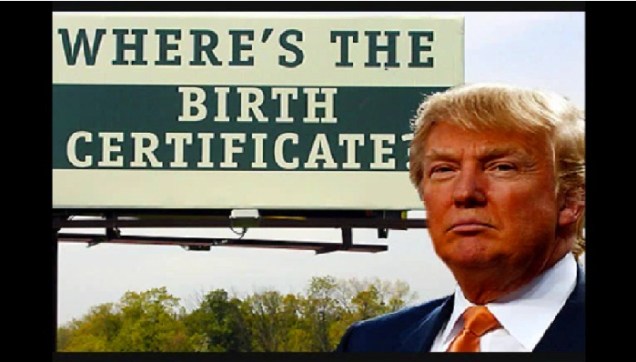
The Hypocrisy of Mitt Romney – Birther Edition

donald-trump-barack-obama-birth-certificate-birtherism

A lot of people have been wondering about the extent to which Mitt Romney would tack back to the centre of the political spectrum in the highly, highly, highly unlikely event that he manages to defeat Barack Obama in November’s contest. And to be fair, Mitt Romney has certainly added fuel to the fire of such speculation by some of his statements, most recently his surprise revelation that everything he has said before about immediately balancing the budget was just a big joke, because he is actually a Keynesian at heart, and knows that to reduce federal spending by $1 trillion in year 1 would not be the most positive thing to do to a fragile economy.

But those people thinking (either worrying or hoping) that a Romney presidency would move to occupy the political centre ground need speculate no more. Because Mitt Romney has now proved beyond question that he is fully and totally beholden to the extreme right wing of the Republican Party, and would no sooner do anything to anger that bastion of support than he would chop off his own hand. How do we know this? Because Mitt Romney refused to distance himself from his most high profile campaign surrogate and supporter, Donald Trump, when he said this:


And then doubled down with this:


Romney, meanwhile, had only this to say when asked about his wayward campaign surrogate:

Mitt Romney said Monday he wasn’t concerned about Donald Trump’s commitment to the “birther” conspiracy, one day before the GOP presidential candidate hosts a fund-raiser alongside the celebrity business magnate.

Asked on his charter plane whether Trump’s questioning of President Barack Obama’s birthplace gave him pause, Romney simply said he was grateful for all his supporters.

“You know, I don’t agree with all the people who support me and my guess is they don’t all agree with everything I believe in,” Romney said. “But I need to get 50.1% or more and I’m appreciative to have the help of a lot of good people.”

Even when his most high-profile supporter and key surrogate goes totally off the rails and revives his old birther conspiracies prompted by nothing at all, Mitt Romney is too afraid of angering his base to unequivocally disassociate himself from the remarks. Surely no one now harbours any remaining belief that Romney would tack back to the centre if he got elected. Tea Partiers, fear not – you may not like the guy and distrust the sincerity of his convictions, but it doesn’t matter – he’s scared of incurring your wrath, so you have him safely in the bag.

If, in some dystopian world, I had to choose between a President Romney and a President Trump, I think I am minded to go for President Trump. He may be batsh*t insane with an ego the size of one of his towers, but at least I would always know what he really thinks about something.

Obama The Socialist

Barack Obama - Socialist - Socialism


Who knew: Apparently I would make a passable journalist, and could be well respected and remunerated for doing so. I know this because after I read Paul Roderick Gregory’s article in Forbes, “Is It Within Bounds To Ask: Is Obama A Socialist?” I did two things: I reminded myself of the definition of socialism using two readily available sources (I was smart and used two independent sources just in case one of them was leading me astray), and I cross-checked this definition against the policy positions set out on Barack Obama’s website.

Paul Roderick Gregory, who “journalists” for a living, did neither of these things; he is professionally negligent and apparently just whipped open his laptop and started typing. Either that, or he is professionally negligent and knows the information to be found on these websites very well, but thinks that all of his readers are idiots who are incapable or unlikely of doing the same. Now which could it be?

I am going to leave aside the semantic arguments about the meaning of the word “socialism” that Gregory employs in his companion piece “Is President Obama Truly A Socialist“, but basically Gregory holds his hands up and pleads that he doesn’t mean the traditional definition of socialism. No, he just means “socialism” as practiced by continental Europeans with their welfare states. Of course, this disclaimer is buried very deep within the article, so that the full impact of conflating Obama’s political philosophy with socialism is felt immediately, while the clarification is given only after the statement has had sufficient time to establish itself as fact:

By “socialist,” I do not mean a Lenin, Castro, or Mao, but whether Obama falls within the mainstream of contemporary socialism as represented, for example, by Germany’s Social Democrats, French Socialists, or Spain’s socialist-workers party?

By this criterion, yes, Obama is a socialist.

If Gregory wanted to make this more nuanced argument (still wrong, in my opinion) – that Obama’s policies are closely aligned to European social democracy – then he could go ahead and do so. But he has no interest in doing that. The only reason he even includes this tortured disclaimer is to clear the ground so that he can land his rhetorical punch on Obama, and label him a “socialist”.

From the stirring conclusion to the original article:

The upcoming November election offers American voters a choice that is starker than they understand. Obama brings to the table a deep distrust of free enterprise and a belief in government as the solution to most problems. Romney offers a vision of faith in private enterprise and a distrust of government intervention. Obama will disguise his views with “fair share” slogans and weak protestations of faith in private enterprise.

This is actually the closest that Gregory comes to cogency in either piece. I come from a centre-right perspective and do sometimes think that Obama is heavy-handed in his administration’s oversight of the free market. Interfering with private companies such as Boeing when they come to make decisions on where to locate their production, for example, strikes me as bullying and control-freakish. But I have never felt as though Obama was secretly yearning to nationalise Boeing and create a state-owned aerospace and defence company.

On the flip side, many of Romney’s contemporaries in industry are only too quick and happy to run to the government when it suits their needs, perhaps to ask for bailouts, favourable trading terms or tax loopholes, or to bring down the regulators on a rival that is becoming rather too successful. Hardly unheard-of.

Why am I even bothering to quote this trash? Only because it is emblematic and typical of the lazy type of charges that are levelled against Obama by some on the right. By calling out Gregory now, I free myself from the obligation do the same thing every time another right wing talking head repeats the same “Obama-Socialist” line on Fox News, or in a newspaper column.

So, Paul Roderick Gregory, the unfortunate person who I picked on to embody every die-hard tea partier and overenthusiastic Republican who is tempted to get carried away with the old rhetoric when disagreeing with President Obama’s economic policies: is it “within bounds to ask: is Obama a socialist?”

Sure, it’s within bounds. It’s just really, really dumb.

I had no idea that the bar for becoming a published Forbes contributor was set so low.

Obama Syndrome – Tom Friedman’s Diagnosis

Tea Party Protest - Barack Obama

In his latest New York Times column, Thomas Friedman succinctly puts into words what many centrists and probably nearly all frustrated liberals will immediately identify as one of the Obama administration’s biggest political failures thus far into his first term – Obama’s inability to properly sell his accomplishments, and their failure to prevent these accomplishments from being distorted and turned into electoral liabilities by the Republican opposition.

Friedman complains:

Barack Obama is a great orator, but he is the worst president I’ve ever seen when it comes to explaining his achievements, putting them in context, connecting with people on a gut level through repetition and thereby defining how the public views an issue.

True, though this is an age old complaint about Democratic politics – the inability to remain cohesive and on-message, and to deliver a point that is consistent, compelling, and easy to repeat and digest.

On what is perhaps Obama’s signature first term accomplishment – however imperfect it may be – reforming the US healthcare system, Friedman delivers the kind of blunt, incontrovertible smackdown of Republican talking points that make people like me want to shout out in agreement and kiss the screen:

“Obamacare is socialized medicine,” says the Republican Party. No, no — excuse me — socialized medicine is what we have now! People without insurance can go to an emergency ward or throw themselves on the mercy of a doctor, and the cost of all this uncompensated care is shared by all those who have insurance, raising your rates and mine. That is socialized medicine and that is what Obamacare ends. Yet Obama — the champion of private insurance for all — has allowed himself to be painted as a health care socialist.

Yes, yes, a thousand times yes. It’s painful that anyone should have to school the Republican party, the self proclaimed champions of fiscal conservatism, in such basic economic concepts as the free rider problem, but if someone has to do it then there is no one who can do so with more style than Tom Friedman. I’m not sure that I have it in me to hear one more Tea Partier lambasting Obamacare and lamenting that the US now has a socialised healthcare system and that he is being made to pay for his neighbour’s keep, without just straight up asking him “well, what the hell do you think you were doing before, idiot?”

And on the somewhat topical subject of government spending and deficits:

Finally, how did Obama ever allow this duality to take hold: “The Bush tax cuts” versus the “Obama bailout”? It should have been “the Bush deficit explosion” and the “Obama rescue.” Sure, the deficit has increased under Obama. It was largely to save the country from going into a Depression after a Bush-era binge that included two wars — which, for the first time in our history, we not only did not pay for with tax increases but instead accompanied with tax cuts — plus a 2003 Medicare prescription drug bill that we could not afford, then or now. Congressional Democrats also had a hand in this, but the idea that Bush gets to skate off into history as a “tax-cutter” and not as a “deficit buster” is a travesty. You can’t just blame Fox News. Obama has the bully pulpit.

The way in which Democrats managed to lose control of the narrative and allow the party who led America into two unfunded wars, a round of unfunded tax cuts and an unfunded expansion of Medicare (oh yes – socialised medicine, too) to reclaim any credibility whatsoever in terms of economic understanding or fiscal responsibility will forever astound me. And Friedman is right, Obama has the bully pulpit. He, his team and his spokespeople should have been sending out the right message from the start, and not have allowed themselves to have been forced to play defense.

To be fair – and as Friedman notes – sometimes actions speak louder than words, and in several notable instances the Obama administration’s actions have been as much of a reason for disappointment as the selling of their message. For me, the almost unforgivable failure of the Obama administration was the failure to embrace and push forward the Bowles-Simpson deficit reduction plan, which enjoyed considerable support (if not quite enough to mandate an up-or-down vote in the House and Senate) and which would have demonstrated beyond any reasonable doubt that Obama was serious about medium term deficit reduction. The Obama administration’s reticence on this point enraged many a centrist Obama supporter, and led blogger Andrew Sullivan to declare:

My own view, however, is that Obama badly bungled this by not embracing his current position in the State of the Union and pummeling the GOP with it for months. Bowles Simpson was his commission after all, and yet he dropped it like a stone and pandered to his left when he had a perfect moment to pivot to the debt question. Giving the GOP any credibility on debt by offering nothing of real $4 trillion substance until last week may well be seen as Obama’s greatest mistake in his first term. Now that he has finally offered it, his ability to maintain the high ground on a fair measure to tackle the deficit is much reduced from his January possibility. This is not a meep-meep moment. And it could easily have been, if Obama had shown, yes, courage sooner … On this score, leading from behind has been pretty much a disaster. And there is no longer much time to lead from the front.

So there are problems here of action as well as messaging. I don’t yet believe that this is cause for panic – as I have laid out in previous posts, I am very confident that given his opposition, Obama is heading for a likely landslide reelection victory. But an administration – and a party – that fails to create and stick to a positive narrative on so important a topic, deserves their fair share of woe.

But unfortunately it is not just President Obama and his administration that suffer as a result of their baleful communication efforts. For with every day that passes without a compelling, effective message from the administration about achievements won and plans for the future, the unrepentantly unreformed party of George W. “two unfunded wars” Bush and Richard “deficits don’t matter” Cheney will seem to more and more people like a potentially viable alternative to run the show again.