Since there seems to be no imminent end to the petulant, childish rage of disappointed Remain supporters at the prospect of being forcibly ripped away from their beloved European Union, we may as well start cataloguing some of the most hyperbolic and far-fetched tales of woe and prophesies of doom.
The inaugural submission comes, naturally, from the Guardian:
Social services for older and disabled people face crisis because post-Brexit migration restrictions could cause a massive shortage of care workers, leading care organisations have said.
The 1.4-million-strong UK care sector’s reliance on European migrant workers means it is vital they are given the right to remain in any future migration arrangements, the charities Independent Age and the International Longevity Centre UK (ILC-UK) said.
Currently about 84,000 care workers – equivalent to one in 20 of England’s growing care workforce – are from European Economic Area countries. About 90% do not have British citizenship and their future immigration status remains uncertain.
The charities said failure to tackle workforce shortages would mean thousands of older people would lose out on support, meaning they could be left housebound, struggle to recover properly from a stroke or fall, or fail to get assistance in getting up and dressed in the morning.
Translation: overturn the EU referendum result, or granny gets it.
(Note too the hyperbolic doomsday assumption of “a scenario which closed off all migration”, something which no serious person expects to happen).
The counterargument to this mini-tantrum, of course, is that cheap, young foreign labour from the EU and elsewhere has helped to ensure that care workers in Britain are paid an absolute pittance – often hovering around minimum wage – for performing a physically and mentally taxing job requiring skill, tact, empathy, good humour and great emotional intelligence in order to look after our loved ones in their final years.
The surly Guardianista charities moaning about the potential impact of Brexit on their sector clearly have no qualms or concerns that a worker can often make more money flipping burgers at a fast food restaurant than caring for our elderly and infirm senior citizens. This is just fine, apparently. But the mere possibility that free movement of labour restrictions might force employers to pay less desultory sums of money to frontline staff sends these “charities” into paroxysms of terror and rage. Whose side are they on? Not that of the patients or the care workers, that’s for sure.
Want to stop the endless drip-drip of care home abuse scandals? Try getting outraged that care is a borderline minimum wage occupation in this country, understand that people who might just as easily be flipping burgers for a living won’t always display the same dedication as Florence Nightingale – and be inordinately grateful for those care workers who do possess these criminally undervalued qualities. And in the meantime, forgive me for questioning the calibration of these charities’ moral compasses.
But why should we be surprised by their intervention? Everything about modern leftism and pro-Europeanism revolves around signalling virtue and ostentatiously displaying the “right” progressive beliefs to the right people.
And right now, it is far more important to be seen opposing those awful racist Brexiteers than it is to question the moral sustainability of an industry which hits its profit margin targets by providing our oldest and most vulnerable citizens with a Tesco Value standard of care.
–
Support Semi-Partisan Politics with a one-time or recurring donation:
–
Agree with this article? Violently disagree? Scroll down to leave a comment.
The EU referendum was not a question of “head vs heart”. When Remainers pretend that they occupied the intellectual high ground, they only delay their necessary and inevitable reckoning with the will of the British people
Remainers simply cannot help themselves. They cannot stop being arrogant and condescending toward Brexit voters, even when making otherwise admirable attempts to extend the olive branch and accept the nation’s verdict on leaving the EU.
Two days before the referendum, I visited the largest private sector employer in my constituency. I had spoken to many of the workers during the general election campaign a year earlier.
Although the chief executive works with a community centre to recruit local young people, like many businesses they also hire many Eastern European workers. It was a tough audience, as many blamed the EU for the squeeze on living standards and most felt immigration was out of control.
The people I met believed leaving the EU would mean less pressure on services and more money for them, because the downward pressure on wages would ease with fewer EU migrants.
[..] I knew in my heart at lunchtime on the day of that visit that we’d lost the referendum. My head had told me – the economist – that we would win because the consequences of leaving were a risk voters wouldn’t take. But, by Friday morning, we knew the Leave campaign’s emotional message was stronger than the rational arguments of the Remain campaign.
My emphasis in bold.
And there it is again – the infuriating “head vs heart” conceit, beloved by Remainers, that they unquestionably held the intellectual high ground when it came to arguing for Britain’s continued membership of the EU, and that the only reason for their defeat was that the base emotions and fears of Brexiteers somehow clouded their rational judgment and (to quote Lincoln, since Reeves tries and fails to do the same) shut out the “better angels of our nature”.
According to this cognitive dissonance-soothing rationalisation of defeat, Remainers were unquestionably right to warn of economic armageddon, and the economy was the sole worthwhile measure on which an existential question about national identity and democracy should be determined.
If this is the fruit of the Left’s attempt to understand Brexiteers (and we know it is, because the bottom of the article states that “This blog is based on a chapter Rachel Reeves MP wrote for the Fabian Society edited collection Facing the Unknown: Building a progressive response to Brexit“) then they have done an unspeakably lousy job.
The biggest issue, according to Lord Ashcroft’s post-referendum poll, was the overwhelming desire to preserve what remained of British sovereignty.
In “How the United Kingdom voted on Thursday … and why,” a survey of 12,369 voters in the United Kingdom conducted the day of the referendum, Lord Ashcroft found the No. 1 issue propelling people to vote “leave” was their belief that the U.K. should remain a self-governing entity not responsible to some supranational body writing rules and regulations about the economy and other matters.
Not hankering for a return to the 1950s.
Not an acute discomfort with dark-skinned people or eastern Europeans.
Not “Daily Mail lies” about curved bananas.
The people of Britain voted to leave the European Union because a majority of us quite rightly refused to accept the false claim that close and fruitful trade and cooperation with our European neighbours is somehow only possible by subsuming ourselves into the relentlessly integrating EU superstate. They were smart enough to realise that an organisation with a parliament, flag, anthem and ambitions for a combined military force has its sights set on something much grander than “friendship and cooperation”, and quite rightly wanted no further part of this doomed experiment in euro-federalism.
What’s more, the Brexit-voting people of this country were enlightened and dedicated citizens enough to see through the hysterical scaremongering propaganda of the Leave campaign, and accept that even if there were some short-term economic costs associated with Brexit, the Remain campaign clearly value our country and democracy too cheaply if they would remain part of a European political union through fear of a potential recession.
Were there oddballs, cranks and racists among the Leave campaign? Yes, of course we had our fair share. But the Remain campaign had Eddie Izzard, so let’s not tar an entire side based on its worst cheerleaders.
Look, I get it – daring to consider that one might have campaigned hard on the wrong side of history must be immensely difficult. The emotional investment of Remainers in their worldview, rhetoric and “identity” as super-progressive, tolerant and all-round awesome people is very strong and hard to see past. But if anyone should have the capacity to move beyond their own intellectual comfort zones it should be our elected MPs, people like Rachel Reeves. Sadly, there is little evidence that many are doing so. Nor will there be, probably, until a couple of decades’ time at which point warnings of economic cataclysm will have been taken over by events.
It is good that Rachel Reeves and some others at various points on the left-wing spectrum, Jeremy Corbyn included, recognise that the EU referendum result must be honoured and are reconciling themselves to the will of the people. But it is one thing to accept the country’s verdict while still sanctimoniously proclaiming that the people were manipulated and hoodwinked, and quite another to reach deep inside for some humility and admit that the people may actually have been right all along.
Nobody expects the Labour Party and other Remainers to make the transition overnight. But well-meaning articles like this from Rachel Reeves suggest that the majority have not even begun the urgently-needed process of reconciliation to the national will. And that is a real concern, for their own tenuous future political careers if nothing else.
Jeremy Corbyn and his supporters vastly outnumber the Labour centrists. So whose party is it really?
Very slowly – journalist by journalist, publication by publication – the realisation is beginning to dawn that the unwelcome outsiders in the Labour Party are now the centrist members of the PLP, and not Jeremy Corbyn and his leftist support base.
A few months ago, Watson and his fellow MPs thought Corbyn was the anomaly. That if he was dislodged, the natural balance of the Labour Party would be restored. Now it’s clear that there are tens of thousands of Corbynites who now hold party membership cards and are itching to use them. Labour MPs are starting to ask if they are the anomaly. And an anomaly that the new far-left members will seek to correct when Westminster boundaries are redrawn and MPs are selected.
Slow hand clap.
Yes, centrist MPs are indeed now the anomaly, just as centrists should always be the pitiable, wishy-washy anomaly in a political party. Finally, realisation dawns that maybe it is the centrist machine politicians who are the parasites in the so-called Labour Party, and not the socialists.
A political party is nothing if not the voice and champion of its members. Any other arrangement – such as the noxious idea that MPs, once selected, should have license to ignore their local party at will while being at no risk of ever losing their seat – makes the party membership little more than a fan club for some generally rather unremarkable career politicians. And under Jeremy Corbyn, the Labour Party is finally becoming less of a fan club and more a champion of its members.
Naturally, there are losers in this reconfiguration, namely the centrist MPs who have enjoyed utter dominance since the late 1990s, who suddenly find themselves out of favour and at theoretical risk of deselection. But what is the alternative? That Blairite and Brownite machine politicians, despised by the very constituency associations who will be tasked with pounding the pavements and handing out leaflets to get them elected, have the right to a “job for life”?
This is why we need to radically re-examine the way in which MPs are selected and removed from office. We need real powers of recall, so that constituents (on gathering a sufficient threshold of signatures in a petition) can recall from Westminster an MP who is underperforming, betraying their election pledges or dishonouring themselves and Parliament through scandal. But more than that, we need to move toward to mandatory re-selection and a competitive primary system.
This would bring Britain into line with other countries like the United States, where Representatives and Senators do not have “jobs for life” and must compete in party primaries if they wish to run for their seat at the next election. Such a move would put the wind up an often self-entitled political class, forcing MPs to justify their worthiness of a place on the ballot at regular intervals and forcing many of the older, less useful bench warmers off into retirement.
No constituency should be lumbered with a doddering old MP who doesn’t care any more, or a sharp-elbowed go-getter who ignores their constituency as they focus on climbing the greasy pole. Mandatory reselection goes a long way to solving those problems.
The current system, by contrast, is an abomination – incumbent MPs, often initially selected to stand for parliament in their constituencies through dubious, opaque or even downright corrupt means are then largely free from scrutiny by their own party for the rest of their career. As soon as they enter parliament they are enveloped in the Westminster self-protective cloak which serves to insulate parliamentarians from the consequences of their behaviour and political decisions.
If you know that nothing you can do will ever get you fired – if there is no political betrayal (like, say, pretending to be a eurosceptic during selection and then turning around and supporting the Remain campaign) for which you will ever be held to account – then there is every incentive to lie about your real political beliefs and motivations during selection, and then behave in as abominable and self-serving a way as you please as soon as your are elected to the Commons.
The Labour Party now has two choices if it wants to avoid a permanent schism:
Rig the leadership election process (deceptively known as “restoring the electoral college”) to ensure that pesky party members and their awkward convictions never again elect an ideological leader, or
Embrace a system of mandatory contested primaries, where sitting MPs have to win a party primary in order to stand as the Labour candidate for their constituency at each general election
Failure to adopt one of these two solutions (and this blog strongly favours the second) will ensure that the party remains permanently vulnerable to irreconcilable differences between the directly elected leader and the PLP, thus rendering Labour ungovernable.
Either it must be made harder for ordinary party members to choose the leader they want, or it must be made significantly easier for party members to remove MPs who prove themselves unwilling to work constructively with that elected leader.
The past year has been a viscerally painful case study in what happens when the can is endlessly kicked down the road and people pretend that some other magic solution will offer itself, saving them from having to pick one of these harsh medicines. And whatever harm Jeremy Corbyn’s left-wing positions may have done to Labour’s electoral fortunes pales in comparison to the harm inflicted by the centrist-led campaign to undermine and destabilise their leader.
Either the centrist Labour MPs must take a hike (at least resigning themselves to a few years of quiet irrelevance on the back benches) or the hundreds of thousands of new party members must take a hike, for they have proven themselves incapable of co-existing.
And while this blog disagrees with nearly the entire Corbynite platform, I side strongly with the ordinary Labour Party members who are about to overwhelmingly re-elect their man.
An independent political press corps with the knowledge and authority to call the shots and confidently call out lies when politicians tell them – rather than giving equal credence to two diametrically opposed crazy positions – is a great idea. If only our media was sufficiently trustworthy and capable of performing such a nuanced, sensitive role
Something funny seems to have happened to the New York Times.
Last Saturday, The New York Times published an extraordinary story. What made the story extraordinary wasn’t the event the Times covered. What made it extraordinary was the way the Times covered it.
On its front page, top right—the most precious space in American print journalism—the Times wrote about Friday’s press conference in which Donald Trump declared that a) he now believed Barack Obama was a US citizen, b) he deserved credit for having established that fact despite rumors to the contrary and c) Hillary Clinton was to blame for the rumors. Traditionally, when a political candidate assembles facts so as to aggrandize himself and belittle his opponent, “objective” journalists like those at the Times respond with a “he said, she said” story.
Such stories, according to the NYU journalism professor Jay Rosen, follow this formula: “There’s a public dispute. The dispute makes news. No real attempt is made to assess clashing truth claims in the story … The symmetry of two sides making opposite claims puts the reporter in the middle between polarized extremes.”
[..] But the Times, once a champion practitioner of the “he said, she said” campaign story, discarded it with astonishing bluntness. The Times responded to Trump’s press conference by running a “News Analysis,” a genre that gives reporters more freedom to explain a story’s significance. But “News Analysis” pieces generally supplement traditional news stories. On Saturday, by contrast, the Times ran its “News Analysis” atop Page One while relegating its news story on Trump’s press conference to page A10. Moreover, “News Analysis” stories generally offer context. They don’t offer thundering condemnation.
Yet thundering condemnation is exactly what the Times story provided. Its headline read, “Trump Gives Up a Lie But Refuses to Repent.” Not “falsehood,” which leaves open the possibility that Trump was merely mistaken, but “lie,” which suggests, accurately, that Trump had every reason to know that what he was saying about Obama’s citizenship was false.
Given the context of a presidential election and the extra scrutiny on media bias, it is surprising and rather heartening to see the Times displaying the courage to report fact rather than controversy; the same headline a month ago might easily have read “Trump Withdraws Birther Allegation”, with no reference to the established facts and outcome of the story.
Jon Stewart (formerly of The Daily Show) must be smiling. Since 2004 and even earlier, Stewart railed against political coverage which ginned up conflict in pursuit of ratings and incessantly reported issues through the prism of Left vs Right, Democrat vs Republican without ever seeking to either restrict coverage to facts or move beyond partisan talking points to get to the truth. The video at the top of this article shows Stewart’s memorable appearance on CNN’s Crossfire show, in which he castigated the hosts for “hurting America” by injecting partisanship and sucking nuance out of the political discourse.
Obviously the New York Times does not inhabit quite the same infotainment space as Crossfire, but the basic operating principle has been very much the same of late – present two or more strongly opposing partisan viewpoints, let the talking heads (or journalistic sources) slug it out in defence of their respective positions, and then move on without ever really applying any kind of judgment as to the respective merits of the contrasting positions.
Nowhere is this approach better summed up than the slogan of the Fox News Channel – “we report, you decide”. It is a relativist worldview which suggests there is no truth in even quite straightforward binary debates, and that we are free to pick our own facts and construct our own reality in accordance with our personal biases and interests.
In justifying his remarks, Mr. Trump falsely claimed that Mrs. Clinton wants to “destroy your Second Amendment,” apparently a reference to her gun control policies.
My emphasis in bold.
At face value this is a good development – the “he said she said” approach to political coverage is what has enabled so much of the spineless print journalism and sensationalist, conflict-stoking television news reporting in Britain and America. Seeing a “respectable” institution finally buck that trend and push back against the toxic idea that reality is malleable and truth exists only in the eye of the super-partisan beholder is, in theory, a very good thing.
Peter Beinart certainly seems to think so:
A certain etiquette has long governed the relationship between presidential candidates and the elite media. Candidates stretch the truth, but try not to be too blatant about it. Candidates appeal to bigotry, but subtly. In turn, journalists respond with a delicacy of their own. They quote partisans rather than saying things in their own words. They use euphemisms like “polarizing” and “incendiary,” instead of “racist” and “demagogic.”
Previous politicians have exploited this system. But Trump has done something unprecedented. He has so brazenly lied, so nakedly appealed to bigotry, and so frontally challenged the rule of law that he has made the elite media’s decorum absurd. He’s turned highbrow journalists into referees in a World Wrestling Entertainment match.
Last Saturday, the Times answered Trump’s challenge. He’s changed the rules, so it did, too.
But this analysis only holds if one has reasonable grounds to trust the journalistic institution or media outlet doing the reporting; will they reserve their merciless news analysis features for instances when there really is a right and wrong binary perspective, or will editorial judgment and personal bias cloud the picture?
While the “he said, she said” ra-ra approach may be divisive and unseemly, it at least offers a right of reply to those whose views are misinterpreted or deliberately slandered by shameless opponents. And while conventional wisdom might hold that it is more often conservative voices who live in a sealed bubble of their own facts, in reality we would all be vulnerable to a style of news reporting in which reporters and editors are given sweeping new authority to pass what often amount to value judgments on behalf of readers. At some point in the future, any one of us could find our unpopular, minority opinion almost entirely frozen out of the public discourse.
So this blog will cautiously cheer along with Peter Beinart at the New York Times’ sudden willingness to call out lies – provided that this is to be genuinely bipartisan new scrutiny rather than merely a one-sided club with which to bash the Trump campaign.
But we should be aware that we are at the top of a slippery slope here. Smacking down candidates and their statements is a positively good thing when we are dealing with easily proven questions of who said what, and when. But the temptation to apply this swashbucklingly assertive style of journalism to more subjective debates (like economic policy, immigration or foreign affairs) may prove to be irresistible for journalists with human biases and editorial boards with agendas.
Donald Trump already provides ample evidence that he is temperamentally unsuitable to be US president without the biased, pro-Hillary American media putting words in his mouth
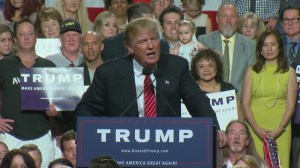
There is a particularly pernicious story making the rounds at the moment that Donald Trump supposedly called for the assassination of Hillary Clinton (again).
Donald J. Trump once again raised the specter of violence against Hillary Clinton, suggesting Friday that the Secret Service agents who guard her voluntarily disarm to “see what happens to her” without their protection.
“I think that her bodyguards should drop all weapons,” Mr. Trump said at a rally in Miami, to loud applause. “I think they should disarm. Immediately.”
He went on: “Let’s see what happens to her. Take their guns away, O.K. It’ll be very dangerous.”
In justifying his remarks, Mr. Trump falsely claimed that Mrs. Clinton wants to “destroy your Second Amendment,” apparently a reference to her gun control policies.
[..] On Friday night, breaking from his prepared remarks and turning his gaze from the teleprompters, Mr. Trump looked straight into the crowd as he made the insinuation about Mrs. Clinton’s safety. He gestured emphatically with his hands as he spoke, at one time pointing to a member in the crowd to find agreement.
In a sometimes bizarre 45-minute speech on Friday night, which opened with the unfurling of a new “Les Deplorables” battlefield flag backdrop, the Republican nominee went off-script to call for his opponent’s bodyguards to “disarm immediately” – adding, “Let’s see what happens to her.”
“Take their guns away!” Trump demanded to loud cheers during a section of the speech in which he said his rival wanted to “destroy your second amendment” and he accused Clinton of “arrogance and entitlement”.
In a statement, Clinton campaign manager Robby Mook denounced Trump’s comments: “Donald Trump, the Republican nominee for President, has a pattern of inciting people to violence. Whether this is done to provoke protesters at a rally or casually or even as a joke, it is an unacceptable quality in anyone seeking the job of Commander in Chief.”
“But we’ve seen again and again that no amount of failed resets can change who Donald Trump is.”
The call to leave the Democratic nominee protected by unarmed secret service agents, first made by Trump in May, raised eyebrows as a reversion to the undisciplined candidate of the primaries rather than the more scripted one of recent weeks. Trump also suggested in August that if Clinton was elected president, “the second amendment people” might be able to stop her from appointing judges. That statement was widely interpreted as a veiled assassination threat as well at the time.
The tone and inference of both of these articles are shockingly misleading.
The point that Donald Trump was making was that it is rather hypocritical of Hillary Clinton to advocate for stronger gun control laws which potentially limit the ability of the citizenry to defend itself when she herself is surrounded by the best trained and equipped armed guards in the world, and does not have to worry for her own safety. Trump was suggesting that were Clinton’s Secret Service protection revoked, forcing her to provide for her own personal security, she might not be so keen to limit the types of weapons available to private citizens.
Now, one can disagree with the premise of Trump’s point and poke all kinds of holes in the logic (though this blog considers the basic thrust of the argument to be quite sound), but by no stretch of the imagination does this amount to a snide assassination threat. It does not even amount to a charge of inciting his supporters to imagine the horrific scenario of an assassination. It is merely a reductio ad absurdum argument intended to make the point that well-protected senior members of the US government should perhaps refrain from dictating to ordinary Americans the manner in which they can defend themselves.
Trump obviously was making the point that he and countless others have made many times before: liberals like Hillary Clinton, who are protected 24/7 by armed guards, are deeply hypocritical when they try to disarm millions of Americans who don’t have taxpayer-funded protection and rely on their own firearms for self-defense. The point is a powerful one, which is why liberal reporters don’t want to acknowledge it. Instead, they absurdly pretend that Trump was hinting that Hillary should be assassinated.
This kind of thing fools no one. Millions of Americans are quietly fuming over the press’s overreach, going over the top, day after day, to defeat Donald Trump. The blowback is building, and will continue building until election day.
At one point, when I was opposing Trump during the GOP primaries, I said to the press: Stop attacking Trump! Liberal reporters often began with a valid point, but their hysterical hatred for Trump caused them to go too far, making arguments that were patently unfair and unsustainable. Therefore, the more they attacked Trump the more his support grew. The same thing is happening now: most Americans have a pretty good sense of fair play, and they know that Trump is being treated badly by the establishment–a group for whom most Americans have no great affection.
But the media, always on the lookout for the next Trumpian outrage, refused to see reality in these terms. Rather than reporting Trump’s rather simplistic but sound argument – one which was worthy of discussion and a response – many media outlets instead chose to claim, with no evidence, that Trump had done something far worse.
This blog has no problem calling out Donald Trump’s extreme and unacceptable language when he actually says something bad – the infamous “second amendment remedies” comment in August being of another order altogether. But on this occasion, Trump was not making an extremist or reckless point, though the media chose to report the two stories with the same level of outrage.
And it is this behaviour, right here, which erodes public trust in the mainstream media. It is tawdry, opportunistic media overreaches like this, so clearly betraying a seething partisan agenda, which drive decent but concerned citizens into the arms of the extremist fringe and the conspiracy theorists.
Sometimes, to watch the American media openly campaign for Hillary Clinton, one wonders if everybody else inhabits a slightly different universe. We all witnessed disturbing footage of Clinton’s lifeless body being dragged into the back of her waiting secret service van on the occasion of the 9/11 memorial in New York City, yet the chirpy presenter on MSNBC that afternoon casually announced that she merely “stumbled” a little – the definition of “stumbled” having been temporarily extended to include loss of motor control and even consciousness. What we see with our own eyes and what the media choose to report are increasingly two very different things.
And while Donald Trump has a treasure trove of past incendiary statements positively bulging with potential scandal, that is apparently not enough for the media – they must also twist Trump’s words and breathlessly and falsely report to the public that the Republican presidential nominee just called for the assassination of his rival.
You don’t need to admire or support Donald Trump to be outraged at the lazy, biased journalism on display here. This blog is certainly no Trump fan. But if someone does happen to support Trump then these unnecessary extra efforts by the media to demonise the candidate and his supporters will only harden their support and erode what little trust is left in the media.
Those perpetually outraged American liberals in the media, on the hunt for their next anti-Trump scandal, should bear in mind that hysterical and obviously-inflated charges will not have the effect of somehow “bringing Trump supporters to their senses”. On the contrary, it will simply drive Trump loyalists and even wavering voters to alternative, less scrupulous sources which echo rather than castigate their beliefs.
Lying to the American public and pretending that Donald Trump’s remarks were a de facto call for Hillary Clinton’s assassination will not cause a single person to flip from supporting Trump to supporting Clinton. But it will ensure that a number of readers wave goodbye to the New York Times and the Guardian, instead placing their trust in pro-Trump outlets like InfoWars or Mike Cernovich.
Now, is the catharsis of manufactured outrage and liberal media grandstanding really worth the potential risk of shoring up Trump’s base?
–
Support Semi-Partisan Politics with a one-time or recurring donation:
–
Agree with this article? Violently disagree? Scroll down to leave a comment.










 Semi-Partisan Politics