Not necessarily as exciting as a manned mission to another planetary body, but (given the current funding and political barriers to that goal which exist in America today) an important step toward human progress in space nonetheless – the first time that a commercially built and operated spacecraft has docked with the space station.
Perhaps it is a good thing that these kind of routine flights are now being handed off in their entirety to the private sector, where they can be refined and made more cost-effective. Now, governmental bodies (well, let’s not kid ourselves, just NASA really) will be free to devote more resources to new programmes with the aim of getting humans beyond low earth orbit again, for the first time since December 1972.
Well, stop blogging for a month or so and when you come back, the world has turned a little bit. The ratcheting up of the Euro crisis, the effective end to the Republican presidential nomination process, the sudden and complete inability of David Cameron’s Conservative Party to do anything right, in terms of either action or image… Guess I learned something there. Anyway, picking up where I left off in April…
So much handwringing in the media at the moment about President Obama’s political fortunes and reelection prospects!
Nothing inspires Democrats like the Barack Obama swagger – the supreme self-confidence on stage, the self-certainty in private.
So nothing inspires more angst than when that same Obama stumbles, as he has leaving the gate in 2012.
That’s the unmistakable reality for Democrats since Obama officially launched his reelection campaign three weeks ago. Obama, not Mitt Romney, is the one with the muddled message — and the one who often comes across as baldly political. Obama, not Romney, is the one facing blowback from his own party on the central issue of the campaign so far — Romney’s history with Bain Capital. And most remarkably, Obama, not Romney, is the one falling behind in fundraising.
…
National polls, which had shown Obama with a slight but steady lead over Romney through April, moved into a virtual tie this month — despite Romney’s clumsy conclusion to the GOP race.
The dirty little secret of campaigns is that there are usually just two messages. Either: Stay the Course or It’s Time for a Change. When Barack Obama won 53 percent of the popular vote and carried 28 states, just 14 percent of Americans thought we were moving in the right direction. So it was obviously a Time for a Change election. When Ronald Reagan and Bill Clinton coasted to easy reelections, the country’s mood was undeniably Stay the Course. The election coming up in November is stuck in between. Americans don’t know whether to forge ahead or swing back.
There are storm clouds on the horizon for Barack Obama’s re-election.
Democrats indulged in over-confidence during the Republican primaries. It was an understandable reaction to the chaos that came with all the pandering to the far-Right and the rise of frankly laughable candidates like Michele Bachmann and Herman Cain in the search for an alternative to Mitt Romney.
After that debacle, the Romney campaign manager’s promise of an “etch-a-sketch” moment to re-shake and re-shape public perception about their candidate seemed a dose too hopeful.
But only a month after the Republican primaries all but officially ended, we have a real horserace on our hands.
…
According to a new Washington Post/ABC poll, 30 percent of Americans say they are worse off than when President Obama took office in the depths of the fiscal crisis. This is comparable to the numbers President George HW Bush faced when he lost re-election to Bill Clinton in 1992.
And right now Obama and Romney are essentially tied when registered voters are asked who would be better at creating jobs and handling the economy.
Why do we do this to ourselves? Why spend so much time speculating about an event the outcome of which is almost a foregone conclusion?
I understand the motives of the professional media. People will not tune in to The Situation Room with Wolf Blitzer or Hardball with Chris Matthews in significant numbers to get their daily dose of the campaign ups and downs if they think that the result is already assured. That would mean less advertising revenues for the networks, and a huge army of unemployed cable news talking heads who would suddenly flood the market and push unemployment back up above 9%. So the word must continue to go out that the uninspirational, unpersonable technocrat who is unable to motivate his base and who campaigns like an electioneering android with a gaffe bug actually poses a serious threat to Obama’s reelection chances.
With regard to the professional media, I think there is also the bias factor. And by that I don’t mean the fact that all news outlets are biased in one direction or another, but actually the fact that all of the television and most print sources (even Fox News to some extent) strive to appear “balanced” when reporting the news, to tell both sides of the story (even if, in Fox’s case, the tone of voice, facial expressions and screen captions help to “guide” the viewer as to which side is correct).
At some point – and not being a student of journalism and media I don’t know when – good television reporting stopped meaning uncovering and reporting the truth, but rather reporting and giving equal weight to both sides of a story. So if Sam says the world is round but Bob says that it is a perfect cube, today’s headline will read “Sam and Bob spar in congress over shape of the world” rather than “Bob effectively ends his career with insane statement”.
But why do we ordinary people do it to ourselves? Are we just led by the media, or is there something else at work too?
I suppose that I will be doing the blogging walk of shame come November this year if the unthinkable occurs and Romney does become president-elect. But seriously. Are we all really so bored and in need of intrigue that we are going to kid ourselves that this one is even going to be close?
As I was browsing The Spectator website earlier today, I noticed a link to a piece from their archives, an article written to mark the consecration of the newly built Coventry Cathedral on 25 May 1962, half a century ago:
Coventry Cathedral was a temporary spiritual home for me during my time studying at nearby Warwick University, particularly during my second year when the university forced us into off-campus housing in the city. Though I converted to Roman Catholicism at the age of eighteen, I quickly grew to love the Anglican service of Choral Evensong, which I would sometimes attend first at my college in Cambridge and later while studying at Warwick. Though these periods were not anything approaching a high water mark in my ebbing and flowing faith, I do have very fond memories of attending Choral Evensong in these places, and feeling closer to God when I did so.
Coventry Cathedral is a particularly inspiring place. You can walk from the still, quiet, grey remains of the old Cathedral (largely destroyed during the Coventry Blitz on 14th November 1940) to the beautifully designed and lit tranquility of the new building, and the feeling when doing so is quite remarkable.
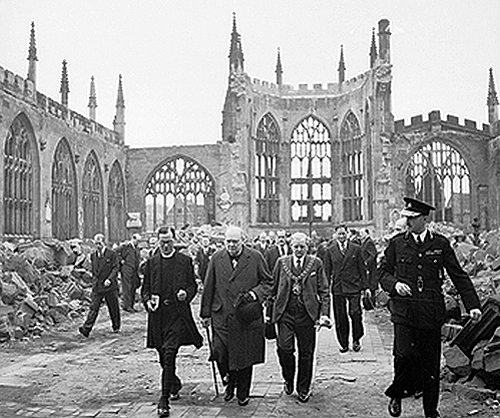
Prime Minister Churchill views the remains of the old Cathedral
The thoughts of the Spectator’s reviewer are worth quoting at some length:
As I stood just inside the glazed ‘west’ wall of Coventry Cathedral, beneath John Hutton’s gaily engraved angels — running, jumping and standing still — I was stunned by the richness of John Piper’s baptistery window, the absolute rightness of the Sutherland tapestry which fills the whole wall behind the altar and the simplicity and serenity of the ‘great barn’ itself — Sir Basil Spence’s own words — in which, from the main entrance, they are the only immediately visible works of art.
It would have been shattering enough simply to see the live version of the building I had admired in models and drawings for several years; it was much more disturbing to hear it. Just by chance, as I approached the cathedral it had been completed — by being filled with music. I cannot remember a more moving experience. With my hand still on one of the tiny bronze door knobs, sculpted as a child’s head by Epstein, I was hit simultaneously by shapes, colours and sounds — the fourteen slender pillars of reinforced concrete which suspend the timber- and-concrete vaulted canopy beneath the roof; the perpetual sunshine that bursts from the centre of deeper colours in the eighty-four-foot-high Piper window, and the familiar hymn tune which reached me — as I reminded myself in an effort to keep emotion in its place — by courtesy of Mr. David Lepine (performing with four manuals and seventy-three speaking stops) aided by acoustic slabs of cork and Weyroc, placed high above the vaulting, and the sound-absorbent surfaces of Sutherland’s Christ in Glory.
I half hoped that by turning my mind towards technical achievements of this kind I would suppress the urge to go away without having the impertinence to write a single word of adverse criticism about the cathedral. So I tore my thoughts away from the simple beauty of the font (a scooped-out boulder from the Holy Land) and Ralph Beyer’s superbly carved lettering on the white stone panels that flank the nave, and tried very hard to see the cathedral as an elegant box of functional tricks. But I had to give in. This is a great and humbling building — a building in which trivial criticisms merely make the critic himself feel trivial. Of course it is a box of functional tricks; but every trick is inspired and designed to help the real user of the building. This is a machine for Worshipping in — a cathedral built round the Communion service.
The ruins of the old Cathedral seamlessly morph into the new building designed by Sir Basil Spence
I like that phrase, “a machine for worshipping in”. I find that it describes very well the utility and efficiency of the building and its contents, as well as the streamlined, modern beauty of the furnishings and commissioned artworks. To my (very) amateur architecture enthusiast mind, Spence’s design epitomises the very best of mid-century architecture. Given the era in which it was commissioned, designed and built, the new cathedral could so easily have been a drab grey brutalist building (not that I object to all of those, but more on that in another blog post), one of many that were being enthusiastically erected up and down the country.
Light streams in through the stained glass of the baptistry window
I will always remember one occasion, one of the first times that I attended evensong at Coventry cathedral. Attendance was particularly light that particular Sunday evening, so one of the Deacons beckoned me from my normal seat in the Nave to sit in the row of seats behind the choir on the raised platform at the front of the church as they sometimes did when there were few attendees. Once I had been guided to my new, front-seat location, however, the Deacon was distracted by some other issue and neglected to tell any of the other arriving congregation members to follow my lead. Soon there was a small gaggle of twenty or so elderly parishioners sitting in their normal places in the Nave, and then me, sitting on the raised section behind the choir, with one of Sir Basil Spence’s soft spotlights gently highlighting my solitude.
And then the organ started to play.
The choir and ministers started to process through to their places from the back of the church, and as they got closer to me, I realised with growing alarm that two of the lead celebrants were walking down the same row that I was sitting on. Was I supposed to move out of their way, or stay there, or acknowledge them or ignore them? I decided to ignore them, and stood there like a lemon while the two men in pointy hats took up position next to me behind the choir. They didn’t seem to be put out at my presence so I figured that maybe I was okay. Not so much.
It wasn’t that anything bad happened; it’s just that in much the same way as you wouldn’t necessarily expect or want to be strapped in next to the pilot for the duration of a commercial flight from London to Paris, neither would you want to be sitting right next to the con-celebrant of a choral evensong service, between him and the congregation, in a large cathedral, when you are not that familiar with the order of service, and haven’t quite mastered the basics of when to stand up and sit down. That’s all I’m saying.
The following week I sat far enough back in the regular seats that the Deacon would not notice me before the service and invite me to “come on down”.
Anyway, enough of rambling anecdotes. I am out of practice at blogging and I’m pretty sure that I need an editor.
But let me close this post by wishing a very happy 50th birthday and a long life ahead to an old friend.
Politico reports that Republicans are protesting that the Democrats are refusing to help them undo automatic cuts to the defense budget agreed as part of the previous debt ceiling deal. Apparently, allowing these automatic cuts to government spending to take effect would risk plunging the US economy back into recession:
Sen. Harry Reid’s refusal to “back off” looming cuts to the Pentagon won’t just harm the nation’s security, Republicans say. It could plunge the fragile U.S. economy back into a recession next year.
GOP defense hawks struck back at the Senate majority leader Thursday for insisting he won’t stave off or delay $600 billion in automatic defense cuts unless Republicans budge on new revenues.
President Barack Obama’s top military advisers, including Defense Secretary Leon Panetta, have warned that the so-called defense sequestration would weaken national security, Republicans said. And a report from the nonpartisan Congressional Budget Office this week handed the GOP more ammunition: It concluded that spending cuts and tax hikes set to take effect in January would stall the economic recovery — at least in the short term.
Yes. Republicans, who have been busy blaming Obama’s stimulus package and increased government spending in general for the current slow rate of economic growth in the US, now say that cutting government spending would put the recovery in jeopardy. Hmm.
Okay, so what do we learn from this snazzy little pirouette by congressional Republicans? Wait, “learn” is the wrong word, let me rephrase. What tired, depressing old certainty is reinforced upon our weary souls by this latest spat?
1. When Democrats expand or maintain government spending for their pet projects (infrastructure, public services, welfare), it increases the deficit, adds to the national debt and is a grave mistake, but when Republicans expand or maintain government spending for their pet projects (like defense), they are taking vital steps to prevent a double-dip recession.
2. People will invoke the Congressional Budget Office to win an argument whenever the CBO pronouncement supports what they want to do, and they will ignore it or trash it if the CBO pronouncement suggests that what they want to do may be unwise.
Neither party exactly makes a serious play for the fiscal responsibility trophy here, but for sheer, barefaced hypocrisy on the matter, it is definitely the Republicans who flunk this round.