In Praise of Glenn Greenwald, Ctd.

A lecture given to students at Yale Law School, based on Greenwald’s recent book, “With Liberty And Justice For Some”:


This lecture is well worth a view, and is a wonderful antidote to the oversimplification of over-used terms such as “the rule of law”,  and the attempt by many people (especially those on the American right) to almost deify the founding fathers and portray them as a unified, homogenised group.

The crux of Greenwald’s argument really comes in an anecdote he gives 28 minutes into the above video, where he contrasts a “healthy, free” society with a tyrannical one. The free society, he says, is one in which those who wield power do so with a healthy amount of fear that they will suffer some harm if they ever abuse that power. This may be fear of civil or criminal liability, fear of reputational harm or fear of potential physical injury to themselves (which of course neither Greenwald nor I would advocate, but nonetheless).

The tyrannical society is the exact opposite of this – a land where not only do those in power have no fears of any kind which might restrain them from abusing their power, but in which the citizens themselves live in fear of the leaders.

Given the fact that we are now five years into an Obama administration in which almost none of the gross infringements on civil liberties introduced by George W. Bush and Dick Cheney have been halted or reversed, this insight from Greenwald – and a fearless, uncompromising assessment of where we currently sit on the continuum between freedom and tyranny – is needed now more than ever.

In Praise of Glenn Greenwald

Glenn Greenwald, former blogger at Salon.com and now writing at The Guardian, is one of the best and most articulate people talking about civil liberties and pressing back against the intrusive power of the government today.

Exhibit 1, in which he tears apart the war criminal Dick Cheney for the casual way in which he celebrated his own lawbreaking and contempt for the US constitution on the eve of the publication of his memoirs:


Exhibit 2, in which he rips into CNN (both the network, the host and her former Bush administration talking head stooge) for their coverage of Julian Assange and the WikiLeaks scandal:


And finally exhibit 3, in which he takes on Bill Maher and Andrew Sullivan in a roundtable discussion on the morality and constitutionality of extra-judicially ordered drone strikes on US citizens.


Keep fighting the good fight, Glenn.

The Cowardice Of The American Right

It was recently confirmed that Dzhokhar Tsarnaev, the surviving suspect in the Boston Marathon bombing investigation, has been presented with criminal charges for his actions.

Predictably, this has made many people on the American right wing very unhappy indeed.

Fox News had devoted hours of coverage post-capture to whether or not Tsarnaev should be read his miranda rights, and the talking heads are not pleased with this turn of events, which will see the suspect given access to legal advice and representation if he chooses to avail himself of it.

The ever-opportunistic Lindsey Graham has been vigorously agitating for Tsarnaev to be treated as an enemy combatant, despite being a United States citizen detained on US soil.

And Donald Trump – whom Republicans actually toyed with the idea of making their presidential nominee in 2012 – took to Twitter in high outrage, and was already dusting off his waterboard in order to torture the suspect before the criminal charges were filed.

All of these things happened, and were easily predictable, because the Republicans are the ones with the strong national security credentials, right? They are the ones that make the tough decisions required to keep us safe.

No. All of these things happened because the Republicans who espouse these views are cowards.

Cowards, cowards, cowards.

Of course, this form of cowardice has to masquerade as macho strength and firmness, but cowardice is what it is, and cowardice is what I will call it today.

There is no evidence as yet that the evil plot to kill and maim innocent civilians as they watched and ran in the Boston Marathon was part of a wider international conspiracy. It may be the case that the suspects acted under foreign direction, or received their radicalisation or training from abroad, but no evidence of this has yet been presented.

Neither is there any credible intelligence that these attacks were the first action of a broader wave of related strikes on the US mainland. Yes, there followed some suspicious mail packages in the following days, as happened after 9/11, but these are not thought to be related.

Nor does anyone yet know the motivations for the attack (not that this should matter – as with capriciously invented “hate crimes”, we should be punishing the act, not the motivation), whether it be jihadist in nature, domestic grievances or the alienation and evil act of specific individuals acting alone.

None of this is known.

And yet the Republican party – this group of people who routinely and unabashedly wrap themselves in the American flag and proclaim themselves the only real “patriots” and defenders of the constitution, would happily, eagerly, throw away some of the most fundamental rights granted to US citizens under the constitution.

It is absolutely astonishing that no one calls out the GOP for the rank hypocrisy which has emanated from the mouths of some of their members in the aftermath of the Boston Marathon bombings.

That the same party who proclaimed “I Stand With Rand” when Senator Rand Paul mounted his laudable filibuster to register his objection to the idea of aerial drone strikes being used to kill US citizens on US soil denied those very same principles and agitated for the government to strip those same citizens of the right to a civilian trial.

These are the people, remember, who like to pump up their base with talk of second amendment remedies – because if you can’t beat Obama at the ballot box, the answer, of course, is to strap on your guns, rise up and overthrow his democratic mandate by force.

This is the party that says “you can pry my rifle from my cold dead hands” whenever anyone questions the modern applicability of, or limits to, the Second Amendment.

These are the people who take the fight to the enemy, who pre-emptively launch wars in order to “fight them over there so we don’t have to fight them over here”.

In other words, those on the neo-conservative right in America like to play the hard man, and strut around as though there were a very large, impressive appendage between their legs whenever they talk about foreign policy or national security. Right up until the moment that something happens to spook them close to their own back yard.

But when the nation suffers an attack such as that which took place last Monday in Boston, all of the tough talk disappears and these Republican armchair warriors rush to shelter behind the legs of the Big Government that they love to trash at all other times, and they urge that erstwhile-“tyrannical” government to use the full weight of its vast might, plus an added heap of unconstitutionally appropriated power, to hurt the Bad People and make them go away. Even if the Bad People are US citizens. It’s pathetic.

Weak, weak, weak.

Andrew Sullivan says it best today on his blog, and I quote in full:

The first US citizen, Jose Padilla, was captured on US soil, detained without formal charges, accused of plotting a dirty bomb, and then brutally tortured until he was a human wreck. Eventually, the dirty bomb charges were dropped in the legal process. And there was a serious question about whether, after such brutal torture and isolation, he had been psychologically brutalized by his own government to the point of insanity.

Tsarnaev, in contrast, was formally charged this morning, will be tried in a civilian court, go through due process, and face a weight of evidence against him.

This is why we elected Obama. To bring America back. To defend this country without betraying its core principles.

Hear, hear.

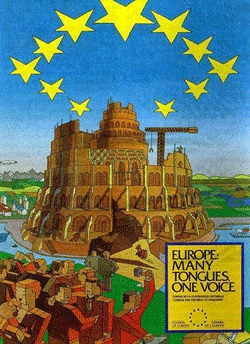
The Spirituality of the European Union

EU church religion


St George’s Day brings yet another wildly misguided and inappropriate intervention from a Church of England bishop, this time the Rt Rev Michael Langrish, Bishop of Exeter.

While back-handedly praising Prime Minister David Cameron for the zeal of some of his reforming efforts, he goes on to expound at length on the question of whether Cameron might be – wittingly or unwittingly – undermining the “deep spiritual roots” of the European Union.

From The Telegraph:

The Rt Rev Michael Langrish, who sits in the House of Lords, told Peers that he was concerned that Mr Cameron’s policies could contribute to the “loss of the European soul”.

He told how the European project has “deep spiritual roots” and said the Church of England “engages with the EU itself through its own representation and structures”.

The Bishop of Exeter is, of course, a Lord Spiritual, one of those Church of England bishops given the right and authority – unique among leaders of all other religions and denominations in this country – to sit in the upper house of the British parliament and meddle in our lawmaking. The Telegraph continues:

Speaking in the House of Lords this week the Rt Rev Langrish insisted that the Church of England has a “European perspective”.

“It may be thought that the Church of England does not have a particularly European perspective, but that is far from being the case,” he said. “Through its diocese in Europe it is present in all the member states of the EU. It has effective links with other churches throughout Europe and is active in the Conference of European Churches. Together with our partner churches, we are also deeply aware of some of the roots of the EU and the vision of its founders in Catholic social teaching.”

First of all – deep spiritual roots? Really? I am not wholly ignorant of Catholic social teaching, and I am probably better informed than most about the history and development of the European project from its humble beginnings as the European Coal & Steel Community. In my misguided undergraduate days I curated a half-hearted, rightly neglected website called the Pro-European Alliance which aimed to explain some of this history and spin it in a way that case favourable light on the modern-day European Union.

Bishop Langrish’s attempt to describe the institutions, mechanisms and workings of the EU as having any spiritual dimension to them whatsoever seem to be a rhetorical step too far. That is not to say that there was or is nothing noble in the idea and reality of the EU. Binding the fractious nations of Europe together through increased trade, some common institutions and a mechanism to resolve local disputes was undoubtedly a good thing. So potentially a tenuous argument could be made that the existence of an organisation such as the EU served or serves some spiritual goal.

But the European Parliament? The Council of Ministers? The Commission, which hasn’t produced an audit-worthy budget and financial statements for years beyond counting? The European Courts? How do any of these inefficient, undemocratic, self-serving institutions, created by bureaucrats to serve the interests of bureaucrats, nourish the roots of spirituality? In any way?

The only way that one can see any spiritual element to any of this is if one subscribes to the view that the nation state and international institutions are the most suitable – or only acceptable – forums for key aspects of the modern welfare state such as regulation, income redistribution and the like to be administered. That people are inherently selfish, thoroughly unaltruistic, and that only through government coercion (either at a national or European level) can we make ourselves administer fair justice and look after the weak and vulnerable in our societies.

And of course this is exactly what large swathes (though not all) of the Church of England does believe today – see “Christ would not privatise our NHS” as just another recent, damning example. Build and maintain a big state sector to do all of the things that humans are too selfish or wicked to do of their own volition for the good of their fellow men, and criticise anyone who holds opposing views from the pulpit every Sunday.

The Bishop concludes:

“I hope that the failure of successive British Governments to articulate a coherent and constructive policy towards our European partners and to manage to take public opinion along with this will not contribute to that loss of the European soul.”

When the Bishop of Exeter defends the spiritual roots of the European Union and attacks David Cameron for seeking to repatriate powers from the EU and return them to the nation state or to the individual, not only is he wrong, but in so doing he is no less than abdicating his own Church’s spiritual roots and its responsibility to empower and enlighten the individual.

On St George’s Day

AGF5X3


Today is April 23rd, St. George’s Day.

Saint George is the patron saint of England, and so by all rights I should be lounging in the sun in a pub’s beer garden, drinking a pint of proper English ale and celebrating all that is great and good about my country.

I am, of course, doing none of those things, and not just because I have to work today.

Ed West, writing in The Telegraph, has an interesting perspective on why he is unenthused about our national day of identity celebrating and enforced cheerfulness:

In summary, the whole national day was invented to sell tat, just as Irish national identity was created to sell beer and expensive woollen fabrics to Americans. I have no interest in celebrating St George’s Day, not because I’m ashamed of our national identity, but because I’m secure in it. After all, I don’t need to ask myself what being a West “means” or what my family identity is; it’s just my family. English people never used to ask what Englishness meant, because there was no need to; it was one of those things. You knew it when you saw it.

The idea of what a national identity should mean has only arisen in the age of mass movement, in response to intellectuals who have denied the idea of the nation as a family as too exclusive or discriminatory. New Labour came up with all sorts of strange notions about what Britishness “meant”, such as “tolerance” and “respect for other cultures”, when it means nothing except coming from Britain, being descended from British people, or adopting Britain as your home (a nation is a family, and just like any family it adopts and marries out).

He goes on to conclude:

As a result we’re having to reinvent tradition, but it all feels a bit pained and unnatural, when this is a day best left to the church. A far better national day would be June 15, Magna Carta Day: a day to celebrate the rule of law and individual freedom, concepts that, contrary to what people believe, do not just spring from nowhere but are intimately linked to the concept of England as a political entity. That’s what makes me feel proud, but most of all grateful, to be English.

On this concluding point, West and I are in total agreement.

I cannot bring myself to excitedly celebrate St George’s Day, because of all the many great, awe-inspiring things that my country has done (and I honestly feel more British than English – or at least both identities cohabit comfortably in my mind in just the same way that one can be both a proud Texan and an American), St George had nothing to do with any of them.

St. George didn’t write or sign the Magna Carta.

St. George didn’t defeat the Spanish Armada, or win the battle of Trafalgar.

St. George didn’t invent the telephone, television, jet engine or the world wide web.

St. George didn’t grant womens suffrage, abolish slavery, establish the NHS (of which I’m no particular fan, but which is viewed as an almost religious national symbol by many in this country).

St. George didn’t stand alone against the threat of Nazi Germany, and then go on to win the cause of freedom.

Any of these accomplishments offer tangible historic feats that could be used as the basis for a national patriotic day that could truly bind us all together as a nation – English, Welsh, Scottish and Northern Irish together – and which could properly be used to reflect and celebrate our nation, just as Independence Day is rightly used in the United States.

But St. George’s Day – no thank you.