On Renouncing Bigotry

Some very welcome news today from an organisation called Exodus International, an American-based Christian ministry that has courted much controversy in the past by advocating and practicing gay reparative (or conversion) therapy.

As does Marcus Bachmann

The leader of Exodus International, Alan Chambers, has published a seemingly very sincere and heartfelt apology for the pain and suffering that his organisation caused to those who came to seek “help” for their homosexual orientation:

And then there is the trauma that I have caused. There were several years that I conveniently omitted my ongoing same-sex attractions. I was afraid to share them as readily and easily as I do today. They brought me tremendous shame and I hid them in the hopes they would go away. Looking back, it seems so odd that I thought I could do something to make them stop. Today, however, I accept these feelings as parts of my life that will likely always be there. The days of feeling shame over being human in that way are long over, and I feel free simply accepting myself as my wife and family does. As my friends do. As God does.

Never in a million years would I intentionally hurt another person. Yet, here I sit having hurt so many by failing to acknowledge the pain some affiliated with Exodus International caused, and by failing to share the whole truth about my own story. My good intentions matter very little and fail to diminish the pain and hurt others have experienced on my watch. The good that we have done at Exodus is overshadowed by all of this.

On a very personal note, he continues:

Please know that I am deeply sorry. I am sorry for the pain and hurt many of you have experienced. I am sorry that some of you spent years working through the shame and guilt you felt when your attractions didn’t change. I am sorry we promoted sexual orientation change efforts and reparative theories about sexual orientation that stigmatized parents. I am sorry that there were times I didn’t stand up to people publicly “on my side” who called you names like sodomite—or worse. I am sorry that I, knowing some of you so well, failed to share publicly that the gay and lesbian people I know were every bit as capable of being amazing parents as the straight people that I know. I am sorry that when I celebrated a person coming to Christ and surrendering their sexuality to Him that I callously celebrated the end of relationships that broke your heart. I am sorry that I have communicated that you and your families are less than me and mine.

This is a rare, almost unprecedented volte-face from a Christian organisation that was until recently so stridently anti-gay. As is often the case with those most vociferously outspoken against homosexuality, the leader of the organisation himself admits to having same-sex attractions of his own. We see this time and time again with the many (usually Republican/Conservative Party) politicians who seem to spend every waking moment condemning homosexuality as an abomination, before being caught in a compromising position which rather undermines their legitimacy to talk about the subject.

Andrew Brown, writing in the The Guardian, is impressed with this very public and humble change of heart:

I think this deserves credit as a genuine example of repentance and public admission of shameful behaviour. It is not up to me to forgive him but I find it rather heartening.

The other interesting thing is that he hasn’t actually changed his mind about what the Bible says about gay sex. He still thinks it’s condemned. But he will no longer condemn it himself: “I cannot apologise for my deeply held biblical beliefs about the boundaries I see in scripture surrounding sex, but I will exercise my beliefs with great care and respect for those who do not share them. I cannot apologise for my beliefs about marriage. But I do not have any desire to fight you on your beliefs or the rights that you seek.”

Something like this must be what ought to be meant by the hideous cant phrase about hating the sin, but loving the sinner.

Andrew Sullivan celebrates what he calls an “unconditional surrender in the culture war”:

It’s very rare that one side in a culture war actively renounces its past positions and embraces a new one. That’s particularly true on the Christianist right, where absolutes hold sway, regardless of doubt or charity. So today is a banner day for those of us who have long fought for the equal dignity of homosexuals as children of the same God as heterosexuals, and deserving of no less love and support.

And with regard to the statement itself, he continues:

That’s an enormous statement given the recent past and, to me, a sign of God’s grace. That’s why when I say “unconditional surrender,” I hope Exodus won’t regard that as some kind of victory lap. It isn’t. It just springs from a deep appreciation of their grace-filled decision to re-examine their conduct as Christians and see where the world may have led them astray. Anyone in the public sphere who openly and candidly comes to terms with an error of judgment, and owns it, and even seeks forgiveness for it, is contributing to a more humane, honest conversation and dialogue.

This statement and change of heart from Exodus International is very welcome news indeed. May it spur other people, groups and denominations within the Church to also re-examine their consciences, and seek to welcome and love rather than try to “heal”.

Our Superficial Media

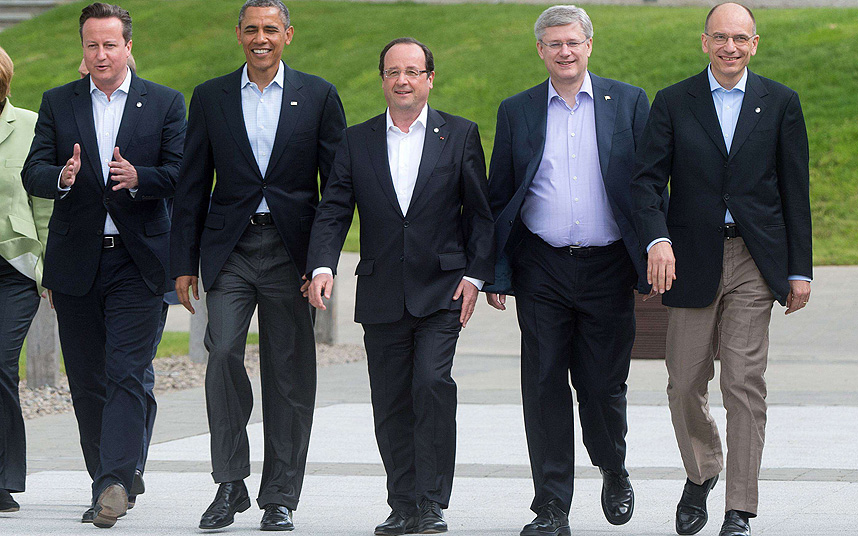
The G8 summit in Lough Erne, Northern Ireland, finished some days ago now, but our intrepid journalists in the press are still on the case, poring over and analysing the ramifications and outcomes of this latest summit.

Unfortunately, the minds of our (supposedly) best journalists and bloggers are not concentrated on the policy substance of what was (and was not) agreed at the meeting, distracted as they are by something far more important and consequential – the fact that David Cameron insisted on a smart-casual dress code for the world leaders at this year’s G8, rather than the buttoned-up suit and tie look that is par for the course at these events.

They mean serious business because the ties have come off

Iain Dale, writing at Conservative Home, sniffs:

Whoever chose Lough Erne as the venue for the G8 should get some kind of honour. As a PR exercise it couldn’t be faulted. The countryside backdrops to all the interviews and press conferences were simply stunning. Less stunning, though, was the fact that David Cameron seemed to have a physical aversion to wearing a tie at any point during the event. Orders had clearly gone out from Number Ten that this was a ‘dress down’ G8, although it was rather difficult to tell whether Angela Merkel had got the message, as in all the pictures I saw she seemed to be wearing the same, tired old lime green jacket. I assume she brought a change of underwear.

What penetrating insight. In The Telegraph, Benedict Brogan thunders:

G8 summits are notorious for their sartorial excesses: matching floral shirts, ponchos, stetsons, it has become a commonplace for the host country to rope the visitors into trying on some sort of local dress. Yet what happens when the world’s most powerful men (sic) gather in the UK? We make them dress like bachelors emerging into the bleary dawn after a vigorous stag party. We might as well ask them to wear jeans. What’s wrong with a bit of understated English tailoring, as a way of plugging one of our more successful exports? In fact, it’s London Fashion Week. There’s all kind of natty pastel numbers available, rather than the blue blazers. But for my money, they should tie one on to show they take the taxpayer – and their responsibilities – seriously.

Someone might be so kind to remind Mr. Brogan that he would be taking his responsibilities as a journalist for a prestigious newspaper more seriously if he focused on the policy agenda of the G8 summit, and not the dress code.

Even The Guardian gets in on the act, with a dedicated feature in their Fashion section:

Not for the first time, the dress code has proved to be one of the trickier aspects of the G8 agenda. Style novice George Osborne underlined the dilemma with his sartorial excuse to BBC Breakfast on Tuesday. “I’m doing what I was asked,” he said. “I got out my jacket and blue shirt.” Forget tax and Syria, smart-casual is tough for these guys.

Cameron demonstrated yet again that for him sleeves rolled up and no jacket semaphores getting down to business. He famously did it on the campaign trail all-nighter and he’s done it at Lough Erne. For him a suit jacket and tie is for everyday prime ministerial humdrum but real power dressing – when he’s hosting international leaders – means pale blue cotton and unironed chinos.

But the real gem comes from the sub-headline to that same Guardian article, which reads as follows:

Forget tax and Syria, smart-casual is tough for these guys. Cameron demonstrated yet again that for him sleeves rolled up and no jacket semaphores getting down to business.

Forget tax and Syria. Indeed. Some people certainly have; unfortunately, they are the people whose job it is to hold our elected leaders to account, to scrutinise, analyse and challenge their activities and policy decisions. With a barely growing economy, persistently high unemployment (we recently celebrated the economy adding 5000 new jobs – a paltry 5000 in country of 65,000,000!) and widespread dissatisfaction with his leadership, David Cameron must have been delighted to be taken to task over his sartorial choices rather than his lacklustre/harmful economic policies and desire for more middle-east adventuring in Syria.

The journalists will no doubt counter that there is a “legitimate public interest” in stories like this, that the public are interested and want to know, justifying all of their column inches on rolled-up shirtsleeves and ties, and the dearth of column inches on the outcomes of the G8 summit. This argument is complete claptrap. The journalists themselves generate the public interest in these process-driven non-stories, thus justifying (in their minds) their decision to cover them in ever increasing detail. After all, it’s far easier to sit at your laptop for twenty minutes and bang out a vapid column about the fashion choices of our politicians than it is to do some real journalism, and pore through meeting minutes and policy papers to educate and inform the public as to what is really going on.

Enough of superficial political “journalism”. David Cameron, Barack Obama and the other six can wear matching gimp costumes to the G8 for all I care; what matters is whether they (for once) manage to cook up some policies that actually benefit the non-elites in our respective countries, and (wishfully thinking) take positive steps toward hammering out a comprehensive EU-US free trade treaty.

But I’m not holding out much hope. Our leaders don’t have the best track record when it comes to acting in our interests, and “journalists” such as Iain Dale and Benedict Brogan seem more interested in clucking disapprovingly at their outfits than scrutinising the decisions that they make.

The GOP’s Immigration Reform Game Theory Dilemma

My Nemesis

When I was in primary school, at about the age of eight, we had a class assignment to make our own abacuses out of wood. We lovingly spent ages glueing them together and painting them with bright colours – to this day, I am still quite proud of that piece of craftsmanship.

The next day, we were due to use our homemade abacuses in class as part of the maths lesson, and it was then that I brought disaster upon myself and earned the wrath of my entire class. There was a girl who had been sick at home the previous day when we were engaged in our arts & crafts, and who consequently didn’t have an abacus of her own to use when the time came. Our teacher approached my desk, where I sat with my best friend Scott, and asked us if we could lend one of our abacuses to the girl so that she could participate in the lesson.

Uh-oh. I looked at Scott. He looked at me. I didn’t want to let me new abacus out of my sight – it was brand new and I hadn’t had a chance to use it yet. Scott clearly felt the same way, even though his model was crooked, garishly painted and looked as though someone had taken an axe to it. I broke the silence first: “Scott, do you want to…?” but he countered “Sam, do you want to…?” (originality was never his strong point).

The teacher became impatient and told us to make up our minds who would lend out their abacus, or the lesson would go ahead sans abacuses for everyone in the class. And still we prevaricated. Even though both Scott and I knew that everyone else in the class was getting increasingly pissed off with us, and that we were in grave danger of ruining the fun lesson for everyone, we couldn’t compromise. So the lesson was cancelled, and Scott and I sat alone at lunch that day.

I recall this long-winded story because the Republican Party is currently making the exact same error that I made when I was eight years old and in primary school, with respect to their stance on immigration reform. Only they have infinitely less excuse, because they are not eight years old (perhaps in mental age) and are paid handsome federal salaries to produce legislation to solve problems.

The Huffington Post reports:

Many House Republicans are chilly or openly hostile to the bipartisan bill before the Senate, embraced by President Barack Obama. Even substantial changes to the bill may do little to placate these lawmakers, who demand strict crackdowns on unlawful border crossings and no “amnesty” for people here illegally.

These Republicans don’t deny that weak support from Hispanic voters is hurting GOP presidential nominees. And they concede the problem may worsen if Latinos think Republicans are blocking “immigration reform.”

These House members, however, worry much more about their own constituents’ opposition to the proposed changes. And they fear a challenge in the next Republican primary if they ignore those concerns.

“It’s hard to argue with the polling they’ve been getting from the national level,” said Rep. Kenny Marchant, R-Texas, referring to signs of serious problems for Republican presidential candidates if immigration laws aren’t rewritten. “I just don’t experience it locally.”

Even the house members themselves admit this gap between the interests of the national party and their local districts. The article goes on to explain the reasoning behind House Republicans’ stances in more detail:

House Republicans, however, spend far more time talking and worrying about their own election prospects, not the next presidential nominee’s.

“It’s a classic challenge when the best interests of the party are at odds with the best interests of the majority of the members individually,” said Rep. Tom Cole, R-Okla. He is close to Speaker John Boehner and other Republican leaders who want a major immigration bill to pass.

“What it takes to get a deal with a Democratic Senate and a Democratic president makes it extraordinarily difficult for a lot of (House) members,” Cole said, “because it can cause you a big problem in your primary.”

Ah yes, the much-feared Tea Party challenge from the right. That nagging fear in the back of the minds of all Republican congressmen and women in this age of the Unreasonable GOP. The fear that leads to gems like this:

Rep. Paul Broun, also seeking Georgia’s Senate nomination, said any immigration deal “must make English the official language of the country.” The U.S.-Mexican border, he said, must be secured “totally, whatever it takes. A double fence high enough to make sure it’s secure.”

Some Republicans wince at talk of massive double fences and making English the official language. They say it fuels arguments that the GOP is unwelcoming to all Hispanics, legal or not.

Hispanic voters are not a homogeneous block, and it would be patronising in the extreme to assume (as many do) that Hispanic disenchantment with the GOP is exclusively due to their policy on immigration reform and what to do with illegal immigrants already settled in the country. Hispanics, like every other voter block, have a whole web of different voting priorities. But with language like this from Rep. Paul Broun (incidentally nominated as America’s Craziest Congressman by Bill Maher), it is not hard to understand how the Republicans managed to lose the Hispanic vote 27-71% in 2012.

I generally don’t like to write articles about process, i.e. the mechanics of how a particular bill gets passed, or the ways in which parties and politicians manoeuvre for advantage. That stuff is usually personality-based gossip of secondary importance, and is covered more than enough by the likes of Politico. But in this case, the process is genuinely interesting and has ramifications that go way beyond who wins the news cycle on a given day, and therefore I decided that it is worthy of comment and discussion.

At some point the Republicans are going to have to make a choice. They cannot claim to be a national party with aspirations of winning future presidential elections without addressing the fact that they overwhelmingly lost the Black, Hispanic, Asian and Female vote in 2012. Yes, in the immediate aftermath of Mitt Romney’s implosion there was a little bit of hand-wringing and soul-searching, but we are now very much back to business-as-usual.

Scarcely a week passes without some new Republican (male) politician deciding to hold forth on the topic of rape in front of a live microphone, or accuse American Muslims of being complicit in terrorist attacks when they don’t denounce them as loudly as is apparently required, or talking about the superiority of a “man’s brain” when it comes to analysing the implications of laws such as ObamaCare.

These cheap, nasty little stunts might play very well back home in their heavily gerrymandered conservative districts, but they will be fatal for the Republicans in 2016. But right now, the party that likes to campaign under slogans such as “Country First” is fragmented, self-serving and unable to step back and solve any problem bigger than avoiding a Tea Party primary challenge.

But It Keeps Getting Worse …

Andrew Sullivan correctly calls out prominent Republicans for their failure to heed ANY of the lessons of 2012, as evidenced by their most prominent leaders turning up to address the Christianist Faith & Freedom Coalition conference with typically fiery, apocalyptic rhetoric.

Andrew Sullivan's avatarThe Dish

I keep being told that the Christianist base of the GOP is calming down, they learned their lesson, they’re not that important, etc. Josh Barro said that in a recent Ask Anything. Ross and Reihan are always poo-pooing the notion. So why did everyone who’s anyone in the GOP turn up for Ralph Reed’s religion-fest last weekend? Rubio, Paul, Jeb, Ryan, to name four, along with the usual nutters. Even Rand Paul – the supposed libertarian – said that there was a “war on Christianity” being conducted by “liberal elites at home and across the world.” And Cain and Palin – two essentially ridiculous figures – are still taken seriously. Alleged sexual harasser Cain:

This train is running full speed down the tracks towards socialism and towards communism. Yes, I said it. Before we stop it and reverse it, we got to slow it down. That’s what we do…

View original post 116 more words

On EU Secession And Straw Man Arguments

Another day, another newspaper column from a political has-been lecturing us on why leaving the European Union or renegotiating our terms of membership would be terrible, just terrible, and consign us to the lowly status of a third world country, adrift in the sea of globalisation with no friends and no influence.

The newspaper columns tend to follow the exact same template, and this time it was the turn of Kenneth Clarke, writing in The Telegraph, to gently explain to us stupid “swivel-eyed” nationalist loons exactly why our views are undermining Britain and putting our future at risk. He writes, with reference to the potential EU-US free trade agreement currently being discussed at the fringes of the G8 meeting in Lough Erne:

For, irony of ironies, it is of course the EU that is making deals with America and Canada possible. It should come as no surprise that President Obama’s officials have commented that they would have “very little appetite” for a deal with the British alone. Quite simply, the political commitment and dedication that the creation of a free market encompassing over 800 million people, 47 per cent of world GDP, and boosting the combined economies of the EU and the US by nearly £180 billion, could only ever be made by the leaders of evenly matched economic blocs.

What nonsense. While this statement may be true for some of the smaller EU member states, until you reach about Spain size, it certainly does not apply to the United Kingdom. Why would any country not wish to negotiate bilaterally with the sixth largest economy in the world, and miss out on the many benefits of tariff-free access to such a large hub of industry, innovation, technology, arts and sciences? Ken Clarke would have us tremble in fear that the mighty President Obama might overlook pathetic, little old Britain if we dared to stand on our own, but he certainly pays attention to the likes of India, Russia, Mexico, Saudi Arabia and countless other countries with much lower nominal GDP than the United Kingdom, so that argument hardly stands up.

But of course, Ken Clarke doesn’t need his arguments to bear scrutiny, because they are straw men. He assumes that a Britain outside of the European Union would automatically be isolated, introverted and inward-looking, seeking to shut itself off from the world, but he is putting words into the mouths of the Eurosceptics. He disingenuously proclaims:

There always has been something of the romantic in the British soul. We can’t fail to be stirred by Charge of the Light Brigade visions of Britain standing alone against the odds. It is the same sentiment behind the idea of exchanging the EU for Nafta.

But, in the end, we are a practical race. We know that the empire on which the sun never set was created by intrepid, relentlessly outward-facing adventurers and administrators, not isolationist John Bulls. That “Brexit” would mean curtains for our ability to have any leadership role in world-defining plays like these free-trade agreements would greatly disturb us. Accepting a diminished situation in which the UK is forced to trade by EU rules which it has had no say in setting is simply not in our nature.

I don’t know of any anti-EU people who want to create a Fortress Britain and isolate ourselves from the world – in fact, quite the opposite is true. We feel that the ever more onerous conditions and regulations that must be observed as part of our EU membership damage our national competitiveness and make it harder for us to do the business that we want to do with the rest of the world. If the EU were simply a free trade area then remaining an EU member to negotiate an agreement with NAFTA or the US would make the utmost sense. But the ever-closer union has become so much more than that, spawning parliaments, commissions, foreign policy chiefs, “human rights” courts, and generally extending its tentacles into every aspect of national life. How does Ken Clarke imagine being beholden to all of these anti-democratic institutions improves our leverage or bargaining position when it comes to discussing matters of free trade?

Of course, Clarke is deeply invested in the success and longevity of the European project. He himself is a current member of the secretive Bilderberg group which in the post-war years was instrumental in formulating many of the policies and initiatives that have helped to bring us to our ever-closer union with our European neighbours and allies. Indeed, at the most recent Bilderberg Group meeting in Watford, England, one of the agenda items specifically focused on “the politics of the EU”, which you can read as “how to make the masses support our floundering European project”. The last thing that he would want is to undo his organisation’s stated objectives of weakening the institution of the nation state in favour of larger, pan-national, anti-democratic organisations. The European Union serves the needs of his political and corporatist friends very well indeed; the average voter, less so.

Personally, I don’t appreciate being talked down to by the likes of Ken Clarke, so in retaliation I am going to post this video of him, taken at a campaign event while he still held fairly high political office, being too fat to get out of a racing car that he was inspecting (skip to the 7 minute mark):


I’ll change my views on Britain’s need to leave the European Union, or at least drastically renegotiate our terms of membership the day that Ken goes on a diet.