Living In The Shadow Of The Bomb

Slate Magazine has a thought-provoking article exploring the condition of disused above-ground nuclear test sites in the former Soviet Union, and the nascent tourism industry which is springing up to give intrepid explorers an experience of this slice of recent military and geopolitical history:
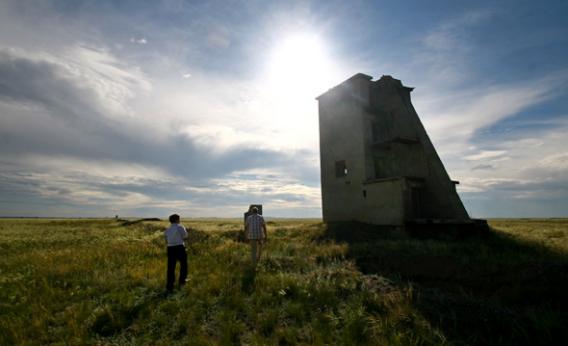
Nuclear test site in Kazakhstan. Photo by Jacob Baynham.

Focusing on a particular test site in Semipalatinsk, Kazakhstan, the article looks at the impact that 116 above-ground nuclear tests can have on the wildlife and topography of an area:

Looking out from the epicenter of these blasts, you can still see remnants of structures the Soviets built to test the power of these explosions. To the right are the crumpled remains of a bridge. To the left are fortified bunkers and barracks that had been filled with dogs, pigs, and goats to approximate the effects a blast would have on soldiers. In a line in both directions, 10 four-story concrete buildings rise from the Earth like the moai of Easter Island. These structures were filled with sensors to measure the explosions. Strilchuk calls them “geese,” because from a distance that’s what they look like: giant goose necks craning up from the grass, facing the place where man played God.

As well as the human impact on those in the nearby towns, fifty miles away:

Anastacia Kyseleva is an 86-year-old resident of the Institution for the Elderly and Disabled in the nearby town of Semey. She was newly married and living in a village near the test site when the explosions began. “We didn’t know what it was,” she recalls 60 years later, wringing a scarf in her hands. It wasn’t until a test in 1956 that soldiers told the villagers to leave their houses and stand beside the river. “We could see the mushroom cloud from the field,” she says. “It looked like a sunset. Since that year, a lot of people started dying.”

But amidst this ongoing legacy of sickness, birth defects and infant mortality, there is also cause for optimism:

The government’s optimism for the Semipalatinsk test site reflects Kazakhstan’s emergence from a Soviet nuclear wasteland into a prosperous capitalist economy. Kazakhstan has come to terms with its history quicker than most former Soviet republics. A wealthy, resource-rich country, Kazakhstan is broadening its profile as a leader of the nonproliferation movement by hosting negotiations on Iran’s nuclear program. They’ve volunteered to establish an international nuclear fuel bank, a measure of nuclear security that the International Atomic Energy Agency is seriously considering. The government even talks of building a nuclear energy reactor of its own, a peaceful application of the fierce atomic power that the Soviet Union once wrought upon the Kazakh steppe.

The full article is well worth a read.

For Andy


Thinking of a very dear friend of mine in hospital at the moment, who would most certainly approve of this musical selection.

You can’t go wrong with a bit of The Divine Comedy.

dreams of drowning

The single best piece of writing that I have read this week, penned by an old friend of mine from my Cambridge days. Her blog, “From The Edges”, is well worth following.

angharadlois's avatarfrom the edges

When I last lived in Spain, there was nothing between me and the sea.  Our street, Calle Virgen del Socorro, clung to the bare rock of Mount Benacantíl at the edges of the city.  From the windows of our 8th floor flat, the view was of infinity.

I dreamed of tsunamis over and over.

Everything was clear – I would be sitting at our table chatting, or hanging out the washing on the balcony, when the water struck.  There was no time to get away.  I felt it hit me, cold and brutal, before I woke up gasping.  Over and over.  I have no idea why; I have never been afraid of drowning – at least, no more than I have ever been afraid of death.  But the sea that filled my senses through the waking day overwhelmed me as I slept.

So much of that year seems like a dream to…

View original post 183 more words

Bad “Journalism” Award

The people at Vice.com were unimpressed with the recent cover story at Esquire magazine, devoted to Hollywood star Megan Fox. Actually, “unimpressed” is putting it too charitably:

The cover story of this month’s Esquire is an interview with Megan Fox by Stephen Marche. And, though I haven’t read every single thing that has ever been written, I can say, with confidence, that it is the worst thing that anybody has ever written. Ever.

With our expectations calibrated to a suitably low bar, the Vice takedown zeroes in on some of the worst things about the Esquire puff piece:

MEGAN FOX BELIEVES THAT BEING FAMOUS IS WORSE THAN BEING BULLIED

“‘I don’t think people understand,” she says. ‘They all think we should shut the fuck up and stop complaining because you live in a big house or you drive a Bentley. So your life must be so great. What people don’t realise is that fame, whatever your worst experience in high school, when you were being bullied by those ten kids in high school, fame is that, but on a global scale, where you’re being bullied by millions of people constantly.'”

When I was at school, there was a kid who everyone picked on because they thought he was gay. One day, a bunch of older kids dragged him into the PE showers and forcibly inserted a broom handle into his ass. Pretty sure he’d trade lives with you, Meg.

And then this, on Fox’s approach to escaping fame:

MEGAN’S UNUSUAL APPROACH TO ESCAPING FAME

According to the article, “Megan Fox doesn’t particularly want to be famous anymore.” Obviously, appearing on the cover of Esquire in your underwear to promote a new movie that you’re starring in isn’t the best way to go about this. But what about some other methods she’s tried?

“She’s tried to escape from her fate as a sex symbol. She starred in Jennifer’s Body, a magnificent, delicious, criminally underrated parable about a bombshell who literally devours men.”

“In December, in Judd Apatow’s This Is 40, she plays a woman so gorgeous that the other characters cannot quite believe it.”

And neither of those things made it so she wasn’t famous anymore? Weird!

But the best part relates to particular pet peeve of mine, the overambitious / anatomically incorrect Photoshop attempt made for the cover picture. You may be familiar with the recent image in Vogue China, in which the model appeared to be missing a leg…y’know, just to tidy up the shot a bit:

I think there's something missing.
I think there’s something missing.

While Esquire magazine managed to (more or less) avoid losing any critical parts of Megan Fox’s anatomy in their Photoshop attempt, it nonetheless had many of the unearthly, not-quite-human characteristics that we are accustomed to seeing in glossy magazines:

No.
No.

As the Vice article drily notes:

How many people must have seen that cover before it went to print? And not one of them said, “Uh, guys, her left thigh is shaped like a teardrop, she has a wrist a third of the way up her arm and her vagina is, like, a foot wide.”

Quite. Good job, guys. Of course, the sheer level of half-assery on display here by Esquire will not have cost them anything in terms of reputation or profit. Nobody reads the drively words anyway, and I’m sure that the Editor’s mailbox has not been inundated with complaints about the photograph either.