On American Exceptionalism

A word of advice for all of the American pundits and commentators who puffed up their chests in wounded outrage when the president of Russia dared to suggest in a New York Times op-ed that it was dangerous for a country or a people to consider themselves exceptional: look at the image below.

Not very encouraging.

There are really only two possible ways to explain the fact that the US cover of Time Magazine diverged from all of the global editions on this occasion. The first is that the publishers of Time believe their American readership to be so shallow, insular or dumb that a story about important geopolitical developments would deter them from reading the magazine, and that featuring a story about college sports would be less intimidating and off-putting. And the second possibility is that the Bad Man, Vladimir Putin, said some nasty things about America a few days ago and hurt our feelings, so now we have to pretend that he doesn’t exist so that we can get back to our happy place as quickly as possible.

Neither scenario is really screaming “exceptional” at me.

This isn’t a post to denigrate America – clearly, any regular reader of this blog will soon sense my deep admiration of the United States and the belief that it remains, in some very important ways, exceptional in the world. And neither do I think it necessary to list (again) the many flaws of Russia, as they are manifold and frequently in the news, as a counterweight to what I have written here. Most people, given the choice of where to live, would choose the United States over Russia; it doesn’t need to be shouted from the mountaintops.

But I will say this to those “patriotic” Americans who feel slighted when every visiting foreign head of state doesn’t issue a statement declaring America to be superior to their own country, and who get upset when President Obama doesn’t take time out to lecture other nations about how the United States is the role model to be emulated in all matters (because we all know that would be such a successful diplomatic stance):

You sound like a spoiled, coddled toddler, always needing reassurance that you are special and perfect. Frankly, it must be quite embarrassing for your less insecure compatriots to be associated with you. Instead of stomping around the world, hammering out angry op-eds about how the USA is A-OK and super, super exceptional, how about you go out and actually do something exceptional to contribute to that exceptionalism? And if you can’t do that, how about just sitting at home and enjoying the exceptionalism in silence without bothering anyone else? Actions speak louder than words.

Ronald Reagan used the term “a shining city on a hill” to describe his aspiration for America, a really quite moving and wonderful phrase. It evokes a beacon of light, guiding people to America’s example through her very existence and perseverance; her deeds and not just her words.

By contrast, today’s neo-conservatives and others who wrap themselves in the cloak of exaggerated “patriotism” resemble not so much a shining light in the distance, leading others to prosperity, but rather a shrill, incessant car alarm, parked outside the house of every foreign nation, its loud, unceasing warble continually scolding them for not living up to America’s own ideals.

I will let comedian Lewis Black have the last word on this subject:


Are we clear, neo-cons? Good.

Music For The Day


The fearsomely difficult Etude No. 5 in F Major “Allegro Barbaro” by French composer Charles-Valentin Alkan (a much-neglected composer, in my opinion), performed here by the wonderful British pianist (and renowned George Gershwin interpreter) Jack Gibbons:

I wasn’t exaggerating when I used the adjective “fearsome” to describe this piece – just to glance at the sheet music for this work would be enough to induce a nervous breakdown in a lesser performer, and as you can see from the way in which Gibbons’ hands turn into a blur as he performs the piece, it demands extraordinary technical abilities and endurance from the performer, especially given the short nature of the piece.

Here is a version with accompanying score:


From Ronald Smith’s “Alkan, The Man, The Music”:

The arresting title Allegro barbaro can give little idea of the fierce impact, even on twentieth-century ears, of Alkan’s fifth study with its harsh textures, pounding rhythms and jagged outlines. Whether or not Bartok heard Busoni play this electrifying octave study in the early 1900s there can be little doubt which Allegro barbaro is, at once, the more barbaric or the more disciplined. Although written and sounding in F major Alkan cancels every B flat, the piece remaining stubbornly on the white keys, its rondo structure etched out in a series of contrasted modes. Phrygian, Aeolian, and Dorian episodes, in turn, confront the Lydian subject, rousing it to ever increasing ferocity until with a final stampede of semiquavers it explodes into numbed silence.

I have always counted the Jack Gibbons recital I attended at Queen Elizabeth Hall in London nearly a decade ago (in which he focused exclusively on the music of George Gershwin) as one of the most enjoyable, entertaining and intimate performances that I have ever attended. His superb recording of Beethoven’s fourth piano concerto reveals a wonderful command of phrasing and dynamics which, for obvious reasons, the Alkan Etude has no need for.

If you are not familiar with this pianist, I heartily recommend a visit to his website here.

Best Thing Of The Day

If you have not already discovered TED Talks, the online channel featuring short, insightful lectures by prominent people from all fields and walks of life about topics that interest them, I highly encourage you to take a visit, either to their YouTube channel or their homepage.

For those who don’t know: With the slogan “Ideas Worth Spreading”, TED began as a conference for people from the worlds of technology, entertainment and design (hence the acronym), but has since expanded to cover just about every conceivable topic. One of the principle outputs from the TED conferences, which take place in cities all over the globe, are the TED Talks, in which an expert in their given field must give an informative, entertaining talk in eighteen minutes or less.

Which brings me to this excellent example from Japanese architect Shigeru Ban, whose work is notable for using sustainable building materials such as cardboard tubes and paper. As well as their obvious usefulness in terms of providing temporary shelter and accommodation during humanitarian disasters, these principles can also be applied to longer term constructions, as Ban’s talk demonstrates:


I had no idea that it was conceivably possible to construct multi-story structures out of such materials, and much as I love watching the rise of the new steel and glass skyscrapers in my home city of London, it is wonderful to appreciate these radically different, more natural structures too.

Pushing the boundaries of possibility even further in another TED Talk, architect Michael Green proposes building safe, multi-purpose structures such as skyscrapers out of wood:


As Green says (and I am in no position to refute despite my love of the steel frame skyscraper):

“Every time I go into my buildings that are wood, I notice that [people] react completely differently. I’ve never seen anybody walk into one of my buildings and hug a steel or a concrete column, but I’ve actually seen that in a wood building, I’ve seen how people touch the wood. And I think there’s a reason for it. Just like snowflakes, no two pieces of wood can ever be the same, anywhere on Earth. That’s a wonderful thing.”

Definitely my best discovery of the day.

In England, We Call It Autumn

This, apparently, is a decorative gourd.


The bleak grey skies, rapidly cooling weather and the incessant rain did tip me off, I must admit. But I was only certain that fall (I’ll stick with autumn, thank you very much) was really upon us when I read this amusing piece by Colin Nissan in McSweeney’s, trumpeting the return of “decorative gourd season”.

He writes:

I don’t know about you, but I can’t wait to get my hands on some fucking gourds and arrange them in a horn-shaped basket on my dining room table. That shit is going to look so seasonal. I’m about to head up to the attic right now to find that wicker fucker, dust it off, and jam it with an insanely ornate assortment of shellacked vegetables. When my guests come over it’s gonna be like, BLAMMO! Check out my shellacked decorative vegetables, assholes. Guess what season it is—fucking fall. There’s a nip in the air and my house is full of mutant fucking squash.

I may even throw some multi-colored leaves into the mix, all haphazard like a crisp October breeze just blew through and fucked that shit up. Then I’m going to get to work on making a beautiful fucking gourd necklace for myself. People are going to be like, “Aren’t those gourds straining your neck?” And I’m just going to thread another gourd onto my necklace without breaking their gaze and quietly reply, “It’s fall, fuckfaces. You’re either ready to reap this freaky-assed harvest or you’re not.”

I’m glad that someone is expressing excitement about the change of season, albeit satirically. From Semi-Partisan Sam’s perch in London, autumn tends to involve more desperate winter coat purchasing and wondering why only one radiator in the goddamn apartment seems to be working than dusting off seasonal decorations and festooning the place with harvest vegetables and fallen leaves. But to each their own. I assume that autumn enthusiasts must live in places that actually experience a reliably hot and enduring summer every year.

Of course, unlike the United States (which has Halloween and Thanksgiving to look forward to in terms of autumnal – sorry, fall – celebrations) we here in Britain jump straight from summer to Christmas. Indeed, the speed at which the charcoal and barbecue accessories are swept from the supermarket shelves to make room for Christmas ornaments and mince pies with an expiration date in early November is quite astonishing. *

* and unwelcome for those of us who like to continue grilling outside right through the deep midwinter.

Now on sale in our local superstore. In September.


So, here’s wishing a happy fall or Christmas season (depending where you live) to my readers.

In September.

More Praise For The Vatican

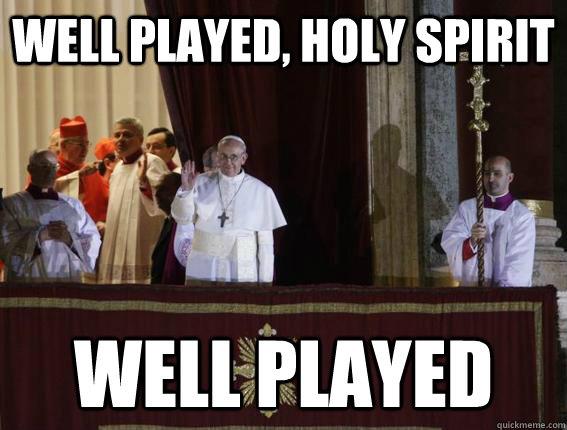
Well, for its current occupant, to be more precise. MSNBC host Chris Hayes (who mirrors his mentor Rachel Maddow in speech and writing to a remarkable degree), is the latest to fall under the spell of Pope Francis I, for many of the same reasons that this blog has praised the new pontiff.

francis1

Hayes gushes:

You know who I freakin’ love? This new pope. Pope Francis. You know who I’m talking about, right? The pope. Are you watching this guy? Because you should be. It’s early, but I’m thinking… best pope ever.

That’s original emphasis, by the way. Aside from the redundancy of explaining to his viewers and readers that Pope Francis is indeed the pope, the style is just like Rachel Maddow Mark 2, right? The stylistic similarities between Maddow and her protege are quite astounding. But I digress. Hayes also picks up on the new pope’s penchant for making cold-calls to the faithful who write to him of their problems:

Perhaps most amazing of all: the pope is now picking up the phone and calling people who write to him for advice and prayers—earning him the nickname “Cold Call Pope.” He phoned a woman who had been raped by a police officer in Argentina, telling her she was not alone, and to have faith in the justice system.

He’s comforted a pregnant woman whose married boyfriend tried to pressure her into an abortion, Francis offering to personally baptize her baby.

He also rightly picks up on Francis’ more humble demeanor:

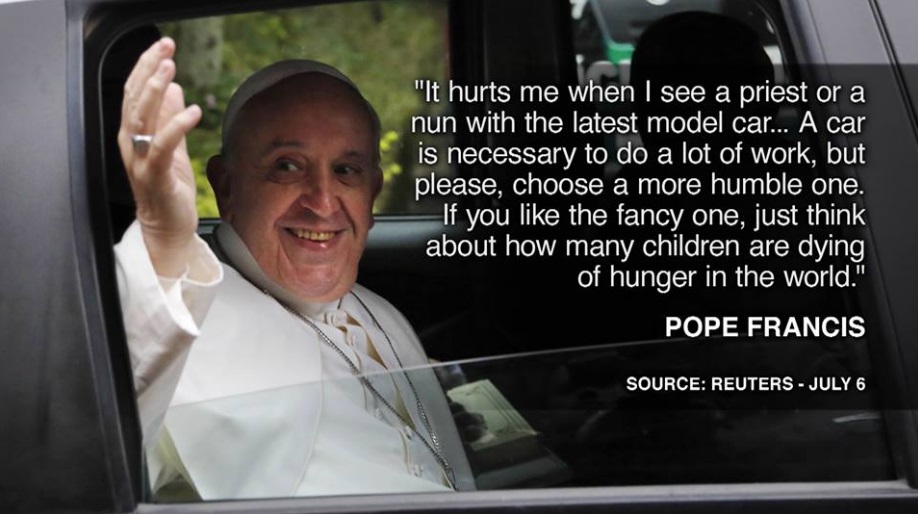
He showed up to World Youth Day in Rio de Janeiro, not in the imposing Popemobile, but in the back of a rental car. He’s not above taking a selfie with the kids. He plans on driving a used car around town. And he’s urged others to do the same: ”It hurts me when I see a priest or a nun with the latest model car. A car is necessary to do a lot of work, but please, choose a more humble one. If you like the fancy one, just think about how many children are dying of hunger in the world.”

francis2

The one area where Hayes and I differ is the degree to which this wonderful, welcome rhetorical shift will actually lead to any significant step change in Church doctrine or Vatican policy. Hayes says this in his article:

But Francis has also shown he’s pretty good substantively, as well. On the once taboo subject of homosexuality, Francis told reporters: ”If someone is gay and he searches for the Lord and has good will, who am I to judge?”

Clearly, he sees this as something substantive, but I find it hard to apply that term unless there are meaningful changes afoot to reform Church teachings on gay marriage, the ordination of women priests and other such issues – something that is clearly not on the horizon.

Nevertheless, I join Chris Hayes in celebrating the warmer, more inclusive tone now emanating from the Vatican. May it spread down from Pope Francis to his brother cardinals, the archbishops, bishops, priests and of course the laity, where it might really start to do some good.

Some interesting and fun Pope Francis memes can be found here.