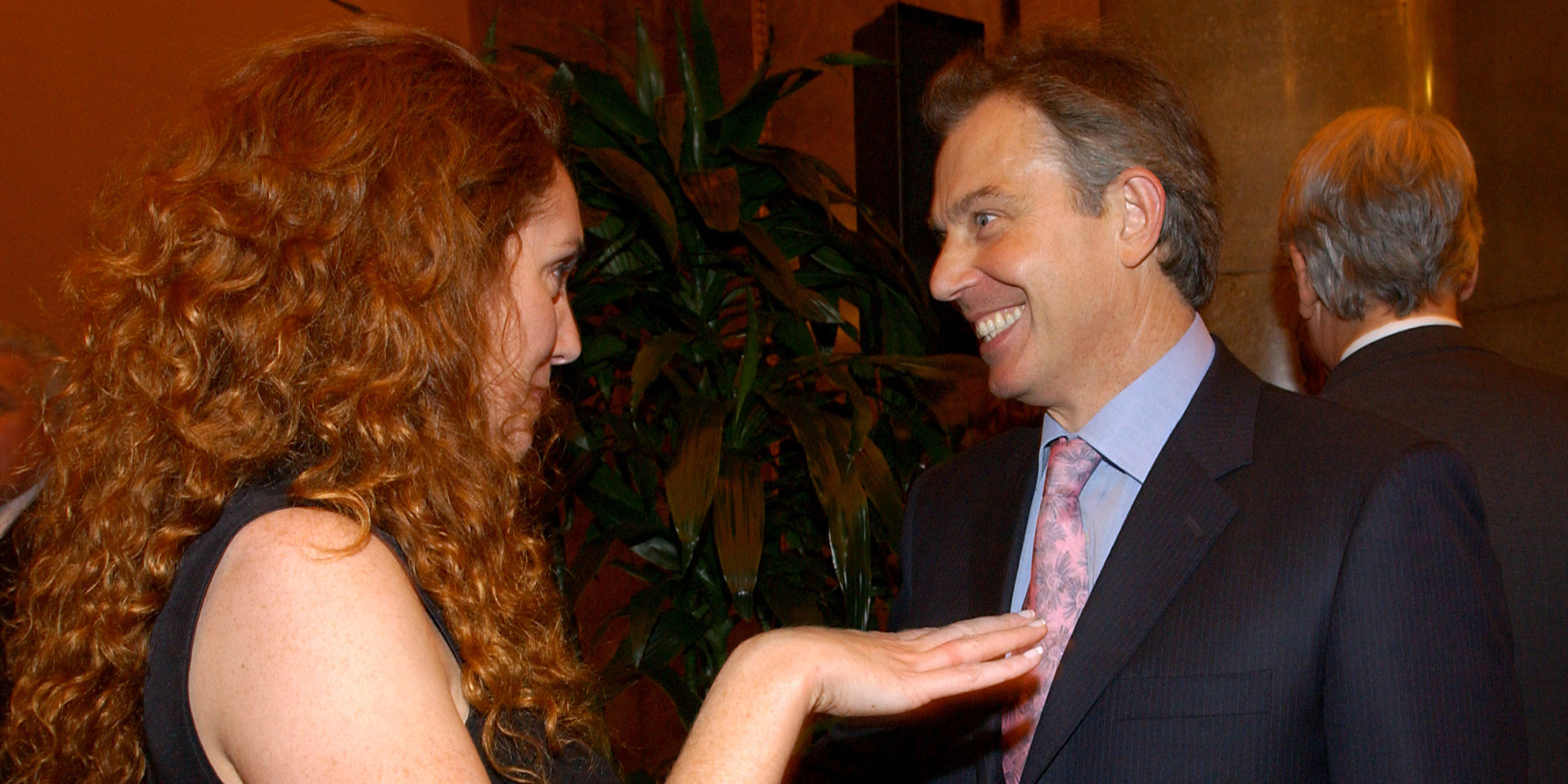
Tony and Rebekah, Sitting In A Tree


Democracy cannot survive without a free press willing and able to act as a check on government power and behaviour.

The relationship between the government and the media should therefore be adversarial – although it was thuggish of David Cameron’s government to dispatch the Cabinet Secretary to the Guardian’s offices to bully them into destroying their computers in the wake of the Edward Snowden scandal, rather this terrible, flagrant abuse of power than the chilling alternative of Sir Jeremy Heywood popping by every single afternoon for tea, chitchat and a list of government-sanctioned news stories for publication.

But it is this latter, far more insidious type of close, symbiotic relationship that has been prevalent between parts of the British media and the politicians on whom they report and are supposed to keep in check.

Former prime minister Tony Blair may no longer occupy Number 10 Downing Street, but the self-evident warmth of his newly revealed correspondence with Rebekah Brooks – former chief executive of News International, now on trial for her alleged role in the phone hacking scandal – shows just how overfamiliar those in power can get to those who lead the publications who supposedly scrutinise them.

The following exchange of text messages between Tony Blair and Brooks on the day after her resignation, reported by The Guardian, really says it all:

Tony Blair: If you’re still going to parliament you should call me. I have experience of these things! Tx

Rebekah Brooks: Definitely depends on the police interview first. I have Stephen Parkinson [a lawyer] here today. I have never met him but people say he is good.

Tony Blair: He’s excellent.

Rebekah Brooks: Great news. Feeling properly terrified. Police are behaving so badly.

Tony Blair: Everyone panics in these situations and they will feel they have their reputation to recover. Assume you have quality QC advice? When’s the interview?

Rebekah Brooks: Sunday probably or Monday. Cms committee. Tuesday. Stephen bringing someone called Emma Hodges and we have QC.

Tony Blair: That’s good. I’m no use on police stuff but call me after that because I may be some help on Commons.

Rebekah Brooks: Great. Will do. X

There are two issues here. The first is the impropriety of a former UK prime minister essentially offering coaching to someone involved in a very current public scandal before they are due to give evidence at a parliamentary committee hearing. While there may be no legal prohibition on this type of interaction, it seems very morally dubious. Were the subject of the hearing about anything else it could perhaps be overlooked, but since it was a hearing of the Culture Select Committee specifically on the allegations of phone hacking and the issues raised about the behaviour of the press, Blair’s offer of counsel and friendly support seems to put him squarely on the side of the alleged perpetrators rather than the victims.

The second issue is the self-evident friendship between the former news executive and the former politician. Friendships such as these are forged over time, some of which was doubtless while Tony Blair was still  prime minister. If Tony Blair’s regard for Rebekah Brooks is such that he was offering her emotional support via text message at the height of the phone hacking scandal, what other acts of friendship was he bestowing upon her while he still occupied Number 10 Downing Street? And how might the publications that Brooks ran have reflected this friendship?

Some might argue that it is unfair to question the nature of this friendship. They are wrong – it is entirely appropriate. Serving as prime minister comes with certain responsibilities and standards of behaviour. It may not be part of the oath of office, but one of those responsibilities is surely to maintain professional relationships with business and the media. If both Tony Blair and Rebekah Brooks were doing their jobs properly during the period of his premiership, this would almost certainly have precluded any meaningful friendship from forming. If, however, they were behaving toward each other then as they apparently do so now, everything suddenly makes a lot more sense.

While the release of Tony Blair and Rebekah Brooks’ text message correspondence doesn’t really tell us anything that we didn’t already know – that our elected leaders are sometimes far too close to the press barons who help to control the news agenda – seeing the evidence in black and white is still unsettling.

Recalling Tony Blair as prime minister and then juxtaposing this new image of “T” sending kiss-laden text messages to the woman who then edited Britain’s most-read newspaper casts that era in a whole new, sordid light. The dirty, illicit feeling that reading these messages evokes would be more at home in the television series “House of Cards” than real-world Britain.

We deserve better from our politicians, and from the news media.

Bold Proposals On Tax, Ignored By Cameron

taxcuts


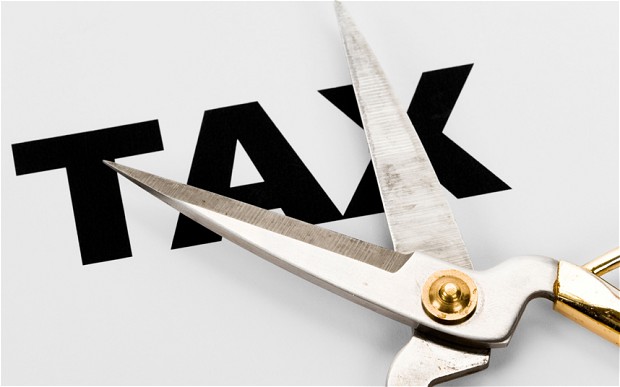
As more people come out in support of scrapping the 40% tax band – or doing something, anything that might alleviate the pinch on middle income earners – David Cameron remains resolutely set against the idea.

This time, it was the turn of one of Cameron’s own No. 10 Policy Board members, Nadhim Zahawi, to advocate for 800,000 people caught up in the fiscal drag which has seen them start paying the 40% rate on their marginal income in the last three years.

The Telegraph reports:

Mr Zahawi on Wednesday praised plans by Renewal, a Tory pressure group, to abolish the 40p rate entirely and deliver a tax cut worth £2,000-a-year for 2 million middle class workers. 

Under the proposals, the move would be funded by lowering threshold for the 45p rate from £150,000 to £62,000. 

In a speech at Policy Exchange, a think-tank with links to the Conservative Party, Mr Zahawi said: “It is a welcome development that Conservatives have started to seriously debate where next for income tax. 

“Labour have the 50p, the Lib Dems have the mansion tax, we need our own iconic tax policy. I think Dave Skelton’s [from Renewal’s] contribution, and his suggestion that we abolish the 40p rate and pay for it by lowering the 45p rate was a great way of starting the conversation.”

Renewal’s plan is not perfect – £62,000 seems far too low to impose what is a very high top marginal rate of 45%, for instance. Nor is the idea of making an ‘iconic’ tax proposal just to have a handy catchphrase with which to compete with Labour and the Liberal Democrats redolent of good policymaking or government.

But this is a problem that affects people up and down the income scale, and the idea of giving some relief to those slightly higher up the scale deserved more than the immediate dismissal that it received from David Cameron. As the Telegraph continues:

Mr Cameron on Wednesday defended the government’s focus on increasing the tax free threshold. 

Asked if Tory back-benchers were right to call for the 40p threshold to be raised, Mr Cameron said: “I’m a tax cutting conservative. I want to see us relieve people’s tax burden. We’ve chosen to do that through raising the personal allowance which helps everyone earning under £100,000.”

David Cameron, the tax cutting conservative. It sounds good, but it is hardly an accurate claim.

When Cameron says that “we’ve chosen” to raise the personal allowance, he neglects to admit that this was a Liberal Democrat, not a Conservative policy. Had the LibDems not manoeuvred their way into coalition government, the Conservatives would likely never have entertained the idea of a personal allowance up to or exceeding £10,000. Now that he is also rejecting the idea of doing anything at all about the 40% tax band – either scrapping it or increasing the level at which it applies – he is committed to doing nothing significant for middle income earners either.

This leaves only those who earn enough to qualify for Gordon Brown’s new top rate of income tax, which George Osborne reduced from 50% to 45%. And that is the situation currently faced by the Conservative Party – the only concrete actions of this ‘tax cutting conservative’ party have been to cut the taxes for the very highest earners. This track record is every bit as bad as the optics make it seem.

Ed Miliband and the Labour Party like to talk about the “cost of living crisis”, and they are right to do so. Aside from the fact that there is obvious electoral mileage to be gained, someone needs to talk about the fact that despite the better economic news of late, wages remain stagnant while inflation continues to eat away at purchasing power. Economic growth means absolutely nothing to people if it is not reflected in their own personal circumstances.

At some point soon, people might start realising that another UK economic recovery built on booming property prices alone is unsustainable and undesirable. And when this happens, the focus will turn to consumer spending, and why it isn’t more buoyant.

Perhaps then the foolishness of treating ever more British wage earners as higher rate taxpayers will become more readily apparent.

Prince Charles, Nearly Exposed

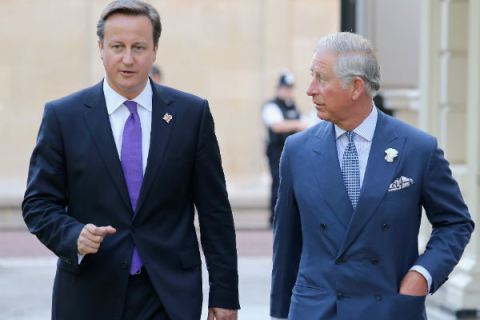
Who really gives David Cameron his marching orders?


Today has seen a rare victory in the fight for government transparency and public access to information, as a judicial review ruled that the Attorney General was wrong to veto the publication of Prince Charles’ voluminous correspondence with ministers – known as the ‘black spider letters’ – and ordered that they be disclosed.

The British government fought this development every step of the way. Dominic Grieve, the Attorney General, had used his veto to keep the letters secret after a previous ruling from an independent tribunal also ruled in favour of the public interest. However, at long last the time may have come for British citizens to read what the heir to the throne really thinks about all number of government policies and positions.

The Guardian – who waged a nine year campaign for access to the letters – report on their triumph:

Grieve had said that a cornerstone of the British constitution was that the monarch could not be seen to be favouring one political party over another. But he had said that any perception that Charles had disagreed with Tony Blair’s government “would be seriously damaging to his role as future monarch because, if he forfeits his position of political neutrality as heir to the throne, he cannot easily recover it when he is king”.

The 27 pieces of correspondence between Charles and ministers in seven government departments between September 2004 and April 2005 “are in many cases particularly frank”, according to Grieve.

Dominic Grieve and the rest of the cabinet clearly take the British people for fools. Only an idiot might think that Prince Charles is politically neutral. He has pungent and forceful views across a whole spectrum of topics from climate change to modern architecture, and his PR people take every opportunity to see that these are widely reported by anyone who will listen.

Rather than treating the British people with kid gloves as though we were sensitive little children liable to burst into tears at the sight of our parents arguing, Grieve should drop his ludicrous opposition and let us finally see what the future King thinks of his government of the people.

As the Guardian notes, the prince has taken an active interest in political matters for almost as long as Prime Minister David Cameron has been alive:

The freedom of information tribunal heard that he had been writing to ministers as long ago as 1969, when he expressed concern to the then prime minister, Harold Wilson, about the fate of Atlantic salmon.

The obvious danger is that Prince Charles’s concerns – the things that make him toss and turn at night – may well have changed and grown in the intervening forty-five years, as the number of government departments that he has corresponded with would seem to attest:

The letters concerned involve ministers in the Cabinet Office and the departments responsible for business, health, schools, environment, culture and Northern Ireland.

Worrying about salmon stocks in the north Atlantic is one thing; idly musing or ranting to ministers about Britain’s energy policy or nuclear deterrent, for example, would be another matter entirely. And one gets the strong suspicion that salmon have not remained the prince’s abiding focus.

Unfortunately, the Attorney General seems in no mood to compromise or listen to the overwhelming consensus of logic and legal opinion, and plans to appeal to the Supreme Court:

A spokesman for the attorney general said: “We are very disappointed by the decision of the court. We will be pursuing an appeal to the supreme court in order to protect the important principles which are at stake in this case.”

What important principles are these, exactly, other than the right of an unelected man to bully and intimidate junior government ministers into bending their policies and actions to his will? Should this really be the top priority for Dominic Grieve and his government office?

And why is the Attorney General going to battle to protect and enshrine the ability of society’s elites – be they financial, political, media or monarchical – to not only get their way, but then to have all record of them ever having tilted the playing field in their favour sealed from public view?

Dominic Grieve may serve as a minister in Her Majesty’s Government, but he was elected to represent we the people. Like the Guardian, I want to know how much money the government has spent on legal fees fighting to thwart the will and the interests of the people who elected them.