The N-Word

N word


One special word has been trending heavily in the British media over the past week, but you are unlikely to have seen it spelled out in print or on screen. Like the character Lord Voldemort from the Harry Potter series, prevailing opinion and political correctness (albeit of the most well-intentioned kind) decree that it shall not be uttered, but only alluded to or heavily disguised for fear of the harm that it may do in its raw form.

Lord Voldemort burst back into the British news this time when popular television host, columnist and author Jeremy Clarkson (of Top Gear fame) had to plead for his job after being caught uttering the word while reciting a rhyme. Such was the frenzied speculation over whether Clarkson had indeed said the word that the Daily Mirror, in possession of the video clip, hired forensic audio experts to analyse the soundtrack in an attempt to decipher the contentious mumbled phrase. In the event, Clarkson apologised as he has never apologised before (rightly so), and lives to offend another day.

But as usually happens when making policy based on political correctness and overwhelming fear of public opprobrium rather than sound reason, the application tends to be panicked, sporadic and contradictory. So it was that after the A-list Jeremy Clarkson was let off the hook with a ‘final warning’ from the BBC and allowed to keep his position despite actually saying the word out loud with his own mouth, the decidedly C-list David Lowe, a provincial radio DJ, was peremptorily asked by the Corporation to resign for unwittingly playing a song containing the same word.

(BBC policy apparently decrees that as you move up the fame hierarchy you can earn the right to skate closer to explicitly saying the word in public without being fired. If the BBC’s top ten stars banded together and offered up their annual vacation allowance and overtime, presumably they could sing the word in the style of a four-part Bach fugue at the start of the Nine O’Clock News.)

What is more concerning than a BBC television star’s casual utterance of the word or the network’s inconsistent treatment of those who fall foul of the complex web of unwritten rules that govern its use, though, is the craven way that the media, almost without exception, voluntarily choose to censor themselves when reporting these stories. Somewhere along the way it was decided that not only is it wrong to say the word in anger (quite rightly – no decent person should), neither is it okay to write or speak the word in the course of a dispassionate news broadcast. And so news consumers are patronised with that childish and awkward compromise, the N-word.

Make no mistake: the word-that-shall-not-be-named is a hateful thing. It brings forth horrible echoes of enslavement, beatings, lynchings and repression, the worst that humanity can do to its own kind. And within some people’s living memory it evokes painful recollections of segregation, discrimination, bullying, voter disenfranchisement and domestic terrorism. But driving the word out of the public discourse completely cannot undo any of these wrongs – the main effect is only to spare us from having to face up to the brutal connotations that come along with it. We may claim to disguise the word for fear of causing offence, but it is just as much an evasion to spare ourselves from feeling discomfort.

The comedian and great observer of human nature, Louis CK, captures this evasion-disguised-as-concern perfectly in his stand-up HBO special comedy routine, “Chewed Up”:

Everybody has different words that offend them, different things that they hear that they get offended by… To me, the thing that offends me the most, is every time that I hear “the N-word.” Not “nigger” by the way. I mean “the N-word.” Literally, whenever a white lady on CNN with nice hair says, “The N-word,” that’s just white people getting away with saying “nigger,” that’s all that is. They found a way to say “nigger.” “N-word!” It’s bullshit ’cause when you say “the N-word” you put the word “nigger” in the listener’s head. That’s what saying a word is. You say “the N-word” and I go “Oh, she means ‘nigger’.” You’re making me say it in my head! Why don’t you fuckin’ say it instead and take responsibility, with the shitty words you wanna say.

CK is right inasmuch as that journalists are not really letting themselves off the hook by referring to the ‘N-word’ rather than its expanded form. Since journalists are effectively planting the word in peoples heads when they refer to the ‘N Word’ in a story, all that refusing to spell or speak the word out in full does is imbue that specific arrangement of letters with some nonexistent, mythical power that must be feared and respected.

The media’s unwritten policy would be slightly more understandable if it applied equally to other racially derogatory terms, but this is not the case. When three football supporters were charged with racial aggravation for chanting the word “yid” at two football matches, the BBC reported on the story and included the word “yid” in the headline. And several years ago BBC Four broadcast a documentary entitled “Kike Like Me”, in which the film maker “goes on a personal journey to find out what it means to be Jewish in the modern world”. But no matter how clinical or non-aggressive the context may be, the word occupies an exalted place among the racial slurs requiring it alone to be diluted before publication.

Yes, the word ‘nigger’ is about as deeply unpleasant a word as can be said. Used as a derogatory term, it has an abiding power to hurt – your blogger speaks from occasional painful experience on the receiving end. But because the word is so hateful, let those in the business of reporting the news show the word’s use in anger to be the outrageous and insensitive thing that it is – by repeating it, straight-faced and in all of it’s ugliness, not by sugar-coating it in the form of a child’s euphemism.

If, in the year 2014, someone in a position of prominence still decides to use the word ‘nigger’ in a derogatory or throwaway manner, we shouldn’t report it euphemistically as though we were embarrassed children tattling about a schoolyard transgression or other act of naughtiness to a teacher – “he said the F-word, she said the C-word!” – we should report it with the honest and brutal simplicity that the facts dictate.

This isn’t school. We are all grown-ups here. So let’s reflect that in our journalism, and put the N-word to bed.

Abusing UKIP Supporters Will Backfire Horribly

UKIP attack

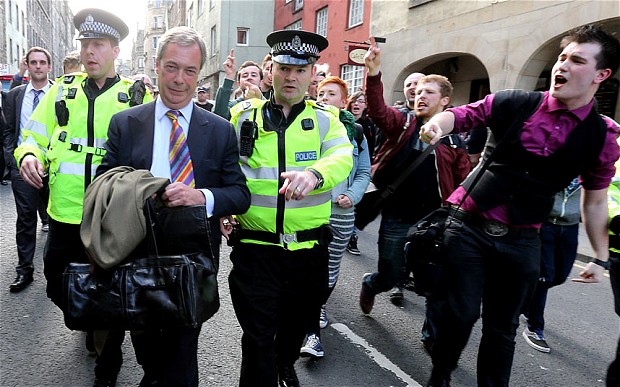
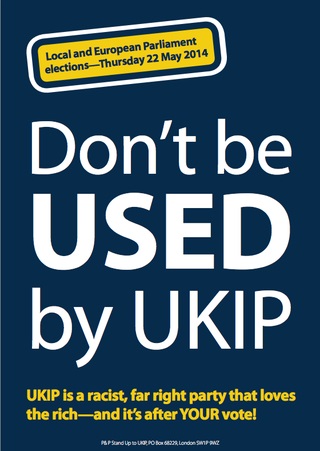
It’s official – there is nothing more fashionable in British politics than to accuse UKIP and their supporters of being closet (or indeed overt) racists. Everyone is at it, from the Scottish “artist” who has taken to painting over the party’s election billboards with grey paint to the scores of people who turned out to heckle and jeer at the UKIP public meeting in London on Wednesday.

Cooler heads might wonder if opposing unchecked immigration from European Union countries (as bad a policy as that may be) is actually more of an economic argument than a race-based one, and that fearing competition from eastern European workers actually indicates rather a high degree of respect for their work ethic and productivity rather than the sneering superiority of an English racial supremacist. But cooler heads are in short supply, and the three main political parties (with some noble exceptions in their ranks) are only too eager to pile on the attack to stave off their own looming electoral humiliation.

The fact that organisations such as Unite Against Facism think it worthwhile to picket UKIP events speaks to the success with which the liberal left have been able to equate opposition to economic migration with racism and nationalism, but more importantly it cheapens and diminishes the important work that they do. UAF rightly stand against racism and bigotry wherever it threatens, but using their name and status to attack a legitimate and moderate political party will rightly be construed by many as “crying wolf”, lessening the impact of their more considered protests.

The commentariat class seems amazed and bewildered that the non-stop repetition of the UKIP-racism mantra and frequent articles about wayward UKIP candidates is not causing a mass exodus among UKIP’s supporters. According to the conventional wisdom, we should all read these stories and extrapolate the bizarre or hateful opinions of the few to represent the many – if one UKIP candidate turns out to be an epic racist, so must all of the others, and the people who support them.

If they had slightly more awareness of their own personal biases and a lot less contempt for the British electorate, these commentators might realise that the yawning gap between reality and what they think should be happening results from the fact that the British people, broadly Eurosceptic and increasingly supportive of UKIP’s goals, are perfectly able to distinguish between the unhinged crazy people who exist at the fringe of a political party (and sometimes sneak through the vetting process) and the general goals and intentions of the party as a whole.

Critique the ideas, don't attack the messengers
Critique the ideas, don’t attack the messengers


UKIP’s stubbornly persistent high poll numbers are not some terrible reflection of the fact that British people turn a blind eye to racism and bigotry, but rather reflect the fact that voters know that the racist and bigoted people seizing the spotlight do not speak for the whole, and that opposition to economic migration (right or wrong) does not equate to racism.

The distinction is lost on much of the mainstream media and those in the public who are opposed to UKIP’s aims, largely because it suits their purposes to tarnish a growing political party and electoral threat with the toxic smear of racism. But these people delude themselves if they think that calling a moderate political party “racist” and insinuating that their many supporters are either nationalist sympathisers or credulous fools will come without a significant cost.

UKIP devotes its energies campaigning for what it sees – again, rightly or wrongly – as Britain’s national interests and has little to say about the main political parties other than pointing out that when it comes to addressing the inexorable growth of the European project, there is nothing to choose between them. The established parties, however, bereft of any honest or coherent arguments of their own when it comes to defining Britain’s relationship with Europe, have resorted en masse to base character attacks and smears.

Nick Clegg and the Liberal Democrats once liked the idea of a referendum on Britain’s EU membership, but now they disown the idea, the thought of consulting the British people only being appealing when they could be trusted to give the desired answer. David Cameron talks in woolly platitudes and promises negotiated EU reforms and British exemptions that he is unlikely to be able to deliver. None of the political parties who have had the chance to attempt meaningful reform of Britain’s relationship with the EU have followed through on their prior promises, and so the public are hardly fools – let alone racists – to reach out to the one party that has not yet let them down on the matter.

Some of the more intelligent critiques of UKIP have attempted to draw comparisons with the Tea Party movement in the United States. This is a lot closer to the truth. Nigel Farage would have no truck with Nick Griffin, the leader of the British National Party (despite the attempts of some to draw out similarities), but would probably get on famously with the likes of Sen. Ted Cruz of Texas or Rand Paul of Kentucky, both of whom, for all their flaws, have strong small government credentials.

Read UKIP’s manifesto or campaign literature and what you will see overall is a small-government oriented, non-interventionist party that believes in maximum personal freedom. They even support libertarian goals such as the establishment of a flat-rate income tax. Like the American Tea Party, an element of cognitive dissonance creeps in when you observe the discomfort with/opposition to gay marriage, but the general thrust of their policies is toward empowering the individual over the government, and the British government over undemocratic decrees from Brussels.

There is no excuse for ignorance about UKIP’s past and present policies – they are readily available on the internet, and any British political commentator still willing to throw around the accusation of racism should be able to draw on supporting evidence from these manifestos in order to maintain their credibility. But the anti-UKIP brigade will search in vain – the ‘smoking gun’ of racist or nationalist invective is simply not there to be found.

Eleanor Roosevelt once said “Great minds discuss ideas; average minds discuss events; small minds discuss people.” In the panic and scramble by the British political establishment to respond to the surging popularity of UKIP, there has been talk of events and an inordinate amount of talk about individual people – rogue candidates and their wacky, off-message personal views. The volume of discussion – and intelligent criticism – of UKIP’s actual policies, however, has been negligible. Small minds predominate.

Interestingly, the one and only time that UKIP’s ideas were put to the test thus far (in nationally televised debates),UKIP triumphed and the establishment lost, badly. So is it any wonder that armed with such unpopular policies of their own and facing a huge credibility gap, the major political parties and their respective cheerleaders in the media have been only too happy to promulgate the idea that UKIP is a racist party?

The only problem with their strategy is this: millions upon millions of normal, decent and tolerant people support UKIP’s stance on Europe and other matters. The establishment’s response to this fact so far has been either to pen hand-wringing and patronising columns fretting about how the public’s inchoate anger at politics-as-usual is causing them to be duped like fools into supporting a nascent far-right party, or to accuse them outright of harbouring racist views. In other words, as the establishment would have it, UKIP supporters are either racists or gullible fools. The third option – that they might be semi-intelligent people with a legitimate political point – is not widely accepted.

On Thursday 22 May, the British political establishment – Labour, Liberal Democrat and Conservative alike, and their friends in the press – will find out whether shaming and insulting up to one third of the electorate in the run-up to an election increases or decreases their resolve as they enter the voting booth.

If the aftermath is messy and humiliating for them, it will be no more or less than they deserve.

End The Scandal Of Squalid Army Accommodation

Catterick Garrison


An overlooked article in the Telegraph reveals that serving British soldiers continue to endure crumbling substandard living accommodation at a time when the political elites in London are more focused on averting a tube strike and pandering to the whims of the RMT union and its overpaid train drivers than looking after the welfare of those who do a truly difficult and irreplaceable job.

The article quotes a complaint written to the letter’s page of Soldier Magazine, detailing conditions that should rightly cause many red faces at the Ministry of Defence:

The letter from an unnamed soldier complained: “We are constantly without hot water, have only three showers per platoon and not all of them work.

The rooms at Somme Barracks in Catterick are “falling to bits”, the soldier wrote.

“We have made every attempt to make them bearable to live in, but their poor condition is now starting to affect the lad’s morale.”

The response given to the soldier by the Ministry of Defence spokesman is breathtakingly dismissive and arrogant, and is worth quoting in full:

The accommodation at Somme Barracks is not condemned. The MOD has already invested some £1.2 million in improving the site in 2011 and 2012, redecorating and upgrading a number of areas including flooring, toilet facilities and utilities rooms.

We will continue to invest in the barracks and are replacing boilers supplying hot water to blocks 11 and 12. This work should be finished by May 2, 2014.

Comprehensive maintenance service is provided but occupants must report any problem promptly to the help desk or repair work may be delayed.

Essentially, the government’s response to a serving soldier’s complaint about appalling accommodation is to call him a liar, boast about supposed renovations that clearly delivered no noticeable improvement when they were completed two years ago, and then to blame the squalid conditions on the soldiers themselves, claiming that they did not report the issue to the help desk as one would a malfunctioning BlackBerry.

Compare the serving soldier’s description of substandard British army accommodation with this grim account of army housing in backward-sliding Russia, taken from the excellent book “Putin’s Russia” by the late journalist Anna Politkovskaya:

[The soldier’s] home is a dreadful officers’ hostel with peeling stairwells, half derelict and eery … The windows of many now uninhabited flats are dark … We go up to the second floor, and behind a peeling door is a squalid, spartan room … There is no hot water, and it is cold, draughty and uncomfortable.

It is a much overlooked outrage that some in the British army live in accommodation that can be described in very similar terms to Russian army lodgings, the Russian army being synonymous with mistreatment of its soldiers. The comparison is even more galling when one considers the fact that the Chief of the Defence Staff earns £250,000 per year, and the Permanent Undersecretary of Defence an impressive £185,000 for his bureaucratic skills.

The story has gained very little traction in the media aside from the Daily Telegraph story, and with much of the national media’ attention focused on the upcoming European elections it is unlikely to do so. But even if the Conservative-led coalition government remains committed to its policy of diminishing Britain’s military capability though underinvestment and spending cuts, ministers could at least ensure that all serving personnel have the dignity of adequate housing.

The Establishment Rounds On UKIP

nigelfarage_nickrobinson

It is neither astonishing nor controversial to observe that the British political establishment – politicians and their client political journalists alike – have only animosity and contempt towards the UK Independence Party and the 30 per cent or more of the British electorate who are likely to vote for them at the European Parliament elections later in May.

From their attempt to pre-ordain the outcome of the recent Nick Clegg vs Nigel Farage debates on Britain’s place in the EU to their laser focus on UKIP’s lunatic fringe, the British media has not been shy to express its negative opinion of euroscepticism or those who in any way seek to change the status quo of Britain’s place sulking at the periphery of EU decision-making.

But there are few examples of this bias – borne out of desperation to discredit the insurgent party and a refusal to engage on any issues of real substance – more telling than the BBC’s latest ‘interview’ with Nigel Farage. Nick Robinson asks the questions, and the thrust of his interrogation is this: because Farage employs his wife, a German citizen, as his personal secretary, UKIP’s arguments about unrestricted European immigration causing downward pressure on wages and reduced employment of indigenous workers are hypocritical, and that Nigel Farage is therefore totally discredited and borderline corrupt himself.

A couple of observations to start. Firstly, this blog is in agreement with the need to curb the persistent practice of politicians (be it MPs or MEPs) hiring family members purportedly to serve as ‘staff’. Sometimes it seems as though absolutely nothing was learned as a result of the parliamentary expenses scandal, when various relatives of politicians were found to be on official payrolls with nominal job titles but no demonstrable evidence of working to earn their money. Though the ideal of competitive and non-discriminatory hiring practices for political staffing jobs may never be reached, we could at least stop politicians from overlooking genuine talent in order to hire gormless relatives. That being said, there is no indication or suggestion that Nigel Farage’s wife is anything other than competent and qualified.

Secondly, this blog supports a liberal, open immigration policy. That is not to refute the various arguments on immigration made by UKIP, or to endorse them; whatever the net effect of unrestricted European immigration on wages and unemployment of British-born workers, it is best debated on other pages. But this blog sees only benefits to making it as easy as possible for skilled and talented people from all over the world to come and to contribute to Britain.

Back to the interview.

Not content with asking his simplistic question – “how can you claim to defend British jobs when you employ a German secretary?” – one time, Nick Robinson indulges himself with a lengthy Jeremy Paxman-style grilling, repeating the insinuation of hypocrisy and scandal (in his trademark bemused and facetious manner) in various different permutations:

You’ve warned about Europeans taking British jobs. Your wife is German! She is your secretary. She’s paid for by the British taxpayer … Was your wife taking someone else’s job then?

Farage’s response – that in his particular case, the hours and demands of the work (late nights at his house) made the secretary role particularly well suited to a spouse, making her the logical choice – did not satisfy Robinson, who continued:

You try to turn everything into a joke. You have a campaign that says that Europeans are taking British jobs. You employ a German woman to work in your office. She happens to be your wife. She happens to spend many hundreds of thousands of British taxpayers’ money. How do you justify it?

Nick Robinson knows full well that Farage’s (and UKIP’s) argument about British jobs being under threat – whether it is a legitimate concern or not – refers to the lower end of the job market, the low-skilled positions, and not to more highly skilled or specialised political staffers. But acknowledging this basic fact would undermine the attack on Farage’s credibility, and so Robinson declines to recognise the distinction.

Farage also points out that Robinson is singling him out for hiring a relative, something that is regrettably common and largely unremarkable in Westminster:

One in four MPs at Westminster employs a close family relative, but actually what’s happening the past two weeks, of 73 British MEPs, I’m the one who is being singled out, and [the press is] saying “goodness me Mr. Farage, you’re costing the British taxpayer an awful lot of money.”

At least one disaffected member of the public spoke wisdom, shouting “What about economic policies?” in the background. Quite right too – what about economic policy? What of the genuine economic costs and benefits of continued British EU membership vs a negotiated secession? The BBC was clearly not interested in following these important lines of enquiry. or asking about specific policy prescriptions.

Gazing on the scene from his adopted home in America, Andrew Sullivan (whose British political acuity has diminished with his years of absence) actually saw Nick Robinson’s glib attempt to concoct a scandal as an example to praise and emulate:

The idea that they [Washington press correspondents] would wreck their access by asking a politician questions that he really doesn’t want to answer – “Isn’t your wife German?” (see above), “Can you give us evidence for your crazy pregnancy stories?” – is preposterous.

So I give you the above video, by the intrepid BBC political reporter, Nick Robinson. Watch him go for the jugular, and watch him not release his grip until the prey is whimpering, near-lifeless on the ground. 

Nick Robinson, intrepid?

This really speaks more about the parlous state of political journalism in Washington D.C. than it does about anything else. So deferential are the Washington press corps to those in power – and Sullivan rightly refers to the recent annual White House Correspondents’ Dinner – that any hounding or questioning of a party leader must in itself seem dedicated and fearless. A closer attention to the specific question being asked, however, would have shown that Robinson’s approach was far from being brave or principled. Sullivan is right about the non-deferential tone of British political interviews being a positive thing, but dead wrong in singling out this particular establishment hatchet-job as  the pinnacle of good journalism.

The BBC had a golden opportunity to ask some real questions of Nigel Farage, to delve into policy differences with the other parties or at least to engage in a bit of speculation and expectations-setting with regard to the upcoming European elections. But they weren’t interested in the policy discussion (the noble option) or in analysing the polls (the political infotainment option). They went instead for the classic hatchet job, the interview ambush that neither educates the informed viewer or grabs the attention of the casual viewer, serving instead only to give David Cameron, Ed Miliband and Nick Clegg some weak ammunition for their negative anti-UKIP political ads.

This was the cheap and tawdry approach taken by a news organisation (if this interview and other recent form is anything to go by) that is becoming increasingly lazy and only comfortable discussing the European Union debate through the existing lens of Labour vs Conservative, more Europe vs a little bit less Europe. The alternative – an end to British membership of the EU – is seen as so radical and threatening to the establishment that it must simply be ignored, or (when feigning ignorance is no longer possible) loudly ridiculed and discredited.

Polling day is on Thursday 22nd May. Soon we will know whether the Nick Robinson strategy has been enough to save the British political establishment from electoral humiliation.