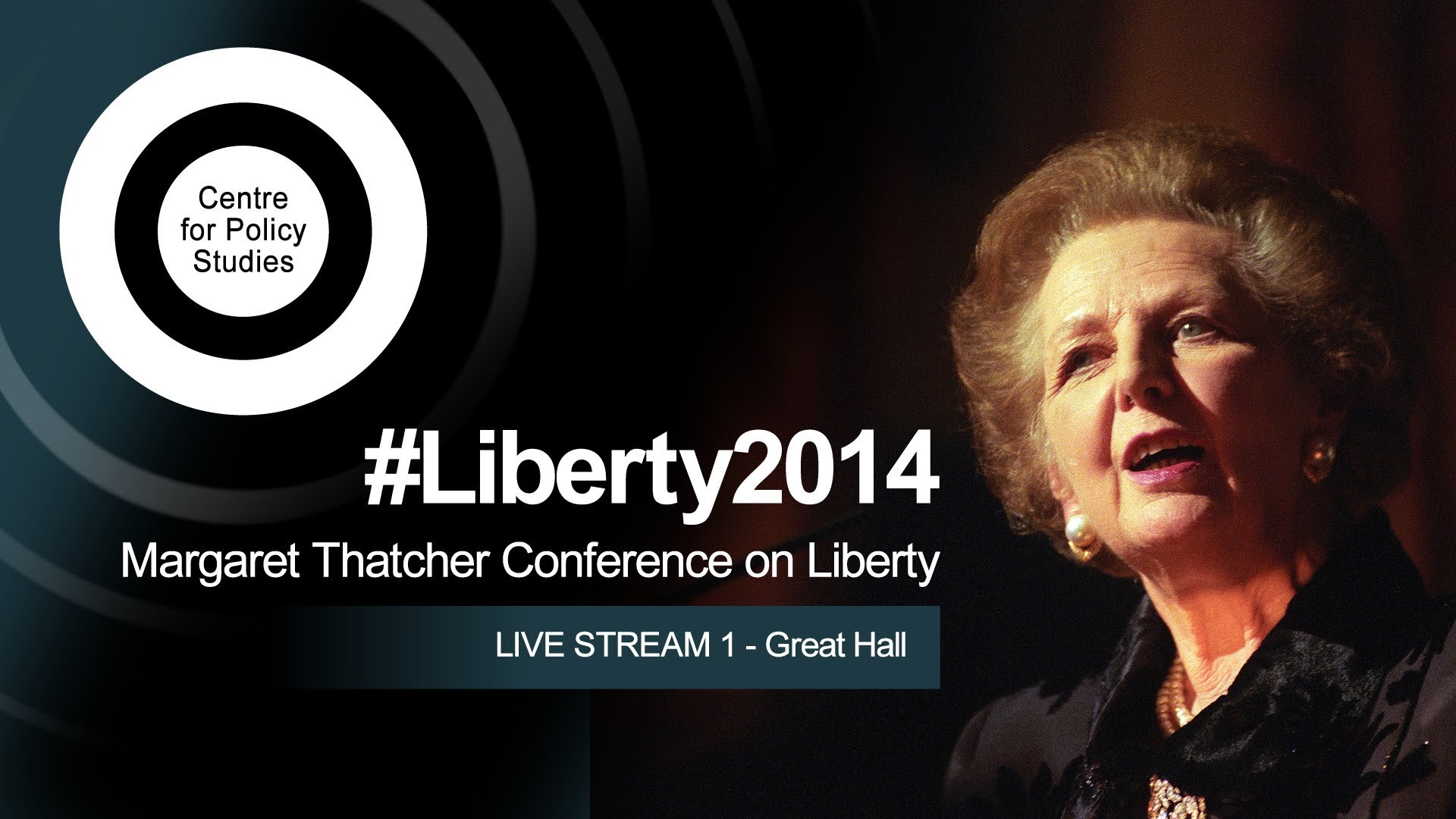
Margaret Thatcher Conference on Liberty – First Impressions

Margaret Thatcher Conference on Liberty 2014 3


The Margaret Thatcher Conference on Liberty 2014 is now underway at London’s Guildhall.

Semi-Partisan Sam is live-tweeting the event here, and previewed the conference here.

First impressions are of a bold start, giving increased hope for the sessions that follow throughout the day. This blog was concerned about the title of the first session, which speculated about whether the EU and big business are ganging up against liberty and the nation state when the answer is all too obvious – but fortunately there was little ambivalence in the lively panel discussion itself.

Indeed, when the time came to vote on whether the EU can realistically be reformed, attendees voted 43% yes (wishful thinking) but a solid 57% no.

Hopefully the remainder of the conference will start to unpick what this means, and what Britain needs to do to preserve and protect her national interests in the all-too-likely scenario that the EU will continue on its course toward ever-closer union without paying heed to the wishes of the European people or the results of the recent European elections.

Other highlights so far:

Daniel Hannan suggesting that the EU should become “a free trade area in the model of NAFTA”

Charles Moore, Margaret Thatcher’s biographer, posing the question “How can capitalism work for people who don’t have capital?. Having a strong, compelling answer to this conundrum is vital if conservatives are to rebuild the winning coalition of working and middle classes that Thatcher built in 1979.

The pernicious relationship between big business and big government being made clear in one arresting fact – that there are now more than 15,000 lobbyists in Brussels, taking advantage of “economies of scale” whereby one lobbyist can seek to influence the policies and laws of 28 EU member states. Big business and the lobbyists truly are able to divide and conquer under the protection of the EU.

A timely reminder that “gifts through the tax code and obscure regulatory benefits” are corporate welfare that distorts the free market.

A suggestion that libertarians, classic liberals, Thatcherites and other pro-capitalism sympathisers need to speak of being pro-market, not pro-business in order to avoid being associated with harmful crony capitalism.


Stay tuned to @SamHooper on Twitter for live-tweets from the conference, and to this blog for discussion and analysis of the conference after the fact.


Can The Margaret Thatcher Conference On Liberty Rescue British Conservatism?

Keith Joseph Margaret Thatcher


These are not auspicious times for people who believe in the rights of the individual and the need for a pared-back, smaller, more efficient state.

It says everything about today’s Conservative Party, governing in weary coalition with the Liberal Democrats, that Ed Miliband’s Labour Party find the current Tory spending levels palatable enough that they have vowed to stick to them should they win back power in 2015, while their eurosceptic credentials are now so widely distrusted that UKIP have become the standard-bearers for defending Britain’s national interests abroad.

Just as Gordon Brown agitated for power and eventually deposed Tony Blair without a real agenda for governing (and we all know how well that worked out for him), so David Cameron’s Conservatives stumbled across the finish line and into Number 10 Downing Street with a half-hearted policy agenda built only to address the immediate economic crisis while ‘detoxifying’ the conservative brand rather than building the foundations for twenty-first century Britain.

Meanwhile, the assault on personal privacy and freedom from the surveillance state is gathering speed and momentum. In the United States, those on the side of liberty have at least found voice through whistleblowers such as Edward Snowden and journalists like Glenn Greenwald, forcing American politicians to at least pay lip service to the protections set out in their Constitution.

In the United Kingdom, however, the juggernaut has continued without so much as slowing down. Politicians from David Cameron on downwards have expressed no contrition that such a pervasive surveillance apparatus was constructed without any public debate or approval, while civil servants from the intelligence services remain unrepentant and continue their work without proper Parliamentary oversight.

As this goes on, the British people are assured that there is no reason to worry because we are only being spied on to protect us from terrorists, and that the surveillance takes place under “strict legal controls” – though thanks to the opaqueness of the British legal system and the propensity of the government to interpret laws creatively in their favour, this is of no reassurance at all.

Britain may not yet be facing a new winter of discontent – there may be no widespread industrial unrest, the rubbish may not be piling up uncollected in the streets and the economy may not be in freefall – but you would have to be mad not to pick up on the sense of pessimism and foreboding. The economic recovery remains an “order book recovery” at present, its benefits not yet felt by many financially squeezed families.

And now we are told to rejoice that six years after the financial crash, Britain’s economic output has finally caught up with where it was in the heady days of 2008. More than half a lost decade.

No, these are not auspicious times.

Paul Goodman agrees, writing at Conservative Home:

50 years on from the new social freedoms of the 1960s, and 30 years on from the new economic ones of the 1980s, liberty has decreased, not increased.  What we drink, what we smoke, what we speak, how we drive, how we bank, how we live: all these are far more restricted by law than was the case in the 1970s.  The reasons for curtailment may be contestable – health and safety, Islamist terror, the Dunblane atrocity, NHS costs – but the direction of travel is clear.

While there is no major existential threat to Britain at present as there was in 1979 – the unions having been tamed and the Cold War won – there is still an urgent need for radical conservative thinking and policy solutions, just as there was in 1979 when Britain stood at the abyss.

All those years ago it was the (then) new think tank, the Centre for Policy Studies, that served as the intellectual engine behind the incoming Conservative government under Margaret Thatcher. No mere talking shop, the CPS developed ideas that changed Britain for the better once put into practice, as John O’Sullivan reminds us in the Telegraph:

This stream of pamphlets argued for limited government, reduced public spending, control of the money supply as a means controlling inflation, an end to prices and incomes control, the abolition of exchange controls, the privatization of industry, the scrapping industrial subsidies and the wider dispersal of wealth. Study groups, at one time numbering more than twenty, were set up. One of them, the Trade Union Reform Group under the chairmanship of Sir Len Neal, a former trade union leader, laid the foundation of the legislation later introduced to reform trade union law. Another pamphlet was inspired by Keith’s vision of the wider ownership of wealth; it led to PEPS (later restructured to become ISAs).

In 2014, the CPS is now celebrating its 40th birthday with a major international conference, the Margaret Thatcher Conference on Liberty.

It should be encouraging that the organ which did so much to inform and influence Thatcher’s government is riding to the rescue once again, but a glance at the agenda for today’s event hints more at the degree to which Britain has fallen back from the ‘peak’ of liberty achieved by Thatcher than it offers hope for bold new policy initiatives ready to be rolled out.

The first order of conference business, after the introductory speech by Sir V S Naipaul, is ditheringly titled: “The EU and the Big Corporations: are they ganging up against liberty and its protector, the nation state?”

After everything that has happened in Europe and Britain over the past several months, with the electorate’s rejection of the pro-European integration status quo and the rise of parties like UKIP, is this still a question that really needs to be asked? A forward-looking conference would be debating the best way to take advantage of the public’s growing scepticism and antipathy toward undemocratic supra-national institutions in order to either enact radical reform or achieve freedom from them, not half-heartedly speculate about whether the EU and the Brussels lobbying industry pose a threat in the first place.

And at the risk of venturing into conspiracy theorist territory, the fact that a number of conference attendees will participate in a session entitled “Big Government, Big Corporations: what chance for small business and innovation?” having come fresh from the Bilderberg 2014 meeting in Copenhagen, where big government gets together with (you guessed it) big corporations to the exclusion of everyone else does not speak very well of their legitimacy to discuss such matters.

One gets the sense that the Margaret Thatcher 2014 conference agenda was devised in order to fit the specialist knowledge and talking points of those special guests who accepted their invitations rather than the more fearless approach, which would have been to identify the most pressing trends facing Britain and the West, determining what needs to be discussed, and then engaging the support of those high-profile individuals who can best offer and promote policy solutions.

And while CPS is eager to promote the credentials and resumes of the conference’s star panellists, some of the luminaries scheduled to impart their wisdom – conservative celebrities though they may be – have decidedly questionable records when it comes to standing up for liberty in action.

If the Centre for Policy Studies is serious about rejuvenating conservatism and ushering in a new birth for freedom (to paraphrase Abraham Lincoln), the honoured guests from America should include the likes of libertarian standard-bearer Senators Rand Paul of Kentucky, or Ted Cruz of Texas (abrasive and odious though he may sometimes be) or at the very least Congressman Paul Ryan of Wisconsin.

If this conference really is to recapture the success of 40 years ago and spark some new ideas, there should be representation from that force which is doing the most to upend the stale conservative status quo across the Atlantic, the American Tea Party.

But instead, the Margaret Thatcher Conference on Liberty 2014 will be hearing from discredited, neo-conservative fossils the likes of Jonah Goldberg, who has never seen a war that he was not in favour of launching (though not personally participating in, of course), and Rich Lowry, who openly and unapologetically fantasises about the populist, proudly anti-intellectual Sarah Palin.

Sure, these big-name commentators may talk the talk when it comes to small government – at least, if you consider relentlessly hammering away at a “no new taxes, ever” message whilst simultaneously seeking to shrink the deficit and ringfence government spending on generous benefits for senior citizens or America’s bloated defence budget to be a “principled” form of conservatism – but it all goes out the window when it comes to foreign policy, national security and the surveillance state. On these issues, the likes of Goldberg and Lowry whine and clamour for big government louder than most die-hard left-wingers.

These people are Believers in Liberty in Name Only – or BLINOs. What insights and advice are they expected to give that they do not already regurgitate week after week in their National Review columns?

People like Jonah Goldberg – neo-conservative nepotism beneficiary extraordinaire – should be pariahs at a rejuvinated, forward-looking Centre for Policy Studies conference, not guests of honour.

It is curious that while some of the CPS’s American invitees are both out of power and widely discredited, their British counterparts are currently in power but are struggling to make a noticeable impact on an otherwise very centrist, pro big state, pro-Europe government.

Michael Gove, due to attend, is a formidable intellect and the closest that the Cabinet has to a libertarian (his bravura performance when giving evidence at the Leveson Inquiry saw him at his best); but Gove has achieved all that he feasibly can at the Education Department, and has recently made a series of political missteps that could harm his chances of winning another major government brief in the upcoming reshuffle.

Likewise, the Conservative MEP Daniel Hannan is an articulate advocate for the eurosceptic cause, and yet his caucus did not do enough by way of defending Britain’s national interest to stop the rising tide of public fury at the antidemocratic European Union, which saw the Conservatives’ European Parliament group leader, Martin Callanan, lose his seat.

John O’Sullivan, writing in The Telegraph, notes:

As Henry Kissinger points out, senior people in modern government are simply too busy and too tired to think creatively about the problems facing them. If they haven’t used opposition to do some fresh thinking, they have to fall back on the ideas of their opponents.

The Margaret Thatcher Conference on Liberty 2014 has the advantage of throwing together conservative thinkers in power (albeit the dying days of coalition with the Liberal Democrats) with those in the wilderness of opposition (as President Obama’s administration inches closer to its lame duck days). According to Kissinger, this should be the best of both worlds – a combination of Tory blue sky thinking and hard nosed pragmatism from the coal-face of government.

Such a conference could do more than generate headlines for one day in a slow news season – it could provide the spark that finally drags British conservatism out of its introspective, apologetic, New Labour Continued stupor.

But the conference is heavy on has-beens and light on rising stars. Instead of conservative thinkers like Andrew Sullivan, we get demagogues like Jonah Goldberg. Instead of rising political stars like Marco Rubio or Rand Paul, we will hear from elderly statesmen like former Australian prime minister John Howard. Instead of someone, anyone with a post-Snowden mindset on national security, we get former CIA director General David Petraeus.

That’s not to say that there will be no people of interest to watch – Michael Gove will be attending, along with Daniel Hannan, Estonian prime minister Taavi Rõivas and intellectual heavyweights such as Niall Ferguson. But nothing sums up the tightrope walked by the Centre for Policy Studies more starkly than the fact that Margaret Thatcher’s biographer, Charles Moore, is also a guest of honour at today’s conference.

British conservatism needs to look forward, but too much of the guest list suggests that the focus is on the past, not the future. Margaret Thatcher was right for her time and place – Britain in the eighties. But the next transformative British conservative leader will not look or sound like Thatcher; nor will he or she share the same priorities or advance the same policy goals. In the year 2014 Britain faces different challenges requiring different, bold solutions.

Tempting though it may be to sit back and reminisce about that day forty years ago when the Centre for Policy Studies was founded, there is too much work to be done in the present if British conservatism is to save itself.

And that work needs to start today.

Margaret Thatcher Conference on Liberty 2014

Margaret Thatcher Conference on Liberty 2014


The 2014 Margaret Thatcher Conference on Liberty, organised by the Centre for Policy Studies, takes place on Wednesday 18 June in London. Semi-Partisan Sam will be live-tweeting the event during key sessions, and offering longer-form analysis after the event concludes.

The Centre for Policy Studies was founded 40 years ago in 1942 by Sir Keith Joseph and Margaret Thatcher, and it is no exaggeration to say that the think tank incubated many of the radical ideas that saved Britain from terminal decline when put into practice by the Thatcher Government.

In the year 2014, when the current Conservative Party is able to govern only in coalition, and spends more time fighting with the Labour Party over the same small patch of non-ideologist centrist turf than continuing Thatcher’s work, a new rejuvenation of British Conservatism is needed more than at any time since 1979.

Though the attendee list (full of conservative grandees from Britain and overseas, but many of them now out of power, discredited or both) does not exactly scream dynamism and innovation, anyone favouring small, efficient government and maximum personal liberty should pay attention and hope for positive outcomes and the beginnings of a new birth of freedom (to quote Abraham Lincoln).

The agenda is set to include the following discussions:

The EU and the Big Corporations: are they ganging up against liberty and its protector, the nation state?

The launch of CapX – an organisation tasked with repairing the image of capitalism and rescuing its reputation from damage caused by cronyism and corporate welfare.

Has the West gone soft? 25 years on from the fall of the Berlin Wall

The Road from Serfdom: Lord Saatchi

Big Government, Big Corporations: what chance for small business and innovation?

“After America, what?”

Has the other side won? Or can liberty and popular capitalism fightback?

New media and liberty

A CONVERSATION: What does it mean to be a Conservative?


Stay tuned to @SamHooper on Twitter for live-tweets from the event, and to this blog for discussion and analysis of the conference after the fact.

Clarence Darrow vs The Rotten Soul Of Today’s Labour Movement

Kevin Spacey Clarence Darrow 2


What would the famous labour lawyer and anti-death penalty advocate Clarence Darrow say to the late RMT union leader Bob Crow if the two men were to meet in Heaven?

The mental image of their fictional meeting would not leave my mind after I watched Kevin Spacey’s remarkable portrayal of the former unfold in the eponymous one-man play Clarence Darrow at London’s Old Vic Theatre on Friday.

The production – which is well reviewed here, here and here, and in which an elderly Darrow looks back on the many victories and tribulations of his long legal career – gave considerable attention to Darrow’s union activism through his defence of the American Railway Union leader Eugene Debs in the 1894 Pullman Strike, and of the McNamara brothers charged with dynamiting the Los Angeles Times building in 1910, among other famous episodes.

But watching Kevin Spacey portray Clarence Darrow is to see an impassioned and eloquent defence of the rights and dignity of working people that today’s current and recently departed left wing political and union leaders could never hope to equal.

Witnessing the spirit and passion of Clarence Darrow flicker to life on a London stage made it starkly apparent just how close the modern labour movement is to purposelessness and death in the Age of Miliband.

While Darrow in full rhetorical flight could have convinced Ronald Reagan or Margaret Thatcher themselves of the need to concern themselves with the welfare and aspirations of the mother and father working minimum wage jobs on zero hour contracts, today’s left-wing figureheads come across as whiny, self-entitled and spitefully partisan by comparison.

Here are the stirring words of Clarence Darrow in an address to the inmates of Cook County Jail in 1902, the theme of which would be taken up by Ed Miliband and the Labour party in a bold reassertion of conviction politics were today’s labour movement not so politically calculating and intellectually inert:

To take all the coal in the United States and raise the price two dollars or three dollars when there is no need of it, and thus kills thousands of babies and send thousands of people to the poorhouse and tens of thousands to jail, as is done every year in the United States — this is a greater crime than all the people in our jails ever committed, but the law does not punish it. Why? Because the fellows who control the earth make the laws. If you and I had the making of the laws, the first thing we would do would be to punish the fellow who gets control of the earth. Nature put this coal in the ground for me as well as for them and nature made the prairies up here to raise wheat for me as well as for them, and then the great railroad companies came along and fenced it up.

How relevant to today, given the present Labour Party’s focus on the “cost of living crisis” and its apparent determination to freeze consumer energy bills.

But here instead is Ed Miliband warning us of the supposedly mortal threat to the unions posed by David Cameron’s Conservative-led coalition government, in a typically unmemorable speech to the 2013 TUC conference:

We have a Prime Minister who writes you and your members off. Who doesn’t just write you off, but oozes contempt for you from every pore. What does he say about you? He says the trade union movement is a “threat to our economy”. Back to the enemy within.

Six and a half million people in Britain. Who teach our children. Who look after the sick. Who care for the elderly. Who build our homes. Who keep our shops open morning, noon and night. They’re not the enemy within. They’re the people who make Britain what it is.

How dare he? How dare he insult people – members of trade unions – as he does?

Terrible speechwriting aside, Miliband’s suggestion that David Cameron spends his every waking hour plotting against the trade union movement like a modern-day Iago is patently absurd. While the Conservative Party – as one would expect – raises objections to various union policies and rhetoric and their self-interested leadership, you will search in vain to find any evidence of the prime minister “oozing contempt”.

Ed Miliband (in his halting, aggrieved and ineffectual way) and others try hard to continue the life-and-death struggle narrative laid out by Darrow a century earlier, but the fact that their comments are aimed at a modern British audience – even the poorest of whom likely own smartphones, personal computers and enjoy access to universal healthcare via the NHS – renders them ridiculous.

Where Darrow wore his heart on his sleeve and walked the walk of labour advocacy – foregoing a more lucrative career in order to oppose his old railroad bosses who were oppressing their workers – today’s leaders such as Miliband and his union counterparts often hail from the same metropolitan middle and upper-middle classes who form the middle management and ranks of senior civil servants for whom so many working Brits toil. And what’s more, Labour politicians and the management class now talk and sound alike.

Whereas Clarence Darrow stood firmly for worker’s rights without lapsing into sentimental and unworkable socialism, the response of the likes of Ed Miliband, Len McCluskey and Mark Serwotka to our present pale shadow of real austerity has been snarling and misleading hyperbole about the Conservatives “hating” the poor and taking an obscene delight in their suffering.

(It is conveniently forgotten by these anti-Tory crusaders that the suffering was largely created by a gradual bipartisan expansion of the state, and by making so many British people dependent on the government for one thing or another that any retrenchment of spending now has a widespread, painful effect that would not be the case if the government didn’t try to do so much.)

The victories won by organised labour in Clarence Darrow’s day saved lives and liberated millions of people from what William Beveridge would later describe as the five “Giant Evils” in society: want, disease, ignorance, squalor and idleness. And they are immortalised in rights and traditions which endure to this day, such as the annual May Day march and rally in London, and the Labor Day federal holiday in America.

The victories won by the left wing establishment of today (and the debauched, rudderless trades union to whom they are captive) are comparatively petty and trivial, and each passing ‘victory’ incrementally serves either to perpetuate inefficient public sector service delivery or entrench benefits for union members at the expense of the ranks of the budding entrepreneur class, the self employed, the underemployed and the jobless.

The union men of Darrow’s America (and their British counterparts) would be horrified to witness the tanned, bloated, self-satisfied swagger of men like Bob Crow, who delighted in tormenting other ordinary working people with their undemocratic strikes in order to preserve the gold-plated salary and benefits of, say, a tube driver on the London Underground who gets paid well over twice as much as a newly trained Private fighting for his or her country in the British Army.

So how would Clarence Darrow feel upon meeting the likes of Bob Crow?

One can only imagine, but in fairness, it is not unreasonable to think Darrow would first feel immense satisfaction and relief that the causes for which he fought have come to fruition and done so much good, not just in the United States but throughout the Western world.

His heart might swell to know that not only have child labour and the exploitative company towns of his day been cast into history, but that the strength of public sentiment stands firmly against multinational companies who try to take undue advantage of lower standards and regulations in other parts of the world – although there is undeniably still much work to be done.

But a man of such conviction as Clarence Darrow would also likely recoil at the nanny-state socialism, self-entitled smugness and the bitter, envious rhetoric of people like Bob Crow and today’s labour movement leaders, who have casually sauntered in his hard-fought footsteps across what is now much easier political terrain.

And a final bold prediction: A century from now, in the year 2114 – no matter how much the current generation of labour leaders try to portray themselves as intrepid generals locked in an ongoing epic battle for the rights of the downtrodden and the dignity of man – nobody will spend hours queueing for return tickets to a play honouring the life’s work of the likes Ed Miliband, Bob Crow or others of their calibre.

Truly great women and men like Clarence Darrow fought and won ninety percent of the battle before today’s privileged, metropolitan, self-appointed guardians of the common man ever picked up a protest placard or stumbled into their first Labour Students Society meeting.


Clarence Darrow finishes its run at The Old Vic Theatre tonight. Kevin Spacey also portrayed Clarence Darrow in a PBS biopic movie of the same name, the climactic speech of which is shown above.


If you enjoyed reading this article, please take a second to LIKE or SHARE it on social media using the buttons below. Help to spread the word and continue the debate.

Happy Flag Day


In her own good land here she’s been abused
She’s been burned, dishonored, denied, and refused
And the government for which she stands
Is scandalized throughout the land

And she’s getting threadbare and she’s wearing thin
But she’s in good shape for the shape she’s in
‘Cause she’s been through the fire before
And I believe she can take a whole lot more

So we raise her up every morning, we take her down every night
We don’t let her touch the ground and we fold her up right
On second thought, I do like to brag
‘Cause I’m mighty proud of that Ragged Old Flag.


Happy Flag Day to my American readers.