On Being A Conservative, Seriously

Looking back, I have just noticed that the first three substantive posts that I have made to this blog might tend to cast me in the light of being somewhat left-wing. This would come as a great surprise to my family and friends in the UK, who probably either groan and roll their eyes whenever I post one of my conservative diatribes on Facebook, or else have already quietly unsubscribed from my newsfeed.

As I attempt to achieve a balance on this blog between US and UK current affairs, hopefully my true political leanings will start to emerge more clearly. When I write about social issues in the United States I am likely to appear far more of a Democrat than I would when I start writing about economic issues. Similarly, when I write about economic issues in the United Kingdom I am likely at times to sound quite far to the right even of the Conservative party, and especially of the present Conservative/LibDem coalition government. This is due to the difference in terms of the leftmost and rightmost boundaries of mainstream political thinking in our two countries.

I wanted to make this small disclaimer before I am categorised as a left-wing activist based on my early posts!

On Being A Good Catholic

I decided to join the Roman Catholic church at eighteen years of age, and went through the Church’s RCIA programme (the Rite of Catholic Initiation of Adults), which required attending weekly lessons with the parish priest over a period of six months. I look back on the night that I was confirmed into the Church as one of the happiest and most sacred moments of my life, and though the strength of my faith (and my weekly Mass attendance)  has seen several peaks and rather more lows in the intervening decade, I still consider myself a member of the Church, and I always intend to be.

Many people have made similar conversions to the Church, notably two of the current Republican presidential contenders, Newt Gingrich, and Rick Santorum. It is said that there is no zealot like a convert, and though I may be the exception to the rule, Gingrich and Santorum appear to prove it rather well with many of their public pronouncements. In many respects, both men are probably better and more observant Catholics than me, at least now (Gingrich), and I don’t presume to judge them at all. What I will do, however, is call them out when they claim to represent the only political party that will defend Catholic teachings and priorities. Because that is pure, grade A baloney.

Said Newt Gingrich of the ObamaCare requirement for employers operating in the public sphere, serving the public and employing people regardless of their religious affiliation, to offer health insurance that includes access to birth control:

“I frankly don’t care what deal he tries to cut; this is a man who is deeply committed. If he wins re-election, he will wage war on the Catholic Church the morning after he is re-elected.”

(Yes, I fear that the O RLY owl is going to be a frequent visitor to this blog).

Really, Newt? Wage war? I’m curious to see Obama’s glistening new clone army sitting in storage, waiting for Inauguration Day in January 2013 when they will be activated and unleashed to desecrate churches and force people into unwilling same-sex marriages across the land.

If I could talk with Mr. Gingrich and Mr. Santorum, I would say: the protection of life should not end at the moment of birth. I will never understand my Church’s current teaching on contraception – especially when male sexual enhancement drugs, in vitro fertilisation and other techniques that can result in the creation or destruction of a fertilised embryo are given a free pass, while contraception, the morning-after pill and stem cell research are not. But I can appreciate the consistency of the argument that all human life is precious, is worthy of respect, and that none should be taken unnecessarily. My own views on abortion are not yet fully developed, but I know that I would want it to be as rare as possible, and yet readily available at least under some limited circumstances (such as the survival of the mother, rape or incest, or in the case of catastrophic developmental anomalies). I understand your policies for caring for and protecting life while it is in the womb. But what effect would your policies have once these children are born? Is it important, as you so often say, that they are born into loving (married, heterosexual) families who are ready for a child, or does it not matter if they are unwanted and abused, or end up in the custody of the state until they reach eighteen years of age? It’s all very well advocating strongly for a new life until it reaches the nine month threshold, but what then?

And to the Bishops, I would say: why do you deny holy communion to politicians who advocate for general public access to abortion services (while not supporting the practice themselves), but welcome with open arms those who support the death penalty, fight measures to improve social justice, support the torture of enemy prisoners or beat the drum for pre-emptive wars around the globe? You diminish your public standing, your credibility and the importance of these other important Church teachings when you do so.

Andrew Sullivan makes a similar point in his excellent blog, with regard to the current enthusiasm in Republican circles to go to war with Iran:

“I’d also argue that pre-emptive war based on an enemy’s alleged intentions, when it publicy declares the opposite, or based on inherent evil or insanity is counter to just war theory. Certainly the rhetoric of Santorum and Gingrich on this subject is a profound attack on Catholic just-war teaching. But don’t expect the Bishops to make any fuss about that. War and torture seem trivial issues to them, compared with access to contraception or gay rights.”

(http://andrewsullivan.thedailybeast.com/2012/03/is-an-iran-war-morally-justifiable-.html)

Seriously, maybe I missed this in my RCIA classes. Will a Republican (since they are the ones who claim to have the direct hotline to God these days) please let me know which of these Church teachings it is okay to brazenly defy while still declaring myself a proud standard-bearer for the Church, and which are so inviolable that I would be literally declaring war on Catholicism if I dare to dissent? Thanks.

On The Tea Party

“The America I know and love is not one in which my parents or my baby with Down Syndrome will have to stand in front of Obama’s ‘death panel’ so his bureaucrats can decide, based on a subjective judgment of their ‘level of productivity in society’, whether they are worthy of health care. Such a system is downright evil” – Sarah Palin, August 2009

“Barack Obama is the most dangerous president in modern American history. This administration has intellectually disarmed, it is morally disarmed, it is incapable of describing what threatens us” – Newt Gingrich, Republican Presidential Candidate, February 2012

“People have birth certificates. He doesn’t have a birth certificate. He may have one but there’s something on that, maybe religion, maybe it says he is a Muslim. I don’t know. Maybe he doesn’t want that. Or he may not have one. But I will tell you this. If he wasn’t born in this country, it’s one of the great scams of all time” – Donald Trump, Improbably Rich Idiot, March 2011

On the Federal Budget.

The US national debt stood at $10.6 trillion when President Obama took office, and in 2011 reached $14.6 trillion. Cue lots of self-righteous bluster from the American right that Obama is wrecking the national finances and, to use a much overwrought phrase “running up the national credit card” that the next generation will have to pay off.

You can agree or disagree with Obama’s economic stimulus, and TARP, and the auto bailouts – though as I remind my Republican friends, it is easy to criticise all of these measures and claim that they had no positive effect when none of us will ever have to live in an alternate reality where they had not taken place. What you cannot do, however, is pose as a staunch fiscal conservative and a concerned American worried about the financial stability of the United States if you have done any of the following:

  1. Voted to approve the wars in Iraq and Afghanistan without seeking additional revenues to fund them.
  2. Voted for Medicare Part D, the prescription drug programme for elderly Americans, again with no commensurate revenue increases (strange how “government-run healthcare” is an assault on individual liberty, with the huge exception of Medicare).
  3. Voted for or supported the Bush tax cuts of 2001 and 2003 that were not met with equal cuts to government spending.
  4. Obstructed the recent vote to raise the US debt ceiling, raising fears of a default and directly resulting in the downgrading of the government’s AAA credit rating.

On Religious Liberty.

I have amused myself watching several of the Republican presidential candidates twisting themselves in rhetorical knots trying to make the case that the founding fathers were only joking when they enshrined a “wall of separation between church and state” in the constitution (in Rick Santorum’s case, he went as far as to say that it made him physically sick to contemplate). Or rather, that it exists in much the same way as a cell membrane permits osmosis, allowing religion (or rather, certain favoured religions and denominations) to impose their beliefs beyond their congregations on the entire US population while making religious organisations themselves immune from any requirement to conform to state or federal laws.

If we take as one example the recent furore over the fact that the Affordable Care Act (ACA, ObamaCare) mandates that insurance companies provide birth control coverage, it is telling that many of the religious prelates – including many Catholic Bishops – have lived under similar requirements to provide employees with insurance that includes birth control in their home states for many years without raising a chorus of objection, until the same issue came up at a federal level. One cannot help but feel that religion and the concept of religious freedom are being used as a convenient cudgel with which to bash the Democrats in an election year, rather than being truly respected and protected by the GOP.

In terms of the Tea Party, there seems to be a genuine if uneven split between the minority true libertarians (of the Ron Paul mould) who believe in a separation of church and state and have the courage to say so, and the bulk of those others who are able to maintain in their minds the cognitive dissonance that must surely arise when you advocate for individual liberty in the economic realm on one hand, but insist that people abide by select teachings from your holy book (whichever it may be) on the other.

On Healthcare.

Being a conservative used to mean being a realist, dealing with the world as it is and hopefully proposing pragmatic, typically non-radical solutions. One of the persistent problems with the US healthcare system is the “free rider” problem. Hospitals are required to treat and care for any patient that arrives suffering from a grave, life-threatening injury or illness, regardless of whether or not that patient carries health insurance. Of course, this includes the more than 30% of Americans who lack such insurance. Even the most fervent tea-partier would (probably) pause before proposing that people be left to die on the street if they are in need of medical care but lacked insurance.

Unfortunately, this creates a rather significant free rider problem, with US taxpayers and health insurance policyholders essentially paying to cover the cost of these uninsured healthcare expenses. This contributes to the unsustainable rate of inflation in US healthcare costs, makes no sense and is just plain silly. Even the conservative Heritage Foundation used to think so too, and at one time proposed an individual mandate requiring all citizens to purchase at least basic health insurance (http://www.forbes.com/sites/aroy/2011/10/20/how-a-conservative-think-tank-invented-the-individual-mandate).

But now any such mandate is considered a grave assault on liberty. Okay, constitutional scholars can debate that point for a long time. But pragmatic conservatives should surely try to find a way around this issue, to solve the serious free rider problem which makes healthcare more expensive for everyone. Instead, the tea party rail against the “tyranny” of having to purchase healthcare, and yet say nothing about the free rider problem which hurts lower income people most of all in the form of higher insurance premiums and medical bills. Neither do they propose an alternative solution to address the fact that so many of their fellow citizens – some through choice but many through no fault of their own – live with the daily fear that accident or sudden illness could bring them to ruin. And no, promising to clamp down on medical malpractice lawsuits and muttering quietly about perhaps allowing insurers to sell policies across state lines, while both sensible ideas, do not solve a problem of this magnitude.

I could go on to talk about “death panels” – the GOP’s term for the basic idea that end-of-life care counselling should be offered (not mandated, just offered) as part of health insurance policies in order that more people are given the opportunity to make these key decisions while they are young and healthy, and potentially avert the suffering and huge proportion of total lifetime medical expense which is incurred during the end stages of terminal diseases, through the issuance of Do Not Resuscitate Orders etc. But there is no need, because anyone who reads the language in the Affordable Care Act (ACA) and somehow extrapolates in their mind that offering end of life counselling as part of an insurance plan could in any way equate to a “death panel” that decides whether the disabled or infirm should live or die is clearly smoking something quite mind-alteringly potent and will not be swayed by anything committed to print here.

I could also talk about the fact that the GOP’s constant use of the term “government-run healthcare”, or suggestions that government has taken over the healthcare industry (i.e. nationalisation) are ludicrous, alarmist and clearly and demonstrably false. But again, there is no need, because any thinking person should be able to see that while government may have now infringed on the way that consumers choose their health insurance provider (to some limited extent, in certain cases), this insurance and the healthcare itself is still provided by private-sector or non-profit organisations as much as it ever was. Those who scream “government takeover” or “socialism” would do well to go back to school and relearn the meaning of those terms – were it not for the fact that getting a college education is, of course, a form of snobbery these days.

But there is no need to talk about these things. At present there is no reasoning or engaging at all on the topic of health reform with the Tea Party-beholden GOP, who, in the words of David Frum, “followed the most radical voices in the party and the movement, and [were led] to abject and irreversible defeat”. (http://www.frumforum.com/waterloo). ObamaCare is here now, with all of its benefits and imperfections. The Republicans had an opportunity to engage with the Democrats and ensure that some more conservative principles were included in the law. Instead, they chose obstructionism and got none of what they wanted.

Why Now?

I am curious about this, and I would love for any thinking, Tea Party-supporting readers to comment and to help educate me. I do not believe that the recent groundswell of constitutional originalism and small government fervour is entirely the result of resentment that a black man currently occupies the Oval Office. I think it is a factor, but not the only one, or even the main one necessarily.

However, given the fact that the US federal government expanded in terms of raw expenditure, percentage of GDP, scope of activities and power over the individual for many years prior to the election of Barack Obama, I would like to understand – why the Tea Party, why now? Why the sudden need in 2009 for people to buy pocket editions of the US constitution, to dress up in 18th century clothes, to attend these rallies and rail against the subversion of America? Why deselect long-serving and relatively competent congressional representatives in favour of unknowledgeable and in some cases laughable primary challengers who vowed even before getting to Washington (or declaring on television that they are not a witch and being comprehensively beaten, in one depressing case) that they would never seek to strike a bipartisan deal?

If you are a fiscal conservative, that’s great, campaign for greater fiscal responsibility. If you believe in small, limited government – marvellous, advocate strongly for it (I assume that your enthusiastic support of individual liberty applies to peoples’ bedroom and nuptial activities too though, right?) If you believe that some of the key edifices of the American social safety net and federal government are technically unconstitutional, then you can probably make that argument quite convincingly. But before you do any of those things, and if your name is not Ron Paul, please explain where you stood, and who and what you voted for in the months and years prior to Inauguration Day, 2009.

Rick Santorum: The Pied Piper of Pennsylvania

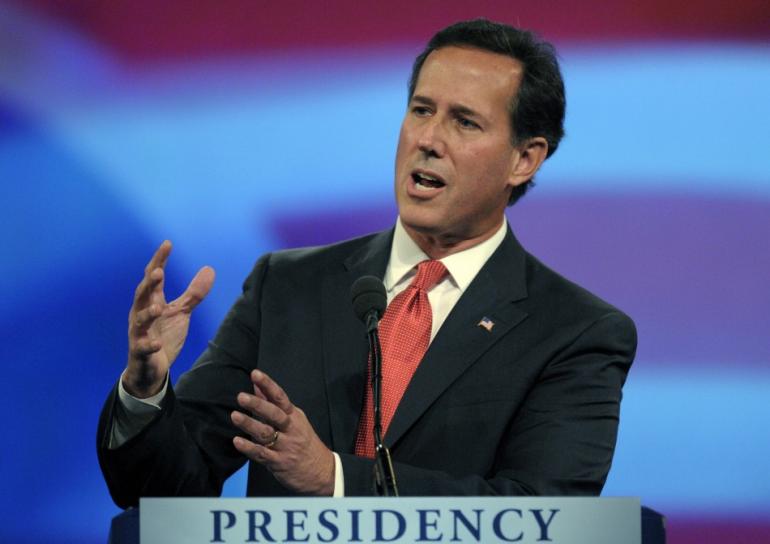
Rick Santorum


Like many people, I have been observing the remarkable rise of former Pennsylvania Senator Rick Santorum in the 2012 Republican Party primary race. Based on the fact that Super Tuesday failed to deal his candidacy anything close to a knock-out blow (though his continued candidacy and his prospects of winning the nomination are two separate considerations to track, and the latter is surely dead if it ever lived) I expect I will have the time to commit everything that I want to say about him to this blog in the fullness of time. However, today I want to focus not on the cultural issues which have come to dominate the media’s coverage of Santorum’s campaign, but on his economic message and policies.

Rick Santorum makes much of his humble, blue-collar, working-class origins. He has at times spoken movingly on the subject, such as his de facto victory speech following the Iowa caucuses, when of his late coalminer grandfather, he said “those hands dug freedom for me”. For anyone struggling to understand the appeal of Rick Santorum, I encourage you to watch this video:


You can say what you want about Rick Santorum’s views on the role of religion in government, on gay rights, on women’s healthcare, on education, energy policy and a score of other things – and believe me, I have a lot to say about them all – but you cannot deny that he is genuine. You can say the same of his fellow candidate Ron Paul, but not Newt Gingrich or Mitt Romney, the presumptive frontrunner. No, Rick Santorum meant everything he said when he lost his senatorial re-election bid by 16 points, and he says the same things now that he is running for president, and he stands by them. He believes, as Brutus did, that “there is a tide in the affairs of men, which, taken at the flood, leads on to fortune”, and that because of America’s current malaise, the rising tide of public anguish over America’s direction will lift his candidacy.

This all helps to explain his solid popularity among all but the upper-most income echelons of Republican primary voters. Also spurring his popularity among these groups is his strong support for a return to a manufacturing-based economy to improve the fortunes of America’s great so-called “middle class”, who have seen their incomes and living standards stagnate for decades. Again, he speaks movingly about the promise of America and every parent’s wish that their child will inherit a better world and greater possibilities.

But when he comes to his prescription to help these people, he could not be more wrong. From the Santorum campaign website’s “Made in America” section, a promise to:

“10. Eliminate the corporate income tax for manufacturers – from 35% to 0% – which will spur middle income job creation in the United States and will create a job multiplier effect for workers” (http://www.ricksantorum.com/made-america).

Though this point may be buried amid a list of 32 proposals to spur the US economy, it is one of his most constant refrains on the stump, and the area where a Santorum presidency would most betray many of those who support him.

Rick Santorum suggests that by eliminating corporation tax for manufacturers (presumably against his own vow not to “pick winners” if elected), this will somehow spur a huge renaissance in US manufacturing. Unfortunately there are several deep flaws in this argument. First of all, thanks to the byzantine tax code, no employer currently pays anything close to 35% corporation tax after taking account of the various deductions and loopholes that already exist. Reducing the tax on manufacturers would certainly make a marginal difference (and probably displease all those companies in the primary and tertiary sectors), but it would hardly be a magic bullet.

Secondly, like so many others, Santorum ignores the obvious reality that these manufacturing jobs are not coming back. They’re just not. Now I don’t know Rick Santorum so I cannot speculate as to whether he sincerely believes that his policies will have their stated effect or if he is just saying words to win blue-collar votes, but I do know that he is painting a picture of a future that can never be.

Thirdly, Santorum actually seemed to bristle at the notion of more Americans going to college and gaining some form of higher education to help them better compete in the new information-age workforce. He went as far as to call President Obama a “snob” for advocating higher education, and suggested that the only reason he did so was because he wanted to send as many young people into an environment where they would become indoctrinated into liberal ways of thinking. Sadly, those manufacturing jobs that do still exist are often more highly skilled and do require the very post-high school education that Santorum appeared to discourage.

Barring the reintroduction of massive trade barriers and tarriffs, most consumer goods produced in America (or in any advanced western country) simply will not be competitive with those produced in lower-cost countries and brought to market through a global supply chain. There are such things as absolute and comparative advantage in the field of economics, and no amount of trying can wish them away. It will always be cheaper to manufacture a shiny new iPad 3 device in China (or whichever country comes next as it moves up the developmental scale and nips at China’s heels) than it will in the United States. This will never change. Barring certain specific exceptions, the manufacturing jobs that America has lost will not return.

And perhaps among all of the things that Rick Santorum says that rile me up, this one makes me the most angry. He is peddling a Pleasantville-style, black and white, 1950s vision of a country where once again it is possible to live a comfortable middle class lifestyle with a decent sized family home and a couple of cars, paid for by the wages earned from assembling televisions, or refrigerators, or cars. And Republican primary voters, many of whom are in the squeezed middle class and have been let down by successive administrations, are listening to Santorum’s claims and gaining hope, and voting for him, even though he cannot in actual fact turn the clock back fifty years, even if he does actually want to. Whether he wins or loses the Republican primary and the general election, the persistence of this argument – and the belief that a few tweaks to the tax code and the drilling of a few more oil wells will spur a resurgence in unskilled and semiskilled manufacturing – simply dooms another generation of people to a life of stagnating or falling living standards.

People trust Santorum because, unlike the other main Republican candidates, he is so genuine. Why would he advocate policies that would hurt them, when he was one of them? And yet the policies that he proposes would either do little to bring back more unskilled or semiskilled manufacturing jobs, or would make the US population even less qualified to perform those jobs which already exist. And all the time that people hold out hope that a Rick Santorum or another politician like him can work this magic, it is time that they are not spending going back into training, or into college or university, and reskilling themselves for the jobs of tomorrow’s economy.

Rick Santorum says all of the things that the Republican Party’s blue collar base want to hear, but in many ways he is just a modern day Pied Piper, promising them a brighter future while marching them off a cliff.

The World’s Greatest (Un)deliberative Body

This innocuous looking Politico article (http://www.politico.com/news/stories/0212/73417.html) about the planned resignation of Senator Olympia (R-Maine) at the end of her current term began with the following statement:

“In one fell swoop Tuesday afternoon, Olympia Snowe may have not only crushed Mitch McConnell’s dreams of taking over the Senate, she also wrote the epitaph for political moderates in the world’s greatest deliberative body.” [my emphasis in bold]

The world’s greatest deliberative body. This is a phrase used frequently by American political pundits when describing the upper chamber of their legislature, and like many tropes it spews from their mouths and pens without much thought. Which is a shame, because its continued use is starting to make them look ridiculous. The greatest deliberative body in the world? To which any sane person, once successfully divested of the notion that everything in America is automatically the best example of its kind in the world, would surely have to say:

Really?

The writers at Politico are a smart bunch though, so I am sure before making such a bold and boastful proclamation, even as an aside, they carefully studied the British Houses of Parliament, the Israeli Knesset, the German Bundesrat and the legislatures of all the other major democracies, in addition to the histories of those from the ancient empires of Greece and Rome. But let’s just assume for a moment that they didn’t.

Deliberation can be defined as “long and careful consideration or discussion”. This, in turn, would suggest that some form of debate has to take place between opposing viewpoints to either conclusively disprove one and approve the other, or to forge a working compromise between the competing ideals. None of this has happened in the US Senate for a long time now. There are no “debates”. Members from the two political parties (and the few independent members) take turns standing at a lectern and reading pre-prepared speeches full of leadership-approved talking points that no one else in the chamber listens to, before sitting down and making way for someone from the other side of the aisle to do the same thing. Sure, legislation has to pass through the Senate before it can become law, but to suggest that it is deliberated is a woeful overstatement of what happens. No, the deliberation as it still exists now happens in polls and focus-groups before the parties even draw up legislation, and by the cable news and talk radio pundits who drive public opinion before legislation even reaches the house floor. Now, some of this is good (the public engagement part) and some is undoubtedly bad, but one would certainly need rose-tinted spectacles of a very strong prescription indeed to look at the US Senate today and call it a deliberative body at all, let alone the world’s greatest. There are high school debating clubs more worthy of the title.

Add to this failure to properly debate issues the fact that individual Senators can block key governmental appointments on a whim without giving a valid reason (though personal grudges and a desire for lucrative earmarks for their states usually feature quite highly on the list), and the existence of arcane Senate rules requiring a “super-majority” of 60 votes in order to pass anything remotely contentious (surely just as the founding fathers intended), and the greatest deliberative body in the world appears to be on even shakier ground. Let us also not forget that this hallowed institution currently enjoys a 13% approval rating with the American public (http://abcnews.go.com/blogs/politics/2012/01/congress-hits-a-new-low-in-approval-obama-opens-election-year-under-50/).

The larger theme that I want to touch on is the idea of American exceptionalism. I am a firm believer in this idea, but not in the blind, unthinking way that many – especially in today’s Republican party – seem to do. I was born in 1982 and history was taught exceptionally badly in British schools when I was younger, so my knowledge of the mid century is not all that it should be – though I am striving to correct this. But it is my belief that Americans of previous generations made their country great, yes, because they believed in the exceptional nature of their country’s founding and its unique mission in the world, but also because they didn’t just talk about being great all the time. They just quietly got on and did it, with much less boasting and chest-thumping than is often now the case.

A country that can betray its Constitution by passing such laws as the Patriot Act, allow torture to take place under its jurisdiction, or whose presidential candidates receive warm applause by accusing the sitting incumbent of either subverting or “apologising for America” is fundamentally more insecure about itself than has been the case for many years. And, in some ways, so is a country whose political class willingly overlooks the mounting pile of contrary evidence to declare their dysfunctional, hyper-partisan upper house the “greatest deliberative body in the world”.