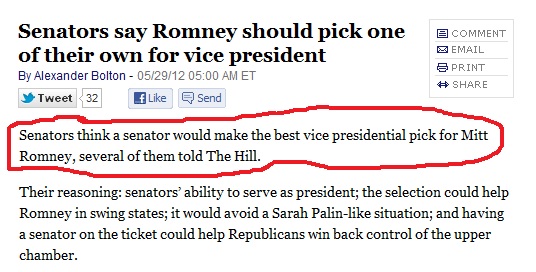
The Hill Channels The Onion

I saw this headline on thehill.com and just had to laugh:

Senators think a senator would make the best vice presidential pick for Mitt Romney, several of them told The Hill.

http://thehill.com/homenews/senate/229757-senators-say-romney-should-pick-one-of-their-own-for-vp

Fancy that. Good to see that they have a sense of humour over there on The Hill.

The Hypocrisy of Mitt Romney – Government Spending Edition

mitt-romney-2012-presidential-election

I missed this when it happened last week, but it appears that during an extended interview with Mark Halperin, Mitt Romney managed to fastidiously lay multiple bundles of high explosive around the foundations of his own economic policy arguments, retreat to a not-very-safe distance, press the plunger and bring the whole thing crashing down around him, revealing his public stance to be the glib, opportunistic sham that it is, with hardly anyone – least of all the interviewer – noticing a thing.

I only found out after being cross-linked through Charles Pierce’s blog at Esquire, where he documents the exchange as follows:

Halperin: Why not in the first year, if you’re elected — why not in 2013, go all the way and propose the kind of budget with spending restraints, that you’d like to see after four years in office?  Why not do it more quickly?

Romney: Well because, if you take a trillion dollars for instance, out of the first year of the federal budget, that would shrink GDP over 5%.  That is by definition throwing us into recession or depression. So I’m not going to do that, of course.


I then picked up the thread when Jonathan Chait jumped on Romney in his piece in the New York Magazine:

Of course! Romney says this as if it’s completely obvious that reducing the deficit in the short term would throw the economy back into recession, even though he and his party have been arguing the opposite case with hysterical fervor. Republicans have committed themselves to Austrian economic notions and other hoary doctrines justifying the position that reducing deficits is a helpful way out of a liquidity trap.

I’ve thought that this represents primarily a case of self-delusion in the cause of political self-interest, as opposed to conscious cynicism: Republicans understood that bigger deficits would spur faster growth and reduce their chances of regaining power, so they found themselves more persuaded by theories suggesting bigger deficits wouldn’t really help. But if they had really converted to this belief, wouldn’t there be even a tiny bit of wailing about Romney’s open endorsement of Keynesianism? It’s not as if conservatives have been shy about holding his feet to the fire when he expresses some tiny deviation from their position. Yet I have noticed zero conservative complaints about Romney’s big fat wet kiss to John Maynard Keynes, which suggests their level of actual devotion to this position borders on nil.

It really does take a special kind of nerve – or else just the realisation that he can be a completely convictionless politician and change his public statements to suit the political mood without ever, ever suffering significant fallout – to execute this kind of 180-degree U-turn in a televised interview, and expect to get away with it.

Aside from revealing an important truth about what a Romney administration would actually do were he to win the election, it also demonstrates a total contempt for his supporters, some of whom he must know actually believe that he will take the immediate and drastic action to balance the federal budget that he still promises in his attacks on President Obama.

What a man.

The Last Word On Bain

Mitt Romney - Bain Capital

Between them, I think that Andrew Sullivan (writing at The Daily Beast) and Joe Klein (at Time) sum up perfectly the way that Romney’s tenure at Bain Capital can be reasonably and fairly framed in the forthcoming election debate.

First Sullivan:

The point is that a president cannot just maximize profts for shareholders. Being a CEO is not the same as being a president. Moreover, even if you think that Romney’s highly profitable adventures in private equity helped the economy more than hurt it, the rigged system in which he paid lower taxes, exploited other loopholes and made money regardless of the outcome in any specific case is not a pretty picture of real market capitalism.

And then Klein:

It seems to me that Obama’s immediate point is wrong: Romney wasn’t primarily about job destruction and corporate plundering. His larger point–that Romney was not so much about job-creation as he was about profit-creation–is correct, though. But the largest point of all is this: private equity capitalism was all about short-term profits–maximizing shareholder value–rather than long-term growth. It ushered in an era of massive executive compensation and bonuses. It prospered because of tax rules that made debt more profitable than equity, and a “carried interest” tax dodge that enabled Mitt Romney to pay a lower percentage in taxes than your average construction worker. It can be a useful tool in restructuring companies and steering them toward profitability, but it is not the sort of model you’d want to apply to the entire American economy.

A President has to be about long-term growth, not short-term profits–and to the extent that Barack Obama is using the Bain ads to make this larger argument, he is not “stumbling” or attacking “free enterprise,” but he is steering the conversation toward the most important topic this year: what sort of economy do we want to have and how do we get there?

There’s nothing in these arguments that sounds stridently anti-capitalist or envious of wealth creation. The point is simply one of short term vs. long term focus, and whether successful stewardship of a large nation requires additional skills over and above those required to succeed in business.

If – if – Obama can stick to this narrower line of attack, as he did at the recent NATO summit press conference, he will be much less vulnerable to the inevitable, tired charges of socialism and class warfare that are already being warmed up by some on the Right.

Obama The Socialist

Barack Obama - Socialist - Socialism


Who knew: Apparently I would make a passable journalist, and could be well respected and remunerated for doing so. I know this because after I read Paul Roderick Gregory’s article in Forbes, “Is It Within Bounds To Ask: Is Obama A Socialist?” I did two things: I reminded myself of the definition of socialism using two readily available sources (I was smart and used two independent sources just in case one of them was leading me astray), and I cross-checked this definition against the policy positions set out on Barack Obama’s website.

Paul Roderick Gregory, who “journalists” for a living, did neither of these things; he is professionally negligent and apparently just whipped open his laptop and started typing. Either that, or he is professionally negligent and knows the information to be found on these websites very well, but thinks that all of his readers are idiots who are incapable or unlikely of doing the same. Now which could it be?

I am going to leave aside the semantic arguments about the meaning of the word “socialism” that Gregory employs in his companion piece “Is President Obama Truly A Socialist“, but basically Gregory holds his hands up and pleads that he doesn’t mean the traditional definition of socialism. No, he just means “socialism” as practiced by continental Europeans with their welfare states. Of course, this disclaimer is buried very deep within the article, so that the full impact of conflating Obama’s political philosophy with socialism is felt immediately, while the clarification is given only after the statement has had sufficient time to establish itself as fact:

By “socialist,” I do not mean a Lenin, Castro, or Mao, but whether Obama falls within the mainstream of contemporary socialism as represented, for example, by Germany’s Social Democrats, French Socialists, or Spain’s socialist-workers party?

By this criterion, yes, Obama is a socialist.

If Gregory wanted to make this more nuanced argument (still wrong, in my opinion) – that Obama’s policies are closely aligned to European social democracy – then he could go ahead and do so. But he has no interest in doing that. The only reason he even includes this tortured disclaimer is to clear the ground so that he can land his rhetorical punch on Obama, and label him a “socialist”.

From the stirring conclusion to the original article:

The upcoming November election offers American voters a choice that is starker than they understand. Obama brings to the table a deep distrust of free enterprise and a belief in government as the solution to most problems. Romney offers a vision of faith in private enterprise and a distrust of government intervention. Obama will disguise his views with “fair share” slogans and weak protestations of faith in private enterprise.

This is actually the closest that Gregory comes to cogency in either piece. I come from a centre-right perspective and do sometimes think that Obama is heavy-handed in his administration’s oversight of the free market. Interfering with private companies such as Boeing when they come to make decisions on where to locate their production, for example, strikes me as bullying and control-freakish. But I have never felt as though Obama was secretly yearning to nationalise Boeing and create a state-owned aerospace and defence company.

On the flip side, many of Romney’s contemporaries in industry are only too quick and happy to run to the government when it suits their needs, perhaps to ask for bailouts, favourable trading terms or tax loopholes, or to bring down the regulators on a rival that is becoming rather too successful. Hardly unheard-of.

Why am I even bothering to quote this trash? Only because it is emblematic and typical of the lazy type of charges that are levelled against Obama by some on the right. By calling out Gregory now, I free myself from the obligation do the same thing every time another right wing talking head repeats the same “Obama-Socialist” line on Fox News, or in a newspaper column.

So, Paul Roderick Gregory, the unfortunate person who I picked on to embody every die-hard tea partier and overenthusiastic Republican who is tempted to get carried away with the old rhetoric when disagreeing with President Obama’s economic policies: is it “within bounds to ask: is Obama a socialist?”

Sure, it’s within bounds. It’s just really, really dumb.

I had no idea that the bar for becoming a published Forbes contributor was set so low.

Obama Syndrome – Tom Friedman’s Diagnosis

Tea Party Protest - Barack Obama

In his latest New York Times column, Thomas Friedman succinctly puts into words what many centrists and probably nearly all frustrated liberals will immediately identify as one of the Obama administration’s biggest political failures thus far into his first term – Obama’s inability to properly sell his accomplishments, and their failure to prevent these accomplishments from being distorted and turned into electoral liabilities by the Republican opposition.

Friedman complains:

Barack Obama is a great orator, but he is the worst president I’ve ever seen when it comes to explaining his achievements, putting them in context, connecting with people on a gut level through repetition and thereby defining how the public views an issue.

True, though this is an age old complaint about Democratic politics – the inability to remain cohesive and on-message, and to deliver a point that is consistent, compelling, and easy to repeat and digest.

On what is perhaps Obama’s signature first term accomplishment – however imperfect it may be – reforming the US healthcare system, Friedman delivers the kind of blunt, incontrovertible smackdown of Republican talking points that make people like me want to shout out in agreement and kiss the screen:

“Obamacare is socialized medicine,” says the Republican Party. No, no — excuse me — socialized medicine is what we have now! People without insurance can go to an emergency ward or throw themselves on the mercy of a doctor, and the cost of all this uncompensated care is shared by all those who have insurance, raising your rates and mine. That is socialized medicine and that is what Obamacare ends. Yet Obama — the champion of private insurance for all — has allowed himself to be painted as a health care socialist.

Yes, yes, a thousand times yes. It’s painful that anyone should have to school the Republican party, the self proclaimed champions of fiscal conservatism, in such basic economic concepts as the free rider problem, but if someone has to do it then there is no one who can do so with more style than Tom Friedman. I’m not sure that I have it in me to hear one more Tea Partier lambasting Obamacare and lamenting that the US now has a socialised healthcare system and that he is being made to pay for his neighbour’s keep, without just straight up asking him “well, what the hell do you think you were doing before, idiot?”

And on the somewhat topical subject of government spending and deficits:

Finally, how did Obama ever allow this duality to take hold: “The Bush tax cuts” versus the “Obama bailout”? It should have been “the Bush deficit explosion” and the “Obama rescue.” Sure, the deficit has increased under Obama. It was largely to save the country from going into a Depression after a Bush-era binge that included two wars — which, for the first time in our history, we not only did not pay for with tax increases but instead accompanied with tax cuts — plus a 2003 Medicare prescription drug bill that we could not afford, then or now. Congressional Democrats also had a hand in this, but the idea that Bush gets to skate off into history as a “tax-cutter” and not as a “deficit buster” is a travesty. You can’t just blame Fox News. Obama has the bully pulpit.

The way in which Democrats managed to lose control of the narrative and allow the party who led America into two unfunded wars, a round of unfunded tax cuts and an unfunded expansion of Medicare (oh yes – socialised medicine, too) to reclaim any credibility whatsoever in terms of economic understanding or fiscal responsibility will forever astound me. And Friedman is right, Obama has the bully pulpit. He, his team and his spokespeople should have been sending out the right message from the start, and not have allowed themselves to have been forced to play defense.

To be fair – and as Friedman notes – sometimes actions speak louder than words, and in several notable instances the Obama administration’s actions have been as much of a reason for disappointment as the selling of their message. For me, the almost unforgivable failure of the Obama administration was the failure to embrace and push forward the Bowles-Simpson deficit reduction plan, which enjoyed considerable support (if not quite enough to mandate an up-or-down vote in the House and Senate) and which would have demonstrated beyond any reasonable doubt that Obama was serious about medium term deficit reduction. The Obama administration’s reticence on this point enraged many a centrist Obama supporter, and led blogger Andrew Sullivan to declare:

My own view, however, is that Obama badly bungled this by not embracing his current position in the State of the Union and pummeling the GOP with it for months. Bowles Simpson was his commission after all, and yet he dropped it like a stone and pandered to his left when he had a perfect moment to pivot to the debt question. Giving the GOP any credibility on debt by offering nothing of real $4 trillion substance until last week may well be seen as Obama’s greatest mistake in his first term. Now that he has finally offered it, his ability to maintain the high ground on a fair measure to tackle the deficit is much reduced from his January possibility. This is not a meep-meep moment. And it could easily have been, if Obama had shown, yes, courage sooner … On this score, leading from behind has been pretty much a disaster. And there is no longer much time to lead from the front.

So there are problems here of action as well as messaging. I don’t yet believe that this is cause for panic – as I have laid out in previous posts, I am very confident that given his opposition, Obama is heading for a likely landslide reelection victory. But an administration – and a party – that fails to create and stick to a positive narrative on so important a topic, deserves their fair share of woe.

But unfortunately it is not just President Obama and his administration that suffer as a result of their baleful communication efforts. For with every day that passes without a compelling, effective message from the administration about achievements won and plans for the future, the unrepentantly unreformed party of George W. “two unfunded wars” Bush and Richard “deficits don’t matter” Cheney will seem to more and more people like a potentially viable alternative to run the show again.