On Death Panels

Sarah Palin - ObamaCare - Affordable Heathcare Act - Death Panels

Normally, I try not to lend this person’s activities any of my time or attention, but Politico reports that Sarah Palin is resurrecting her scaremongering “death panel” message in anticipation of the upcoming US Supreme Court ruling on the new health care law’s constitutionality.

Says Politico:

Palin charged in a August 2009 Facebook post that the Democrats’ health care bill would empower a “death panel” of government bureaucrats who can decide who lives or dies. The 2009 claim earned Palin Politifact’s “Lie of the Year,” but she said today that the president’s health care law’s Independent Payment Advisory Board makes life-or-death decisions.

“It was a pretty long post, but a lot of people seem to have only read two words of it: ‘death panel,’” Palin wrote today. “Though I was called a liar for calling it like it is, many of these accusers finally saw that Obamacare did in fact create a panel of faceless bureaucrats who have the power to make life and death decisions about health care funding.”

No, Palin. People read the whole thing, their minds just stuck on those two words – “death panel” – because it was such an outrageous distortion of one of the best bits about the Affordable Care Act, or ObamaCare. Requiring health insurance providers to cover end-of-life care discussions between patients and their doctors was an excellent idea, one that would have encouraged thousands of Americans to decide whether or not they would want very aggressive and costly treatment during their final days, potentially saving them or their loved ones from unnecessary and prolonged pain and anguish when the time comes, not to mention saving vast sums of money and lowering insurance premiums for everyone.

Equating this with a room full of stern bureaucrats weighing the value of your life in their hands and deciding whether or not you are worthy of treatment was a case of shameful fantasy and hyperbole, and ultimately resulted in this provision being struck from the finished law – and you think that you are doing the American people a service?

Essentially, this seems to come down to a quibble about which invisible, mysterious forces are allowed to exercise life-or-death decisions over us (for after all, there is potentially unlimited demand for healthcare, and very limited resources to go around). Palin seems to prefer the invisible hand over the faceless bureaucrat, but if she could think in full colour rather than monochrome black/white, right/wrong for just a moment, she might realise that rationing of healthcare inevitably occurs in any system, and that the unchecked free market is little better a solution than the dark room of emotionless socialist bureaucrats created by her fevered imagination.

The End Of America As We Know It? Hardly.

Andrew Sullivan posts an excellent retort to Mitt Romney’s fear mongering that the United States is about to make a binary flip from being a free enterprise nation to having a “government-run economy”, based on this illuminating chart:

As you will note, the line indicating growth in corporate profits (in billions of dollars) obstinately refuses to go in the direction that it would need to point in order to signify the government-led smothering of the private sector that Romney wants us to believe is currently taking place.

The Republican presidential candidate has been giving speeches bemoaning the notion that President Obama doesn’t understand capitalism or the free enterprise system, and that this ignorance is leading Obama to implement policies that are harming the economic recovery. Romney has advanced this line of attack frequently, most recently at a campaign event in St. Louis, Missouri, though to be fair, he seems willing to ascribe Obama’s supposed failures to ignorance rather than malice:

I do not believe this has been done with evil intent or ill will. But for a family watching their house being sold at foreclosure, or the family that is forced to spend their kid’s college savings just to make ends meet, the results are just as devastating.

Oh wait, perhaps not:

I will not be that President of deception and doubt. I will lead us to a better place.

Then, of course, comes the obligatory lie about Obamacare, the Affordable Healthcare act:

Today, government at all levels consumes 37 percent of the total economy or G.D.P. If Obamacare is allowed to stand, government will reach half of the American economy. And through the increasing controls government has imposed on industries like energy, financial services and automobiles, it will soon effectively control the majority of our economic activity.

This line only works if you are ill-informed enough to actually believe that Obamacare effectively appropriates and nationalises the entire US healthcare industry, bringing it under government ownership as opposed to just regulating the industry to a higher degree and increasing the customer base of the insurance companies through the individual mandate. So it’s basically a big fat lie, though Romney is clever enough to choose his words carefully, stating “government will reach half of the American economy”, a quite meaningless phrase, but one that deliberately and incorrectly suggests ownership and control of half of the US economy without actually putting him on the record as having said so.

And finally, the crux of Romney’s argument:

One must ask whether we will still be a free enterprise nation and whether we will still have economic freedom. America is on the cusp of having a government-run economy. President Obama is transforming America into something very different than the land of the free and the land of opportunity.

We know where that transformation leads. There are other nations that have chosen that path. It leads to chronic high unemployment, crushing debt, and stagnant wages.

I don’t want to transform America; I want to restore the values of economic freedom.

This is what really irritates me about the Romney argument, this idea that there is a binary choice between “free enterprise” and “government-run”, that America has always dwelt on the free enterprise side of the line and that Obama wants an old-school socialist planned economy. It is borne out of the total allergy to nuance or shades of grey currently affecting the Republican party, and is one of the main reasons why I cannot bring myself to support them at the moment.

Of course there is no such binary choice. What percentage of GDP would have to be consumed by government spending for “free enterprise” to officially be declared dead according to the Romney definition? 37%, the current figure? 50% + 1? Something else? All conservatives – myself included – want to see government spending account for as small a proportion of GDP as possible, and most would agree that the current level – in Britain as well as in America – is too high. But the size of government has expanded under both parties, and though Obama may be guilty of failing to reverse the trend, he has at least slowed the rate of increase in the size of government, when the stimulus measures are factored out. For Mitt Romney to suggest that the US is teetering on the brink of becoming a planned economy under Obama when government spending accounts for 37% of GDP is not only the worst type of scaremongering, it also ignores the significant contribution that his own party made to the problem.

And as for this narrative about Obama seeking to “transform” America, to turn it into something unrecognisable from before – while it may be the only narrative that Romney can hope to ride to the White House in November, it is also untrue. Obama is a centre-left politician implementing mostly centre-left policies, some of which would actually have enjoyed a measure of support among Republicans if they had been proposed by a President Bush, Cheney or McCain. But for Romney to get out the vote, he must convince his supporters of something patently untrue, that Obama is a radical, a dangerous subversive trying to alter the fabric of America.

I’m an economic conservative, I believe in a small state and limited government involvement in private markets. But given the choice between someone on the centre left who is making an honest effort along Keynesian lines to solve the economic difficulties facing America and someone on the right who screams “socialism!” where none exists, and who remains in denial about his own side’s complicity in the downturn and the detrimental effect that his policy proposals would have on the recovery, I have to hold my nose and support the centre left guy.

Which is a shame, because it would be nice to have a genuine choice in 2012.

My Turn To Be President

Politico reports on Jeb Bush’s surprisingly frank confession that he believes 2012 was his “time” to run for the presidency, and that he may now have missed his chance:

“This was probably my time,” Bush told “CBS This Morning,” referring to the ongoing presidential campaign. “There’s a window of opportunity, in life, and for all sorts of reasons.”


I think we can all quite happily do without a third member of the Bush dynasty ascending to the presidency and making a mockery of American meritocracy. Thanks for sitting this round out, Jeb.

That said, the Florida Republican doesn’t know whether he ever wants to be president.

“Have you made a decision that you don’t want to be president?” asked CBS host Charlie Rose.

“I have not made that decision,” Bush responded.

Uh-oh.

How Not To Cover An Election

It is very hard to disagree with this damning article from Politico, assessing the current state of cable news in America:

If ever there was a political event to lay bare the partisan ideologies of the cable news media, the Wisconsin recall was it.

MSNBC was blatantly rooting for Tom Barrett to defeat Gov. Scott Walker, even sending union champion Ed Schultz to cover an event with no apologies for the dog he has in the fight. (Earlier tonight, Chris Matthews even told Schultz that if he wasn’t an MSNBC host, he could be head of the AFL-CIO.) When it became clear that Barrett would lose, Schultz looked almost teary eyed. Not long after, the network’s contributors immediately began suggesting that this was, in fact, good news for Obama — who, after all, hadn’t even set foot in Wisconsin — and began attacking Mitt Romney.

Meanwhile, Fox News was blatantly rooting for Gov. Walker, and the moment it became clear that Walker might win, host Sean Hannity called it “a repudiation of big unions,” which did “everything they could do to demonize Scott Walker.” Guest Hugh Hewitt then predicted that, five months from now, Romney would follow Walker just “as Reagan followed Thatcher.” Fox’s Greta Van Susteren later hosted what amounted to a victory celebration for the Republicans.

Given this blatant partisan coverage, it was absolutely impossible to watch either network and weed out any clear understanding of the actual significance of the event, much less what effect it would actually have on the 2012 presidential election.

http://www.politico.com/blogs/media/2012/06/the-worst-night-on-cable-news-125389.html

Out of a mixture of boredom, insomnia and a ravenous (bordering on unhealthy) appetite for US political news, I stayed up until 2AM watching MSNBC’s live coverage of the Wisconsin gubernatorial recall election (MSNBC being the only channel I was able to stream on the internet since our satellite television decided to break at the weekend). And goodness me, the coverage was bad. And by “bad”, I mean really unworthy of a channel that purports to be a television news network rather than a propaganda station.

Don’t get me wrong – I like MSNBC a lot. As the US Republican Party has lurched ever further away from being a centre-right party favouring limited government towards becoming a win-at-all-costs, fear-stoking, hypocritical, economically and historically illiterate party for idiots I have found no small degree of comfort in having my displeasure and frustration validated by the likes of Chris Matthews, Martin Bashir, Rachel Maddow, Al Sharpton and the rest of the MSNBC cast. I think that’s a fine and healthy thing to do in small measures, so long as one does not go too far and close oneself off from divergent opinions and other sources of news. However, at some point – I’m not even precisely sure when – it became okay for news networks to openly cheerlead for certain politicians or parties, not just during the opinion shows but while covering live election events. No pretence at impartiality any more, just open bias toward one or other party throughout the broadcast.

MSNBC dispatched their entertaining and highly watchable anchor Ed Schultz to Wisconsin to cover the results in front of a crowd of union-supporting, pro- Tom Barrett people. After talking up Barrett’s prospects throughout the show, he did not try very hard to conceal his disappointment when Republican incumbent Scott Walker was projected to survive the recall challenge:


At this point it really goes without saying that the Fox News team were up to exactly the same type of shenanigans on their network, before and during the voting:


Of course.

What exactly is wrong – or detrimental to good ratings – with having a lively, spirited but even-handed broadcast while we wait for the results to come in and a victor to be declared, featuring moderated discussions with people from all sides of the political spectrum (so we actually have a chance to learn something rather than just have our existing prejudices reinforced), which could then segue into the usual partisan bombast, in a separately branded show, once the results were announced?

Look, I get it. Conservatives long perceived a bias in the news networks and took to talk radio to find a place where they could hear their opinions reflected in the coverage. Conservative talk radio was eventually augmented by the Fox News Channel, which became so successful that liberals felt that they also needed a channel of their own, at which point MSNBC was hijacked and directed to “lean forward”. CNN tried to maintain an ideological balance and haemorrhaged viewers as a consequence, supposedly validating the “pick a side” approach taken by the others, and has had to resort to ever more desperate technological gimmicks such as interactive video walls, holographic reports beamed into the studio, and Wolf Blitzer, just to remain competitive. Apparently we want our news delivered to us by people who share our political leanings. I’m all for the free market, so what’s wrong with that? Nothing, really.

Except that aside from doing a disservice to the many excellent television journalists who have gone before, it is just plain tacky to call yourself a news network and then park yourself in front of a bunch of partisan supporters and openly support one candidate over another, before polls close, during a segment that is billed as live election coverage rather than political commentary or opinion piece.

Really, really tacky.

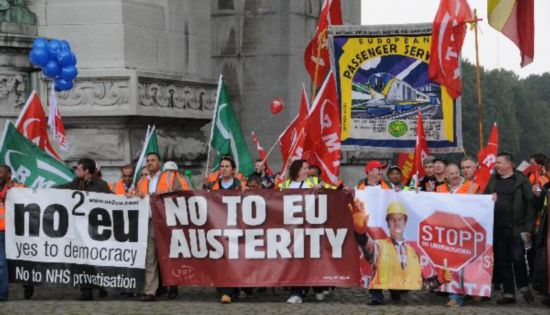
On Austerity, Learning The Wrong Lessons From Europe

Europe Austerity 2


As the US presidential election draws closer and the political debate rumbles on, I find myself becoming increasingly frustrated by those voices on both the left and the right, who seek to hold up the example of “Europe” (that homogenised, cohesive whole) as Exhibit A in an attempt to win their economic policy argument.

I am talking about the ongoing “austerity/stimulus debate” – whether America should make drastic and immediate cuts to public spending in order to tackle large government budget deficits, or whether even higher levels of government spending are required in the short term to spur economic growth, before deficit-tackling measures are undertaken at some point in the future.

When talking about these issues, both Democrats and Republicans are playing fast and loose with the truth, and doing the American people (at least those who have already tuned in to the election-year political coverage) a disservice in the process.

On the left, it is fashionable to point at Europe and exclaim that austerity policies are not working because “Europe” has drastically scaled back government spending, and yet is experiencing either a very tepid recovery or an outright double-dip recession. A typical example, from The Washington Post:

Europeans are rebelling against austerity. That’s the read on Sunday’s elections in Greece and France. But why do voters loathe austerity? Perhaps because, as economists have found, efforts to rein in budget deficits can take a wrenching toll on living standards, especially in a recession.

In a recent paper for the International Monetary Fund, Laurence Ball, Daniel Leigh and Prakash Loungani looked at 173 episodes of fiscal austerity over the past 30 years. These were countries that, for one reason or another, cut spending and/or raised taxes to shrink their budget deficits. And the results were typically painful: Austerity, the IMF paper found, “lowers incomes in the short term, with wage-earners taking more of a hit than others; it also raises unemployment, particularly long-term unemployment.”

The left-leaning media across the pond is also keen to seize on this narrative, as the following opinion piece from The Guardian deftly demonstrates:

Third, the president should make it clear he won’t allow government spending cuts to take precedence over job creation. He won’t follow Europe into an austerity trap of slower growth and higher unemployment. While he understands the need to reduce the nation’s long-term budget deficit, he should commit to vetoing any spending cuts until the unemployment rate in the US is down to 5%. Instead, he should commit to further job-creating investments in the nation’s crumbling infrastructure – pot-holed roads, unsafe bridges, inadequate pipelines, woefully-strained public transportation, and outmoded ports.

Finally, Obama should make sure Americans understand the link between America’s fragile recovery and widening inequality. As long as so much of the nation’s disposable income and wealth goes to the top, the vast middle class lacks the purchasing power to fire up the economy. That’s why the so-called “Buffett rule” he has proposed – setting a minimum tax rate for millionaires – needs to be seen as just a first step toward ensuring that the gains from growth are more widely shared. He should vow to do more in his second term.

Such an economic strategy – forcing banks to help distressed homeowners, stopping oil speculation, boosting spending until unemployment drops to 5%, and fighting to ensure economic gains are widely shared – is critical to jobs and growth. It’s the mirror image of Europe’s failed austerity policies.

These arguments do not stand up to scrutiny for several reasons, many of which are well articulated in this piece from Forbes:

The trouble with Europe’s post-crisis budgets, then, isn’t so much that they’ve increased taxes. It’s that they haven’t meaningfully cut spending. “Following years of large spending increases,” Veronique de Rugy explains, “Spain, the United Kingdom, France, and Greece — countries widely cited for adopting austerity measures — haven’t significantly reduced spending since 2008.” De Rugy points to data that shows those countries “still spend more than pre-recession levels,” with France and Britain making no cuts, and Italy increasing spending in 2011 “more than the previous reduction” between 2009 and 2010. Without significant, substantial cuts, tax increases alone don’t amount to austerity. Yglesias is correct that tax hikes can contribute to austerity. What tax hikes cannot do, however, is be austerity. Tax hikes are neither necessary nor sufficient for an austerity program.

Inconsistent though it may be with the liberal worldview in the US, this is very true. Government spending, by many measures, is actually higher than pre-recession levels in Britain and other countries. The so-called “austerity” that everyone is wailing about is nothing more than a reduction in the rate of increase in government spending. Furthermore, as anyone living in Britain can easily attest, many of the “austerity” measures have been tax increases, and not spending cuts – which also does little to support the liberal view that draconian spending cuts have stymied an economic recovery.

Also missing from the left-wing take on austerity is an understanding of the fact that, unlike the US, European economies grappling with anaemic growth or double-dip recession do not have the good fortune to be underpinned by the world’s primary reserve currency. It is much easier to enact a large scale stimulus programme while retaining the confidence of the global bond markets if your currency is the US dollar, a fact that is glossed over by many people, including some in the Obama administration who hold up Europe as a cautionary tale of what happens if you fail to meet economic downturn with government stimulus.

The Washington Post reports:

“The situation in Europe is slowing things down,” Obama told donors at the New Amsterdam Theatre. At the home of hedge fund executive Marc Lasry, Obama said that Romney and congressional Republicans favored an austerity plan that would “drastically shrink government,” hurting job growth and middle-income Americans.

“That is fundamentally different from our experience in growing this economy and creating jobs,” Obama said.

Where Obama was subtle, not drawing a direct line between Europe’s approach and Romney, Clinton was not.

The former president said Republicans were adopting “the European economy policy.”

As a European watching the American political debate unfolding, it frustrates me to see such sweeping statements and generalisations being made about other countries, and seeing their actions and policy stances mischaracterised without even the pretence of trying to understand them – and this applies to both sides of the political aisle. I also fear that it does not do much to dispel the false but common notion that most Americans are insular and lacking any real understanding of the world beyond their borders.

This stereotype, where true, is unfortunate enough to the extent that it applies to the general population, but even more concerning when it manifests itself in current and would-be future political office holders.