Politico The Prude

Politico reports that John Stewart has been criticising the Democratic legislators and mayors who have been bullying and threatening Chick-fil-A over the position on gay marriage taken by that company’s CEO, mocking them on The Daily Show:

Comedian Jon Stewart ripped Mayors Rahm Emanuel and Tom Menino on Thursday night for pledging to block Chick-fil-A from opening new restaurants in their cities, siding with those on the right who say such a move would be unconstitutional.

“Pretty sure you can’t outlaw a company with perfectly legal business practices because you find their CEO’s views repellant. Not sure which amendment covers that, but it’s probably in the top one,” Stewart said. “I think maybe the mayors hadn’t thought this thing through.”

Very true. I have already written about the hypocrisy and illiberalism of those people who, like Rahm Emanuel and Tom Menino, want to punish individuals or groups not for their actions but their beliefs.

Unfortunately, we then get this:

Stewart mocked the chicken chain’s supporters, too, using sexual innuendo in a joke about “the million mouth march.”

“And what better way to stand up and say, ‘I oppose gay people’s rights to get married,’ than to head down to a Chick-fil-A, grab a hold of two buttery buns, split down and gobble down some of that hot, greasy…” Stewart said before saying a certain synonym for chicken that also refers to the male anatomy.

I think the word they are grasping for is “cock”. That’s C-O-C-K.

Could you find a more tortured way of not to say “cock” than to write “a certain synonym for chicken that also refers to the male anatomy”?

And “the male anatomy”? Is even the word “penis” out of bounds these days?

It irritates me when news organisations refuse to use certain words when they are central to the story or quote under discussion. Sometimes this is due to tortured political correctness or oversensitivity – if there is a story about racism, for example, we will hear lots about the offender uttering “the N-word”, for example. Sometimes it is due to squeamishness or prudishness, such as talking about someone who lets “the F-word” slip. And sometimes it is due to willful ignorance, such as when the New York Times refers to waterboarding as “torture” when it is carried out by a foreign country, but “enhanced interrogation” when committed by the United States.

In this case, it doesn’t really matter. The article is a light-hearted piece about a parody news show. At other times and with other stories it does matter though, and failing to report a quote accurately, or use the correct term, can have damaging or insidious consequences.

The only time that offensive words have the power to harm is when they are put on a pedestal and only referred to in roundabout, opaque ways. News organisations and journalists make themselves look silly when they falsely ascribe such power to a harmless arrangement of letters.

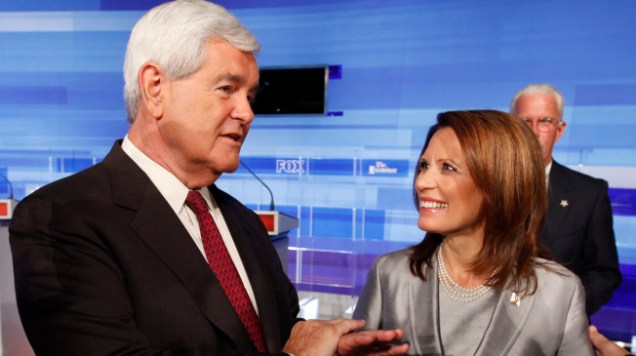
Newt Gingrich, Michele Bachmann And The Muslim Brotherhood

Michele Bachmann, Newt Gingrich

For some inexplicable reason, Politico invited former Speaker of the House Newt Gingrich to write a 2,500 word piece in support of Michele Bachmann’s witch hunts against federal workers whom she capriciously determines to have connections to the Muslim Brotherhood and as a consequence represent an apparent threat to the national security of the United States.

I should let it go, I know I should. Or I could do a point-by-point rebuttal.

Here we go, from the top:

The recent assault on the National Security Five is only the most recent example of the fear our elites have about discussing and understanding radical Islamists.

Newt Gingrich, there is absolutely no way that you can define “elites” without including yourself in the group. You were one of the most powerful politicians in the country, you spent years in Washington, you were a presidential candidate and you had a $250,000 line of credit at Tiffany’s. You are in no way a man of the people, get over yourself.

When an orchestrated assault is launched on the right to ask questions in an effort to stop members of Congress from even inquiring about a topic — you know the fix is in. The intensity of the attack on Rep. Michele Bachmann (R-Minn.) as well as Republican Reps. Trent Franks of Arizona, Louie Gohmert of Texas, Tom Rooney of Florida and Lynn Westmoreland of Georgia is a reminder of how desperate our elites are to avoid this discussion.

Oh yes, it is the plucky brave witch-hunting Republican congressional members who are being intimidated and bullied here. Right. And again, quit it with the “elite” talk. You are our “elites” as much as anyone else.

Given all the painful things we learn about people every day and the surprises that shock even the experts (the head of the FBI anti-spy effort was a Russian spy, for example), you have to wonder why people would aggressively assert we shouldn’t ask about national security concerns.

Ah yes, let’s create a straw man argument so that we can knock it down and look clever. I don’t think that any one of the many people who condemned Bachmann’s baseless attack on Huma Abedin’s loyalty or patriotism think that we should not be concerned about national security – they just think that you need something approaching tangible evidence, or at least reasonable suspicion, before you smear someone’s character and good name.

We have replaced tough mindedness about national security with a refusal to think seriously and substituted political correctness and a “solid” assurance that people must be OK because they are “nice” and “hard working” for the systematic, intense investigations of the past.

Again, where is this coming from? Who said this? Is Newt Gingrich now just inventing fictitious people in his mind and giving them strange, subversive and cowardly views so that he has someone to argue with? Is he that bored now that his presidential aspirations have imploded in on themselves under the weight of their own moralising pomposity?

The underlying driving force behind this desperate desire to stop unpleasant questions is the elite’s fear that an honest discussion of radical Islamism will spin out of control. They fear if Americans fully understood how serious radical Islamists are, they would demand a more confrontational strategy.

Okay, so if we did have the American intelligence services do a more detailed check on Abedin and any other dark-skinned or oddly-named people that make certain Republicans uncomfortable (beyond the ones that have undoubtedly already taken place before they were allowed to assume jobs such as chief aide to the Secretary of State), one of two things happens. 1 – everyone is exonerated, and the time and effort was spent in vain, or 2 – someone does have a skeleton in their closet, and they do harbour some kind of anti-American or pro-Islamist beliefs or connections. In the unlikely event of scenario 2, what do we do? And how do we guard against others infiltrating the US government in future? Do an extra background check on anyone with a non-western surname, or anyone who went to school with someone who turned out to be crazy? Invite Michele Bachmann to use her divining rod to determine whether they are “true patriots” or not? Exactly what is the “more confrontational strategy” that you are talking about in this context, Newt?

A young John F. Kennedy wrote “Why England Slept” to try to understand how the leadership of a nation could ignore, repress and reject warnings about Adolf Hitler and Nazi Germany. A future JFK may write “Why Washington Slept” to explain our current period. The case of the National Security Five would be a good chapter on the desperation of the elites to avoid reality and their determination to smother any wake-up call, which might make them come to grips with Blair’s warning.

Don’t even go there, Gingrich. Don’t compare the Bachmann 5 (National Security 5 is far too generous) to John F. Kennedy. Or, indirectly, to Winston Churchill, who anticipated the dangers of Nazi Germany and was initially ridiculed for warning others.

The case of the Pakistani-American car bomber has yet another lesson for those willing to learn it. At his sentencing, Faisal Shahzad asserted, “If I’m given 1,000 lives, I will sacrifice them all for the life of Allah.” He had apparently planned to build another car bomb in the next two weeks. The Pakistan Taliban had given him $15,000 and five days of explosive training just months after he became a U.S. citizen.

As Fox News reported: “The judge cut him off at one point to ask him if he had sworn allegiance to the United States when he became a citizen last year. ‘I did swear’ Shahzad answered, ‘but I did not mean it.’”

So we can’t trust the word of any Muslim because of the actions of this individual? If that is not what you are saying, what are you saying?

This long war with radical Islamists is a very different struggle. There are many nuances and long-term developments. Much of the struggle involves ideas and language alien to most American leaders and unknown even to most of the State or Defense Department professionals.

So the right or wrong adviser can be enormously powerful. Getting the right advice can be everything.

Therefore, whose advice we rely on becomes central to national security. Asking who the advisers are, what their prejudices are and what advice they give is a legitimate — indeed, essential — part of any serious national security system.

Again, where do you draw the line? Michele Bachmann’s family hold Swiss Citizenship. Should we be concerned that she may be tempted to use her position to influence US government policy in favour of Switzerland? And what should be the trigger for this investigation that Bachmann and the Bachmann 5 clearly want to see take place? Is it automatically given to every Muslim? Every Arab? How about Christian Arabs? Everyone born overseas?

[There then follows a long passage about Israel’s exclusion from an international conference on terrorism – which I happily concede was the height of foolish counterproductivity, since Israel has more experience than most in dealing with terrorism, and their exclusion rendered the conference about as valid and legitimate as the UN’s committee on human rights – but which has absolutely nothing to do with the topic at hand]

[There then follows an even longer passage criticising the Obama administration for failing to refer to Jerusalem as Israel’s capital, another sideshow that has nothing to do with his primary argument. Newt Gingrich was clearly stretched to find 2500 words in support of Michele Bachmann]

Another example of these legitimate questions, consider the strange case of Louay Safi.

Safi ran the Islamic Society of North America (an unindicted co-conspirator in the Holy Land Foundation Hamas financing case) and who was himself an unindicted co-conspirator in the Sami Al-Arian terrorism case (involving Palestinian Islamic Jihad terrorist org). As Andy McCarthy, a former federal prosecutor in terrorism cases, explained, “So what happens? Pentagon hires him as expert to teach Islam to our troops before they deploy from Fort Hood! And now, of course, he is the leader of the [Muslim] Brotherhoods’ government-in-waiting for Syria. You just can’t make this stuff up!”

Isn’t it appropriate to ask: Who were the Muslim chaplains approved by this extremist? How did he get chosen to be in such a key position? What system of checking for extremism broke down so badly, or is so biased, that it allowed members and allies of radical Islamist organizations to play key roles in the U.S. government?

Yes! Yes, it is very appropriate! By all means! We should definitely do that, and learn the lessons from it, and ensure that vetting is stricter in future if indeed this is the case. But again, where do we stop? Assuming that radical Islam is the greatest national security threat facing America and that some kind of targetted vetting process is indeed necessary, what do we do to counter the second and third greatest national security threats, whatever they may be? What if one of the threats turns out to be anti-government militiamen, or Alaskan separatists? Do we also start getting concerned about any federal worker or member of Congress who has links, however many degrees of separation away, from such people? Are they also likely to seek to subvert US policy in secret, nefarious ways?

The Muslim Brotherhood is a serious worldwide organization dedicated to a future most Americans would find appalling. Seeking to understand its reach and its impact on the U.S. government is a legitimate, indeed essential, part of our national security process.

The National Security Five were doing their duty in asking difficult questions designed to make America safer. Their critics represent the kind of willful blindness that increasingly puts America at risk.

Fine. I don’t know a single critic of the Bachmann 5 who would disagree that the Muslim Brotherhood harbours values that are very much contrary to those of America, and that they seek to spread these values around the world, possibly through violent means. That is not the issue. The issue is whether we are going to be cowed by our fear of these people into doing something very un-American, and investigating US citizens and federal workers to establish ties to the Muslim Brotherhood based on nothing more than speculation, links of blood or friendship (as opposed to actions), or the fevered imaginations of Michele Bachmann.

If we do not want a book to describe “Why Washington Slept,” we will have to encourage elected officials to follow the advice of a later Kennedy book and exhibit “Profiles in Courage.”

Bachmann, Franks, Gohmert, Rooney and Westmoreland are showing a lot more courage than the defenders of timidity, complicity and passivity.

Please. There’s no courage on display here, just post September 11th scaredness and confusion and timidity, and a defensive lashing out at “the other” people by a group of some conservatives who are frightened of the world in which they find themselves, and who should know better.

The Bachmann 5 called out individuals by name and said that there were serious questions and concerns about their fidelity to the United States, and that consequently they should be investigated to ensure that there are no conflicts of interest in play. When pressed, they doubled down on their position. So I think we all have a right to know how this proposed new modern day Un-American Activities committee would work in the minds of Bachmann, her acolytes and her new cheerleader, Newt Gingrich.

Romney Gets Owned By The Economist

Ouch.

The Economist seems to have taken an even dimmer view of Mitt Romney’s recent foreign excursion than I did. In a scorching piece subtitled “Like Bush, but without the cosmopolitan flair”, the newspaper rips Romney for what they call his “horn-honking, floppy-shoed clown show” of a foreign trip.

The newspaper rightly lays into Romney for stating before he left on his ill-fated trip that he would not comment on foreign policy matters while on foreign soil (in accordance with usual protocol), but then reneging on his promise and doing precisely that while in Israel. They note:

… he moved on to Israel, where his campaign promptly involved itself in a diplomatic scandal (this time with actual consequences) over whether it had said that Mr Romney would back a unilateral Israeli strike on Iran. Mr Romney went on to declare Jerusalem the capital of Israel, a position no American administration has ever taken because discussions over the final status of the city are the most explosive subject in Israeli-Palestinian peace negotiations. Then this morning, at a fund-raising breakfast largely populated by ultra-rich Jewish Americans, Mr Romney managed to suggest that Palestinians are poor because their culture is inferior to that of Jews.

Sigh. Presidential candidates are just not supposed to do that. Aside from the fact that it is highly irresponsible to start announcing an alternate US foreign policy abroad before the votes have been counted and you have been sworn in to office, explicitly backing the policies of one foreign political party (Likud), or a coalition, unnecessarily meddles in Israel’s domestic politics. It is a blunder committed by someone with no sense of diplomacy and no thought to the consequences of his actions, save for the effect it would have on shoring up his base at home.

The Economist takes particular exception to Romney’s speech at a fundraiser:

“As you come here and you see the GDP per capita, for instance, in Israel which is about $21,000 dollars, and compare that with the GDP per capita just across the areas managed by the Palestinian Authority, which is more like $10,000 per capita, you notice such a dramatically stark difference in economic vitality,” the Republican presidential candidate told about 40 wealthy donors who breakfasted around a U-shaped table at the luxurious King David Hotel.

Don’t say things like that when The Economist is listening. They have facts and figures to hand, and both the time and brainpower to use these facts and figures to make you look like an ass hat:

To make matters worse, Mr Romney got his numbers wrong. Per capita income in Israel is over $31,000; in the Palestinian territories it is closer to $1,500. Those aren’t the kinds of numbers that divide industrious Protestants from happy-go-lucky Catholics. They’re the kind of numbers that divide South Korea from Ghana. You don’t get those kinds of divisions because of cultural differences.

Comparing the income of the average Israeli to that of the average Palestinian, as though their prospects at birth had been equivalent and their fortunes today are largely the result of their own efforts and their “culture”, is gratuitously insulting and wreaks damage to American diplomacy.

It really does wreak damage to American diplomacy. Yes, to some extent Obama did the same thing with his own foreign tour in 2008 – his speech in Berlin where he talked of the need to engage better with the world and partner with other nations, while quite true to my mind, was also perhaps an inappropriate repudiation of the existing American policy under then-president Bush – but this is of a different order altogether. At some point, a future hypothetical President Romney would have to engage with the Middle East peace process, and enraging one half of the debate with needless and groundless attacks on their “culture” are only going to make that already vexing job even more complicated.

Furthermore, the idea that some ethereal thing such as “culture” accounts primarily for the disparity in per capita wealth between the two populations is so absurd as to be ridiculous. A man as supposedly intelligent as Mitt Romney surely understands that, regardless of  your views on where responsibility for the troubles lies, Palestinians and Israelis are not born with equal prospects at birth, diverging only because of one culture’s superiority over the other.

As The Economist wryly notes at the end:

Perhaps at a fund-raising breakfast in New York, Mr Romney might compliment the city’s wealthy Jews and Hindus on their culture of educational excellence, which has made them so much richer and more accomplished, on average, than America’s evangelical Christians and Mormons.

I think we all know that Romney won’t be saying anything of the kind. Calling Palestinian culture inferior carries no penalties back home. Criticising evangelical Christians, on the other hand…

When Homemade Signs Fail

The Obama re-election campaign recently released via Facebook this picture of an Obama supporter holding aloft a hand-written sign, detailing in colourful lettering the reasons why they voted for the president in 2008 and plan to do so again in 2012:

This is all very well and good, notwithstanding the dubious nature of some of the “achievements” listed, but then it all goes wrong in point #8. The placard creator writes:

“Despite inheriting one of the worst economic messes since the Great Depression, he added 2.6 million private sector jobs to our economy, and indications are that the economy is slowly improving. To anyone who thinks it’s been too slow – don’t you know you can’t turn the Titantic around in a day?”

Now, I get the message behind this, and I actually agree with it. The economy was falling off a cliff when Obama took office, and the tales told by Republicans about how sunny and wonderful everything would have been if only John McCain had won and we hadn’t had that awful stimulus package that did nothing to help us are just pure grade A baloney. The stimulus was necessary – much of the money may have been misdirected and there may have been a dearth of “shovel-ready” projects in which to invest, but it is a great falsehood to argue that it made things worse.

However, I also think that any election literature that includes the phrase “indications are that the economy is slowly improving” is pretty weak and perhaps should not see the light of day. And the Titanic metaphor?

Apparently you “can’t turn the Titantic [sic] around in a day”. In fact, you probably can’t turn it around at all, given the fact that the wreck lies two miles beneath the surface of the north Atlantic ocean. But if it were still afloat, I’m sure that it’s turning circle wouldn’t be that bad. Then again, maybe that’s why it hit the iceberg.

But do you really want to be comparing the US economy to the Titanic? Really? Is that wise? Are you just trying to give some ammunition to the Romney campaign at this point?

Come on, Obama campaign, you can do better than this.


# you can’t turn the titanic around in a day

Cantor Defends The Indefensible

michele bachmann


In this case “the indefensible” refers to Michele Bachmann, also known as “Minnesota Palin”.

Eric Cantor – “Young Gun”, darling of the right and sadly House Majority Leader – has come out in defence of the Bachmann Witchhunts, and her attempts to smear US government workers by drawing tortuous and far-fetched links tying them to the Muslim Brotherhood or other radical Islamist organisations. Cantor, always one to try to out-conservative his boss, House Speaker John Boehner (even Boehner denounced the actions of Bachmann and her paranoid accomplices), came out swinging in an interview for CBS and refused to criticise or moderate Bachmann’s stance.

Politico reports:

House Majority Leader Eric Cantor (R-Va.) Friday defended Rep. Michele Bachmann’s questioning of a top Hillary Clinton aide’s loyalty to the United States, saying the Minnesota lawmaker’s “concern was about the security of the country.”

Ah, well now I think I understand. We can say what we like and cast any aspersions we wish about a person’s character or patriotism, so long as we do so out of a concern for the security of America.

So here’s my attempt:

Michele Bachmann is a dangerously ignorant politician. Worryingly, and despite the fact that she sits on the House Foreign Intelligence Committee, she remains as woefully unknowledgeable about foreign affairs as she is on the history of her own country. She is deliberately divisive, will stoop at nothing to stoke the fears and resentments of those equally ignorant as her for political gain, and in doing so is undermining the fabric of American society and government. Her husband and family hold Swiss citizenship. As we all know, Switzerland is a neutral country and historically has not sided with the United States in some of the most important issues and conflicts in our nation’s history. I am sure I am not the only one concerned that Bachmann’s torn loyalties between the country of her birth and that of her husband might lead her to use her prominent position to influence US government policy in favour of the Swiss and at the expense of the United States. – Samuel Hooper, 30th July 2012.

And I say this not through any personal animus, but out of a genuine concern and fear for the future safety of the United States of America. So it’s okay.

I look forward to Eric Cantor’s endorsement.