This EU Referendum Is Of Existential Importance. So Why Is The Campaign Rhetoric So Unequal To The Occasion?

David Cameron - EU Referendum - European Union - Brexit - Speech - Rhetoric

The age of glib soundbites and dumbed-down, instantly shareable viral social media memes is perfectly suited to the Remain campaign’s strategy of sowing fear, uncertainty and doubt as widely as possible. But if we still lived in the age of great political speeches, the Brexiteers would be winning this EU referendum by a landslide

Because I’m an oddball, sometimes I like to spend time reading or listening to great political speeches from the past – particularly those from American politics.

Two of the more obvious such speeches – JFK’s “We Choose To Go To The Moon” and Theodore Roosevelt’s “Dare Mighty Things” – have been forcing themselves repeatedly to the forefront of my mind lately, though until tonight I was unsure why.

Then this evening I stumbled on this 2011 article by Peggy Noonan, Wall Street Journal columnist and former speechwriter for President Ronald Reagan. Though the article’s discussion of social media shows its age, it makes for an interesting read today:

One way to change minds about the current crisis is through information. We all know this, and we all know about the marvellous changes in technology that allow for the spreading of messages that are not necessarily popular with gatekeepers and establishments. But there’s something new happening in the realm of political communication that must be noted. Speeches are back. They have been rescued and restored as a political force by the Internet.

In the past quarter-century or so, the speech as a vehicle of sustained political argument was killed by television and radio. Rhetoric was reduced to the TV producer’s 10-second soundbite, the correspondent’s eight-second insert. The makers of speeches (even the ones capable of sustained argument) saw what was happening and promptly gave up. Why give your brain and soul to a serious, substantive statement when it will all be reduced to a snip of sound? They turned their speeches into soundbite after soundbite, applause line after applause line, and a great political tradition was traduced.

But the Internet is changing all that. It is restoring rhetoric as a force. When Gov. Mitch Daniels made his big speech – a serious, substantive one – two weeks ago, Drudge had the transcript and video up in a few hours. Gov. Chris Christie’s big speech was quickly on the net in its entirety. All the CPAC speeches were up. TED conference speeches are all over the net, as are people making speeches at town-hall meetings. I get links to full speeches every day in my inbox and you probably do too.

People in politics think it’s all Facebook and Twitter now, but it’s not. Not everything is fractured and in pieces, some things are becoming more whole. People hunger for serious, fleshed-out ideas about what is happening in our country. We all know it’s a pivotal time.

Look what happened a year ago to a Wisconsin businessman named Ron Johnson. He was thinking of running for the Senate against an incumbent, Democratic heavy-hitter Russ Feingold. He started making speeches talking about his conception of freedom. They were serious, sober, and not sound-bitey at all. A conservative radio host named Charlie Sykes got hold of a speech Mr. Johnson gave at a Lincoln Day dinner in Oshkosh. He liked it and read it aloud on his show for 20 minutes. A speech! The audience listened and loved it. A man called in and said, “Yes, yes, yes!” Another said, “I have to agree with everything that guy said.” Mr. Johnson decided to run because of that reaction, and in November he won. This week he said, “The reason I’m a U.S. senator is because Charlie Sykes did that.” But the reason Mr. Sykes did it is that Mr. Johnson made a serious speech.

A funny thing about politicians is that they’re all obsessed with “messaging” and “breaking through” and “getting people to listen.” They’re convinced that some special kind of cleverness is needed, that some magical communications formula exists and can be harnessed if only discovered. They should settle down, survey the technological field and get serious. They should give pertinent, truthful, sophisticated and sober-minded speeches. Everyone will listen. They’ll be all over the interwebs.

What a strange idea: the internet restoring rhetoric as an important part of our political debate. While this positive trend may have flared briefly in America for a time as Noonan indicates, we have certainly seen no comparable renaissance of political speechwriting here in Britain. Sure, Nigel Farage can deliver a withering put-down in the European Parliament and the SNP’s Mhairi Black can make sentimental lefties go all misty-eyed, but as a rule, for at least the past thirty years, political speeches in Britain have been pedestrian and utterly forgettable.

This is rather odd. Britain is currently engaged in an existential debate over whether we leave or remain in the European Union, the seriousness of this one issue dwarfing any mere general election, as the prime minister himself has opined. Surely the speeches made by our politicians should therefore reflect the gravity of the decision before us. But does our rhetoric meet the level and tone required of such a debate? Hardly.

As an ardent Brexiteer, one of the main problems I encounter when debating the issue with people – particularly online – is that abstract concepts such as democracy and self-determination are much harder to put into words or summarise with a glib but memorable phrase, while the fearmongering rhetoric of the Remain campaign naturally lends itself to viral sharing. It is much easier to (falsely and hysterically) declare that pensioners will be £32,000 worse off or that 100,000 marriages in London will fail because of Brexit than to explain the intangible importance of living in a properly free society – and almost inevitably the person attempting to argue the side of self-governance ends up sounding ponderous and vague in contrast with the swivel-eyed certainties uttered by Remainers.

And when eurosceptics try to dial up the rhetorical heat, too often it comes off badly. While UKIP-ish phrases like “we want our country back” are certainly memorable, they also have a distinctly nativist twang which alienates a good many people even as it fires up true believers. It is the same story with these key phrases, repeated over and over again by the official Vote Leave campaign, from their daily emails to the phrases of key surrogates:

We send £350 million a week to the EU – enough to build a new hospital every week

250,000 EU migrants a year come to the UK and five new countries are in the queue to join – including Albania, Serbia, and Turkey – it’s out of control and damages the NHS

It’s safer to take back control and spend our money on our priorities

This is apparently the best that the cream of Britain’s eurosceptic talent can do – an utterly unbelievable pledge about diverting 100% of our current EU contributions, including the rebate, to building new hospitals, and an unconnected pivot from the NHS to it being “safer” to spend money on our priorities. One can just about see what Vote Leave is trying to do, but it is an amateurish, almost childlike attempt at political messaging.

Meanwhile, here is the slicker effort from Britain Stronger in Europe:

Britain is stronger, safer and better off in Europe than we would be out on our own.

Join the campaign to remain in Europe – and let’s secure a stronger Britain that delivers opportunity now and for future generations

Never mind that it is based on a lie. A lie repeated identically and often enough can be incredibly effective, as it is with Vote Leave’s misrepresentation that leaving the political organisation known as the EU means leaving the continent of Europe. There is also more of a positive message here – where Vote Leave talk about Brexit being “safer”, suggesting danger and a defensive attitude, Stronger In talk about “deliver[ing] opportunity now and for future generations”, exuding positivity for today and for tomorrow as well.

Only when the message delivery window is longer than a quick email or a short social media meme does the Brexit side begin to redress the balance. Put aside their dubious and counterproductive tactics for a moment, but Vote Leave spokespeople like Michael Gove and Daniel Hannan (even Nigel Farage) can paint an extremely attractive picture of Britain outside the European Union in a speech, particularly when they aren’t butchering the idea of how to go about achieving their goal.

Even more pertinently, look at the Flexcit plan for leaving the European Union, which is increasingly being seized upon by key influencers who despair of Vote Leave’s amateurism and lack of a clear, risk-minimising Brexit plan. Flexcit itself is a 400 page document, while the summary pamphlet clocks in at a still substantial 40+ pages. At a recent TED-style talk in central London, Dr. Richard North (Flexcit’s primary author) took an hour to lay out the ideas and reasoning behind it. Though the Leave Alliance network of committed bloggers (full disclosure: I am one of them) do a sterling job of breaking down and simplifying the concepts so as to sell them more effectively to key influencers and the public, Flexcit will never be an easily-shared, one page meme on Facebook. Nor should it be. Serious and weighty issues require serious responses.

But increasingly it appears that the Leave camp will be punished at the ballot box for the fact that its core argument about democracy and self-determination cannot be boiled down to a single positive phrase or graphic in the same way as the establishment-backed Remain campaign can churn out endless content, together with slick but abhorrent messages from professional agencies:
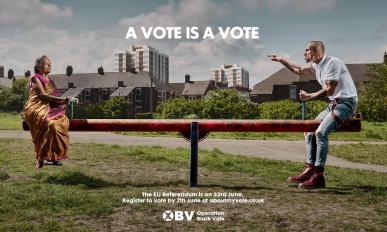
Operation Black Vote - OBV - A vote is a vote - EU Referendum - European Union

Of course Vote Leave are guilty of shameless fearmongering too, never more so than with this dreadful fearmongering ad about Turkey joining the EU:
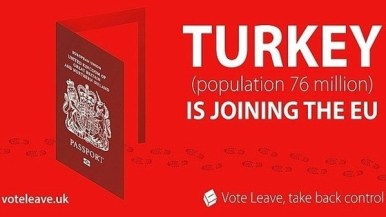
Vote Leave - Turkey Joining EU

But whether it is raising fears of knuckle-dragging, Brexit supporting skinheads or the armies of Turkish immigrants who will apparently all decamp to Britain en masse at the first opportunity, both are seen as highly effective tools by their respective campaigns, and both rely on communicating a primitive, fear-based message not with rich rhetoric but with a short, sharp visual, the better to hold our limited attention spans.

In many ways, it is a tragedy for the Brexit cause that this opportunity to extricate ourselves from an unwanted supranational government of Europe has come about when the internet has taken off and the average person’s idea of profound political engagement is liking and sharing the latest snide Huffington Post article with their friends on Facebook. When the debate over whether or not Britain should join Europe raged in the late 1960s and early 70s, the art of making serious (if not quite great) speeches was still just about alive – Hugh Gaitskell’s famous address to the Labour Party conference warning against joining the EEC stands as one such example of memorable oratory, culminating in the famous “thousand years of history” quote:

We must be clear about this; it does mean, if this is the idea, the end of Britain as an independent European state. I make no apology for repeating it. It means the end of a thousand years of history. You may say: “Let it end.” But, my goodness, it is a decision that needs a little care and thought.

But when the history of Britain’s 2016 EU referendum comes to be written, what will we remember? Of all the particularly dramatic moments in the campaign to date, none of them have been speeches. Sure, sometimes the fact of a speech has been newsworthy, such as when an unexpected establishment figure has been wheeled out to say that Brexit will usher in the apocalypse, but the content – the oratory itself – has rarely raised hairs or stiffened spines.

In fact, proving Eleanor Roosevelt’s famous assertion that great minds discuss ideas, average minds discuss events and small minds discuss people, the media has determinedly reported almost exclusively on the latter two. Of course that is always the temptation for journalists, but our politicians have hardly given the media much to work with on the ideas front, even if they were minded to cover them.

This is a depressing state of affairs. This most important debate should be bringing out the best in our politicians and our media. We should be witnessing a straight-up fight between advocates of the democratic, independent nation state and those who ardently believe in the euro-federalist dream, adjudicated by a press corps  beholden to neither side and always willing to challenge baseless assertions rather than merely provide a “fair and balanced” platform for two partisan idiots to yell at each other for an equal amount of time.

In this debate, our elected leaders should be role models in setting the tone of the debate. Of course they are not, because our professional political class are very much part of the problem – the main reason why Brexit should only be the first step in a broader process of constitutional reform and democratic renewal in Britain.

But here we are, a country administered by followers rather than leaders, watched over by a childish and corrupted press who would rather giggle about the referendum’s personal dramas than fulfil their democratic function. And too little time before the referendum to hope that anything much will change.

All of which is bad for Brexiteers. After all, this is an age when scaremongering claims and assertions about the supposed cost of Brexit can be “quantified”, slapped on a smug little infographic and shared ten thousand times before breakfast, while the importance of self-determination an democracy – the ability of the people to influence the decisions which affect them and dismiss those with power – is almost impossible to boil down to a single eye-catching number, despite being the most precious benefit of all.

Without honest political leaders to establish a narrative and bigger picture – and without a robust media to report – it is effectively left to well-intentioned citizens to hold the grown-up debate amongst themselves, citizens who (for all their pluck) often struggle to cut through the noise of the vapid official campaign.

What’s most galling about all of this is the fact that there are many people alive today who have living memory of hearing great political rhetoric deployed in service of consequential issues – if not in Britain, at least in America:

The Only Thing We Have To Fear Is Fear Itself.

We Choose To Go To The Moon.

The Great Society.

I Have A Dream.

Ask Not What Your Country Can Do For You.

Robert Kennedy’s speech on the assassination of Martin Luther King.

Tear Down This Wall.

And even Britain has managed to offer worthy efforts, including:

We Shall Fight On The Beaches.

The Few.

The Winds Of Change.

The Lady’s Not For Turning.

The Grotesque Chaos Of A Labour Council.

What words uttered by our contemporary politicians during this EU referendum will be long remembered or quoted fifty years from now?

My prediction: not a damn one. But at least there will be a great treasure trove of vapid tweets and misleading infographics for historians to pick through as they wonder why Britain signed away her freedom.

 

European Union - United Kingdom - Britain - Flags

Top Image: Guardian

Support Semi-Partisan Politics with a one-time or recurring donation:

Agree with this article? Violently disagree? Scroll down to leave a comment.

Follow Semi-Partisan Politics on TwitterFacebook and Medium.

Donald Trump’s Path To Victory

Donald Trump - Andy Borowitz

If Donald Trump becomes president of the United States, it will now be largely thanks to the army of sanctimonious, virtue-signalling left-wing commentators who are unwilling to (or incapable of) grappling with the roots of his appeal

Donald Trump’s path to victory in November leads directly through sanctimonious, fatuous, hectoring, intellectually snobbish attitudes like that shown in the image above, currently being widely circulated on social media.

Writer Andy Borowitz, wringing his hands about the presidential candidacy of Donald Trump, pompously warns us:

Stopping Trump is a short-term solution. The long-term solution – and it will be more difficult – is fixing the educational system that has created so many people ignorant enough to vote for Trump.

One does not have to be a supporter of Donald Trump to realise that this is exactly the kind of morally certain, unfoundedly intellectually superior leftist bilge which could yet deliver the presidency to the unstable, egotistical reality-TV star.

It is the kind of toxic mindset which endlessly repeats to itself that the only reason someone might disagree with the pro-Identity Politics, pro-illegal immigration status quo is through a mental defect of some kind.

If Andy Borowitz were capable of extricating his head from his own posterior for a few short seconds, he might note that the median annual income of a Trump supporter is around $72,000 while that of Bernie Sanders and Hillary Clinton supporters is just $61,000 – a whole $11,000 more. In other words, Donald Trump supporters are so ignorant and uneducated that somehow they manage to out-earn the highly “enlightened” supporters of the two remaining Democratic Party candidates.

And yet the myth persists of the Trump voter as a knuckle-dragging, uncultured simpleton who has been led astray by Evil Right Wing lies and propaganda, while even the most air-headed of Clinton or Sanders supporters is preposterously transformed into a high-minded philosopher, imbued with deep wisdom and knowledge. What dangerous nonsense.

More odious still is the implication that Trump supporters need to be “re-educated” – that their political views and priorities are somehow invalid, and that rather than openly debating and examining those views in the marketplace of ideas, the holders of Trumpian views should be quietly taken aside and indoctrinated with “good” left-wing ideas.

It is the easiest thing in the world to make a snap judgement that those people who hold differing views do so out of either ignorance or malevolence. This is an emotional comfort blanket which the American (and British) Left cling to ever-more tightly, but which now increasingly threatens to suffocate them. Assume your opponent is stupid and the best you can hope to achieve is a loud shouting match. Actually take the time to understand your opponent’s arguments and put yourself in their place, and real political dialogue becomes possible.

People support the candidacy of Donald Trump for many reasons. Some are highly disaffected conservatives or anti-establishment types nursing a “let it burn” attitude toward Washington D.C. in general. Some are dispirited social conservatives who sense that they have lost the culture war and see in Trump someone who may not share their values, but who will nonetheless give their un-magnanimous liberal foes a good kicking.

Yes, some are racist and some are Islamophobic – though this critique of Trump supporters by the New Republic is little better than Borowitz’s own fatuous take. Others simply hold the position that people who are illegally present in the United States should not be conferred with the comfort and security of American residency or citizenship. Some are very wealthy and others are very poor. And crucially, Trump supporters are drawn from every level of educational attainment.

It may be technically possible to fix the educational system so as to stop producing people likely to support Donald Trump, as Borowitz wants, but it would mean the creation of a nationwide network of leftist madrassahs, places where conservative thought and academic freedom were utterly banished, which would hardly be conducive to liberal democracy.

If Andy Borowitz really wants to fix a festering national trend, he should worry less about an educational system which sometimes has the temerity to produce Donald Trump supporters, and more about the growing inability of American citizens to handle exposure to contrary ideas without resorting either to unbearable condescension or shrill demands for the offending speech to be banished.

For as long as Democrats and assorted anti-Trump forces assume that conservatives and others who disagree with them do so merely through lack of education, they will continue to underestimate their opponents – in this case, with potentially disastrous consequences.


Donald Trump Hosts Nevada Caucus Night Watch Party In Las Vegas

Agree with this article? Violently disagree? Scroll down to leave a comment.

Follow Semi-Partisan Politics on TwitterFacebook and Medium.

Tales From The Safe Space, Part 36 – Michael Bloomberg’s University Of Michigan Commencement Address

Michael Bloomberg delivers a college commencement speech worth hearing

While it is true that a generation of university students – the product of our therapeutic culture and “you can’t say that” attitude to political debate – is now being indoctrinated into the Cult of Social Justice and Identity Politics with alarmingly little resistance from the educational establishment, there is at least one graduating class which has been sent out into the world with a rather more inspiring (and small-L liberal) message ringing in their ears.

Former New York City mayor Michael Bloomberg was invited to address the University of Michigan’s graduating class of 2016, and from the first word of his speech he tore into the culture of safe spaces, trigger warnings and all of the other illiberal symptoms of this new orthodoxy.

From Bloomberg’s speech:

The most useful knowledge that you leave here with today has nothing to do with your major. It’s about how to study, cooperate, listen carefully, think critically and resolve conflicts through reason. Those are the most important skills in the working world, and it’s why colleges have always exposed students to challenging and uncomfortable ideas.

The fact that some university boards and administrations now bow to pressure and shield students from these ideas through “safe spaces,” “code words” and “trigger warnings” is, in my view, a terrible mistake.

The whole purpose of college is to learn how to deal with difficult situations — not run away from them. A microaggression is exactly that: micro. And one of the most dangerous places on a college campus is a safe space, because it creates the false impression that we can insulate ourselves from those who hold different views.

We can’t do this, and we shouldn’t try — not in politics or in the workplace. In the global economy, and in a democratic society, an open mind is the most valuable asset you can possess.

Think about the global economy. For the first time in human history, the majority of people in the developed world are being asked to make a living with their minds, rather than their muscles. For 3,000 years, humankind had an economy based on farming: Till the soil, plant the seed, harvest the crop. It was hard to do, but fairly easy to learn. Then, for 300 years, we had an economy based on industry: Mold the parts, turn the crank, assemble the product. This was hard to do, but also fairly easy to learn.

Now, we have an economy based on information: Acquire the knowledge, apply the analytics and use your creativity. This is hard to do and hard to learn, and even once you’ve mastered it, you have to start learning all over again, pretty much every day.

Keeping an open mind to new ideas is essential to your professional success — just as it’s crucial to our collective future as a democratic society.

Note the loud booing quickly drowned out by cheering when Bloomberg talks about the inherent intellectual and academic danger of a “safe space” – while his remarks were warmly received, there is clearly a very vocal group of students who did not want to hear this message, and who will step forth from the University of Michigan with very warped views about how political debate (and even ordinary interpersonal relationships) should be conducted.

Bloomberg then turns his attention to the presidential race and the state of American democracy in general:

Democracy in action can actually produce a lot of inaction, which we see every day in Washington and other levels of government, too. When governments fail to address the needs of the people, voters in both parties get angry and some politicians exploit that anger by offering scapegoats instead of solutions.

If we want to stop demagogues, we have to start governing again, and that requires us to be more civil, to support politicians who have the courage to take risks, and to reward those who reach across the aisle in search of compromise.

Here, Bloomberg is almost channelling Andrew Sullivan, who makes his incredibly welcome and sorely needed return to political commentary in the New York magazine with these words:

An American elite that has presided over massive and increasing public debt, that failed to prevent 9/11, that chose a disastrous war in the Middle East, that allowed financial markets to nearly destroy the global economy, and that is now so bitterly divided the Congress is effectively moot in a constitutional democracy: “We Respectables” deserve a comeuppance. The vital and valid lesson of the Trump phenomenon is that if the elites cannot govern by compromise, someone outside will eventually try to govern by popular passion and brute force.

(I’ll be blogging a response to Andrew Sullivan’s piece separately in due course).

Bloomberg closes with this warning:

Think about this: In 1960, only 4 to 5 percent of Democrats and Republicans said they would be upset if a member of their family married someone from the opposing party. In 2010, one in three Democrats and one in two Republicans said they would disapprove of such a marriage. In 1960, most people would never have believed that interparty marriage would attract such resistance, while interracial and same-sex marriage would gain such acceptance.

For all the progress we have made on cultural tolerance, when it comes to political tolerance, we are moving in the wrong direction — at campaign rallies that turn violent, on social media threads that turn vitriolic, and on college campuses, where students and faculty have attempted to censor political opponents.

As durable as the American system of government has been, democracy is fragile — and demagogues are always lurking. Stopping them starts with placing a premium on open minds, voting, and demanding that politicians offer practical solutions, not scapegoats or pie-in-the-sky promises.

This is a message which many students will not want to hear, but which needs to be transmitted nonetheless – and not only by commencement speakers, refreshing though it is to hear the likes of Bloomberg take up the cause.

University administrators and professors must also absorb and embrace this message and change the way they approach issues of free speech and academic freedom, for while they are not entirely responsible for the censorious and emotionally fragile nature of new students entering their institutions, they do represent the last and best hope of turning those students into robust and resilient young citizens by the time they graduate.

Michael Bloomberg delivering a crowd-riling, viral-ready commencement speech just as students are about to graduate cannot be our only firewall against the onslaught of this new illiberal movement. We must erect meaningful defences and interventions much earlier in the learning process – rather than simply bowing to the excessive demands and exaggerated sensibilities of perpetually offended students – if we wish to prevent our workplaces and government from going the same way as our university campuses.


Safe Space Notice - 2

Agree with this article? Violently disagree? Scroll down to leave a comment.

Follow Semi-Partisan Politics on TwitterFacebook and Medium.

Federalism Is Not A Dirty Word Simply Because It Is Associated With The EU

Towards a Federal Europe

If political and social cohesion is fraying even in the United States, where citizens share a strong common American bond, what chance is there for successful European government?

In her latest Telegraph column, Janet Daley makes an interesting comparison between the prospects of European federal union and those of the United States (currently experiencing its own political turmoil with Donald Trump’s successful insurgency on the Right and a nearly-successful  insurgency on the Left in the form of Bernie Sanders).

Daley writes:

That ideal of the European continent as a unified entity, presenting an alternative presence in the world to the overweening superpower across the Atlantic was once the whole point – wasn’t it?

[..] But, as I say, nobody who favours remaining in the EU is talking up that idea these days. In fact, it’s the other guys – the ones who want to leave – who are most inclined to remind us of it, to the clear embarrassment of the Remainers. Could this be because the political model itself – the American success story of a federation of states joined together under a central government – seems to be going badly wrong? The nation that appeared to have found the ultimate solution to conjoining separate states, each with its own semi-autonomous authority, under one set of national governing institutions is now apparently facing an electoral choice between the demagogic and the disreputable.

I get what Daley is trying to do here, but she makes a leap too far in suggesting that the nature of federal government itself is responsible for American political woes. The federal model has served the United States well for nearly 250 years; today’s problems are indeed mirrored in Europe and America, but they are not the result of federalism, tempting as it might be to discredit federalism in order to prevent its unwelcome imposition on the countries of Europe.

On the contrary, the current political disillusionment and the rise of the insurgent outsider candidates is largely the inevitable consequence of corporatism, an unhealthy perversion of capitalism in which unaccountable and undistinguishable elites from all major parties leech off the state to unfairly consolidate their hold on power, which is common among many Western governments. And tellingly, Daley provides no evidence to back up her assertion that federalism is to blame for this.

Daley then goes on to discredit her argument further with this highly inaccurate portrayal of conservatism in America:

Most disturbingly, the US seems to be prey to the same excesses which are so worrying n the European scene. American federal elections both at the presidential and the congressional level, used to be predictably, boringly moderate. For generations, both the major parties (and there were no others worth considering) could have fit within what was, in European terms, a narrow spectrum of political possibility: roughly the middle ground of the British Conservative party. Capitalism under reasonable controls and a strong defence of individual liberty were the basic tenets of a consensus which underpinned every plausible candidacy, allowing only for differences of emphasis and intonation.

This is wrong on several counts. Firstly, it is a wholly wrong to suggest that the entire spectrum of American political thought would miraculously fit within the British Tory party. To make this claim is to overlook the numerous areas of social policy (gay rights, abortion and religion in public life are just the first which spring to mind) where the British Conservative Party has more or less completely moved on and abandoned its past conservative stances, while the Republican Party continues to exploit the culture wars as a vote-winning wedge issue.

It is also to overlook the fact that in terms of economic policy, the Tories are often comfortably to the left of even the US Democratic Party in terms of their tolerance for state involvement in political life, the scope and depth of the welfare state and – how can one forget – the British worship of nationalised healthcare. True, there are isolated Democrats who openly support a “public option”, but almost nobody in American political life thinks that the NHS is a great model to emulate, or would be caught dead suggesting its adoption by the United States.

In almost every way, the British political spectrum sits (at least) a few points to the left of America’s, with our dreary post-war collectivism standing in marked contrast to the individualism of the United States. To suggest that both Republicans and Democrats would find a comfortable home within the Conservative Party is simply false – even the most Thatcherite of Tory MPs would be laughed out of the GOP as a ludicrous socialist.

Secondly, while recoiling in horror from Trump (admittedly a demagogue) and Bernie Sanders (who this blog admires for bringing genuinely left wing conviction to the debate, if only so that it can be exposed as flawed) Daley seems almost approving when she writes of “predictably, boringly moderate” government which allowed only for slight “differences of emphasis and intonation”. But this is exactly the problem – it is when the major political parties begin to look and sound indistinguishable from one another that a void opens which is often filled by glib and unsavoury types like Trump. In many ways, Britain has been fortunate in this regard – going into the 2015 general election, Labour and the Conservatives could hardly have been more depressingly alike, and yet the worst we have to show for it is a diminished UKIP and Jeremy Corbyn.

Daley appears to be defending consensus politics and railing against demagoguery at the same time, while failing to understand that an excess of the former all but guarantees the latter. Her column also forms part of an unwelcome trend of unnecessarily problematising issues around the EU referendum. Both sides are guilty – mostly desperate Remainers, who in their desperation to win are prone to suggesting that the smallest of bureaucratic or diplomatic hurdles to Brexit is an immovable showstopper, but also many on the Leave side who are apt to grasp at any problem with the EU or any world event and seek to fashion it into a weapon to be fired at Brussels.

In this case, holding Donald Trump and Bernie Sanders up as evidence suggesting that the American federal model itself is broken may help to land a solitary punch on the European Union this once, because the EU’s inexorable direction of travel is toward federal union. But by slandering an entire mode of governance in this way, we limit ourselves when it comes time to think about how we may wish to be governed if and when we leave the European Union. Some – including this blog – actually believe that moving towards a federal United Kingdom following a constitutional convention to be held after Brexit would be a great outcome.

So a plea to everyone on both sides (but in reality, only to those on the Brexit side – for we know that the Remain camp will tell any lie and stoke any fear in their desperation to win): there are sufficient real problems with the European Union as it is now and is soon likely to become without attacking every single word or concept associated with Brussels. So let’s debate where we can win – not getting into a mud slinging contest with trumped up economic figures, and not disparaging every single thing associated with the European Union, but by focusing on democracy and sovereignty, and building a positive vision of how Brexit can be the first step in Britain’s re-emergence as a global player.

The Brexit side is already accused of being alarmist. Let’s not live up to the hype by slandering federalism – a mode of government which has worked exceedingly well for many countries, including the most powerful and prosperous on Earth – in our desperation to slander everything which is also connected with the European project.


European Union - United Kingdom - Britain - Flags

Agree with this article? Violently disagree? Scroll down to leave a comment.

Follow Semi-Partisan Politics on TwitterFacebook and Medium.

Bartlet For America

Your daily dose of nostalgia:

TV’s favorite White House Press Secretary was back at the White House podium Friday when Allison Janney made a surprise appearance.

Janney, who starred as C.J. Cregg for seven seasons on The West Wing, shocked the press core when she walked into the Press Briefing Room instead of current Press Secretary Josh Earnest. Janney said that Earnest was having a root canal, a callback to an episode in the first season of The West Wing, in which C.J. had a root canal that led to a disastrous press conference conducted by Josh (Bradley Whitford).

Earnest did show up to reveal that the Mom star was there to discuss the opioid epidemic and to support those who help people dealing with substance abuse. Janney, whose character on Mom is a recovering addict, honored the White House Champions of Change, a group of individuals who are recognized for their work with substance abuse issues.

Janney did take one question when a reporter asked who President Bartlett (Martin Sheen) was supporting for the Democratic nomination. In typical C.J. fashion she replied, “I think you know the answer to that question.”

I’m actually not sure that we do know the answer to that question.

In fact, I think that Jed Bartlet’s take on the current field (on both the Democratic and Republican sides) would be more like his future chief of staff Leo McGarry’s attitude was when trying to persuade a reluctant Bartlet to run:

Leo McGarry: Because I’m tired of it – year after year after year after year having to choose between the lesser of who cares. Of trying to get myself excited about a candidate who can speak in complete sentences. Of setting the bar so low, I can hardly bear to look at it. They say a good man can’t get elected President. I don’t believe that. Do you?

Jed Bartlet: And you think I’m that man?

Leo: Yes!

Bartlet: Doesn’t it matter that I’m not as sure?

Leo McGarry: Nah. “Act as if ye have faith and faith shall be given to you.” Put another way: Fake it ’til you make it!


“Every time we think we have measured our capacity to meet a challenge, we look up and we’re reminded that that capacity may well be limitless”

Bartlet for America - The West Wing - 2

Agree with this article? Violently disagree? Scroll down to leave a comment.

Follow Semi-Partisan Politics on TwitterFacebook and Medium.