Donald Trump Victory Reaction: Everybody Take A Deep Breath

shun-the-non-believer

America’s new president-elect is bad, but he is hardly evil on a world-historical scale. Unfortunately, the hysterical media reaction to Donald Trump’s election victory leaves no room for nuance or restraint

In these fractious times, it is very difficult for those of us who fall into the “really didn’t want Donald Trump to win, but don’t consider his victory to be quite the end of civilisation” crowd to say anything, for fear of reprisal – not from Donald Trump supporters, but from certain anti-Trump activists who have taken to using a person’s level of anger at the election result as an indicator of their personal moral code or worth.

Since Trump’s unexpected victory, the strong message being transmitted by much of the left-wing post-election commentary has been that if you aren’t rending your garments, taking to the streets with burning torches, retreating to a safe space or dissolving into tears every five minutes then you must be a closeted Donald Trump supporter.

Look: I really really did not want Donald Trump to be the next president of the United States. This blog has been pretty clear about my estimation of Donald Trump and the low regard in which I hold the president-elect. But not every charge flung at Donald Trump by left-wing partisans deserves to stick, because some of them are major overreaches prompted by partisan fervour rather than objective accuracy. And it should be possible to point out where criticism of Donald Trump goes too far, or is flat-out wrong, without being accused of supporting the man himself.

It does nobody any good if this election causes America to fracture into three distinct factions: unapologetic pro-Trump supporters, furious anti-Trump activists and a group of pragmatists who want to make the best of a difficult situation but who have been cowed into sullen silence for failing to pick a side and express either blanket admiration or total hatred for Donald Trump. If the country is to knit back together, it is this final group which must act as the cords which bind the nation’s wounds and bridge mutual suspicion. Assailing people for neither hero-worshipping Trump nor treating him like Hitler really is not the smartest thing to do in terms of improving the toxic atmosphere in American politics.

I’m told that I cannot possibly understand what it is like to be black, disabled, Mexican, female, gay or transgender in Trump’s America. Well, okay. But I did grow up mixed race in 1990s Britain, when not everybody was super friendly toward people who are not white. Sure, I never had to fear being gunned down in the street by a policeman for walking or driving suspiciously, but as a child I have been shoved and called all the worst racial epithets one can think of. I didn’t let it scar me for life and as I’ve grown older I can probably count the total number of verbally or physically hostile interactions over the past decade on two hands, but I certainly don’t have the dreaded “white privilege”. Yet while I certainly do not look forward to Donald Trump’s presidency, I do not fear it in a physical sense.

Donald Trump is objectionable for all of the reasons that the mainstream media has (belatedly) gotten around to pointing out. He is vulgar and thin-skinned, and in a confrontational situation he will use any defining characteristic to taunt or belittle an opponent. If you are fat, Trump will harp on about how massive you are. If you are not conventionally attractive, Trump will be sure to point that fact out to everyone. And most distastefully, he will apparently do the same if you are disabled. Donald Trump is not a nice person.

But there is vast gulf between being personally repellent and representing an active physical danger to the very same people that Trump insults on Twitter, in television interviews or on stage at his rallies. And we need to recognise that fact. It should be possible to abhor Donald Trump’s mockery of a disabled journalist without making the leap of imagination that a Trump presidency will somehow lead to the state-sanctioned persecution of disabled people. It should be possible to oppose Donald Trump’s most ignorant or insulting rhetoric about racial minorities without imagining World War 2 era Japanese internment camps for black people and lawful, legal immigrants.

The point is this: if we go nuclear in every single criticism of Donald Trump, we have nowhere left to go when somebody with truly severely racist or homophobic views comes along. It is important to leave some slack in our language so that we have room left to describe true evil when it crosses our path. If we wear out our strongest warnings and our most alarmist rhetoric on somebody who has a foul mouth but no evident plans to single out American citizens for persecution, what do we do if one day there is a presidential candidate who actively refuses to associate with black, Hispanic, gay or trans people and who runs on an unabashedly Jim Crow platform?

(Furthermore, I feel compelled to note that right now it is the Social Justice, Identity Politics Left which is clamouring to bring back racial and gender segregation, and not the conventional or alt-right).

Even as I write this, I can feel some people becoming outraged and accusing me of being a Trump apologist. But Trump is terrible! Yes, he is really bad. But the momentary catharsis of accusing Donald Trump of every prejudice and evil under the sun, whether each one is deserved or not, is really not worth the additional damage which going nuclear is doing to our political discourse. At some point it might be nice to persuade some of those who voted for Donald Trump in 2016 to vote for somebody else in 2020. It will be much easier to engage them in dialogue if we have not first accused them of being latter-day Nazi collaborators.

If it sounds like I am rather treading on eggshells in this piece, it is because I am. Trump’s election victory has divided America, divided the world, divided families. And maybe two weeks after the election is too soon to expect the blood to have cooled and objectivity to reign. So while I struggle to put into words what I am trying to say, I encourage everybody to read this piece by Scott Alexander of the SlateStarCodex blog, who offers some excellent perspective and advice.

(Hat tip to Brendan O’Neill for bringing the piece to my attention on Facebook).

It’s a long piece of analysis, but I will quote the conclusion, which should be required reading for everyone in America (and anyone else moved to write about American politics):

Stop fearmongering. Somewhere in America, there are still like three or four people who believe the media, and those people are cowering in their houses waiting for the death squads.

Stop crying wolf. God forbid, one day we might have somebody who doesn’t give speeches about how diversity makes this country great and how he wants to fight for minorities, who doesn’t pose holding a rainbow flag and state that he proudly supports transgender people, who doesn’t outperform his party among minority voters, who wasn’t the leader of the Salute to Israel Parade, and who doesn’t offer minorities major cabinet positions. And we won’t be able to call that guy an “openly white supremacist Nazi homophobe”, because we already wasted all those terms this year.

Stop talking about dog whistles. The kabbalistic similarities between “dog-whistling” and “wolf-crying” are too obvious to ignore.

Stop writing articles breathlessly following everything the KKK says. Stop writing several times more articles about the KKK than there are actual Klansmen. Remember that thing where Trump started out as a random joke, and then the media covered him way more than any other candidate because he was so outrageous, and gave him what was essentially free advertising, and then he became President-elect of the United States? Is the lesson you learned from this experience that you need 24-7 coverage of the Ku Klux Klan?

[..] Stop turning everything into identity politics. The only thing the media has been able to do for the last five years is shout “IDENTITY POLITICS IDENTITY POLITICS IDENTITY POLITICS IDENTITY POLITICS IDENTITY POLITICS!” at everything, and then when the right wing finally says “Um, i…den-tity….poli-tics?” you freak out and figure that the only way they could have possibly learned that phrase is from the KKK.

Stop calling Trump voters racist. A metaphor: we have freedom of speech not because all speech is good, but because the temptation to ban speech is so great that, unless given a blanket prohibition, it would slide into universal censorship of any unpopular opinion. Likewise, I would recommend you stop calling Trump voters racist – not because none of them are, but because as soon as you give yourself that opportunity, it’s a slippery slope down to “anyone who disagrees with me on anything does so entirely out of raw seething hatred, and my entire outgroup is secret members of the KKK and so I am justified in considering them worthless human trash”. I’m not saying you’re teetering on the edge of that slope. I’m saying you’re way at the bottom, covered by dozens of feet of fallen rocks and snow. Also, I hear that accusing people of racism constantly for no reason is the best way to get them to vote for your candidate next time around. Assuming there is a next time.

My emphasis in bold. Scott Alexander concludes with this plea:

Stop centering criticism of Donald Trump around this sort of stuff, and switch to literally anything else. Here is an incompetent thin-skinned ignorant boorish fraudulent omnihypocritical demagogue with no idea how to run a country, whose philosophy of governance basically boils down to “I’m going to win and not lose, details to be filled in later”, and all you can do is repeat, again and again, how he seems popular among weird Internet teenagers who post frog memes.

In the middle of an emotionally incontinent reality TV show host getting his hand on the nuclear button, your chief complaint is that in the middle of a few dozen denunciations of the KKK, he once delayed denouncing the KKK for an entire 24 hours before going back to denouncing it again. When a guy who says outright that he won’t respect elections unless he wins them does, somehow, win an election, the headlines are how he once said he didn’t like globalists which means he must be anti-Semitic.

Stop making people suicidal. Stop telling people they’re going to be killed. Stop terrifying children. Stop giving racism free advertising. Stop trying to convince Americans that all the other Americans hate them. Stop. Stop. Stop.

I have no desire to denigrate the fear and pain of anybody who is in genuine fear following Trump’s election victory. I do not take perverse joy from laughing at the terror and misery of other people. But it is my contention that much of this fear has been manufactured by various people and for various reasons – some vaguely noble, others much less so.

Frequently we hear the refrain that various identity groups “no longer feel welcome in America”. Would that include gay people, whom President Barack Obama did not consider worthy of the institution of marriage until changing public opinion (and a big helping hand from Joe Biden) caused him to shift position? Would that include illegal immigrants, whom Hillary Clinton voted to thwart with a border fence and Barack Obama deported in record numbers? Would that include black people, whom the sainted Hillary Clinton once described as “super-predators“?

Once the excitement of the election has properly died down we urgently need to separate the things which are actually concerning about Donald Trump from the frivolous dangers which exist mostly in people’s minds.

Much is (belatedly) being written about how the media failed to do a good job covering Donald Trump’s presidential candidacy in the early months. Quite right too – they chased ratings, broadcast voyeuristically lingering live coverage of his meandering speeches for entertainment rather than educational value and failed to ask tough questions or do proper investigative journalism until way too late in the process.

But the media is failing now in a different way, having overcompensated for past sins by now reporting any hysterical fear about Donald Trump, no matter how absurd or far-fetched, as though it is inherently legitimate and worthy of consideration. Take this hypersensitivity to Donald Trump’s boorish rhetoric coupled with an infantilised population who sometimes seem to prefer to act like helpless babes rather than autonomous and resilient adults, and the result is not pretty. In fact, it is downright ugly.

I am very aware that this blog post is not up to the usual standard – it probably does not “flow” as it should, and is much more a stream of consciousness than anything else. But the bottom line is this: there will be enough work to do scrutinising the Trump administration and keeping its worst excesses at bay for the next few years without also turning on each other, fellow people who opposed Trump’s candidacy.

This post will likely see me damned by those who are fully on board the Trump train as well as those implacably opposed to Donald Trump (as I was) and determined to see only evil in everything that occurs until he departs the scene. So be it. I find it very strange to be in the position of the “moderate middle” for once – somewhere I never find myself when it comes to British politics – but there we are.

I knew there was a reason why I named this blog Semi-Partisan Politics.
 

donald-trump-presidential-election-victory-speech

Support Semi-Partisan Politics with a one-time or recurring donation:

Agree with this article? Violently disagree? Scroll down to leave a comment.

Follow Semi-Partisan Politics on TwitterFacebook and Medium.

Sorry, President-Elect Trump, But You Don’t Get To Choose Britain’s Ambassador To The United States

donald-trump-nigel-farage

It was wrong when President Obama sought to interfere in Britain’s EU referendum debate earlier this year, and it is wrong now when President-elect Trump tries to undermine the UK government and install his pal Nigel Farage as a replacement British ambassador

When Barack Obama saw fit to fly to London, stand next to David Cameron at a joint press conference and lecture/threaten the British people that voting to leave the EU would incur not only his personal wrath but also America’s cold shoulder, his behaviour was rightly denounced as an act of arrogant bullying and coercion.

This blog wasted no time in taking President Obama to task for his ignorance and presumption in daring to interfere with our domestic affairs. And UKIP leader and referendum-maker Nigel Farage was also quick to criticise Obama, noting “last time we followed foreign policy advice from a US President was when we went to war in Iraq. We should be wary“, and negatively comparing the American president to Vladimir Putin.

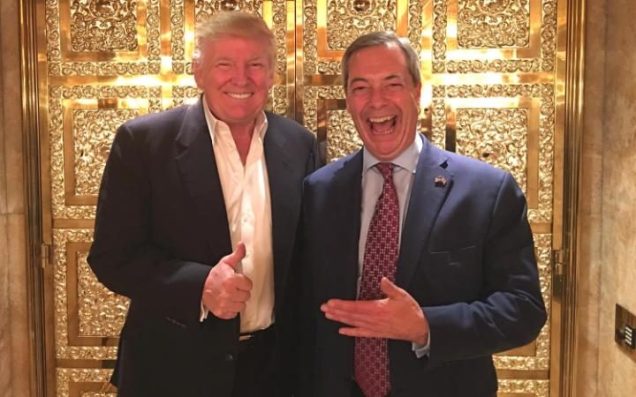
Unfortunately, Nigel Farage does not seem to be consistent when it comes to the principle of staying out of the internal affairs of other countries. Because now his good friend and campaign trail buddy, US president-elect Donald Trump, has made the highly irregular move of suggesting that Farage should become the UK’s ambassador to the United States – even though we currently have an ambassador in place (albeit not a very good one):

The Guardian reports:

The US president-elect, Donald Trump, has suggested that the Ukip leader, Nigel Farage, should be the UK’s ambassador to the US.

“Many people would like to see [@Nigel_Farage] represent Great Britain as their Ambassador to the United States,” Trump tweeted on Monday evening. “He would do a great job!”

In a brief call with BBC Breakfast, Farage said he had been awake since 2am UK time when the tweet was first posted.

The Ukip leader said he was flattered by the tweet, calling it “a bolt from the blue” and said he did not see himself as a typical diplomatic figure “but this is not the normal course of events”.

But a Downing Street spokesman said: “There is no vacancy. We already have an excellent ambassador to the US.”

Now Donald Trump is known to tweet strange and provocative things as and when they drift into his head, but the probability of him having penned this particular tweet without having first at least run it past Nigel Farage (and more likely Trump was acting on a specific request as a favour to Farage) is close to zero. So there goes Farage’s principled opposition to meddling in the affairs of a sovereign nation – he likely encouraged the president-elect of the United States to do what he criticised Barack Obama for back in April.

The Telegraph’s Michael Deacon also spots the hypocrisy:

When Barack Obama said he hoped Britain would stay in the EU, Nigel Farage was appalled. An American president, he said, had no right to meddle in British affairs. Britain was quite capable of making her own decisions, thank you very much. The president, in short, should “butt out”.

Today, however, Mr Farage appears rather more relaxed about political interference from across the pond. When Donald Trump told Britain she should make the on-off Ukip leader her ambassador to the US – even though she already has one – Mr Farage was not appalled. He did not say Mr Trump had “behaved disgracefully”, he did not order him to “butt out”, he did not remind him that the British don’t take kindly to being told “what we should do” by foreign powers.

On the contrary, he welcomed Mr Trump’s intervention. “I would do anything,” he said nobly, “to help our national interest.”

Taking back control from Brussels. And then handing it to Washington.

This episode also shows seriously bad judgement on the part of Donald Trump, though this of course is much less surprising. If offending the UK foreign office by airily suggesting on Twitter that the British ambassador should be replaced is the biggest diplomatic howler committed by the incoming Trump administration then we will be able to count ourselves extraordinarily lucky. Even assuming that Trump assembles a moderately experienced team around him by the end of the transition, the incoming president’s penchant for going off-script and acting unilaterally at 2AM is likely to lead to all manner of gaffes and calamities. But still – offending the government of your closest ally by publicly scorning their present ambassador is arrogant and foolish.

Adam Barnett at Left Foot Forward also has a crack at explaining why Nigel Farage becoming Britain’s ambassador to the United States would be a terrible idea:

Nigel Farage would make a great British ambassador to the US, according to Donald Trump, who will make a terrible President of the United States.

As Downing Street helpfully points out, the position is already filled, though they should have added it’s not Trump’s job to appoint foreign diplomats.

Unfortunately, not one of the reasons that Barnett then goes on to list has anything remotely to do with Nigel Farage’s competence or potential suitability for the role of ambassador. Rather, each is a finger-wagging, morally censorious (and often inaccurate) judgement and demand for Farage’s excommunication from any role in public life, the kind of thoughtless attack sadly now typical fare from the authoritarian, illiberal left.

The Spectator’s James Forsyth does a better job of explaining why Nigel Farage should be nobody’s choice for the role of ambassador, and suggests a better way for the British government to leverage Farage’s close relationship with Trump:

Now, obviously, Farage shouldn’t be the UK’s man in Washington. As Farage has admitted, he’s not a natural diplomat and it is hard to imagine Theresa May trusting him in that role. But it would be foolish of the Foreign Office not to pump Farage for information on Trump and his circle. Whatever information Farage has about who actually has influence with the president-elect would be useful for Britain.

The sensible thing to do would be to have Boris Johnson invite Farage down to Chevening for the weekend and over dinner try and talk out of the Ukip leader everything he knows about Trump world. I suspect that Farage would be both sufficiently flattered by the invitation and keen enough to help, that he would happily reveal all he knows about Trump and the people around him.

This sounds a lot more sensible. Nigel Farage should not become our ambassador, not least because he has no discernable diplomatic skills, nor any specific interest in that role (besides a desire to remain in the limelight and close to power). But the British government would be foolish to squander the relationship he has built with the new president-elect altogether.

After all, who is best placed to nurture that relationship? A bunch of effete, elitist UK civil servants and career diplomats like our current ambassador Sir Kim Darroch, who were all doubtless super-confident “Never Trump” people (as indeed I was) and therefore failed to build any meaningful relationships with the Trump team, or somebody whom the new president considers to be an ideological and perhaps even temperamental soulmate?

In other words, why reinvent the wheel? Why pour time and effort into leveraging a new relationship from scratch when Trump and Farage are clearly already friends and allies? Britain should not waste time emulating this relationship – we should appropriate it and use it for our own ends. Love him or loathe him, Nigel Farage happens to speak Trumpian with a natural accent at a time when we have few other native linguists. That isn’t an advantage you throw away just to express general disapproval of the man.

Now, of course Nigel Frage is a flawed individual – and one can argue about the precise way in which the government puts him to use. Rather than making him ambassador, I would forge a new role, perhaps investigating the possibility of formally seconding Farage to the Trump administration as a gesture of trust and goodwill. Not only would this give Britain valuable eyes and ears in Washington DC, it could greatly aid the future negotiation of a future US-UK free trade agreement.

The details can be worked out later, but one thing is crystal clear for now – Donald Trump has no business interfering in the diplomatic staffing decisions of the British government. The ambassadors we send to Washington D.C. should be chosen by the British government alone, not foisted upon us by an inexperienced not-quite-president.

Donald Trump claims to have great affection for Britain, which is good. But he needs to learn that the best way to display that affection is to respect British sovereignty. If the president-elect insists on appointing his kids as White House advisers and can find his way around the federal anti-nepotism rules, that’s one thing. But we can pick our own ambassadors, thank you, Mr. President-elect.


pop-art-donald-trump-2

Support Semi-Partisan Politics with a one-time or recurring donation:

Agree with this article? Violently disagree? Scroll down to leave a comment.

Follow Semi-Partisan Politics on TwitterFacebook and Medium.

Donald Trump Victory Reaction: The American Left Struggles To Regain Perspective

american_soldiers_recover_the_dead_after_d-day

Rather than following through on their much-publicised threats to leave the country in the event of a Clinton defeat, Donald Trump’s most vehement left-wing opponents are now making plans to stay in America and become completely insufferable instead

There is something to admire in Michael Krikorian’s instruction to his readers to rediscover their courage, stand and fight against the incoming Trump administration for what they believe in, delivered in his latest LA Times Op-Ed.

I particularly like the acknowledgement – largely missing among the mass hysteria – that America has indeed been through “far worse” before, and survived:

No one’s moving anywhere. My friends Dahlia and Chris aren’t going to Mexico, and Alexis is not going to Copenhagen. My gal Nancy’s not permanently packing up and moving to Umbria, and Duke is not moving to Thailand with his cousin Jake.

And you?  You aren’t going wherever the heck you say you are moving to now that Donald Trump is going to be president of the United States of America.

What we all do is this: We stay and fight.

First, we wait and see. Even Hillary Clinton said Wednesday, “We owe him an open mind and a chance to lead.”

But if we don’t like what happens, we fight it. We take to the streets and rekindle memories of the anti-Vietnam War protests and civil rights marches. We don’t run and hide. We don’t abandon America.

This is all good. Yes, there will likely be much that is objectionable about the coming Trump presidency, for conservatives and libertarians too, as well as those on the Left. But there is no need to sit under a coffee table and cry like you are five years old and still scared of monsters or fireworks or loud noises. Rediscover some backbone and composure. We are all adults here.

But then just as Krikorian is on a roll of common sense, he goes on to remark:

I feel, strangely, not what I thought I would “the morning after.” I’m more patriotic than I was yesterday. More in love with my country than I have since, I guess, Sept. 11, 2001.

Oh dear. A tacit suggestion that the outcome of this election is the worst thing to befall America since 9/11. To be fair, Krikorian does temper that comparison with this observation:

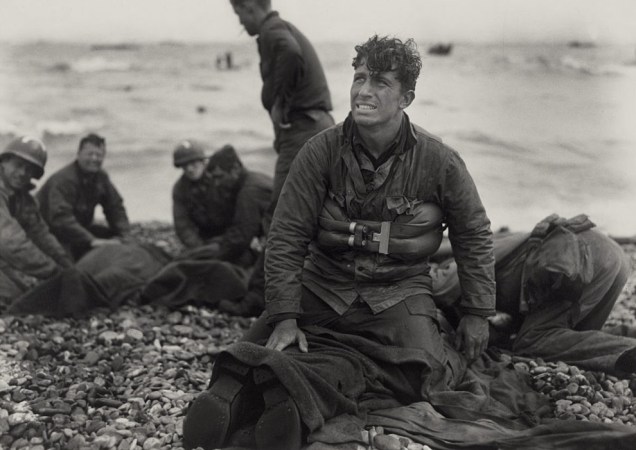
Yesterday, a guy I know from the streets showed me a knife he had in his waistband. A killing knife. It made me think of “Saving Private Ryan”and a brutal, achingly sad scene:  room-to-room fighting, a German soldier slowly pushing a killing knife into the chest of an American soldier.

When I went home, I Netflix’d “Saving Private Ryan” with the intention of forwarding to that scene, but instead I started watching from the beginning. The first 25 or so minutes show the first wave of Allied forces landing on the beach at Normandy, D-Day, 1944. It’s one of the most powerful  movie sequences ever filmed, and it ends with a panorama of bloody corpses washed along by the tide.

What happened Tuesday doesn’t compare to those days. Everyone walking around like it’s the end of civilization now that Trump is in? It’s not. We’ve  been through far worse. A perceived threat is not as bad as a punch in the face.

So the election of Donald Trump is traumatic enough that it provokes the same resurgence of shock-induced patriotism as 9/11, but bearable enough that watching thousands of British, American and allied soldiers being mown down by machine gun fire on French beaches in Saving Private Ryan puts things back into perspective. Okay, got it.

Do these people ever stop to listen to themselves? Do they ever pause to wonder how those who do not share the same political views are likely to react when they openly declare “I consider you getting your way in a national election to be the worst man-made disaster to befall this country since 9/11”, or “the temporary prevalence of your worldview reduced me to the brink of despair, until I watched a man being bayonetted to death and realised that things could be worse”?

I shouldn’t snipe. Krikorian’s is one of vanishingly few voices from the American Left to tentatively suggest that America still has a future and that the end of the world was in fact likely not set in motion on November 8. And by and large, Krikorian is counselling against hysteria and self-pity, which is an admirable thing to do.

But when some of the coolest heads on the American Left are reacting to Hillary Clinton’s defeat at the hands of Donald Trump by counting themselves fortunate not to be storming the beaches on D-Day then it seems we still have some way to go before the two Americas are in a position to talk to one another respectfully or productively.


donald-trump-presidential-election-victory-speech

Support Semi-Partisan Politics with a one-time or recurring donation:

Agree with this article? Violently disagree? Scroll down to leave a comment.

Follow Semi-Partisan Politics on TwitterFacebook and Medium.

John F Kennedy On The Responsibilities Of Educated Citizens

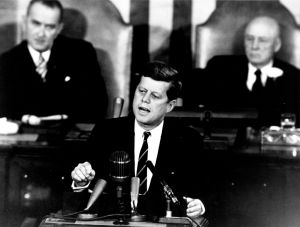
John F. Kennedy, May 29, 1917 – November 22, 1963

From Kennedy’s address to the 90th anniversary convocation of Vanderbilt University in Nashville, Tennessee, delivered on May 18, 1963:

But this Nation was not founded solely on the principle of citizens’ rights. Equally important, though too often not discussed, is the citizen’s responsibility. For our privileges can be no greater than our obligations. The protection of our rights can endure no longer than the performance of our responsibilities. Each can be neglected only at the peril of the other. I speak to you today, therefore, not of your rights as Americans, but of your responsibilities. They are many in number and different in nature. They do not rest with equal weight upon the shoulders of all. Equality of opportunity does not mean equality of responsibility. All Americans must be responsible citizens, but some must be more responsible than others, by virtue of their public or their private position, their role in the family or community, their prospects for the future, or their legacy from the past.

Increased responsibility goes with increased ability, for “of those to whom much is given, much is required.”

[..] You have responsibilities, in short, to use your talents for the benefit of the society which helped develop those talents. You must decide, as Goethe put it, whether you will be an anvil or a hammer, whether you will give to the world in which you were reared and educated the broadest possible benefits of that education. Of the many special obligations incumbent upon an educated citizen, I would cite three as outstanding: your obligation to the pursuit of learning, your obligation to serve the public, your obligation to uphold the law.

If the pursuit of learning is not defended by the educated citizen, it will not be defended at all. For there will always be those who scoff at intellectuals, who cry out against research, who seek to limit our educational system. Modern cynics and skeptics see no more reason for landing a man on the moon, which we shall do, than the cynics and skeptics of half a millennium ago saw for the discovery of this country. They see no harm in paying those to whom they entrust the minds of their children a smaller wage than is paid to those to whom they entrust the care of their plumbing.

But the educated citizen knows how much more there is to know. He knows that “knowledge is power,” more so today than ever before. He knows that only an educated and informed people will be a free people, that the ignorance of one voter in a democracy impairs the security of all, and that if we can, as Jefferson put it, “enlighten the people generally … tyranny and the oppressions of mind and body will vanish, like evil spirits at the dawn of day.”

[..] Secondly, the educated citizen has an obligation to serve the public. He may be a precinct worker or President. He may give his talents at the courthouse, the State house, the White House. He may be a civil servant or a Senator, a candidate or a campaign worker, a winner or a loser. But he must be a participant and not a spectator.

[..] Third, and finally, the educated citizen has an obligation to uphold the law. This is the obligation of every citizen in a free and peaceful society–but the educated citizen has a special responsibility by the virtue of his greater understanding. For whether he has ever studied history or current events, ethics or civics, the rules of a profession or the tools of a trade, he knows that only a respect for the law makes it possible for free men to dwell together in peace and progress.

He knows that law is the adhesive force in the cement of society, creating order out of chaos and coherence in place of anarchy. He knows that for one man to defy a law or court order he does not like is to invite others to defy those which they do not like, leading to a breakdown of all justice and all order. He knows, too, that every fellowman is entitled to be regarded with decency and treated with dignity. Any educated citizen who seeks to subvert the law, to suppress freedom, or to subject other human beings to acts that are less than human, degrades his heritage, ignores his learning, and betrays his obligation.

I think that we can all take something from this speech as an inspiration to strive to be better citizens, no matter our position on American politics and the forthcoming presidency of Donald J Trump. None of us are above learning from the example set by great men and women of the past.

Yet nobody gives speeches like this any more. Why?

Is modern political speechwriting so poor because it reflects the abysmal quality of our present political discourse, or is our political discourse so poor because our contemporary leaders, more concerned with bribing and placating a fickle public than calling us to any kind of higher duty, have increasingly lost the rhetorical skills required to persuade and inspire their citizens?


president-john-f-kennedy-address-to-congress-announcing-the-apollo-program

Bottom Image: Wikimedia Commons

Support Semi-Partisan Politics with a one-time or recurring donation:

Agree with this article? Violently disagree? Scroll down to leave a comment.

Follow Semi-Partisan Politics on TwitterFacebook and Medium.

Oh, So Now You’re A Liberal? Part 2 – Maajid Nawaz Calls Out The Illiberal British Left

maajid-nawaz-lbc-liberalism-left-authoritarianism

Maajid Nawaz warns about the rise of the “Control Left”, an authoritarian tendency which has left liberalism and liberal values far behind

Recently, this blog took to task those on the authoritarian Left who have reacted to Brexit and the election of Donald Trump by falsely draping themselves in the clothes of liberalism and hysterically mourning an idealised liberal past which they did as much as anybody else to knife in the back.

In that piece, I made the point that people who only weeks ago could be found arguing for greater censorship, the expansion of “hate crime” legislation, trigger warnings, safe spaces, higher taxes on alcohol and tobacco, national ID cards, longer pre-trial detention periods and even more intrusive government surveillance have absolutely no business calling themselves “liberal”.

Though the authoritarian Right are by no means innocent in this regard, it must be acknowledged that most of the recent assaults on liberty and liberalism have come from the Left, in America as well as Britain.

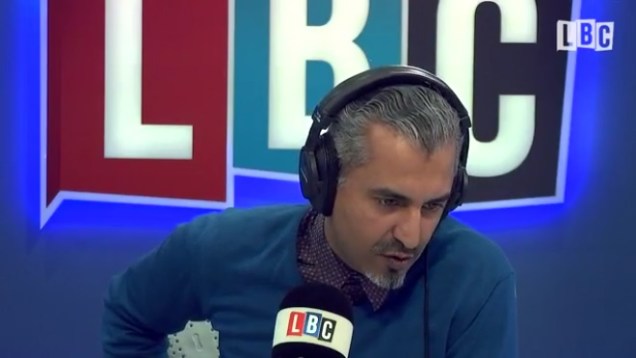
Picking up on this thread, Maajid Nawaz hits the nail on the head on his LBC talk radio show yesterday:

I suspect that the most vocal elements of the Left – and I don’t mean every single person who sympathises with left-wing views, let me make that very clear, I’m talking about the organised left, the most vocal elements of our Left, and the Left in the form of Momentum who have taken over the Labour Party under Jeremy Corbyn – my view is that that Left, today’s Left, today’s active, organised Left is no longer liberal.

What do I mean by that? Well let’s look at a few things that I don’t consider to be liberal. Let’s look at censorship, let’s look at being “post-factual”, let’s look at violence being seen as an option, let’s look at prioritising group identity over individual rights. None of these four traits are liberal.

Censorship is not liberal, so when today’s organised Left begins organising in campuses and across colleges across the nation, across the world, and says things like “you cannot say that here, this is a safe space, we will exclude you from speaking because your views offend us”, when they choose to take offence, when they become more sensitive, and so sensitive in fact that they want to shut debate down simply because they don’t like what somebody is saying, that’s not a liberal approach. A liberal will always prioritise free speech over offence.

What about being post-factual? Well I remember – and I hope many of you remember – at the beginning of this year, the way in which mass sex attacks were reported in the German city of Cologne. And what was known then as the liberal press actively conspired to cover up that news. Facts were known and they were not reported because they didn’t want to be accused of being racist. The German state television station had to come out and openly apologise, days later, when they realised that this story was not one that they could cover up. So being post-factual is also not being liberal.

What about considering violence as an option? When you have the Shadow Chancellor of the UK Labour Party, John McDonnell, being caught on video saying that it’s okay to riot, it’s okay to destroy property and to ruin people’s lives and their private property, that’s not liberal. That may be anarchist, it may be revolutionary hard-left socialist, as John McTernan suggested, but it isn’t liberal.

When people are prioritising group identity over individual rights, saying things like “kill all white men”, saying things like “black people can’t be racist because racism is about power and only white men have power” – Diane Abbott says that. Well I’m sorry Diane Abbott MP, go and walk into any council estate and speak to a white working class lad and try and have a rational, reasonable conversation with that young white working class lad and tell him that he has more power than you, and that’s why you can’t be racist towards him. Complete and utter rubbish. But when group identity is prioritised over individual rights in that way, when leftist activists think it’s okay to say “kill all white men” and that that’s somehow an empowering statement, when they think it’s okay to be racist to all white people as a group, and think somehow that’s what it means to be progressive, erasing the individual, stereotyping entire groups, that is not liberal.

So I have taken the view that this behaviour – censorship on the organised Left, post-factual behaviour, violence being seen as an option and prioritising group identity over individual rights, that isn’t liberal. And like the alt-right has emerged, we’ve now got this new group – it’s called the Control Left. They want to control our lives, control what we think, control how we behave, control how we even feel. And control what we think. That is not liberal. That is the Control Left.

So my message to you, Control Left, is stop telling us you are liberal. My message to the press: stop describing them as the liberal Left, they are no longer liberal. Call them for what they are – Control Left.

A devastating excoriation of the modern Left. And while I’m not sure that Nawaz’s preferred phrase “the Control Left” will catch on, it does describe quite plainly their new strategy of bringing about change not through persuasion but by coercion and force.

Maajid Nawaz has cause to be particularly aware of the new illiberalism gripping the Left, having recently been singled out by the fabled Southern Poverty Law Center in America for supposedly promoting anti-Islamic extremism, a ludicrous accusation given that Nawaz is himself a Muslim. (Nawaz’s real sin was to call for moderate Islam to take more responsibility for its violent, fundamentalist offshoots at a time when much of the Left is furiously pretending that “there is nothing Islamic about ISIS”).

We now need many more people to summon the courage and willingness to tell truth to power exhibited by Maajid Nawaz. It’s all very well having dyed-in-the-wool conservative, libertarian or conservatarian journalists and bloggers such as myself ranting on about the many ways that the modern Left has left liberalism behind. But we can only carry the message so far – since it is we who are most often the targets of this censorship and identity politics, it is too easy for the Control Left to accuse us of acting in our own self-interest rather than the national interest.

Therefore it is vital that more left-wing liberals like Maajid Nawaz stand up and call out these authoritarian tendencies, declaring “not in my name” to the censorship, bullying and control freakery of the modern Left. This is in their interest as much as anyone else’s – with the election of Donald Trump in America, we have seen that peddling a constant diet of authoritarian identity politics eventually provokes a similar identity politics backlash among those groups not marked out for special favour by the Left.

So for the country’s sake as much as their own, those on the Left must learn to renounce authoritarianism and seek to achieve their political agenda through persuasion rather than coercion. To continue on their present course is to plant the seeds of their own destruction, as well as ours.


liberalism

Support Semi-Partisan Politics with a one-time or recurring donation:

Agree with this article? Violently disagree? Scroll down to leave a comment.

Follow Semi-Partisan Politics on TwitterFacebook and Medium.