On Article 50 Day

United Kingdom Britain EU Secession - Article 50 Letter - Downing Street - Theresa May - Donald Tusk - European Union

A genuine opportunity for democratic renewal – if we can keep it

Many believed – either through arrogance or hopelessness – that this day would never come.

Article 50 Day: the day that the British government triggered Article 50 of the Lisbon Treaty and formally signalled to the European Union our decision to secede from that dysfunctional, anachronistic and profoundly anti-democratic political union, conceived more than a century ago and constructed in a post-war age now almost completely alien to us.

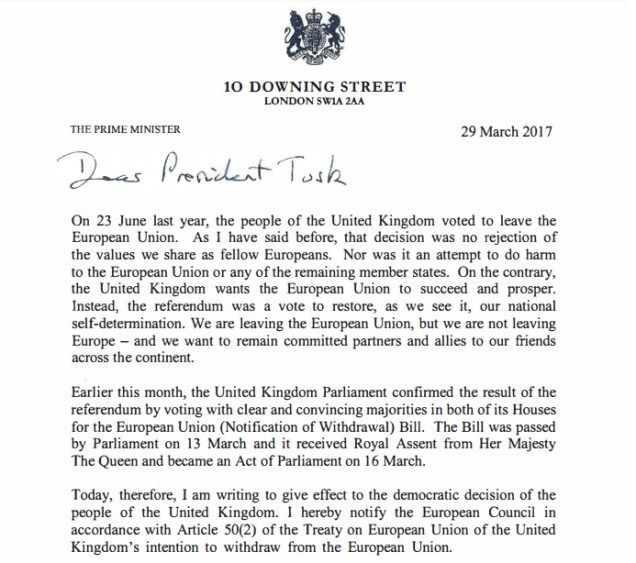
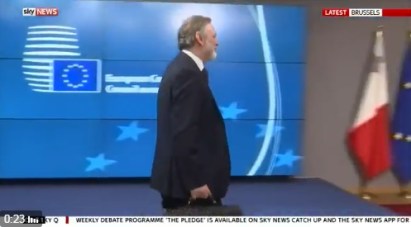
Of the many pictures which may come to represent “Brexit Day” in historical memory, the two images which struck me are the photograph of Theresa May signing the Article 50 notification letter in Downing Street last night, and the television footage of the British official (Ambassador Sir Tim Barrow) in Brussels, striding into the European Council building to deliver the note to president Donald Tusk.

Why? Because these images more than any other represent the astonishing triumph of democracy over the near-unanimous will of the political establishment.
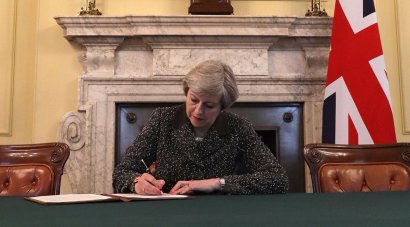
Theresa May signing Article 50 Letter - Downing Street - Brexit - EU

Sir Tim Barrow - Article 50 letter - Brexit- European Union - Britain

Theresa May did not want to sign the Article 50 letter. During the referendum she campaigned, albeit half-heartedly and often nearly invisibly, for Britain to remain in the European Union before accepting the inevitable and promising to implement Brexit as she manoeuvred for the Tory leadership.

And the British civil service, foreign office and diplomatic corps, represented here by Tim Barrow, our Permanent Representative to the EU, certainly did not want to deliver the letter, so accustomed are they to thinking and operating only within the narrow tramlines of those competencies not surrendered to Brussels..

The generations of politicians, diplomats and bureaucrats who currently run Britain were raised on a narrative of national decline and inevitable dependence on the Brussels political union as the only means of amplifying our fading voice in world affairs. Their formative years were spent during the Winter of Discontent and marked by one post-war national humiliation after another. The tremendous post-1970s (Thatcherite) revival has failed to disabuse them of the utterly false, poisonous notion that Britain is a small and insignificant country, no longer capable of governing herself in the manner of other independent countries such as Canada or Australia, let alone as the fifth largest economy and major cultural, commercial, diplomatic and military power that we truly are.

By huge margins, these people were deeply wedded to Britain’s inevitable future as a European Union member state, and consider Brexit a huge mistake bordering on a tragic act of national self-harm. And yet Theresa May signed the letter, Tim Barrow delivered it, Article 50 was duly triggered and the process of Britain’s secession from the European Union was put into motion.

Why is this something to be celebrated? Because at a time when there is every reason for cynicism and doubt, it shows that at a fundamental level, the British people are indeed still in charge of their own destiny.

Theresa May did not want to sign the letter and Tim Barrow did not want to deliver it, but they did so because they retain a sufficient fear of (if not respect for) the public that they dared not abuse their power by overriding the results of a public referendum. Note that there is no such reticence about subverting democracy in the diminished union we are now leaving – unfavourable referendum results in member states (relating to EU treaties or the ill-fated constitution) have consistently been treated as unfortunate but minor setbacks and then sidestepped by the Brussels machinery, its leaders safe in the knowledge that they are so insulated from democratic accountability that they will suffer no consequences for their actions.

In Britain, however, there remained just enough fear of the people for our leaders to be forced to do the right thing, against their will. That’s not to say that they will get Brexit right, not by a long stretch – right up until Referendum Day, many Brexiteers were too busy hating the EU to identify the future relationship they wanted to have with it, while bitter Remainers did much to poison public and media opinion against the kind of transitional EEA deal which would have caused the least economic disruption. But given a mandate to take Britain out of the European Union our leaders are now doing so, however clumsily and against their will. This is as it should be.

Brendan O’Neill also gets it:

What we’re witnessing in Britain today, with Theresa May triggering Article 50, is something radical: the political class is going against its own judgement under the duress of the demos. The polite, peaceful duress of the demos, it should be pointed out.

We know that 73 per cent of MPs want to stay in the EU. We know many in the House of Lords are horrified by Brexit and were keen to hold it up. We know 70 per cent of business leaders wanted Britain to remain, and that some of them launched costly legal battles to try to stymie the Brexit momentum. And yet in the end, all of them, every one, has had to roll over and give in to the masses: to the builders, nurses, teachers, mums, old blokes, unemployed people and others who effectively said to the political class: ‘You’re wrong. We should leave’. To the people surprised that such a state of affairs can exist, that the political set can be made to do something it doesn’t want to by the mass of society, including even uneducated people: what did you think democracy meant? This is what it means.

Yes, this is what democracy means. To do anything else – to override or subvert the referendum decision for Brexit – would mean the triumph of technocracy  and well-meaning dictatorship over democracy.

We tend to forget, because it has not been this way within living memory for many citizens, but in a democracy the leaders are supposed to fear and respect the people and their judgment, not the other way around. As government relentlessly expanded and the bureaucratic state encroached ever more on our lives, we have unfortunately come to fear the government far more than government leaders fear the public – but not so with Brexit. Government ministers know that to defy the Brexit vote and seek to remain in the EU against the wishes of the people would visit such anarchy and destruction upon the country that they daren’t seriously even consider it (save inconsequential politicians such as Tim Farron). And so no matter how much they dislike it, today they implement our instructions.

Of course, Brexit is just one issue. In many other arenas of public life, officials have absolutely no qualms about defying public opinion and treating voters as polling units to be managed or placated rather than autonomous, thinking and engaged citizens to be feared and respected. We must take care not to merely repatriate powers from Brussels back into the arms of a power-hungry, over-centralised Westminster government that will fail to act in the interest of the UK’s diverse home nations and regions, and which carelessly surrendered its own powers to Brussels without democratic consent in the first place. Now, more than ever, we must hold our politicians and civil servants to account.

Brexit is the start of an opportunity for real democratic and constitutional reform, not an outcome in itself. Secession from the European Union makes the rejuvenation of our democracy possible, but by no means inevitable.

When queried by a stranger as to the outcome of the constitutional convention he was leaving, American founding father Benjamin Franklin famously replied: “A Republic, if you can keep it”.

Today, as Theresa May’s government (for all its many flaws) triggers Article 50 and serves notice on the European Union, we seek to reclaim our national self-determination and renew our democracy – if we can keep it. If we can rise to the occasion and collectively seize the great opportunity which now stands before us.
 

Theresa May signing Article 50 Letter - Downing Street - Brexit - EU

Support Semi-Partisan Politics with a one-time or recurring donation:

Agree with this article? Violently disagree? Scroll down to leave a comment.

Follow Semi-Partisan Politics on TwitterFacebook and Medium.

The EU Snubs Britain At Its Own Risk

Friendship and cooperation

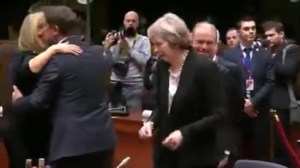
No, Theresa May was not mortally humiliated at the current EU summit underway in Brussels. Somehow, probably after a few nights in intensive care and some trauma therapy, the prime minister of the United Kingdom of Great Britain and Northern Ireland will bounce back from being denied the opportunity to make idle small talk for a few minutes with the likes of Federica Mogherini.

Let’s be serious. Were there non-stop footage of every political leader to ever attend an EU summit, we could undoubtedly find instances where each one of them stood alone with nobody to talk to for a short while, even the sainted Angela Merkel. Keep watching the video beyond the first twenty seconds and you actually see May engaged in several conversations with other European leaders. This is a complete non-story.

But seizing on the footage of Theresa May looking momentarily awkward, however, helps to reinforce a narrative that Remainers (and their friends in the media) are desperate to encourage – that of pathetic, little old Britain being banished to the margins of the world having voted to isolate ourselves “from Europe”.

This is an idiotic and superficial analysis, and it speaks volumes about the people pushing the theory that they seem to take delight in what they see as the humiliation of their own prime minister (who, let’s not forget, represents all of us). If Brexiteers have been too harsh in impugning the patriotism of Remainers, as is sometimes claimed, then now is the time for Remainers to finally take their patriotism out for a spin. They claim that our prime minister has just been insulted on the world stage – therefore they should be encouraging a collective national outrage rather than trying to score smug political points.

Remainers claimed throughout the referendum campaign that the EU is a bastion of rationality, of grown up countries cooperating sensibly with one another. Well, what is grown up and sensible about deliberately ostracising one head of government just because the member state she represents is exercising its right to leave (not that any such ostracisation took place)? What is enlightened and admirable about such childish behaviour? And why is this snarling, punitive and insecure little club something of which we would want any further part?

Iain Martin goes further in a piece for Reaction:

It’s a funny video, although not in the way May’s opponents might think.‎ Funny meaning odd, curious, in that your response to it is probably shaped by your existing view of May and Brexit.

For Leavers – and quite a few Remainers who accept the reality that Brexit will happen and no amount of shenanigans by Blair, Mandelson and Clegg (what a dream team!) will stop it ‎- a British Prime Minister being treated in a rude fashion will only encourage Brits to say “if that’s your attitude then please get stuffed” to the EU.

In that gathering I see a room that‎ is overwhelmingly male – a sausage party of smugness. May is too polite or diffident to charge up to them and start “handbagging” and beating up the boys Thatcher-style, so she hovers. Millions of people, most people, who lack liberal elite social confidence will know the feeling from school or parties ever since. It induces sympathy.

We’re not talking to you, you smell, we don’t like you, is the message. Oh, and ‎the UK is not invited to dinner.

The response all this provokes – in me, anyway – is incredulity at the continuing stupidity of the EU’s leaders in their determination to rough up Britain in a manner that amounts to self-harm. Yes, we voted to leave the EU, which is our right and had been coming for ages, ‎but we cannot leave Europe. That would be a geographic, culinary, cultural, commercial impossibility, thank goodness. That means we are going to have to get along, and find new ways of co-operating and co-existing. Punishing Britain and being rude to Theresa May is simply a waste of time and energy, when the world is changing this fast.

I would caution Iain Martin against going down the identity politics route, trying to drum up additional sympathy for Theresa May by portraying her as a lone female in a room of arrogant and threatening men. I see no evidence that gender has anything to do with this non-story. Martin (I assume) is not a fan of the Cult of Social Justice and Identity Politics, and he should avoid resorting to their tactic of playing the oppression card when engaging in argument.

But that minor quibble aside, Martin is quite right. Many people will indeed empathise with the awkwardness of walking into the middle of a room of people who generally already know each other quite well and who are already engrossed in conversation. Throw in the fact that the television cameras were rolling and May becomes quite a sympathetic character. So if Remainers’ best argument is now “see how they treat you when you scorn them and try to leave the club” then I think it will largely backfire.

If anything, the history of recent British diplomacy has been one of excessive fawning and deference, punching well beneath our weight considering our status as Europe’s second biggest economy, one of only two nuclear powers and possessing the continent’s most deployable and skilled armed forces, not to mention the popularity and dominance of our culture. Martin also picks up on this point:

Britain has the leading listening, intelligence and security capability in Europe, at a time when the place is under assault from jihadist maniacs and the Russians are out to discredit democracy and create mischief in elections in Germany and France. Even in its depleted state, Britain is a leading player in Nato, which is dedicated to the defence of Western Europe. On the cyberwarfare front in particular that defence is now an urgent priority.

The UK also provides in the City of London ‎the capital of the eurozone, which makes the giant debt machine go round. The British economy is growing and we buy a lot of cars and much else from Europe.

What will it take to wake up the countries of the EU? Their post-1989 experiment is in a terrible state, with the euro and open borders proving to be a disaster. They need a bit of humility and a rethink.

I don’t normally go for “we buy lots of cars from them!” style arguments, but it is not wrong, and everything else that Martin says is persuasive.

If anything, the trouble is that our goodwill and cooperation is too easily taken for granted by our partners. We tend to enforce EU laws and directives while other countries skirt, bend or flout them. We generally honour our obligations with little fuss. And so we should, when that behaviour is equally reciprocated. But right now that reciprocity is missing.

The fact that Britain will be a supplicant during the secession negotiations is currently emboldening the leaders of some otherwise quite unremarkable and forgettable countries to “play the big man” and swagger around, lecturing or threatening Britain safe under the wing of Brussels. They would be advised to realise that at some point Brexit will be complete, and that future goodwill and cooperation from Britain – which many of them need – should not be taken for granted if things become too heated or punitive during the exit negotiations.

Martin notes that the shift is already starting to happen:

Away from Brussels the smart Poles have realised that Britain will remain a partner, and are talking of the UK being the key country in the defence and security space in Europe. The Germans too, seem to be waking up to the need for a different way of thinking about these questions. The conversation at a dinner I was at recently with German policymakers and business people was one of the most interesting, open and illuminating things I’ve heard all year.

But Brussels blunders on, playing its usual games, thinking it clever to humiliate the naughty British. Carry on like this and they really can get stuffed.

It is altogether time for less EU-style holding hands beneath a rainbow (which is all fake, anyway) and more good old fashioned self-interest and realpolitik. Immediately following Brexit we witnessed a number of gestures of solidarity and support from true allies outside the EU while our supposed partners and allies within dealt in condescending language and veiled threats. That alone tells us that membership of the European Union has forced us to pour time and effort into nurturing partnerships which were never natural or terribly fruitful while having to ignore closer and more natural alliances beyond the artificial construct of the EU.

But if the EU and its member states are behaving irrationally and emotionally it is only because they remain in thrall to a beguiling, powerful but unachievable vision of continental political union by stealth from which Britain thankfully escaped. Sensing an existential threat to the group delusion, other countries may naturally wish to lash out at Britain, to make us “pay the price” (and there will be a price – serious Brexiteers have never shied away from that fact).

But while this may explain intransigent or punitive behaviour from the European Union, it will not excuse such antics for much longer. The time for childish temper tantrums and playground insults is over. Voters in Britain and across Europe did not elect their politicians with a mandate to create unnecessary drama just because one country chose to reject a rusting mid-century vision of political union and peaceably extricate itself from that union. And unnecessary drama they must absolutely not create.

A deal must be done and the deal will be done. Hopefully it will be a deal based on common sense, achieving the goal of extricating us from the political union we voted to leave while taking a transitory and measured approach (through continued EEA participation) to avoid any cliff-edges or avoidable economic disruption.

But whatever kind of deal emerges, it will not be influenced by video footage of Theresa May standing alone at an EU summit, no matter how much the images may warm the hearts of strangely-motivated Remainers.


theresa-may-snubbed-eu-summit-brussels

Support Semi-Partisan Politics with a one-time or recurring donation:

Agree with this article? Violently disagree? Scroll down to leave a comment.

Follow Semi-Partisan Politics on TwitterFacebook and Medium.

Meet Baroness Henig, Stoking Fear Of Terrorism To Benefit Her Private Security Business

baroness-ruth-henig

Baroness Henig’s exploitation of the Paris Attacks anniversary to advocate new laws demanding that concert venues invest more in security – while herself employed as chair of a private security firm which just so happens to provide these services – showcases British politics at its most tawdry and corrupt

There are innumerable reasons why the House of Lords in its current state is an utterly intolerable affront to democracy and ethical decision-making, but an example from today really takes the biscuit.

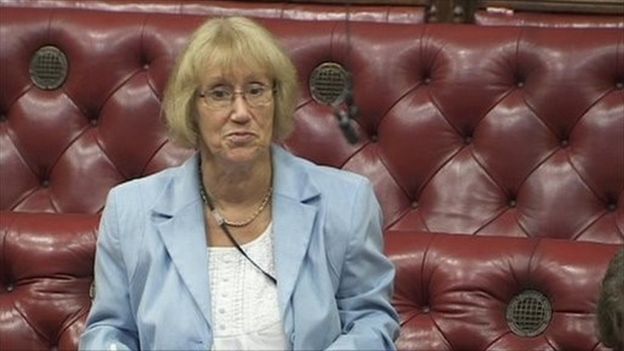
We are coming up on the one year anniversary of the heinous coordinated terrorist attack at the Bataclan concert hall and across Paris, and Baroness Ruth Henig – a Labour peer appointed in 2004 – decided that today would be the perfect day to pop up on the BBC News Channel to declare that private concert venues should do more in terms of anti-terrorism security and training, enforced by law through a potential change to the Licencing Act 2003.

From BBC News:

Licensing laws should be changed to force entertainment venues around the UK to undergo counter-terror training, a private security expert has said.

Baroness Ruth Henig told the Victoria Derbyshire programme that some venues did not take such training “seriously”. The former chair of the Security Industry Authority now plans to table an amendment to the 2003 licensing act, to include counter-terror training. Her comments come nearly a year after 130 people died in attacks in Paris.

[..] Baroness Henig said: “There are clearly a number of venues, often the larger venues, I think, but not always, who have airport-style security, who, for example, do have metal detectors, who do have very well-trained security personnel and they top up this training regularly.

“But I think at the other end there is a tail of venues who aren’t taking it seriously, we know this from the police, who don’t co-operate, who don’t take up the offers that are made to them and where I think there are some concerns.

“And the issue is how do you get to that tail of venues who are perhaps not doing as much as they should be about security.”

So far, so noble, you might think. After all, Baroness Henig only recently completed two terms as chair of the Security Industry Authority (SIA), the government regulator for private security firms run under the auspices of the Home Office. Who better to make a reasoned, fact-based case for more necessary security regulation than somebody who was in charge of holding the industry to account?

Only that is no longer Baroness Henig’s role. Rather than regulating the industry and ensuring that professional standards are upheld, Ruth Henig can now be found on the board of SecuriGroup, a private security consultancy and provider itself regulated by the SIA – and not just as any board member, but as the Chair of that organisation.

Here’s her official company bio:

Baroness Henig joined SecuriGroup after completing two successful terms as Chair of the Home Office Regulator, the Security Industry Authority (SIA). Baroness Henig’s commitment to security and policing is well documented having held the post of Chair of Lancashire Police Authority and the Chair of the Association of Police Authorities in England and Wales which led to the award of a CBE in 2000 for services to policing. The Baroness also served on the National Criminal Justice Board and Street Crime Action Group, chaired by the then Prime Minister, Tony Blair.

She was appointed as Deputy Lieutenant for Lancashire in 2002 and made a life peer in 2004 as Baroness Henig of Lancaster. As a Deputy Speaker of the House of Lords, Baroness Henig takes her place on the European Security Committee on Foreign Affairs and is a member of the Independent Policing Commission.

And most conveniently, some of the services offered by SecuriGroup include counter-terrorism strategy training, security guarding, door supervision and event security. One might say that SecuriGroup are perfectly poised to provide the very services that their CEO is currently insisting are made mandatory from her unelected seat within the UK Parliament.

To move instantly from a position regulating an industry to the chairmanship of one of those companies being regulated is concerning in and of itself. In fact, the free flow of individuals back and forth between regulator and regulated organisations is one of the primary symptoms of “regulatory capture,” a phenomenon whereby a government body established to regulate an industry “instead advances the commercial or political concerns of special interest groups that dominate the industry or sector it is charged with regulating”.

In this context, Ruth Henig’s sudden concern that smaller music venues are not stumping up for expensive anti-terrorism security countermeasures starts to look a lot less like high-minded public interest and a lot more like grubby concern for the bottom line. Is Henig worried about “that tail of venues who are perhaps not doing as much as they should be about security” because the safety of concertgoers has been keeping her up at night, or because a valuable revenue stream for SecuriGroup has been going unexploited? Given that she now derives her pay cheque from a private security firm, one has to assume that it is at least partly the latter.

Henig tries to cast herself in a virtuous light by pointing out the fact that the initial police consultations with event venues offered as part of Project Griffin are free. And so they are. But when the risk-averse police advise small venues operating on shoestring budgets that they need to pay for additional private security (by hiring the services of SecuriGroup or its competitors), that certainly will not be free. The sums of money involved would likely shut down or severely restrict the operations of many of Britain’s smaller music venues.

Of course there is nothing surprising about a Labour politician downplaying the cost of regulatory compliance – this is their bread and butter. But to do so because one has a direct financial interest in more stringent regulation is morally grey at best.

And this is one of the main problems with the House of Lords. Henig’s case is far from unique. It is just particularly disgusting, because it involves taking advantage of the anniversary of the terrorist murder of more than a hundred people to help drum up more business for SecuriGroup. But regulatory capture is an inherent feature of an appointed House of Lords, not an awkward and unintended quirk.

When governments appoint people to the upper legislative chamber based often on their industry experience (and that’s a best case scenario, assuming they aren’t simply cronies being rewarded for political services rendered), those people will naturally retain extensive links to the industries in which they built their careers and reputations. Sometimes this can be a good thing and lead to better, more considered lawmaking. But if the legislator in question is still working (or intends to return to work) in that field, then their judgment is inherently compromised.

Unfortunately, rather than realising the glaring conflict of interest and recusing herself from debate on the subject, Baroness Ruth Henig decided instead to roll up her sleeves and abuse her position as an unelected peer to further the interests of the company she runs – and all in the run-up to the anniversary of a terrorist attack which killed 130 innocent people.

Britain is crying out for proper constitutional reform to build up the public’s diminished faith in our democratic process. Part of that means proper reform of the House of Lords – making it a fully elected chamber (with term limits, length of terms and the candidate pool open for discussion, so long as we produce a more deliberative body), ending the “elected dictatorship” of the primacy of the Commons, kicking out the theocratic Lords Spiritual and drastically shrinking the membership.

But it also means cracking down on the kind of morally dubious behaviour exhibited by people like Baroness Ruth Henig. We must end the revolving doors which currently exist between Parliament and industry, Parliament and lobbying and between regulator and regulatee. Somebody who just completed two terms regulating the private security industry should not then immediately be allowed to go and work in that same sector. Just because it is commonplace and seen by the establishment as a “deserved reward” for having previously slummed it on the public purse does not make it right.

Using the anniversary of the November 2015 Paris Attacks to promote a bill making it mandatory for even the smallest of music venues to invest heavily in additional security is politics at its most cynical – particularly when you consider that heavily armed and well trained gunmen such as those who committed the Paris Attacks (and the previous attack on Charlie Hebdo) would hardly be deterred by the presence of additional unarmed security guards.

But promoting an ineffective course of action which also happens to result in significant monetary gain for one’s outside business interests is about as low as it is possible to get. By all account, Baroness Henig’s career thus far has been distinguished and honourable. She should reverse course and either give up her chairmanship of SecuriGroup or otherwise immediately recuse herself from any further part in legislating security issues – or risk tarnishing that good reputation forever.


baroness-ruth-henig-securigroup

concert-venue-security

Top Image: BBC

Bottom Images: Pixabay, Twitter / SecuriGroup

Support Semi-Partisan Politics with a one-time or recurring donation:

Agree with this article? Violently disagree? Scroll down to leave a comment.

Follow Semi-Partisan Politics on TwitterFacebook and Medium.

Britain’s Leftist Open Borders Zealots Have Turned Migrants And Refugees Into Political Pawns

lily-allen-calais-jungle-child-migrants-refugees-2

The migrant crisis is too great an opportunity to ignore for many virtue-signalling members of Generation Me, Me, Me

Brendan O’Neill hits the nail on the head with his latest criticism of sanctimonious celebrity campaigners for open borders, in a piece entitled “You’re so vain, you think the refugee crisis is about you”.

O’Neill writes:

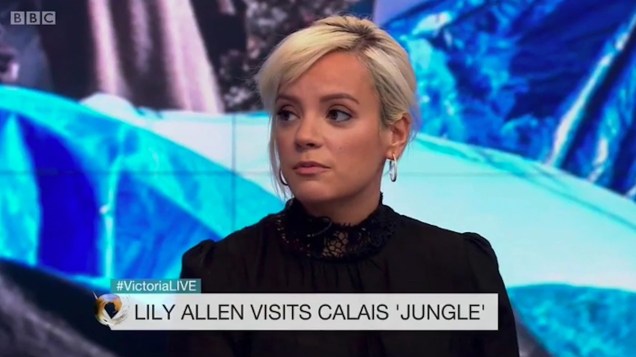
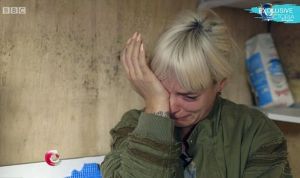
Narcissism runs through the discussion. The question these refugees raise is ‘What kind of people do we want to be?’, says one columnist. The keyword here: ‘we’. On the supposedly pro-refugee side, the game of self-reflection has been intense. Witness Allen’s TV-camera tears when she was chatting to an Afghan boy in Calais, after which the entire discussion became about her. Her image was everywhere. There was a thinkpiece war, some saying ‘Allen was right’, others saying ‘Allen was wrong’. It became about the role of celebrities in public life and whether emotionalism has a part to play in political decision-making, with the migrants reduced to mere objects of our self-reflection, and our tears, not the subjects of their own story.

Then there was Stella Creasy, the self-promoting Labour MP, interviewed in the London Evening Standard, promising to stand up for these child migrants regardless of how much flak she will get (shorter version: ‘I am brave’). The piece was accompanied by a massive picture of Creasy: no image of refugees, just her, because this is about her, not them. Then the story became all about Lineker, after he tweeted his concern for the refugees and was blasted by the Sun for doing so. What is the role of BBC people if not to be morally switched-on, a thousand op-ed scribblers asked, because this is about the Beeb, and the media, and us, not them. Jeremy Corbyn got stuck into the discussion of ‘what kind of people we want to be’ by praising Allen and Lineker for showing ‘Britain at its best’. It was a surreal illustration of the evacuation of substance and seriousness from public debate and their replacement by The Spectacle, largely of emotion: a political leader hailing media representations of sorrow for migrants over anything solid or concrete in relation to the actual lives of the actual migrants.

The media discussion has provided a striking insight into what being pro-migration largely means today: that you – the keyword being ‘you’ – are compassionate. Migrants are latched on to, not because of a genuine commitment to the idea of free movement (witness Creasy saying of course some migrants will have to be kept out), but rather as a means of self-distinction. To be pro-migrant is to be superior to those badly informed Others, who have a name now: Brexiteers. This is why so much of the child-refugee discussion has become bound up with Brexit-bashing. ‘What do we see each morning, post-Brexit, when we look in the mirror?’, asked a Guardian columnist of the child-refugee situation (keyword: ‘mirror’). He says we see a nation ‘hollowed out in terms of compassion’, but of course he means that is what ordinary, ugly, Brexit-voting Brits see in the mirror, not the migrant-loving Brits at the Guardian.

My emphasis in bold.

To be fair, Brendan also accuses many of the most strident anti-migrant voices of the same sin; I do not want to misrepresent his piece. But then Brendan O’Neill and Spiked (bless them) are enthusiastic advocates for completely open borders and the free movement of people everywhere – “it doesn’t matter if they’re kids, teens or adults: the length of their journey and the strength of their desire to live and work on Britain are surely sufficient to grant them access” – an idea rather ahead of its time (not to mention politically toxic so long as such disparities of wealth, culture and values persist).

But Brendan is absolutely right to note that the people of the Calais Jungle – genuine refugees and economic migrants alike – have largely been become political pawns in the ongoing British immigration debate. What matters to many people is how they are seen to talk about the migrant crisis rather than there being found an effective solution – as we saw only this week when Labour MP Chi Onwurah got upset about a poster mocking leftist credulity about migrants posing as refugees, claiming that it was “offensive” when it in no way targeted genuine child refugees.

O’Neill also writes perceptively of the “moral thrill” experienced by many of the “let them all in” camp, and indeed you see it coursing through numerous posts on social media, the intent of many seems far more to do with aggrandising the poster than trying to reach a reasonable compromise with those who do not want to let every last person into Britain unquestioningly.

But to his criticism of the political right:

The narcissism of the other side is striking, too. It is hard to believe that these right-leaning observers really believe that 70 young people coming to Britain will have any kind of terrible impact. And yet they demand that the arrivals’ teeth be checked to see how old they are, and furiously tweet photos of the young men with adolescent moustaches and mobile phones as if to say: ‘See! They’re grown-up! They’re dangerous!’ This is a performance of toughness, of security, to match the performance of compassion of the other side. Just as the pro-refugee side sidelines serious debate about freedom of movement and the role of their beloved EU and its Fortress Europe in creating this crisis, so the anti-refugee side dodges difficult questions of what is really causing a sense of insecurity in 21st-century Europe in favour of turning a handful of young refugees into symbols of existential disarray. Indicators, symbols, mirrors – that’s all these people are, to both sides.

I don’t see it that way at all. While some people do demand that Britain stop accepting any further refugees, a majority would be happy, I believe, if the UK government was simply a little less credulous and a bit more discerning about the people we do accept – both as to their age and the validity of their status as refugees rather than economic migrants.

The pictures do not lie – many of those already brought to Britain from the dismantled Calais Jungle camp are clearly adults. Does that automatically mean that they are not deserving of help? No, and I don’t think that anybody serious has claimed otherwise. But if this country is accepting fully grown men who claim to be children, what is to say that other levels of scrutiny which are supposedly taking place – like checking that entrants are not violent jihadists – are any more reliable? If the UK government is squeamish about insisting that child refugee applicants submit to dental tests to verify their age, have they also been reticent to ask whether the people they are ferrying from Calais to Croydon intend to wage jihad from inside their adoptive country? The incompetence we have already seen rightly makes us wonder about the incompetence which is being kept hidden from us.

These are perfectly legitimate questions to ask, and they do not constitute virtue signalling in the same way that the Left have seized on the migrant crisis to portray themselves as saints and the rest of us as sinners. Particularly in the context of the recent bloody history of ISIS using the migration crisis as a cover to slip Islamist extremists into Western countries, a basic level of scrutiny should be one of the first duties of government – yet there is now legitimate cause to fear that this scrutiny is not being applied for fear of causing “offence”, either to the migrants themselves or (more likely) to their powerful left-wing cheerleaders.

And here’s the thing.

Far right-wing rhetoric may be much more unpleasant to the ear than trendy lefty dronings about a borderless world of people holding hands beneath a rainbow. But leftist rhetoric and actions when it comes to the migrant crisis have killed far more people than anything said or done by those who are sceptical of accepting every last economic migrant who fancies a new life in Britain.

It was the leftist cheerleaders of Angela Merkel’s “open doors” policy who encouraged thousands more people to make the treacherous journey across Europe, some in genuine fear of imminent harm but many simply seeking a better life.

It was the leftist campaigners who accused sceptics of heartlessness for wanting to start turning boats back as a disincentive to make perilous the sea voyage who tacitly encouraged many more people to do so, and drown in the process.

And it was the false hope given by leftist agitators that Britain would ultimately accept a trumped-up moral obligation to accept thousands of people already enjoying the protection of France, hardly the most dangerous country in the world, which encouraged even more people to flock to the Jungle and remain there.

And yet we are supposed to believe that open borders zealots and sceptics are equally at fault when it comes to virtue signalling about the migrant crisis? Absolutely not. Exploiting migrants and refugees to burnish their own compassion credentials is the Left’s bread and butter, and it is an emotional comfort blanket whose cost can be measured in human lives.

So let’s not pretend that there is any moral equivalency in terms of blame for the suffering of migrants holed up in Calais. There is none. This is a crisis manufactured by the Left and encouraged by the Left for the benefit of the Left. They own it.

And all of Lily Allen’s tears will not wash away their culpability.


lily-allen-calais-jungle-child-migrants-refugees

Support Semi-Partisan Politics with a one-time or recurring donation:

Agree with this article? Violently disagree? Scroll down to leave a comment.

Follow Semi-Partisan Politics on TwitterFacebook and Medium.

Adults Migrants Posing As Children Make A Mockery Of British Asylum, But Pointing This Out “Offends” The Left

syrian-child-refugee-poster-parliament-house-of-commons-chi-onwurah

Leftists do not scream “that’s offensive!” out of overwhelming, saintly concern for the supposed “victims” of free speech. They do so as part of an authoritarian ploy to shut down unwanted discussion and mockery of their own sacred values

One does not need to see the dental records of some of the people currently being brought to the UK from the soon-to-be-demolished Jungle refugee camp in Calais to know that a number of those migrants (for who can say whether most are genuine refugees?) are not, as they claim to be, under the age of eighteen.

In fact, one barely needed a functioning brain to correctly predict that a number of enterprising military-age males might seek to game the system, claiming to be both children and refugees when one or both assertions are entirely false (current figures show that two thirds of “child” refugees challenged by Home Office officials turned out to be adults).

As Peter Hitchens notes:

I confess I was rather looking forward to the arrival of the alleged ‘children’ from the Calais migrant camp.

Leftists have an oily habit of stretching the definition of this emotional word. It helps them make the exaggerated claims of suffering, by which they so often achieve their political aims.

I fully expected to see square-jawed, muscled, hairy young men of military age, and I have greatly enjoyed the embarrassment of the soppy idiots who spread and believed the propaganda about them.

Of course it’s possible that they are all really 12, and have been terribly hardened by war and suffering. But if that is so, how come they are in a crime-ridden camp in France, which exists purely to besiege our borders and launch illegal attempts to cross them?

Nobody ever asks how the inhabitants of this camp got there, because the answer in almost all cases is that they were trafficked there by well-paid crooks. What responsible parent would put an actual child in the hands of such people, notorious worldwide for their ruthlessness?

And why are we supposed to be so tear-stained that these people are stuck in France? France, the last time I looked, was one of the most civilised countries in the world. It is not a war zone. Nobody starves there. There are schools. Many fashionable British liberals own houses there. The quality of the coffee has gone down a bit in recent years, but that is no reason to stow away in a lorry or climb a 15ft fence so you can move to Tottenham or Slough.

And with so many transparently post-adolescent people being dutifully shipped across the English Channel and ushered into Britain by a credulous Home Office, it does not fall beyond the bounds of reasonable political humour to joke about the way in which British immigration and asylum rules are being so nakedly and egregiously flouted (the photo captions in this Daily Mail piece are some of the best political comedy this month).

Unless, that is, you are a thin-skinned Labour MP whose metro-leftist ideology demands that anybody and everybody who demands admittance to Britain is immediately and unquestioningly allowed in. For in such cases, joking about octogenarian “children” being rescued from the perils of France is not mere political banter – it is inherently racist for a start, and worse, it is highly offensive and triggering to those leftist MPs whose ideology and motivations are being mocked.

The Mirror reports:

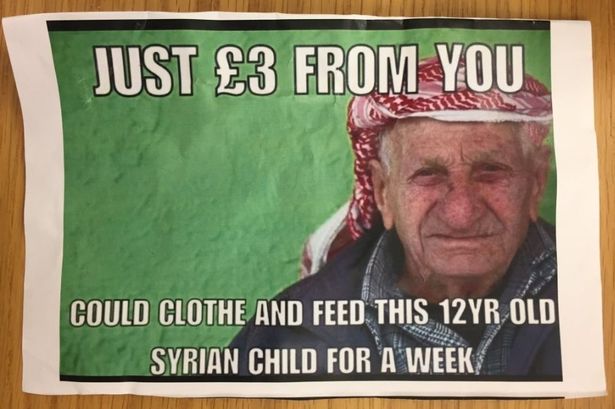
A Labour shadow minister has been left upset after someone stuck up a “highly offensive” child refugees joke in her shared kitchen in Westminster.

Chi Onwurah shared the A4 sheet on Twitter after it was found this morning in the room she shares with Labour, Tory and SNP MPs.

The message mocked refugees after pundits and Tory MPs questioned the age of arrivals in Britain who said they were under 18.

It showed an old man with the message: “Just £3 from you could clothe and feed this 12-year-old Syrian child for a week”.

Highly offensive, really?

Who, exactly, does Chi Onwurah think is offended by this poster? Genuine child refugees from Syria? None of them have visited the House of Commons kitchen, or had an opportunity to see the offending poster. Genuine child refugees will have far more pressing cares and concerns on their innocent minds than a poster which mocks people who are clearly above the threshold of adulthood but trying to pass themselves off as children.

No, the only people “offended” by this poster are the virtue-signalling, bleeding heart lefties who are currently puffing themselves up with over-conspicuous compassion for people who already enjoy the shelter and protection of a safe and very pleasant country (France) because their metro-leftist ideology calls them to undermine the nation state at every turn and defy national borders wherever they exist.

And as even the MP herself emphasises to us, the main takeaway from this event is that Chi Onwurah, not any refugee or person directly connected to the migrant crisis, was left “upset” by the incident:

In other words, Onwurah – who, as an MP, is an immensely privileged and powerful member of society – was left distressed because somebody challenged and mocked her worldview in the form of a poster. That’s what we are invited to feel upset about, really. Not the genuine child refugees themselves. Screw the child refugees. Screw the adult refugees posing as children, for that matter. No, what really matters here is that a virtue-signalling Compassion Olympian like Chi Onwurah encountered some unexpected pushback against her leftist worldview, and promptly fell to pieces as a consequence.

This is – oh, how best to put it? – completely and utterly pathetic. This blog has sympathy for anybody desperate enough to traverse the continent of Europe and then rot in an improvised camp in Calais just to try to reach our shores. That sympathy does not extend to wanting to throw open our borders to anyone who seeks to abuse the asylum process to have their pick of safe European destinations – that’s not what asylum is for or how the system is supposed to work, and the nation state ceases to mean anything if everyone who fancies a life in Britain can claim one – but there is great sympathy nonetheless. And I back that concern and sympathy with action where I can, with charitable donations to appropriate organisations seeking to provide relief to genuine refugees.

But this blog has absolutely no sympathy for Chi Onwurah. I hope that with time and extensive therapy, the MP for Newcastle Central will manage to recover from the immense personal trauma of encountering a poster which contradicted and mocked her own personal worldview. It is truly a calamity of monstrous proportions, verging on torture, for a leftist MP to accidentally behold a poster which scorns her own personal belief that every last migrant seeking to gain entry to Britain is a legitimate refugee from the Syrian conflict, or that everyone who claims to be a child is actually under the age of eighteen. We may as well be honest – the person who put up this poster in the House of Commons tea room effectively mentally waterboarded poor Ms. Onwurah. There is simply no other way to put it.

And yet call me crazy, but this blog would sooner feel sympathy for those genuine refugees who have undergone untold sufferings on their voyage to Europe than for an MP who (shock, horror) experienced indirect mockery in the House of Commons – an unheard of and unprecedented indignity, I’m sure.

But this is how the modern Left operates. They have weaponised victimhood and offence-taking to such an extent that the target of any supposedly “offensive” speech no longer even has to be the victim group currently being exploited for political gain. Now, it is an equal crime to “offend” the leftist advocates of that victim group. Insulting Chi Onwurah is like insulting a vulnerable child refugee herself, according to this ridiculous mindset. To offend against a leftist white knight is to offend against their beneficiary.

The Mirror article concludes:

Directing her comments at whoever posted the image she said: “It’s a communal area, not everybody shares your sense of humour.

“There are many things I get angry about but I’m not going to force that on my work colleagues.

“I don’t think it’s funny. Not when you see what people have been through coming from Syria.

“People often share jokes but this is a communal area and I and others shouldn’t have to suffer what you think is funny.”

Ms Onwurah said her researcher took the poster down, and she was unlikely to make a formal complaint if it broke the rules because she had already highlighted it by making it public.

Again, we are invited to feel sympathy for and rend our garments in solidarity with Chi Onwurah, who has seen refugees from a distance, rather than with the refugees themselves. It is her trauma we are supposed to care about, not that of the migrants and refugees in Calais. The self-involvement of Onwurah’s complaint would be hilarious, were it not quite so sickening.

From her fainting couch, Onwurah writes that she should not have to “suffer” the sense of humour of the person who erected the poster, despite also conceding that other “people often share jokes”, seemingly without arousing her ire. In other words, Onwurah effectively sets the bar for offence within the Palace of Westminster at the low level of her own easily-triggered sensitivities.

And yet Onwurah actually believes she is being magnanimous by not reporting the incident to the House of Commons authorities (who presumably have an HR policy ready to go, just waiting for the moment when a Labour MP was triggered by a satirical poster). Onwurah clearly believes that it is perfectly within her legal and moral rights to summon the authorities and have them crash down like a ton of bricks on the head of the perpetrator – and that she is showing mercy to the perpetrator by not doing so.

Ultimately, Chi Onwurah’s complaint asks the British people to be more concerned that a home-made poster violated the safe space for leftist groupthink that is the House of Commons communal areas than we are about the plight of genuine child refugees stranded in Calais.

Leftists like Onwurah are aghast that a harmless poster mocked and contradicted their worldview, and have no compunction about assuming the same language of frailty and victimhood as the people they so ostentatiously affect to help, even though we can say with cast iron certainty that No Refugee Was Harmed In The Making Of This Poster.

And that really tells you everything you need to know about the self-involvement, decadence and moral bankruptcy of the modern Left.


chi-onwurah-mp-2

Bottom Image: Chi Onwurrah / Twitter

Support Semi-Partisan Politics with a one-time or recurring donation:

Agree with this article? Violently disagree? Scroll down to leave a comment.

Follow Semi-Partisan Politics on TwitterFacebook and Medium.