Stronger Together? The Mighty European Union Is Dancing To The Tune Of A Petty, Minor League Tyrant

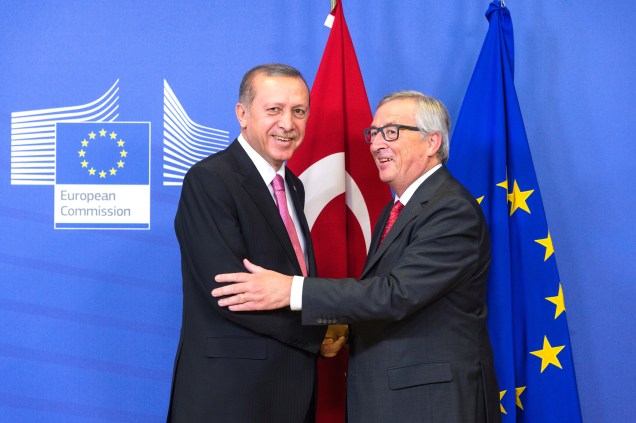
Greeting between Recep Tayyip Erdoğan, on the left, and Jean-Claude Juncker

The unedifying sight of European leaders falling over themselves to flatter and persuade the two-bit despot of Turkey to help solve a problem largely of their own making is damning proof that EU member states are definitively NOT stronger together

The most common refrain heard from Remainers and assorted EU apologists is that by pooling (read: surrendering) sovereignty with 27 other nations, we are “stronger together” and mysteriously greater than the sum of our collective parts – that something magical happens when Ireland, Britain, Slovakia and Croatia act through a supranational government based in Brussels which (for reasons they never explain) could not be achieved through friendly inter-governmental cooperation between sovereign countries.

This tiresome and unsupported claim is fatuous beyond words, and usually uttered by people who don’t understand the first thing about either the history of the European Union or how it operates, but who nonetheless cheer on the idea of European political integration in order to virtue-signal the fact that they hold the “correct” progressive  opinions to their equally vapid friends and peers.

And if you want proof that being part of a remorselessly politically integrating club of 28 diverse countries actually makes us the very opposite of “stronger together”, one need only look at how the European Union is being hoodwinked and bullied by that beady-eyed, egotistical, embryonic dictator from Turkey, president Recep Tayyip Erdogan.

Douglas Murray writes in the Spectator:

Recep Tayyip Erdogan, the Turkish president, has persuaded the EU to grant visa-free travel to his 75 million countrymen inside Europe’s passport-free Schengen area. In so doing, he has made more progress than any of his predecessors. Using a combination of intimidation, threats and blackmail, he has succeeded in opening wide the doors of Europe.

Erdogan’s success matters, because it says much about the EU — and the idea that it exerts ‘soft power’. This was the theory in 1999 when the EU declared Turkey to be ‘a candidate State, destined to join the Union’ so long as it fulfilled the standard criteria for membership. Its state should have ‘achieved stability of institutions guaranteeing democracy, the rule of law, human rights, respect for and protection of minorities’.

And it was all going so swimmingly. Oh, wait:

As Erdogan has worked out, however much Turkey fails to live up to the EU’s expectations, the EU’s attitude to Turkey is ‘ever onwards’. Its 2013 ‘Visa Liberalisation Dialogue’ set out 72 conditions on security, migration, public order, fundamental rights and readmission of irregular migrants that Turkey needed to achieve. Despite failing them, in November last year the EU and Turkey agreed that visa-free travel should start this October. All the time Turkey demanded more and faster.

As well they could. Because last year — after the German Chancellor opened the borders of Europe to anyone who could get here — the tables turned. Persuaded that every problem in the Middle East, Far East, North and Sub-Saharan Africa was Europe’s fault and Europe’s responsibility, millions duly came. And will again. Today, even the European Commission and Frau Merkel realise that in order to avert political catastrophe in Europe, they must bring the number of entrants down. Suddenly, as Erdogan himself said, ‘The European Union needs Turkey more than Turkey needs the European Union.’

So this is the European Union’s much-vaunted “soft power”. This is how forcing 28 separate countries – incidentally, countries which often lavish money on social programmes but completely neglect their own security and defence – to act through a single supranational government actually works in practice. How other nations must tremble when Europe speaks.

The supposed soft power of Brussels is supposed to be European political union’s chief advantage and a key foundation of the Remain campaign’s case for staying in the EU, yet on the most important of issues it is virtually non-existent, a paper tiger. Turkey’s president openly mocks and belittles EU leaders to their faces, even as they roll out the red carpet and treat him “like a prince” (in the word’s of the European Commission’s own pandering  President Juncker).

But as Tom Slater correctly points out in Spiked, the real fault is not with Turkey and Erdogan, thin-skinned, authoritarian despot though he is. The problem is with Europe and its profound crisis of values:

As for the migrant deal, it was EU incompetence that ceded Erdogan all of his leverage in the first place. Having chosen to ignore the fact that it had long lost control of its southern borders – not least because of some of its members’ cack-handed crusades in the Middle East and North Africa – the EU’s response to the refugee crisis was chaotic and can-kicking. The EU elite’s attempt to enforce migrant quotas on member states was a typically anti-democratic move. But it couldn’t even pull that off. The EU is as inept as it is tyrannical, meaning cutting a deal with Turkey became the only option.

The ground-shaking power of Turkey is the fantasy of a continent that doesn’t know what it is anymore. The more Europe drifts from its founding values, the more EU elites struggle to execute anything other than a photo-op, the more Erdogan, the ‘tall man’ of Ankara, grows in stature. Bashing Turkey can only distract us from this profound crisis.

But how can this be? How did this “profound crisis” come about? Forcing 28 separate countries under the suffocating umbrella of one supranational government with one collective presence on the world stage was supposed to amplify our voice. Hell, the EU’s most starry-eyed lovers even dream of Brussels rivalling and eventually supplanting the United States as the most consequential actor in world affairs. And yet here we are, failing in our negotiations with a pathetic little tin-pot dictator, throwing away billions of taxpayer euros in the hope of the slightest concession from Turkey, while the eurocrats are bested and humiliated at every turn.

This is what happens when the EU tries to prance around on the world stage as though it were a legitimate country, despite not having the one thing most fundamental to any nation state – a cohesive demos, a people with a shared European identity, let alone common interests. This is what happens when the conflicting priorities, fears, red lines and neuroses of 28 separate countries are forcibly mashed together – the result is a laughable compromise backed with the weakest of wills, easily picked apart by a half-competent negotiator.

Erdogan isn’t stupid. He knows that having eliminated internal borders, the EU’s Schengen area countries are desperate to stop the immigration crisis at (or at least near) source, and that consequently he holds all of the cards. Erdogan knows that the EU is hopelessly divided, with German chancellor Angela Merkel having made the grandiose and criminally irresponsible gesture of welcoming anybody with the means to enter Europe – seeking to expunge Germany’s past national guilt in a single stroke, knowing that hundreds of thousands more would be encouraged to come while other countries would end up footing much of the bill.

A Europe that was not intent on forcing itself against common sense and natural law to become a single political entity might be able to deal with the Syrian (and broader) refugee and economic migration crisis in a rational, productive way. A Europe based on inter-governmental cooperation rather than supra-national control might be able to hammer out a deal to accept more genuine refugees, share them equitably, take only the brightest and best of the economic migrants, and offer real assistance and solidarity to countries like Greece and Italy which bear the brunt of the crisis. But this is not the Europe we have. Once again, the stubborn desire for European political union is actively killing people.

So let’s hear it again from the Remainers and desperate EU apologists. Let them continue to lecture us about how the European Union “amplifies our voice” and enables us to “punch above our weight“. Let them tell us how Europe’s representative on the world stage, former Young Communist Federica Mogherini, is universally feared and respected, the modern day hybrid of Charlemagne and Henry Kissinger.

Let them continue to peddle the preposterous myth that little old France, Germany and Britain – two of them nuclear powers, and the other the world’s fourth largest economy – are helpless on their own and only worthy of sitting across the table from the mighty President Erdogan to seek his favour because they cower behind the EU’s skirts.

Let them tell us again how being in the European Union gives us the diplomatic clout that countries like Australia, Canada, Japan, India and Russia so effortlessly wield every day, but which pathetic little Britain would struggle to replicate on our own.

Go on. Tell us. Read the latest account of hundreds of migrants drowning in the Mediterranean Sea and tell us again just how star-spangled awesome the European Union is, and how successfully it helps us grapple with the most pressing challenges in today’s world.

Seriously. I’m all ears.

 

European Union - United Kingdom - Britain - Flags

Agree with this article? Violently disagree? Scroll down to leave a comment.

Follow Semi-Partisan Politics on TwitterFacebook and Medium.

Gibraltar Brexit Fears Are False, But Remainers Are Right: Our Foreign Policy Clout Has Atrophied Within The EU

Brexit - Gibraltar - EU Referendum - Philip Hammond - FCO

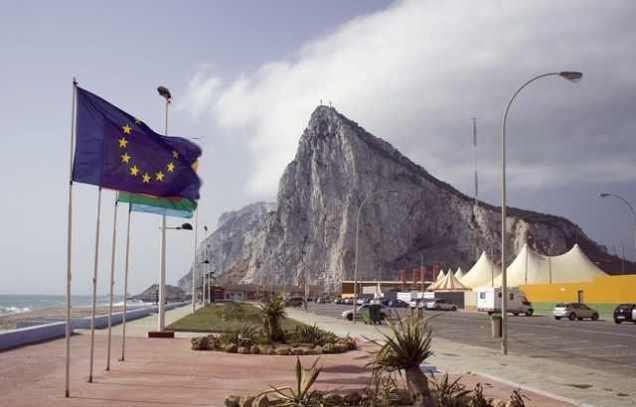
The government’s case for remaining in the European Union is based on an unedifying, unpatriotic and false misrepresentation of Britain’s supposed weakness and vulnerability as an independent country. But there is a small, disturbing element of truth to the Foreign Office’s scaremongering claims

One theme which has emerged consistently throughout the EU referendum debate is the degree to which the British government’s ability to conduct an independent economic, trade and foreign policy has atrophied through over-reliance on the European Union to manage our affairs.

This is primarily seen in the debate on trade – the future lies with the slowly emerging and hugely promising global single market, but on this most critical of issues, Britain has simply outsourced our own decision-making ability by vesting it in the EU.

To prosper in this globalised world, Britain should be exercising our full influence on key global bodies such as UNECE, Codex Alimentarius, the ILO, IMO and others, but since we allow the European Union to speak for us and interpret rules made by these bodies on our behalf, Britain’s ability to argue our own national interest has gradually withered through lack of practice.

We see the same corrosive forces at work in foreign policy. Nearly every pro-Remain intervention made by the hapless Foreign Secretary, Philip Hammond, has served to reveal not only his own incompetence in the role, but also the Foreign & Commonwealth Office’s growing inability to robustly defend British interests outside the context of being an EU member state.

The latest example:

Foreign Secretary Philip Hammond has angered Brexit campaigners by claiming a vote to leave the European Union would put British sovereignty over Gibraltar at risk.

His shocking comments came in a joint warning with Gibraltar’s chief minister today, which has led to accusations of scaremongering from the out campaign.

The Rock’s Fabian Picardo even said the prospect of Spain wrestling back at least partial control of the Mediterranean island would be “back on the table” if the UK opts to leave the Brussels union next month.

His stark warning risks being seen as another example of the pro-EU camp’s Project Fear and comes as Mr Hammond visits Gibraltar to discuss security threats to the British Overseas Territory.

On his first official visit to the Rock since taking up the post in 2014, the Foreign Secretary said: “I genuinely believe that the threat of leaving the European Union is as big a threat to Gibraltar’s future security and Gibraltar’s future sovereignty as the more traditional threats that we routinely talk about.”

As is always the case with those on the Remain side, Hammond speaks as though Britain is entirely without agency, a passive blob to be moulded and shaped by outside forces rather than a powerful global player in our own right.

And yet there is some truth in Hammond’s pessimism. Having acted primarily through the European Union for so long, and with the EU’s Federica Mogherini a better known voice on the world stage than our own Foreign Secretary, it could almost be the case that Britain’s ability to wield our clout and influence on the world stage has atrophied to such an extent that the FCO is genuinely no longer capable of preventing foreign interference with a British Overseas Territory.

This is what the EU does. This is the modus operandi of Brussels – gradually assuming more and more of the day-to-day governing from national governments, until one day, quite unexpectedly, the national layer of government finds that it no longer has the technical capability or willpower to function on its own. But the answer is not to throw our hands up in acceptance of this state of affairs, or play the hopeless part of an insect stuck in a Venus flytrap. The answer is to extricate ourselves, and re-learn those skills and competencies which we shamefully allowed to lapse during our failed flirtation with supra-national government.

Pete North puts it best:

George Osborne has said of Brexit re-negotiations: “If we leave EU, the House of Commons is going to be doing nothing else for many, many years”. He’s right. The government will have to govern. It’s going to take years to undo the damage. We are going to take years rebuilding our domestic expertise and design new policy. The whole Whitehall establishment will have to be re-ordered and redesigned. The Foreign Office will have to get busy doing what they should have been doing for the last forty years.

We are going to have to have serious debates about fisheries management. We are going to have to rethink our rural policy. We are going to have to take a very close look at our energy policy. We will need a serious debate about foreign aid, immigration and trade. We are going to have to rethink the way we do nearly everything. Leaving the EU means rebuilding our capacity for self-government and we will have to muddle through that process, kicking out the failures as we go.

What it does mean is that we are not bound by EU directives and targets which means we are free to innovate in policy making – which means we may actually see some change because ministers are then responsible. The buck stops with them rather than idly shrugging their shoulders and saying “the EU made me do it”.

And furthermore, as this blog pointed out the last time our Foreign Secretary decided to be a spokesperson for Brussels instead of his own country:

If Hammond’s words are to be taken seriously, it means that he has presided over the worst diplomatic failure in recent British history – namely the failure of a declared nuclear power, as well as a leading military, economic and cultural power, to command such respect on the world stage as might survive us leaving a supranational arrangement which we no longer believe works in our favour. Is that really what the Foreign Secretary wants to tell the British people?

Europhiles and Remainers can’t decide whether Brussels is friend or frenemy; whether the other EU member states are dear friends who would be sorry to see us go, or bitter rivals who would seek to punish Britain for rejecting their vision of a politically unified Europe.

Is the European Union a cuddly, benign club of countries coming together to trade peaceably, or a snarling mob waiting to inflict “punishment beatings” and infringe on our sovereign territory if we cross them?

It’s about time that Remainers made up their minds.


European Union - United Kingdom - Britain - Flags

Top Image: International Adviser

Agree with this article? Violently disagree? Scroll down to leave a comment.

Follow Semi-Partisan Politics on TwitterFacebook and Medium.

The Guardian, The EU Referendum And Britain’s Entrenched Sense Of Inferiority

Obama Merkel Cameron Renzi Hollande - 3

A cake-filled misery-laden grey old island…

When does the Guardian become an enthusiastic, uncritical cheerleader for US foreign policy?

Why, when the US president jets in to lecture us all on the importance of voting to remain in their beloved European Union.

Meanwhile, we know exactly what the Guardian thinks about Britain from this giveaway paragraph in their article hailing Barack Obama’s arrival:

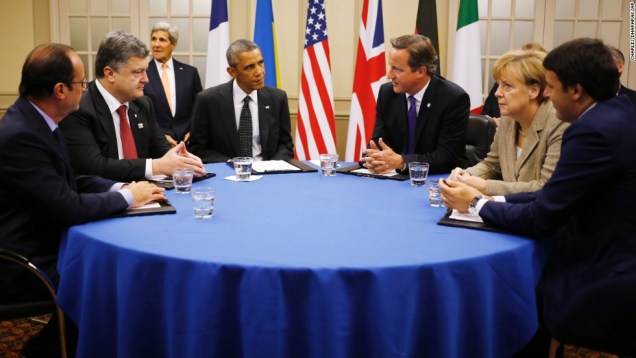
The importance of the UK as a key figure inside the EU club will be symbolically underscored when Obama again meets David Cameron, Angela Merkel, Mario Renzi and François Hollande in Hanover, Germany, on Monday to discuss Syria, Libya and the consequent migration crisis. The implicit message is that the UK outside the EU would not have been invited to such a high-level transatlantic conclave.

Oh gosh! How kind of Italy and France to allow Britain to take part in their Super Important Meeting with Germany and the United States. Of course, puny little Britain – the fifth largest world economy and pre-eminent European military power – would never normally be allowed to sit around the table with François Hollande and “Mario” Renzi, but for the fact that we are part of the same supra-national political union.

Is the Guardian serious? Sometimes it is hard to tell whether this dismal, miserablist attitude toward Britain is entirely genuine, or an attitude which is affected purely for the purposes of keeping our self-esteem just low enough that we don’t get ideas of national independence above our station.

The trouble, though, is that the Guardian is very much a thought leader in this area. Where the Guardian sighs, tuts and shakes its head at the hopeless prospects of puny, pathetic Britain, so many of its readers have been conditioned to automatically do the same. I’m frequently amazed by the number of conversations I have with otherwise intelligent, knowledgeable people who genuinely believe that Britain is a small and inconsequential nation.

It is almost as though someone distilled Britain’s despairing psyche when we were at our 1970s nadir into its purest, bleakest form, and then injected that dismal serum into half of today’s population. Once the infection takes hold, the feeble country that these National Inferiority Virus sufferers hallucinate bears absolutely no relation to the objective reality of modern Britain.

And these are the people who will be voting in the referendum on 23 June. These are the the pessimistic, resigned views which millions of people sympathetic to the Guardian’s position will carry with them into the polling booth. Citizens of a nuclear power, a P5 UN Security Council member, the world’s fifth largest economy and home to the financial and cultural capital city of the world, who nonetheless believe that it is only our membership of the EU which gives Britain’s prime minister the undeserved privilege of being in the same room as the leaders of Germany, France and Italy.

God help us.


European Union - United Kingdom - Britain - Flags

Top Image: CNN

Agree with this article? Violently disagree? Scroll down to leave a comment.

Follow Semi-Partisan Politics on TwitterFacebook and Medium.

Thanks For The EU Referendum Advice, Mr. President. America Should Give Supra-National Political Union A Try

David Cameron - Barack Obama. President Barack Obama - 2

An open letter to Barack Obama, responding to the American president’s heartfelt intervention in our EU referendum debate

Welcome back to Britain, Mr. President. It’s always a pleasure to have you here.

Thank you also for sharing the fruits of your wisdom on how we should vote in our coming referendum to leave or remain in the European Union. Your deep respect and affection for the United Kingdom (and the countless small ways in which you have honoured the special relationship since taking office in 2008) is well known here, and we are sure you would not have made this intervention at David Cameron’s personal request unless you sincerely believed it was the right course of action, and had our country’s best interests at heart.

But before you jet back to Washington DC on Air Force One, Mr. Obama, please allow us to reciprocate by sharing some words of advice for your own country and fellow citizens. We offer this advice in exactly the same spirit with which you blessed us with yours.

Mr. President, it is time for the United States of America to admit that the age of the nation state is over, to let go of excessive pride and patriotism, and form a political Union of the Americas. Don’t waste another moment. Assemble the heads of state from North, Central and South America and immediately sign and ratify a Treaty of Tijuana creating a political and customs union between your respective countries. For this is the only way that the great prosperity which Americans have known in the twentieth century can possibly be preserved in the twenty-first.

Now, we know what you’re going to say. The United States is still the world’s pre-eminent military and economic power. That’s true. But the same was said of the United Kingdom a mere century earlier, and look what a beating Britain took in the first eighty years of the 20th century – a huge expenditure of blood and treasure defending freedom in Europe, a global empire lost and an economy which went from being the world’s largest to smaller than that of Italy.

It was only by the election of Margaret Thatcher joining the European Community that a battered and declining Britain managed to staunch the bleeding and halt the decline. America should seize the initiative, recognise that – like Britain – her best days are firmly in the past, and hedge against the scary and uncertain future by dissolving the political ties which separate her from Canada, Mexico, Belize, Guatemala, El Salvador, Honduras, Nicaragua, Costa Rica, Panama, Suriname, Colombia, Argentina, Venezuela, Peru, Paraguay, Uruguay, Bolivia, Chile, Ecuador, Guyana, French Guyana and Brazil.

Consider: America’s economy will soon be overtaken by China in terms of raw nominal GDP, as will that of our own blessed European Union. And the population of the United States is dwarfed by both India and China, two developing countries with nuclear arsenals and strong regional interests which are often at odds with America’s. If you wait too long to band together into a regional political union based on your shared continental values it may be too late – China will divide and conquer the continent.

No one country from the Americas can hope to stand up to China or wield the leverage to sign the amazing trade deals that one of your potential successors is promising. Only by binding your fate inexorably to that of Venezuela and Ecuador can the United States hope to secure a fair deal. Remember: united you stand, but divided you fall.

And speaking of being united, isn’t it about time that any citizen of North or South America was able to live, work or retire anywhere they please? The new American single market for goods, services and capital is incomplete if there is not also a single labor market, and so the very first act of this new Union of the Americas should be to abolish national borders and establish passport and visa-free travel across the entire continent.

Now, some may object to this with shrill warnings about national security, but consider – as part of this new Union, the United States will have access to the world-class intelligence services of Peru and Costa Rica. As we all know, national security cooperation is only possible through full political union, and so by joining this Union of the Americas the CIA and FBI will for the first time ever be able to share information with Mexico and Canada for the prevention of crime and terrorism.

We anticipate that your labor unions will also kick up a fuss at the thought of millions of economic migrants from South and Central America moving to the United States in search of work and higher living standards. But if you give Tony Blair a quick call, he will tell you that it is possible to overcome these objections by furiously ignoring them and labelling anybody who gets angry about the suppression of wages and conditions as a racist or xenophobe.

So how should this Union of the Americas work? Well, we humbly suggest that you model it on our own European Union, whose institutions are so beloved by all European citizens and whose founding fathers are no less well-known and revered than Thomas Jefferson, James Madison and Benjamin Franklin.

Of course you will need a government for this union. We have found that a Commission of 28 mostly failed politicians from our respective countries serves this purpose very well indeed. This body will be the only one which can propose new laws for your union, so finding the right calibre of candidates is important. It’s the strangest thing, but former prime minister and presidents who left office under a cloud of scandal and popular dissatisfaction often turn out to make amazing commissioners. We don’t know why it works, it just does.

You will need a Parliament for your union, too, in order to act as a rubber stamp for new directives and legislation. But it is no good having each country voting along national lines – remember, the goal is to gradually weaken and erode national identity so as to gain public acceptance for our new Union of the Americas. So each member state should be divided up into regions, with each region represented by a number of MAPS (Members of the American Parliament). You might think that the United States is already ideally divided into fifty such constituencies in the States, but this is entirely the wrong way of thinking. The regions should be arbitrary places to which nobody feels any sense of connection or belonging. Geographic descriptions like “North East” and “South West” are always a good choice, because they help to break down peoples’ backward and antiquated feelings of patriotism and pride in their home, and finally begin to see themselves as the pan-American citizens that they are.

And we can’t forget the judicial branch. Your new Union of the Americas must uphold the rule of law and ensure that national governments, corporations and individuals are in compliance with foundational treaties and Union laws and directives. The American Court of Justice (ACJ) will fit nicely above your own Supreme Court – and of course, any decisions which the US Supreme Court makes are subject to review by the ACJ because lovely though your own Constitution may be, Union Law must have primacy if this new arrangement is to work.

The goal, as you can probably tell, is the gradual accretion of power and responsibility at the supranational level, so that key decisions are taken in Tijuana rather than the capitals of each member state. National identity is so anachronistic, and stubbornly clinging to outdated concepts of nationhood will doom the American peoples to a lost century of relative decline. Now, naturally you may encounter some resistance to all of this from the voters, which is why it is actually best to talk about the whole enterprise exclusively in terms of trade and co-operation. If anybody accuses you of harbouring grander plans for political union, just dismiss them as cranks and conspiracy theorists. It works really well.

And don’t worry – you can keep all of your institutions. Congress, the Supreme Court, the office of the presidency, all of it will still exist under the new Union. It’s just that various powers and responsibilities will need to be outsourced to the supranational level to ensure the smooth running of the new Union. We think you will quickly come to like the arrangement – having dedicated civil servants in Tijuana administering social policy, negotiating trade deals and hammering out a common foreign policy will free up so much time for partisan grandstanding, political fundraising or a few more sneaky rounds of golf.

We know how tiring you have found the partisan gridlock in Washington. Well, by signing the United States up as a founder member of the Union of the Americas, you don’t have to worry about it any more! Democrats and Republicans can continue to posture, argue and filibuster about a whole range of largely symbolic issues, while increasingly all of the governing that actually matters moves to the supranational level. It’s a win-win situation.

I hope that by now you can sense the excitement we feel for the potential of this new Union of the Americas. And frankly, from a selfish European (I nearly said British – old habits die hard) perspective it would make our lives much simpler, too. It is rather time-consuming and expensive to maintain embassies and consulates in so many countries and cities across North, Central and South America. And at times of crisis, I know that Federica Mogherini, our incredibly well-qualified and able High Representative for Foreign Affairs, would find it so much easier if she only had to dial one number to speak to the Americas.

Nation states are a thing of the past. And good riddance, too – they have brought us nothing but war, misery and shame (as our French and German compatriots keep reminding us). So, Mr. President, let your parting legacy to the United States be setting in motion the process of her abolition.

But we do not need to convince you of any of this. After all, it is you urging us vote to remain in the European Union, because you understand the advantages of post-democratic, supranational governance better than many of our own stubborn, backward citizens.

And of course you would never recommend anything for your closest ally that you do not also consider good enough – and earnestly desire – for the United States.

Would you, Mr. President?


European Union - United Kingdom - Britain - Flags

Top Image: Mirror

Agree with this article? Violently disagree? Scroll down to leave a comment.

Follow Semi-Partisan Politics on TwitterFacebook and Medium.

Virtue Signalling Celebrities – Silly. Virtue Signalling Government – Dangerous

Benedict Cumberbatch - Virtue Signalling - Syria - Refugees

When celebrities indulge in open virtue-signalling and Something Must Be Done-ery, it is irritating but ultimately harmless. But now political leaders and governments are doing the same thing, and it is deadly serious

Tony Parsons – who only last year bravely admitted to being “Tory Scum” – has a great new piece in GQ magazine, blasting the prevalence of virtue-signalling behaviour among the celebrity and political class.

After ridiculing certain actors and celebrities, whose Something Must Be Done-ery and hand-wringing at the existence of the Evil Tories is misguided but ultimately harmless, Parsons goes on to warn that it is much less funny when political leaders and entire governments are engaging in the same virtue signalling exercise.

His conclusion is worth quoting at length:

All this smug, self-satisfied, shockingly empty posturing would be merely laughable if it was confined to a few pompous luvvies who make clods of themselves every time they say a line that isn’t written by someone far smarter than them. But the desire to demonstrate moral purity now extends its cloying reach all the way to Downing Street, where even pink-faced Tory boys strain to prove their liberal credentials.

Many civilised nations such as Australia, Canada, France, Japan and Ireland have vastly reduced their foreign aid budgets after reaching the conclusion that shovelling billions to the developing world does nothing but encourage corruption, erode democracy and throw away taxpayers’ hard-earned money like a sailor on shore leave.

But in our own country the commitment to spend 0.7% of gross national income on foreign aid has been enshrined in law. The UK spent more than £12 billion on foreign aid last year, at a time when almost every other area of public spending was being slashed. Only the NHS and foreign aid were spared George Osborne’s cuts.

How can this be? How can a new private plane for a developing world despot be more important than the police, or the armed forces, or benefits for the disabled? How can it be rational, or even sane, for a country to care more about flood defences in Congo than it does about flood defences in Carlisle?

Because it doesn’t really matter if that £12bn a year in foreign aid itself is effective. It is not about feeding hungry mouths. Foreign aid is purely about demonstrating impeccable liberal goodness. Cameron’s Conservatives need to demonstrate that they are kind, decent and virtuous, need to show that they bought “Do They Know It’s Christmas” when they were at Eton and Westminster. Our foreign aid budget – millions of it shipped to nations where the British are despised – is meant to be conclusive evidence that the Tories care.

Virtue signalling begins and ends in the developing world. So Benedict Cumberbatch can’t give a thought to a small German town like Sumte (population 102) that finds its infrastructure collapsing under the burden of giving a home to 750 migrants. Sherlock can only prove his liberal goodness by fretting about Syrian refugees.

There is a debate to be had – and it is the debate of our age – about how we manage our moral obligation to our own people with our humanitarian impulse to help the world. But you will never hear that difficult subject broached among the virtue signallers who scream their pious certainties and wag their censorious fingers at the wicked Tories – which is bitterly ironic as David Cameron is the biggest virtue signaller of them all.

This blog dissents from the suggestion that the bulk of the foreign aid budget should not have been returned to taxpayers but merely reallocated to an unreformed NHS and welfare state, but the main thrust of Parsons’ argument – that we are essentially spending nearly one percent of our GDP not to do good but rather to look good – is devastatingly accurate.

And since those who disagree with the Conservative government are already determined not to see it as merely politically misguided but as a sociopathic millionaire’s club actively seeking to hurt the poor, there is little point in continuing to ringfence international aid spending as part of a PR exercise which has already failed.

Virtue signalling when practised by lame comedians and other assorted commentators angling for a cheap laugh is tiresome but essentially harmless. But when our elected government signals its virtue with taxpayer money and national policy, it can be the difference between life and death.

Which is why David Cameron and George Osborne should focus on sound policymaking and (just for a change) conservative principle, leaving the compassionate handwringing to the more-than-capable Sherlock Holmes and Dr. Watson.


Postscript: None of this is to say that this blog does not sometimes agree with the causes fleetingly taken up by celebrities, even Benedict Cumberbatch.


Benedict Cumberbatch - This Is What A Feminist Looks Like - Virtue Signalling

Top Image: ITV

Agree with this article? Violently disagree? Scroll down to leave a comment.

Follow Semi-Partisan Politics on TwitterFacebook and Medium.