Tales From The Safe Space, Part 9 – Safe Space Culture Stunts Young Minds

Safe space culture stunts young minds and prevents activist students from learning how to debate. Whatever happened to “use your words”?

If one video could perfectly encapsulate the deleterious effect of having students marinate 24/7 in Identity Politics culture, protected by safe spaces, trigger warnings and campus speech codes, it would be this brief video of a scene from a pro-life protest and pro-choice counter-protest at the University of California, Davis.

Some context, from Campus Reform:

During the “three days of demonstrations,” Students for Life at UC Davis set up shop in a common area on campus where members distributed pro-life materials and polled students on whether or not later terms abortions should remain legal in California.

But counter-protesters were quick to disrupt the demonstration, throwing pro-life materials to the ground and even harassing some participants for taking pictures of the protest.

In a video obtained by Campus Reform, members of UC Davis Students for Life appear to be talking to a counter-protester who in turn pushes a stack of pro-life flyers to the ground and proceeds to walk away.

“I’m not sorry, I’m not sorry!” she said to cheers from her fellow protesters.

Although a campus police officer was monitoring the protests, no action was taken against the student.

Now, this has nothing to do with the rights or wrongs of the protest and counter-protest. Whether you personally believe in completely unrestricted abortion or are vehemently pro-life is irrelevant here. What matters is the behaviour of the protester who chose to vandalise the pro-life students’ materials, throwing their literature to the floor and walking away without even seeking to engage them in discussion.

Note the exchange which takes place when the student speaks with the campus security officer who witnessed the event:

Officer: Did you touch their stuff? Yes?

Student: Yes.

Officer: Why?

Student: Well, cause, like… [gestures limply at the pro-life stand, smirks and rolls eyes]

This student, accosted by a campus security officer for vandalising the pro-life students’ display, is utterly unable to account for her actions. She clearly believes she is completely in the right – as evidenced by her supporters’ chants of “she did nothing wrong!”. But when pressed as to the reason for her behaviour, the student is utterly incapable of accounting for herself with even the simplest of intellectual arguments.

But while the student was capable of nothing more than dumb aggression, we can easily paraphrase the argument which went through her mind as she picked up a bunch of leaflets with contrarian views and threw them to the floor. She thought: “I don’t like this. I disagree with this, and therefore I should not have to put up with its presence. Because I am offended and am unambiguously in the right, I have the right to lash out in any way I please at those who contradict me”.

This is what the Politics of Identity does to young minds. Not all protesters are so sulkily monosyllabic, of course. Many are able to speak quite eloquently, and in so doing give the outward  appearance of being reasonable, happy and willing to debate their beliefs and hear from those who disagree. But even those students who are able to do more than shrug and smirk betray themselves with their calls for safe spaces, campus speech codes and mandatory re-education or social probation for those whose hold opinions which are deemed “offensive”.

Because these students have been raised to treat encountering a contrary opinion from someone the same way as being physically or mentally “assaulted”, they can never be content, never rest, until they impose their ideological homogeneity on their entire campus environment, using either the carrot or the stick as suits their purposes.

And yet in many ways, these student crybullies are more sinned against than sinning. They did not make themselves this way. They are the product of a society which has increasingly promoted authoritarian restrictions on freedom of speech on the spurious grounds of public “safety”, as well as a therapeutic culture which constantly told them as they were growing up that “sticks and stones may break their bones, but words can kill them stone dead”. They did not grow up in a vacuum, and those responsible for educating them and governing during their formative years have much to answer for.

But the fact that the snowflake student generation are not entirely to blame for the way that they turned out does not absolve us of our responsibility to criticise what we see, and call it what it is – a real and present danger to academic freedom on university campuses, and freedom of speech and thought in our wider societies.

A more intellectually and emotionally developed student would have been able to walk past the pro-life student display and either ignore it or engage in a robust exchange of views with the organisers. But modern campus Identity Politics does not teach or encourage this skill. Rather, it affirms the existing world view of the student and tells them that they have the right not to ever have to see or hear a dissenting opinion. And so rather than debate, we have toddler-style lashing out and defacing of opposing literature.

Identity Politics and safe space culture do not merely coddle the American mind. They actively stunt and inhibit young minds on college campuses everywhere they are present. And the damage they inflict on certain individuals may not be reversible.


Safe Space Notice - 2

Agree with this article? Violently disagree? Scroll down to leave a comment.

Follow Semi-Partisan Politics on TwitterFacebook and Medium.

Tales From The Safe Space, Part 8 – Discussing Crybully Students At CPAC

The United States may have helped to incubate the crybully student phenomenon, but American conservatism also points the way towards a cure

Following on from yesterday’s Tale From The Safe Space, which focused on Oklahoma Wesleyan University president Dr. Everett Piper showing us how university administrators should be pushing back on ludicrous student demands and complaints, the video shown above develops these ideas further.

Dr. Piper made minor waves last year when he admonished his students, reminding them that they are not in daycare but rather at an adult university. And last week he was invited to speak on a panel at CPAC 2016, entitled “Campus Crackdown”.

The entire panel discussion is worth watching or listening to in full, but here is the money quote from Dr. Everett Piper, responding to a question asking why the problem of student attacks on free speech has exploded in recent years:

I personally believe it’s the result and the consequence of several decades of teaching lousy ideas. I addressed it last night in my speech to the Reagan Gala. Richard Weaver told us in 1948 that ideas have consequences. That was the title of his seminal work – “Ideas Have Consequences“. What was his point, what was his premise? Ideas have consequences. Ideas always lead somewhere. Bad ideas lead to bad culture, bad community, bad college. Good ideas lead to the opposite. So I think we’re reaping the results, to quote Barack Obama’s pastor, “the chickens are coming home to roost”.

What we’ve done is taught this ideological narcissism, we’ve taught ideological fascism and that’s really what we have today, we have an ideological fascism that’s prevailing on the college campus rather than the academic freedom that we hold dear.

The liberal arts academy was established – let’s go back to Oxford, some one thousand years ago – to educate a free man and a free woman, to liberate us, to give us an understanding of liberty and liberation and freedom and justice, and to give us the context for embracing those truths. And when we get rid of those ideas and embrace the narcissism of our time we’re gonna suffer the consequences accordingly, and it will result in a fascist attitude of “you shall submit, you shall agree, and if you don’t you shall be silenced and you shall be expelled”. That is what is prevailing on the campus today.

But the unreasoning, free speech-hating crybully students only win when spineless, obsequious university administrators roll over and submit to their demands for fear of being labelled as cavalier about student “mental safety” rather than pushing back robustly at their attempts to self-infantilise.

If this trend is to be reversed, it will only be when more university leaders like Dr. Everett Piper in the United States, and Oxford chancellor Chris Patten in Britain, are prepared to poke their heads above the parapets in defence of academic enquiry and freedom of thought and speech.


Postscript: And isn’t it about time that we in Britain had our own version of CPAC, an alliance of people willing and able to carry the torch for freedom, liberty and conservative-minded thought when the Conservative Party in government seem intent on betraying those principles at every turn?


Safe Space Notice - 2

Agree with this article? Violently disagree? Scroll down to leave a comment.

Follow Semi-Partisan Politics on TwitterFacebook and Medium.

Tales From The Safe Space, Part 7 – Halting The Encroachment Of Identity Politics On Campus

A role model for spineless university administrators everywhere

If rolling over and meekly submitting like a well trained dog is not the answer to the ideological coup underway in many of our universities – and it most assuredly is not – then what is the correct way for university administrators to respond to the encroachment of Identity Politics and its attendant chilling effects on freedom of thought and speech on campus?

Amid the ignominious resignations and grovelling apologies, we have seen a few encouraging early signs of academic leaders pushing back on the demands of their coddled students for their universities to be turned into ideologically homogeneous, endlessly self-validating bubbles. The speech by Oxford University chancellor Chris Patten, in which he told students protesting a statue of Cecil Rhodes that they should consider being educated elsewhere if they are unable to tolerate difficult or contrary points of view, stands out as one such example.

But no response to student complaints has been so direct as that of Everett Piper, president of Oklahoma Wesleyan University, a Christian institution in the American heartland.

After attending a mandatory chapel service at university, in which the sermon was from the book of Corinthians and on the topic of love (of all seemingly benign subjects), a student approached Piper and complained that he felt invalidated and victimised for not having lived up to the Biblical standard in his own life. Because being set an aspirational standard of moral behaviour at a religious institution was, to the student’s mind, an intolerable criticism of his own “lived experience”.

Piper perhaps had a little more latitude in the frankness of his response than many other university administrators, being the president of an explicitly religious private institution rather than a public university in receipt of taxpayer money. But nonetheless, his electrifying response is worth reproducing in full, because it puts so many other academic leaders to shame.

From the Oklahoma Wesleyan University president’s blog:

This past week, I actually had a student come forward after a university chapel service and complain because he felt “victimized” by a sermon on the topic of 1 Corinthians 13. It appears this young scholar felt offended because a homily on love made him feel bad for not showing love. In his mind, the speaker was wrong for making him, and his peers, feel uncomfortable.

I’m not making this up. Our culture has actually taught our kids to be this self-absorbed and narcissistic. Any time their feelings are hurt, they are the victims. Anyone who dares challenge them and, thus, makes them “feel bad” about themselves, is a “hater,” a “bigot,” an “oppressor,” and a “victimizer.”

I have a message for this young man and all others who care to listen. That feeling of discomfort you have after listening to a sermon is called a conscience. An altar call is supposed to make you feel bad. It is supposed to make you feel guilty. The goal of many a good sermon is to get you to confess your sins—not coddle you in your selfishness. The primary objective of the Church and the Christian faith is your confession, not your self-actualization.

So here’s my advice:

If you want the chaplain to tell you you’re a victim rather than tell you that you need virtue, this may not be the university you’re looking for. If you want to complain about a sermon that makes you feel less than loving for not showing love, this might be the wrong place.

If you’re more interested in playing the “hater” card than you are in confessing your own hate; if you want to arrogantly lecture, rather than humbly learn; if you don’t want to feel guilt in your soul when you are guilty of sin; if you want to be enabled rather than confronted, there are many universities across the land (in Missouri and elsewhere) that will give you exactly what you want, but Oklahoma Wesleyan isn’t one of them.

At OKWU, we teach you to be selfless rather than self-centered. We are more interested in you practicing personal forgiveness than political revenge. We want you to model interpersonal reconciliation rather than foment personal conflict. We believe the content of your character is more important than the color of your skin. We don’t believe that you have been victimized every time you feel guilty and we don’t issue “trigger warnings” before altar calls.

Oklahoma Wesleyan is not a “safe place”, but rather, a place to learn: to learn that life isn’t about you, but about others; that the bad feeling you have while listening to a sermon is called guilt; that the way to address it is to repent of everything that’s wrong with you rather than blame others for everything that’s wrong with them. This is a place where you will quickly learn that you need to grow up.

This is not a day care. This is a university.

What astonishing, revolutionary words – the idea that university should not be first and foremost a place of “comfort and home“, but rather a place of academic enquiry and personal growth through challenge. How astonishing, too, that a Christian university leader might dare to suggest that campus life should not revolve around the arbitrary offence-taking of students, and indeed that things larger than the individual self – community, society, God’s creation – are equally important and deserving of attention.

Except that none of this should be astonishing at all. This should be the way that every university president or chancellor reacts when confronted with the self-obsessed complaints of a generation of students who by most measures are the most privileged in history, but who nonetheless want to wallow and talk endlessly about their “pain”.

Piper’s interview with The Daily Signal (see video above) is also instructional as to the root of  the problem. Today’s snowflake students did not create themselves – they are a product of social and educational policies stretching back decades, and cannot be separated from the therapeutic yet authoritarian culture that has given us draconian hate speech laws, absurd political correctness and the elevation of Identity Politics.

In the interview Piper argues:

We’ve taught lousy ideas for decades. Let’s just cut to the chase. The academy, the university, the College with a capital C has created this monster. We’ve taught narcissism and self absorption. We’ve taught self-actualisation rather than personal morality. We’ve told students generation after generation it doesn’t matter what you believe as long as it works for you. We’ve actually come to the point where we can say I can’t tolerate your intolerance and I hate you hateful people and I’m sure that nothing is sure and I know that nothing can be known and I’m absolutely confident that there are no absolutes.

It’s the self-refuting duplicity of the 60s and 70s and 80s coming home to roost in the current generation, so we’ve got faculty who have created this monster and celebrated it until it turned around and bit them and starts consuming them, and now they’re scared.

Could there be a more blisteringly accurate condemnation of the missteps which have led our colleges and universities to their current dystopian reality of trigger warnings, safe spaces and Identity Politics mob trials?

And could there be a greater demonstration of how to show true leadership of an academic institution – not by meekly surrendering to the brazen power play being executed by today’s youthful, misguided activists, but rather by placing free speech, academic enquiry and debate first and foremost in the life of a university?


Postscript: Dr. Everett Piper was presented with the Jeane Jordan Kirkpatrick award for Academic Freedom at CPAC on 4 March.

h/t Rod Dreher at The American Conservative


Safe Space Notice - 2

Agree with this article? Violently disagree? Scroll down to leave a comment.

Follow Semi-Partisan Politics on TwitterFacebook and Medium.

Tales From The Safe Space, Part 6 – California State’s Civility Cafe

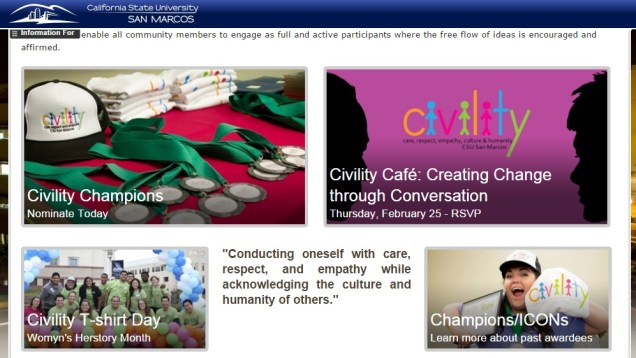
Womyn's Herstory Month - California State University San Marcos - CSUSM

For an increasing number of universities, re-education (or indoctrination) of students into the cult of Identity Politics is becoming a central part of the induction process

When the young, eighteen-year-old me arrived at Cambridge in the autumn of 2001, there were of course a number of welcome and induction events, ice-breaking activities and Freshers Fairs to attend. But at no point did the University of Cambridge consider it necessary to run a remedial workshop for new students, teaching us how to function in society and engage in civil discourse with our peers. That basic level of understanding was, shockingly, taken for granted.

And this wasn’t just a snobby Oxbridge thing. When I first arrived at Warwick University a couple of years later, I was likewise expected to be able to take care of myself and conduct myself like the fully grown adult that I was. The Warwick Student Union (then a bit loopy but now apparently one of the most snarlingly authoritarian in the country) gave us each a welcome bag which I recall contained a Cadbury Boost bar, a Wilkinson Sword razor and a pack of condoms to help me on my way, but was otherwise happy to stand back while I enjoyed varying degrees of success with each of these gifts without feeling the need to further intervene in my life.

And as it was for me, so it was for thousands more people who went to university as little as a decade ago. Which is partly why it is proving so hard to raise the alarm about what is happening on university campuses today. People see the odd sensationalist headline (often written by a generalist commentator) about comedians being banned or campaigns against statues or the replacing of applause with silent jazz hands, and think that they are puff pieces based on isolated incidents. After all, many people think, I only graduated a few years ago myself, and I never witnessed any of this craziness.

Well, things have changed a lot in the space of a decade, and the alarm is very much justified. Sure, the inexorable growth of statist Big Government and authoritarian crackdowns on free speech have been going on for much longer than a decade – and this blog tirelessly makes the case against censorship in all its forms and for unrestricted free speech. But to deny that something uniquely concerning has recently started to take place on university campuses in Britain and America is to bury one’s head in the sand.

One of the most troubling aspects of this new environment has been the number of universities which, hoping to avoid being embroiled in a wave of hysterical social justice protests such as those which consumed Yale and Mizzou last year, are deciding to come out ahead of the trend and pre-emptively embrace the new Cult of Identity Politics, weaving it into the fabric of their institutions before they are pressured to do so by crazed protesters.

A case in point: California State University San Marcos, which has opened what it calls a “Civility Cafe”, less of a laid-back study lounge and more of a hectoring seminar where any hopeful expectations of free speech are swiftly recalibrated by campus authorities.

The aim is to turn all students into “civility champions”, as the university’s website explains:

CSUSM recognizes students, faculty and staff who display Civility on our campus by conducting themselves with care, respect, and empathy while acknowledging the culture and humanity of others.  Like waves through the ocean, our vision is that one simple act will have a ripple effect and a tsunami of civility will take over our campus.  We encourage you to identify and nominate students, faculty and staff on campus.

Students are then “invited” to take the following pledge:

As a member of the CSUSM community
I will conduct myself with care, respect, and empathy
while acknowledging the culture and humanity of others.

The university’s student newspaper, the Cougar Chronicle, elaborates:

The Civility Cafe, a skill-based workshop, aimed to encourage and educate students on how to engage in civil discourse with their peers.

John Loggins, University of San Diego’s Director of Community-Based Student Leadership and Learning, facilitated the event on Feb. 25 in USU 2310.

[..] Students then participated in an activity designed to increase their empathy and listening skills. Students partnered up and were invited to tell their partner a story about an instance in which they either excluded someone from a community or felt excluded themselves. After students shared their stories, their partner had to tell another student the story they had just heard, but from a first-person perspective.

Loggins then played a video for those in attendance. The film featured Dan Savage, a known advocate for LGBTQIA rights and creator of the It Gets Better foundation. After watching the video, students were asked to reflect and share actions, words or ideologies that trigger negative emotions.

“How we react to triggers says more about us than what triggers us. Try to reflect before speaking out of hurt or anger; this can create more civil discourses,” Loggins said.

Note Loggins’ use of the term “triggers”. It is now difficult to recall that the concept of trigger warnings originated in online discussion forums for rape and sexual abuse victims, as a means of flagging explicit discussions for those suffering from legitimate PTSD. But we have come so far from that limited usage now – and trigger warnings are now so widely used in academia and even the media – that the expert sent from the University of San Diego to run the Civility Cafe talks about “how we react to triggers” as though every single one of us is a victim of some kind.

Sure, we may not have been the victims of sexual violence. But we can nonetheless be “triggered” by the most minor perceived cultural slights, goes the theory, and we must attend special seminars to train us to manage our reactions when we are so triggered. What literally every generation of human beings before us managed to do (with a little trial and error) since the dawn of history now must be taught as a specific Life Skill by universities more obsessed with micromanaging the lives and daily interactions of their students than imparting a rigorous, valuable academic education.

This is incredibly corrosive, part of a wider narrative whereby everyone is treated as being sick – or a victim – by default, rather than by exception. But we should expect to see more of this, and more Civility Cafes (or similar devices) popping up at college campuses everywhere. Why? Because university administrators are risk-averse.

They saw what happened to Tim Wolfe, former president of the University of Missouri, who was unceremoniously forced to resign at the hands of mob justice. They saw what happened to legions of university professors and administrators who found themselves rooted to the floor, being screamed at for largely imaginary offences recast as capital crimes under the law of Identity Politics. And so, as a perverse form of liability insurance, some universities are now leaning into the trend, making Identity Politics indoctrination a mandatory or strongly encouraged part of the student experience so that they have a defence to fall back on should protests erupt on their own campuses over some future scandal, real or imagined.

Unfortunately, this only adds legitimacy to what the Identity Politics practitioners and the New Age Censors are trying to do, giving it the official imprimatur of the university and its leadership team. Rather than obsequiously bowing down to these demands and establishing two safe spaces for every one that was originally demanded, universities should be pushing back on the student activists and telling them that as adults, they are each responsible for managing their own human interactions, and must get out of the habit of looking to an external authority figure to mediate every single dispute or to mete out punishment for what often amounts to thoughtcrime – daring to hold or articulate beliefs which are in any way contrary to the prevailing Identity Politics narrative.

None of this is to say that genuinely racist, sexist, homophobic or otherwise discriminatory incidents do not occur on college campuses. Clearly they do. But the sense of panic and “danger” (student victims-in-waiting love to paint themselves as being in physical danger of nebulous words and ideas) is completely out of proportion to the issue, and overlooks the remarkable strides which have been made in overcoming prejudice and discrimination in our societies.

The American university system went from mass segregation to full integration in little more than a decade – precious gains which were made possible by exercising of unrestricted free speech, it should be pointed out. Why, then, do we need the most draconian measures – campus speech codes, re-education classes, social probation sentences for giving arbitrarily-taken offence to other students – to travel the last ten percent of the journey?

This is the case that the Identity Politics practitioners and New Age Censors need to answer. Why should freedom of speech, expression and thought be more severely curtailed now than ever before at this late stage, when most of the victories for tolerance, civility and equal rights have already been won?

Don’t expect an answer from them any time soon – for they have none. But do expect to see a lot more Civility Cafes popping up, serving flat whites with a sanctimonious side of social justice. It’s what the petty campus tyrants want, and many university administrations – like that of California State University San Marcos – either fully agree with their toxic agenda or are simply too spineless to stand up to them.


Safe Space Notice - 2

Agree with this article? Violently disagree? Scroll down to leave a comment.

Follow Semi-Partisan Politics on TwitterFacebook and Medium.

Tales From The Safe Space, Part 5 – Return Of The Sombrero Scandals

Sombreros - Cultural Appropriation

The selective outrage at supposed acts of “cultural appropriation” on university campuses takes proactive offence-seeking to a dismal new level

There is no article of clothing more likely to make a British or American university administrator break out in a cold sweat today than the sight of a sombrero on campus. Because as we all know, wearing a sombrero when not of Mexican origin is a hateful and violent act of cultural oppression, second only to donning the white robe and prancing around a burning cross.

In the UK, sombreros caused a stir last year when the University of East Anglia took it upon itself to ban and confiscate hats handed out to students by an off-campus Mexican themed restaurant. Possessed of an oversensitive racism detector which seems to jerk violently from “OK, I suppose” to “Hitler! Hitler!”, the UEA felt that the sight of non-Mexicans wearing sombreros was “discriminatory” and “stereotypical”, thus justifying their tyrannical dress code.

One might think that sombreros would at least be acceptable at a tequila party, but this too is now quite intolerable for the New Age Censors, as several unfortunate students at Bowdoin College, Maine, recently discovered to their cost.

The Washington Post reports:

Two weeks ago, some students threw a birthday party for a friend. The email invitation read: “the theme is tequila, so do with that what you may. We’re not saying it’s a fiesta, but we’re also not not saying that :).” The invitation — sent by a student of Colombian descent, which may or may not be relevant here — advertised games, music, cups and “other things that are conducive to a fun night.”

Those “other things” included the miniature sombreros, several inches in diameter. And when photos of attendees wearing those mini-sombreros showed up on social media, students and administrators went ballistic.

College administrators sent multiple schoolwide emails notifying the students about an “investigation” into a possible “act of ethnic stereotyping.”

Partygoers ultimately were reprimanded or placed on “social probation,” and the hosts have been kicked out of their dorm, according to friends.

Consider just how fascistic and totalitarian the concept of “social probation” is. And yet this is apparently a routine form of punishment at Bowdoin College, meted out to anybody who transgresses the strict, often post-hoc lines which are drawn to mark out unacceptable speech and behaviour for fully grown adults.

(The college immediately clammed up and refused to answer journalists’ questions in the aftermath of sombrero-gate, so precisely what is involved in “social probation” is not fully clear – but one can reasonably assume that it involves attending the same kind of Identity Politics re-education classes that have sprung up elsewhere. The student handbook makes reference to restrictions on “off-campus study” and the infantilisation of students by informing their parents of any misdeeds).

The Bowdoin Student Government (the student union) released a portentous declaration following the terrible sombrero incident, announcing:

WHEREAS, the Assembly reaffirms its adherence to a definition of cultural appropriation as a power dynamic in which members of a dominant culture take elements from a culture of people who have been systemically oppressed by that dominant group, perpetuates racist stereotypes, and/or misrepresents people’s culture;

WHEREAS, on Friday, February 20th, 2016 members of the student body organized a “tequila party”, during which students appropriated aspects of Mexican culture;

WHEREAS, this act of cultural appropriation is offensive for the previously stated reasons, is disrespectful, creates an environment where students of color, particularly Latino, and especially Mexican, students feel unsafe, and contradicts our goal to refine the education of students in an inclusive residential community;

[etc. etc. – you get the idea]

The statement then goes on to make the predictable list of “recommendations” (underscored by implicit threat of interminable protests in the event of non-capitulation) which we have come to expect, namely:

Recommend, that the administration should more immediately acknowledge incidents of this nature, and it must acknowledge not only their occurrence but also the deep hurt that students may be feeling immediately following such acts.

Further Recommend, 

That the administration must make clear to students, well in advance, their commitment to creating a supportive space for students who have been or feel targeted, for as long as students deem necessary.

Further Recommend,

That the administration must create a space for those students who have been or feel specifically targeted.

Further Recommend,

That the administration must create a separate space open to other students for discussion, support, and processing of the incident.

In other words, it was not enough that their well-trained lapdog university administrators immediately rushed to highlight and condemn the incident, and mete out “social probation” punishments on fully grown adults for engaging in harmless activity at a social event. This is now the bare minimum. What the university should have done additionally is to explicitly acknowledge the deep, searing, life-altering injury sustained by students who felt that their culture was being mocked, belittled and somehow appropriated and marginalised at the same time.

But this pales in comparison to Bowdoin College’s failure to provide multiple safe spaces following the traumatic event – one for students who were (or who felt) “targeted” by the wearing of mini sombreros, and another for students who weren’t affected in the least, but who still might want a well-appointed room with board games and puppy dog videos so that they can have a good, validating cry about the whole thing.

Two safe spaces – the Hierarchy of Oppression works a bit like airline lounges, with one reserved for first class passengers and one for business class and those who purchase day passes. Very important.

And of course:

Further Recommend,

That the Office of Academic Affairs mandate an academic or experience in the classroom for those involved in such incidents.

Further Recommend,

That the College develop processes for punitive measures to be undertaken against those involved in such incidents.

Further Recommend,

That the College remain cognizant of the time and academics of students of color following such incidents and take appropriate measures to ensure their academic, mental, and social wellbeing.

There’s the punishment bit. Of course it is not enough for those whose delicate psyches were injured by encountering something with which they disagreed to be comforted and fawned over in their imaginary distress. No, those who transgress in thought, word and deed must suffer the consequences – in the case of Bowdoin College, an “experience in the classroom” would seem to hint at a form of public shaming ceremony.

And finally we have the cautionary shot across the bows of the college, warning administrators that students should not have their vital social activism curtailed by onerous academic demands, and that the university is on the hook for their “mental and social wellbeing”.

Once upon a time – if the legends are true – people went to college to learn, and not simply to exchange one set of parents back at home for another set of overbearing auxiliary parents in the form of ever-watchful university administrators. And yet increasingly, universities are devoting more time catering to their students pastoral needs than their academic rigours, either reactively (after being bullied and bossed around by student mobs) or proactively (by professors and administrators too craven to stand up to said mobs).

Giving in to these petty campus tyrants only encourages them to come back with even more absurd demands. So if student activists are absolutely insistent that university authorities tend to them as though they were children, then colleges should begin administering tough love and discipline as well as obsequious hand-holding.

There may be a time and a place where people need to be monitored to ensure compliance with a dress code, and placed in detention (or “social probation”) for bad behaviour. But it’s called middle school, not college or university.

And any students who have genuinely failed to master Human Interaction 101 – and still require an external authority figure to mediate their interpersonal affairs by the time they reach the age of eighteen – should seriously stop and consider whether they are cut out for higher education.


Safe Space Notice - 2

Top Image: The Tab – “Sombreros banned from Freshers’ Fair

Agree with this article? Violently disagree? Scroll down to leave a comment.

Follow Semi-Partisan Politics on TwitterFacebook and Medium.