Tales From The Safe Space, Part 26 – Literally Shredding The Constitution

There is seemingly no limit to what coddling and overindulgent (or scared and intimidated) university administrators will do to keep identity politics-wielding student cultists happy and quiet

Watch this video.

Late last year, an undercover reporter from Project Veritas posing as a student went to university administrators in several colleges to complain about somebody handing out copies of the US Constitution on campus. The Constitution, explains the student, is having a triggering effect and causing her panic attacks because of the document’s inherent racism and oppression.

We all know what comes next. Naturally, the university administrators tell the student to grow up and stop being silly, and that even if the United States Constitution (with all its brilliance and acknowledged flaws) was not an almost sacred document and the guarantor of every single one of their liberties, they would no sooner ban it from campus than they would ban any other book or document.

Except that that isn’t close to what actually happened. In real life, infantilising student welfare administrators listened with concerned attention to the undercover reporter’s tale about being made to feel unsafe by America’s foundational document, nodding along sympathetically at every turn.

And not only did these professors and equal opportunities directors fail in each case to push back against the reporter’s tremulous plea for their respective colleges to create a safer space by removing all copies of the Constitution from campus, in one case they actually offered – unprompted – to destroy the document there and then as a means of providing catharsis and healing to the student.

At Vassar College in New York state, the “student” told Kelly Grab, the Assistant Director of Equal Opportunity:

Last week something kind of happened on campus that kind of really upset me and I ended up having a panic attack.

[..] They were handing the Constitution out on campus. I don’t know, they were handing it out and as soon as I saw it, you know, I started to not be able to breathe, hyperventilating. My vision went blurry and I just – kind of just lost control.

[..] I didn’t think that this would happen, but I realised that the Constitution is kind of a trigger for me.

And rather than telling the undercover reporter to take a hike, Grab responded:

So what I think you are sharing with me is that your interaction in receiving this was harming, right? And that’s what we certainly want to avoid. We don’t want to limit people in exchanging ideas or having opposing viewpoints, but when it’s disruptive or causing harm…

While at Oberlin college in Ohio, Professor of History and Director of Gender, Sexuality and Feminist Studies, Carol Lasser, tells the person she believes to be a student traumatised by the Constitution:

The Constitution is an oppressive document. The Constitution makes change slow, it intends to make change slow.

And then adds, sotto voce:

Right now, given who is in charge of the US House of Representatives, I think it’s a good thing.

Darn that pesky Constitution and its checks and balances for making it hard to impose the latest left-wing thinking on an uncertain America all at once. But at least it is also making it harder for those evil, knuckle-dragging Republicans to kill anyone who is not white, male and on at least $100k a year. Amiright?

But the best response comes from Colleen Cohen, then Director of Affirmative Action and Professor of Anthropology at Vassar College:

It’s horrible that this is something that has caused you such pain. And unless the people are from off campus we can’t keep them from disseminating it.

[..] Can I destroy this? Or do you want to hold on to it?

We already knew that there is a dramatically expanding “equal opportunities” sector within (particularly American) academic institutions, with faculties growing to accommodate ever more impeccably credentialed and highly paid experts brought in to help universities submit more quickly and smoothly to the identity politics revolution.

But until now, many of the horror stories had an apocryphal feel to them – or worse still, they smacked of Daily Mail alarmism. No more. Now, we have hard evidence of exactly how these inclusivity gurus interact with students, and the extreme trade-offs they are willing to make between academic freedom and the rights of the “oppressed”.

And in a battle between the foundational document of the United States government and the rights of any random student to have things which they dislike purged from campus, it turns out there is no contest. The Constitution literally goes in the shredder, while the tearful student (in these instances an undercover reporter) is continually validated and told that they have every right to be upset and to want censorship in response.

Goodness knows how many other similar conversations have been taking place on other university campuses, only with real students. In order to emphasise their own message, Project Veritas deliberately chose very liberal colleges as their guinea pigs – the undercover reporter certainly would have received a much more refreshingly forceful reaction had they attempted the same stunt at Oklahoma Wesleyan University, for example.

But regardless of the obscenity of college administrators actually shredding the United States Constitution (certainly doing so is itself a protected act of free speech), something is seriously wrong when those in authority either buy in to the same identity politics dogma as their students and see eye to eye with them, or when they perhaps vehemently disagree with their students but are too afraid for their jobs to stand up to the students and call them out for behaving in a manner utterly inconsistent with the ethos of a university.

So forget the shredding of the Constitution itself. Far more worrying in practical terms is the fact that when dealing with student complaints, the default response from university administrators is that the student’s feelings, whatever they happen to be, are sacrosanct, and that anything which they perceive as a threat or an insult should be treated as such by campus authorities.

And at this point, you have to defer to age – it is the older adults in charge of universities and campus diversity schemes who should exhibit the wisdom and character to push back on ludicrous student demands when they are made, and tell the adult baby students that their own personal feelings are in fact not the overriding concern of the university authorities. Right now, they are failing in this most important responsibility, and the thought of any university administrator dispensing much needed tough love is apparently completely unrealistic at Vassar and Oberlin colleges.

This undercover reporter managed to get at least three separate copies of the US Constitution shredded – literally fed into a shredder machine and destroyed while she stood and watched approvingly – simply by claiming that the document made her feel threatened and oppressed. Imagine the emboldening effect experienced by real students every day when their equally ludicrous demands are taken deadly seriously and cravenly pandered to by those in charge. Imagine the sense of entitlement and self-regard that it must build.

And imagine the almighty collision with reality which these students face when they graduate and (some of them, at least) enter the real world.


Postscript: This insufferable Vassar student’s aggrieved response to the Project Veritas undercover filming shows the level of intellectual disconnect here. The student is utterly incapable of understanding the reason for conducting the undercover filming, perceiving it as an attack on the confidentiality of real students (none of whom had anything more than a walk-on bit part) and the mental wellbeing of the very administrators who were so happy to destroy the US Constitution.

I don’t know how one can possibly reason with people like this, or communicate meaningfully with anybody who has percolated for so long in a victimhood culture, and who speaks only in the hierarchical grievance language of identity politics.

While there are things we can do now to change the way we raise kids, like re-learning the importance of building resilience and anti-fragility – what doesn’t kill me makes me stronger – in our children, it is hard to view the current cohort of identity politics practising students (appreciating that they are hopefully just about still a minority among their peers) as anything other than a lost generation, whose best and last hope rests on a harsh but highly instructive collision with the real world after graduation.

That is, if they survive the impact.


Safe Space Notice - 2

Agree with this article? Violently disagree? Scroll down to leave a comment.

Follow Semi-Partisan Politics on TwitterFacebook and Medium.

Introducing Camsurf Safespace – The Social Network For Safe Space Dwellers

Camsurf Safespace

Behold our victimhood culture’s latest creation: a new G-rated social media platform for those too delicate to use Facebook, Twitter, Snapchat, Instagram, WhatsApp, Tumblr, Chatroulette…

Well, here it is – the logical end result of a victimhood culture in the grip of an identity politics feeding frenzy. Camsurf present to you their new Safespace social network – a heavily monitored video chat site for people (including grown adults) for whom all of the existing online platforms are simply too unsafe to ever contemplate using.

Camsurf describes Safespace in these terms:

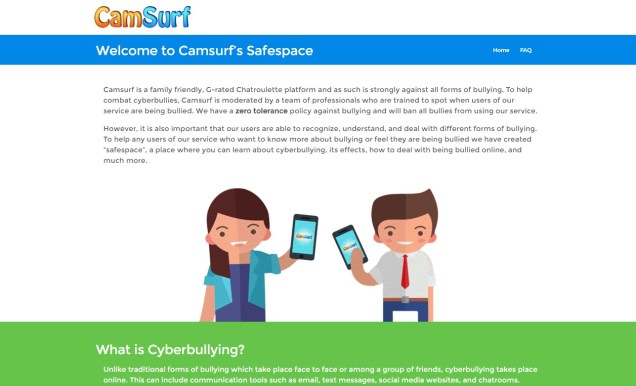
Camsurf is a family friendly, G-rated Chatroulette platform and as such is strongly against all forms of bullying. To help combat cyberbullies, Camsurf is moderated by a team of professionals who are trained to spot when users of our service are being bullied. We have a zero tolerance policy against bullying and will ban all bullies from using our service.

However, it is also important that our users are able to recognize, understand, and deal with different forms of bullying. To help any users of our service who want to know more about bullying or feel they are being bullied we have created “safespace”, a place where you can learn about cyberbullying, its effects, how to deal with being bullied online, and much more.

While the press release notes:

Camsurf is delighted to announce the launch of the world’s first ‘Safe Space’ social network, an innovation designed to put a stop to cyberbullying through education and active participation. The idea behind the campaign stems from the rise in bullying and harassment on the web, specifically on social networks such as Facebook, Snapchat and Twitter, a phenomenon which has grown rapidly in recent years to become more prevalent than bullying in the real world.

Users of Camsurf, and anyone else who feels overwhelmed by the rise in cyberbullying, can access the online arena and find a range of educational material and statistics, ask questions anonymously, and interact with other users in a safe and understanding environment. Participation in ‘Safe Space’ is solely focused on putting a stop to cyberbullying and all forms of online harassment. It is the first social network to openly place an emphasis on discussing and eliminating cyberbullying in a dedicated environment.

Camsurf Safespace is not merely a social network which takes a strong stance against cyberbullying. The whole ethos of the site sits in the shadow of cyberbullying – the “About” page says almost nothing about the technical or social features of the site, focusing exclusively on all of the measures in place to protect their oh-so-vulnerable users from ever being made to feel “uncomfortable” (a word that crops up frequently in the FAQs). And it freely uses the university campus-derived, identity politics terminology of safe space theory to promote itself.

But note the picture on the front page. These are not teens or tweens shown using the site, but fully grown adults – the woman is dressed in distinctly professional-looking attire, and the man is likewise dressed for work a shirt and tie. Safespace is not targeted specifically at schoolchildren (the group most likely to suffer from legitimate cyberbullying), but at people with jobs and mortgages and maybe even kids of their own – people who presumably shoulder all of the normal burdens of life, and yet believe themselves unable to participate in the same social networks as the rest of us for fear of being made to feel uncomfortable.

In fact, Safespace goes to great lengths to emphasise that adults are often the victims of “cyberbullying” too:

Q. Are teens the only people who get cyberbullied?

A. Not at all. Cyberbullying is a problem that affects both teens and adults. Although many adults would not like to admit it, cyberbullying is said to affect up to 40% of adults who use the internet. Cyberbullying transcends age or sex and anyone can be the victim of an online bully. In fact, many adults who are cyberbullied lash out by becoming bullies themselves. It is therefore extremely important to confront the problem by taking to someone rather than keeping it all locked up inside.

Yes, Safespace would have you believe that nearly every one in two adults are being persecuted online by nefarious cyberbullies right at this moment (of course, the term “bullying” has been defined downward to the extent that it includes any interaction which sees the victim come away with anything less than warm and fuzzy feelings of contentment).

And worse still, if these adult victims fail to take the correct protective actions and run to an authority figure (either a Safespace moderator or perhaps a trained counsellor) then they are at the risk of turning into a cyberbully too. Apparently being a cyberbully follows the same contagion principles as becoming a zombie.

Fortunately, Safespace has all manner of tools at its disposal to ensure that nothing remotely interesting or controversial ever takes place within its boundaries:

How Camsurf is Standing Up to Bullies

Our aim at Camsurf is to create a bully-free and family-friendly environment that is welcoming to all. As part of that mission we are taking a stand against cyberbullies by implementing various schemes to catch bullies and bar them from our service. We employ a team of moderators who monitor the chat platform for nudity, inappropriate behavior, and signs of bullying. All of our moderators undergo a course in understanding online bullying and how to spot the signs of someone who is being bullied. We are also implementing a series of informative articles and guides to help any victims of bullying and to educate our users to spot the signs of bullying. By taking these steps we will create the safest and friendliest Chatroulette platform online.

And they are very clear that when in doubt, users should err on the side of banality:

Q. Am I a cyberbully if I engage in an argument on Camsurf?

A. Not necessarily. It is important to distinguish the difference between talking to someone about a topic you disagree on and cyberbullying. On Camsurf you can meet thousands of strangers from around the world, all of whom have different opinions and views of the world. On some occasions you might find someone who disagrees with you about a certain topic. If you discuss this topic with them in a civilized manner where both of you can get your points across then it is not bullying. However, if you use insults and hurtful language while discussing issues then you may offend someone or hurt their feelings. This is the line between cyberbullying and talking about a topic you disagree on. The best way to avoid this is to stick to talking about topics you and the person you are chatting with are interested in. Remember, Camsurf is about having fun while meeting new people!

Cue lots of talk about the weather, and not quite so much about a certain American presidential candidate, then.

Note too the defining downwards of the concept of bullying, along the lines described by Jonathan Haidt and Nick Haslam in their recent excellent Guardian OpEd:

When research on bullying began in the 1970s, an act had to meet four criteria to count: it had to be an act of aggression directed by one or more children against another child; the act had to be intentional; it had to be part of a repeated pattern; and it had to occur in the context of a power imbalance. But over the following decades, the concept of bullying has expanded in two directions.

It has crept outward or “horizontally” to encompass new forms of bullying, such as among adults in the workplace or via social media. More problematic, though, is the creeping downward or “vertically”so that the bar has been lowered and more minor events now count as bullying. For example, the criteria of intentionality and repetition are often dropped. What matters most is the subjective perception of the victim. If a person believes that he or she has been made to suffer in any way, by a single action, the victim can call it bullying.

So this is what it has come to. Grown men and women forswearing online forums where they might potentially encounter a boisterous or rude opinion in favour of a “walled garden” where their every interaction is monitored by watchful moderators looking out for their “safety”. Everyday human interaction is now being presented as so fraught with peril that it is best not attempted at all without external supervision.

Fortunately, Safespace doesn’t have the feel of a platform that will be with us for very long, or challenge the major social networks for pre-eminence. But the mere fact of such a site’s launch is sufficiently alarming that we must take note.

Bear in mind that one of the key reasons why heavily moderated, anti free speech platforms are not challenging more aggressively for market share is because the big beasts – particularly Facebook – are choosing to respond to pressure to deal with cyberbullying in almost as draconian a way.

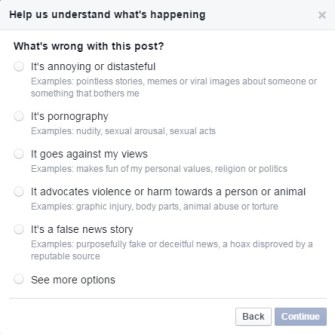
These are the options currently presented to users who want to report something on Facebook which they find to be offensive:

Facebook Report Post - Anti Free Speech

Note the third option – “It goes against my views” – which is now legitimate grounds to report someone else’s post as being offensive and deserving of removal from Facebook.

It can be tempting to make light of sites like Camsurf Safespace, regarding them as a sheltered playground for children, unrepresentative of the mainstream. But when the world’s pre-eminent social network treats its users in the exact same way, it is no laughing matter.

Cyberbullying is a real and concerning phenomenon where it occurs. But the idea of a fully grown, mentally capable adult being “bullied” is absurd, as are these incremental but damaging steps toward regulating and monitoring all of our online interactions to ensure that we are using the internet “safely”.


Safe Space Notice - 2

Agree with this article? Violently disagree? Scroll down to leave a comment.

Follow Semi-Partisan Politics on TwitterFacebook and Medium.

Stephen Fry Commits Egregious Act Of ‘Victim-Blaming’, Torpedoes Own Career

‘Victim-blaming’ the survivors of sexual abuse by daring to suggest that safe spaces and trigger warnings are not the best response? Stephen Fry clearly has a career death wish

Never one to avoid controversy, while giving an interview to American media Stephen Fry decided to share his thoughts on a number of subjects – including the Rhodes Must Fall campaign, the general infantilisation of our culture and (really pushing his luck given the current climate) the demands of some students to slap trigger warnings on works of art and academic materials which include discussion of rape or sexual abuse.

Naturally, this went down tremendously well with Safe Space apologists, who all immediately saw the light and took to Twitter praising Fry for introducing a note of levity into their carefully constructed  culture of victimhood.

The Independent reports:

Stephen Fry has been criticised for suggesting sexual abuse survivors should not “pity” themselves.

Fry made the comments when airing his views on free speech, religion and political correctness while appearing on US show The Rubin Report.

Speaking to host Dave Rubin, he discussed the practice of safe spaces and trigger warnings, including those that are used for plays and books which contain scenes of rape or abuse and can possibly set off traumatic memories and flashbacks for survivors of rape or abuse. They are sometimes used on university campuses.

He said: “There are many great plays which contain rapes, and the word rape is now even considered a rape. […] They’re terrible things and they have to be thought about, clearly but if you say you can’t watch this play […] it might trigger something when you were young that upset you once because uncle touched you in a nasty place.

“Well I’m sorry yes it’s a great shame and we’re all very sorry that uncle touched you in that nasty place. You get some of my sympathy but your self-pity gets none of my sympathy because self-pity is the ugliest emotion in humanity.

“Get rid of it because no one’s going to like you if you feel sorry for yourself. The irony is we’ll feel sorry for you if you stop feeling sorry for yourself. Grow up.”

Stephen Fry can currently be found being roasted alive by the permanently outraged, virtue-signalling Twitterati for daring to promote the sacrilegious concepts of resilience and antifragility, and – if the mob get their way – will be found next year as the “featured guest” presenting a QI knockoff show on a cheap Caribbean cruise.

Well, it was a good career while it lasted.

Grovelling apology and recanting of previous remarks in 10, 9, 8, 7, 6…


Safe Space Notice - 2

Agree with this article? Violently disagree? Scroll down to leave a comment.

Follow Semi-Partisan Politics on TwitterFacebook and Medium.

Tales From The Safe Space, Part 25 – Student Action Alone Cannot Halt The Growth Of Safe Spaces And Censorship

St Olaf College Protest - Safe Space Policy

Students are leading the fightback against campus illiberalism and the Identity Politics takeover with almost no support from professors and university administrators. No wonder they are having limited success

As this blog noted last week in a worrying development, even some of those students who are now making the news for opposing the most authoritarian clampdowns on free speech on their campuses turn out to support the idea of safe spaces, trigger warnings and No Platforming in principle. In other words, their problem is not with censorship per se, but merely a quibble over its overenthusiastic application.

Latest case in point, this student from St. Olaf College in Northfield, Minnesota, who ruined a perfectly good protest about campus speech codes and draconian restrictions on free speech by conceding the broader point about the necessity of Safe Spaces.

From the Manitou Messenger:

On March 29, subscribers to St. Olaf Extra received an email from Anders Wahlberg ’17 in which he expressed his frustrations with St. Olaf ’s “incredibly broad and overreaching” policies regarding speech on campus and “the ridiculous concept of safe spaces.” Wahlberg closed the email with a call to other students who feel similarly to join his student organization, which “will offend people” and “will violate the sanctity of St. Olaf’s safe spaces.”

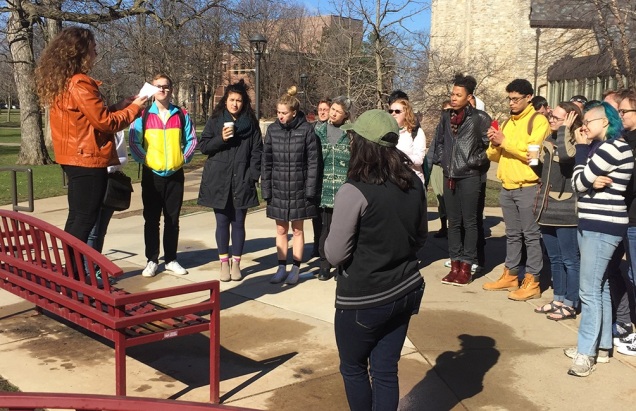
Within days of the email being sent out, Nikki Lewis ’18, Udeepta Chakravarty ’17 and Cynthia Zapata ’16 organized a rally in response. The rally was held in the quad on April 1 during chapel time and drew many students despite the cold temperatures. Both the organizers and representatives from safe spaces on campus spoke to the crowd.

“It’s always very hard when marginalized students on campus are trying so hard to make it clear that there’s issues at St. Olaf, and then emails like that go out,” Lewis said, “with so little regard to the fact that a lot of students on campus are subjected to hate speech and sometimes even hate crimes on this campus. So just sending out an email like that, what are you thinking?”

[..] Wahlberg’s email indicated that it wasn’t that safe spaces should be attacked, but that the mentality of safe spaces has not been contained in those safe spaces.

“By all means there should be safe spaces on campus. But making the entire campus a safe space is a threat to academic discussion and places people’s feelings above free speech. I don’t think there is a single issue that is ‘above debate.’ Classrooms, above all else, should not be safe spaces,” Wahlberg said.

In other words, limit free speech and infantilise students as much as you like on campus as a whole, just don’t do it within the classroom.

We should, perhaps, see the positive side in this. At least the student, Anders Wahlberg, appears to be motivated out of a strong and genuine concern for academic freedom. But tolerating any kind of exclusionary safe space where speech is restricted is inevitably the thin end of the wedge – conceding the principle of safe spaces means that the fight for free speech will ultimately be fought at the threshold of our own liberty.

Of course, one does not know the full extent to which potentially enormous social pressures force students to moderate or in some instances completely suppress their criticism of draconian speech codes, No Platform policies and other infantilising measures. It could be that Wahlberg would like to do away with Safe Spaces altogether, but knows that he would face total social ostracisation to the extent that speaking out fully is impossible.

And if so, who can really blame him? With very few honourable exceptions, most university administrations are running terrified of their student populations, falling over themselves to apologise and grant perks and concessions for the supposed injustices committed on their watch, almost before the Stepford Students themselves have had time to get into full outrage mode.

If I were a student today I like to think that I would take a vociferous, absolutist stance on free speech – but I would be under no illusion that the university hierarchy would have my back.

Cowardly concession after cowardly concession has shown that in a desperate final attempt at appeasement, many university administrations are happy to throw their allied supporters of academic freedom and free speech under the bus to buy a few more months of peace and quiet from their restive student populations.

It is always heartening to see students push back against attempts to infantilise them and limit their freedoms. But we are kidding ourselves if we believe that years of accumulated authoritarian and censorious policies can be overturned without the active participation of the academic establishment – dragged out kicking and screaming in support of academic freedom, if necessary.


Safe Space Notice - 2

Top Image: Manitou Messenger

Agree with this article? Violently disagree? Scroll down to leave a comment.

Follow Semi-Partisan Politics on TwitterFacebook and Medium.

Tales From The Safe Space, Part 24 – Finally, The Academy Strikes Back

Academic Freedom In An Age Of Conformity - Joanna Williams

When will professors and university administrators realise that they must work together with colleagues and rivals to stand a chance of withstanding and rolling back the current unprecedented threats to academic freedom?

Lest we begin to think it is all doom and gloom, it should be pointed out that some voices within the academy are pushing back on the demands of censorious students and the self-censoring impulse among university faculty to avoid giving offence or courting controversy.

Already in this series we have looked at the inspiring example of Dr. Everett Piper, president of Oklahoma Wesleyan University, whose resistance of “ideological fascism” puts many of his Ivy League peers to shame.

And now, winging its way to an Amazon locker near me is a copy of “Academic Freedom in an Age of Conformity” by Joanna Williams, a book which promises to get into detail as to the specific nature of the problem within our universities. Hopefully it will also provide some more detail – as well as proposed solutions to some of the questions raised – in Mick Hume’s worthwhile polemic “Trigger Warning: Is The Fear Of Being Offensive Killing Free Speech“.

Williams recently gave an interview to Inside Higher Ed to discuss the book, and this section from the Q&A is a breath of fresh air:

Q: Academic Freedom in an Age of Conformity has some choice words for the students who have in recent years sought to ban controversial speakers, discussions, art, etc., from their campuses. But you blame their censorship largely on their instructors, from whom you say they have learned. Is that fair? Some instructors, at least in the U.S., now say they’re afraid of their students, and are self-censoring because of them.

A: I think many academics are looking on in bemusement, or indeed horror, at this generation of censorious students. But I think academics need to engage in a far more honest debate about where such students have got their ideas — and their tactics — from. Of course higher education does not operate in a vacuum — and students do not arrive at university as blank slates. There are lots of different things going on here.

Too often nowadays students arrive at university having led quite sheltered lives and having been protected from discomfort. In many ways I think childhood itself has come to be equated with vulnerability. This carries over into universities. Young adults are treated as if being a student is in and of itself enough to make them vulnerable and in need of special protection. The campus comes to be seen as a safe space with infantilizing therapeutic interventions such as petting zoos. Students do not expect — and ultimately are not able — to deal with things that threaten their fragile sense of self.

These same students are often taught in the classroom that language is all powerful in constructing reality — that words can wound — in a way that goes beyond rhetoric that can upset us, move us and stir our emotions but actually to inflict psychic harm or real violence. When students who have come to see themselves as vulnerable are taught that language and images can threaten their identity, then the desire to ban is understandable.

Academics who are afraid of their students need to enlist the support of their colleagues in creating a university culture that is about learning through intellectual challenge rather than an entitlement to protection from discomfort.

Absolutely. The abysmal position in which even our top universities now find themselves is a confluence of several things going on all at once. There is the notion that some speech is beyond the pale and that bad words can equate to violence, which started with the “No Platform” concept several decades ago, and has grown to result in hate crime legislation which criminalises speech, writing or online activity which is perceived by any third party as likely to cause alarm or distress – a remarkably low bar for censorship.

Then there is our modern therapeutic culture, which as Joanne Williams (and this blog) rightly notes has raised a generation of young adults who believe that they are special, beyond reproach but also uniquely vulnerable and in need of constant protection by watchful authority figures. This sees students equating good mental health with a state of childlike regression, trying to face-paint and colour their way to equanimity.

And finally there is the rise of the Cult of Identity Politics or what Dr. Everett Piper calls “ideological narcissism”, whereby young minds are conditioned to believe that their arbitrary (and sometimes shifting) identity trumps not only the rights of other people to hold and express ideas which criticise those identities, but even trumps physical reality itself. Thus some students openly fret that allowing, say, a speaker who does not hold the mandatory stances on transgender issues to air their opinion will “invalidate the experience” or even the existence of trans students – as though Brendan O’Neill setting foot on their university campus would cause all trans people within a five mile radius to vanish in a puff of smoke.

What has been missing so far is any sign of co-ordination in terms of a fightback by the academy, which is where Joanna Williams’s book comes in. She herself has lamented that one of the problems is that professors and university administrators do not care about academic freedom in the abstract as much as they should, only becoming alarmed when their own campus or lecture theatre is engulfed in protest by self-entitled Identity Politics cultists.

Hopefully this book, “Academic Freedom in an Age of Conformity”, will begin to change that introverted aspect of academic life and prompt more professors and others to realise that the slide toward illiberalism and censorship taking place on one far-away college campus is a direct threat to their own.

Stay tuned for a full review of the book here in the coming weeks.


Safe Space Notice - 2

Agree with this article? Violently disagree? Scroll down to leave a comment.

Follow Semi-Partisan Politics on TwitterFacebook and Medium.