In this excellent piece, Andrew Sullivan anticipates the potential eventual outcomes from Pope Francis’ survey of Catholics on their views on the family and family life. Whilst I fear that a wholehearted embrace by the Church hierarchy of the more “progressive” responses such as that by leading German theologians (heavily discussed by Andrew in the article), we can all dare to dream. Any move by Francis and the Church to move toward viewing human sexuality as a gift rather than a doctrinal minefield of issues to be policed and rules to be enforced can only be a good and wonderful thing.
One of the great question marks still hanging over Pope Francis’ tenure as Bishop of Rome is whether any actual doctrinal changes will occur. Damon Linker has a provocative and honest piece out wondering if “liberal” Catholics even care about doctrine any more – because so many have been content simply to celebrate the sharp transformation of tone in the Francis era and the new emphasis on Christianity as an urgent and empowering and demanding way of life. Money quote:
I had assumed all along that liberal Catholics wanted to liberalize Catholic doctrine — that they wanted to bring the church, as I wrote in TNR, “into conformity with the egalitarian ethos of modern liberalism, including its embrace of gay rights, sexual freedom, and gender equality.” But here was a liberal Catholic telling me I’d gotten it all wrong. The pope’s warm, welcoming words are “everything,” Trish said, because…
Christians actively NOT being persecuted in Britain.
The Telegraph’s resident Moraliser-in-Chief, Cristina Odone, has done it again.
In a short column, clearly phoned in and devoted more to promoting her “new ebook” than advancing an intellectual idea of any kind, Odone decides to directly compare the persecution of Christians in other lands – persecution often marked by violent killing – to what she sees as persecution of Christians at home here in Britain. No really, she does:
Being a Christian, in some parts of the world, carries a death sentence. It carries little weight — and attracts a lot of opprobrium — in this part of the world. Having done their best to erase God from public life, secular authorities have stealthily loosened our identity as Christians. As I have written in my ebook, “No God Zone”, traditional ceremonies, rituals and even pledges have been suppressed because of their “religiosity”. Thus, when we witness the sufferings of our “brothers and sisters in Christ”, we feel only a twinge, where once we would have felt a shock.
One poorly written ebook about how Cristina Odone is prohibited from practising her religion in that terrible place, the United Kingdom, available now on your Kindle or iPad. Check for yourself.
And let me paraphrase. Cristina Odone feels so persecuted and reviled for her faith here in Britain that when she sees fellow Christians hacked to death in the middle east it is now all she can do to give them a wry, knowing nod of the head, empathising with their pain? And she thinks that other similarly “afflicted” British Christians feel the same way?
There follow a couple more uninspired paragraph where Odone waffles and fails to express an idea, and then we end with this:
Tragedies like the ones in Nairobi and Peshawar do not make me think all Muslims want to kill Christians; the al-Shabaab guerrillas are no more representative of Islam than the suicide bombers in Pakistan are. But these atrocities do bring home, as a Spectator blog quotes the former Chief Rabbi saying, the dangerous “silence of our friends”. Sadly that silence is rooted in hostility to our faith.
Where to begin? Let’s start with the notion that nefarious “secular authorities” have “stealthily loosened our identity as Christians”.
Odone would do well to find out how many readers of her column attended a church service last Sunday. Or this year. Or in their recent memory. I suspect that when she talks of “our [shared] identity”, she is actually speaking to a minority, even if they call themselves Christian (let’s call them CINOs, people who erroneously use the word Christian interchangeably with “British” or “white”).
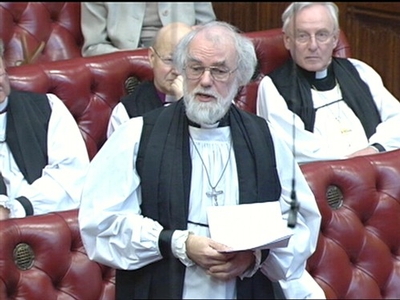
While we’re at it, we should also send Odone back to Citizenship 101 class, so that she can learn about our hereditary monarchy pledged to “defend the faith”, the Lords Spiritual who meddle in our laws and seek to impose their particular brand of Christianity on the nation, the fact that public holidays in Britain coincide with Christian festivals and that Christian hymns are sung in state school assemblies up and down the land. How dreadfully secular.
A walking, talking advertisement for the benefits of separation between church and state
How huge must Odone’s white persecution complex really be, to behold these manifold examples of the Christian faith woven into the fabric of our society, and still come away feeling slighted, aggrieved and persecuted? Newsflash, Odone – denying civil rights to gay people and imposing your morality on others is not part of expressing your faith. Expressing your faith is all about what you yourself choose to say, read, write, eat or wear – not what you want other people to do.
Odone also chooses to bemoan what she perceives as a weak-willed response by western nations to [real] persecution of Christians abroad:
Why should the Foreign Office move heaven and earth to protect Christian minorities in the Middle East when this Coalition allows Christians to lose their livelihood on account of their religious beliefs? Why should the EU get heavy with governments in the Middle East when its member states have signed up to 41 laws that discriminate against Christians?
Here we actually have the semblance of a lucid thought, but of course Odone stops at the feeling aggrieved part rather than proposing any potential solutions to this problem. The EU does not seek to use any of its economic leverage to stop persecution of Christians in the middle east – okay, so what form should this leverage take? Cristina Odone is silent on the matter.
Actual persecution of Christians might look like this.
As for the recent suicide bombings and mass shootings at churches in Pakistan and Kenya, Odone is similarly silent when it comes to a plan of action. Does she favour a military intervention, economic sanctions, or just harsher diplomatic words? We don’t know, because she doesn’t say. And she doesn’t say because she hasn’t given it a moment’s thought.
Because of course, to Cristina Odone, this isn’t really about those long-suffering Christians tucked away in the far corners of the world. It is all about her, the Cristina Odone show, railing against the fact that centuries of engrained bias in favour of her own religion (my religion too, incidentally) are starting to be rolled back in favour of something more slightly resembling equality before the law.
Andrew Sullivan’s take on the extraordinary interview given by Pope Francis to a Jesuit publication is well worth a read. In this series of articles, Sullivan explores not just the stylistic differences between the new pope and his predecessors, but also the likely (and less likely) implications for church doctrine and policy. Well worth a read.
Well, if the theocons hadn’t got the message by now, they can only blame themselves. The new interview with Pope Francis is a revelation. This Pope is not the Pope of a reactionary faction obsessed with controlling the lives of others – a faction that has held the hierarchy in its grip for three decades. He is a Pope in the spirit of the Second Vatican Council, a Pope with a larger and more humane perspective than the fastidious control-freaks that have plagued the church for so long. I need to read and absorb the full interview – it’s 12,000 words long – before I comment at any greater length. But here are the key phrases that are balm to so many souls:
“This church with which we should be thinking is the home of all, not a small chapel that can hold only a small group of selected…
You know who I freakin’ love? This new pope. Pope Francis. You know who I’m talking about, right? The pope. Are you watching this guy? Because you should be. It’s early, but I’m thinking… best pope ever.
That’s original emphasis, by the way. Aside from the redundancy of explaining to his viewers and readers that Pope Francis is indeed the pope, the style is just like Rachel Maddow Mark 2, right? The stylistic similarities between Maddow and her protege are quite astounding. But I digress. Hayes also picks up on the new pope’s penchant for making cold-calls to the faithful who write to him of their problems:
Perhaps most amazing of all: the pope is now picking up the phone and calling people who write to him for advice and prayers—earning him the nickname “Cold Call Pope.” He phoned a woman who had been raped by a police officer in Argentina, telling her she was not alone, and to have faith in the justice system.
He’s comforted a pregnant woman whose married boyfriend tried to pressure her into an abortion, Francis offering to personally baptize her baby.
He also rightly picks up on Francis’ more humble demeanor:
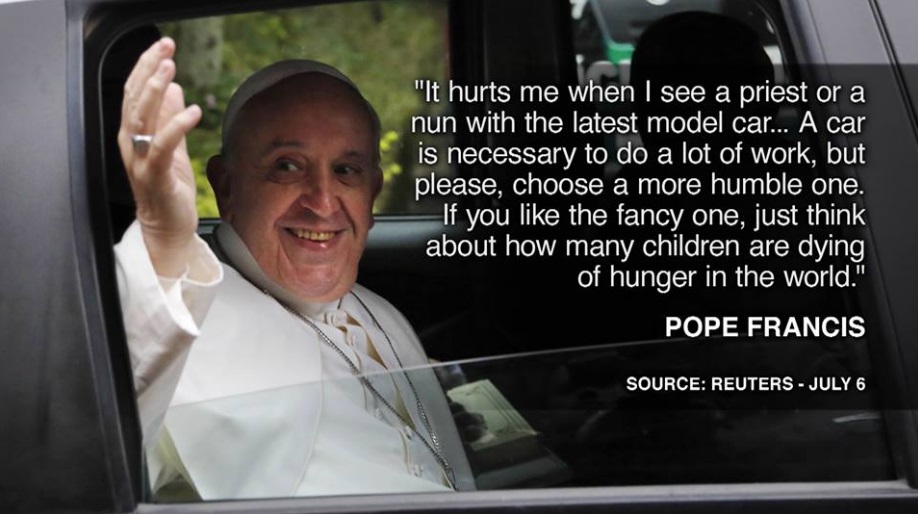
He showed up to World Youth Day in Rio de Janeiro, not in the imposing Popemobile, but in the back of a rental car. He’s not above taking a selfie with the kids. He plans on driving a used car around town. And he’s urged others to do the same: ”It hurts me when I see a priest or a nun with the latest model car. A car is necessary to do a lot of work, but please, choose a more humble one. If you like the fancy one, just think about how many children are dying of hunger in the world.”
The one area where Hayes and I differ is the degree to which this wonderful, welcome rhetorical shift will actually lead to any significant step change in Church doctrine or Vatican policy. Hayes says this in his article:
But Francis has also shown he’s pretty good substantively, as well. On the once taboo subject of homosexuality, Francis told reporters: ”If someone is gay and he searches for the Lord and has good will, who am I to judge?”
Clearly, he sees this as something substantive, but I find it hard to apply that term unless there are meaningful changes afoot to reform Church teachings on gay marriage, the ordination of women priests and other such issues – something that is clearly not on the horizon.
Nevertheless, I join Chris Hayes in celebrating the warmer, more inclusive tone now emanating from the Vatican. May it spread down from Pope Francis to his brother cardinals, the archbishops, bishops, priests and of course the laity, where it might really start to do some good.
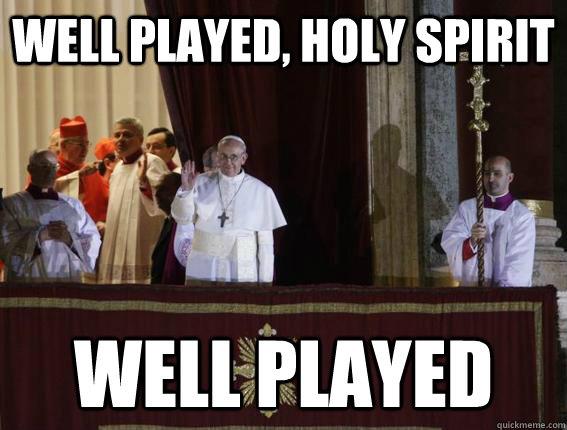
Some interesting and fun Pope Francis memes can be found here.
Apparently, continuing his penchant for calling regular people out of the blue and surprising them, Pope Francis has made a telephone call to a young gay Catholic man in France, in response to a letter the man sent him expressing his emotional turmoil and stress at the thought that his nature was in some way against God or church teaching.
The Huffington Post reports the account as follows:
“He said ‘Christopher? It’s Pope Francis’. I was unsettled, of course. I asked, ” Really? ” He replied : “Yes.”
“I received the letter that you sent me. You need to remain courageous and continue to believe and pray and stay good,” the Pope told him during the nine-minute conversation in Spanish.
“Your homosexuality. It doesn’t matter. One way or another , we are all children of God. This is why we must continue to be good,” the Pope told him.
Though many writers have argued that Francis’ more inclusive and friendly tone does not necessarily mark any great upcoming shift in church teachings on homosexuality, it is certainly a good beginning, and a vast improvement from the cold, clinical indifference that was the hallmark of the Benedict XVI papacy:
While Francis’ predecessor Benedict XVI was an extreme opponent of gay rights – once describing homosexuality as a “defection of human nature” – the most recent Pope has expressed his tolerance towards homosexuality.
During his recent visit to Brazil he said: “If a person is gay and seeks God and has good will, who am I to judge?”
Once this spirit of friendship and true empathy is established, as Pope Francis is working so hard to achieve now – not just in terms of Church attitudes toward gay people, but also the poor, underprivileged and dispossessed – the opportunity may eventually present itself for a revision of Church teaching in this regard.






 Semi-Partisan Politics