


Tottenham Court Road, London
Tottenham Court Road, London

Week 3 of the Big Issue Online Journalism Training course saw me hitting the streets of Clapton, getting vox pops from passers by, corresponding with a local vicar by email and interviewing a local borough councillor. As well as gathering information for local publication the Hackney Citizen, our efforts led to this news article which I wrote up today. Next week: features, and the type of more in-depth writing that is closer to my heart and hopefully particularly helpful for my future work. The training continues…
 Picture: Ian Aitken: Bishops Wood Almhouses on Lower Clapton Road
A seventeenth century Clapton building is facing demolition after a charity put it up for sale, claiming that renovations would be too expensive.
The Grade II listed Bishops Wood almhouses, which have housed poor elderly people for more than three centuries, are being put up for sale by owners the Dr Spurstowe and Bishop Wood Almshouse Charity which plans to use the proceeds to build a larger facility on a new site in Hackney.
However, the sale has raised fears that a private developer will purchase the building and demolish it to make room for the creation of more profitable luxury flats. Demolition would also mean the loss of the chapel, which is part of the structure and reputedly the smallest in the country.
The charity says that while the sale is regrettable, refurbishment would cost as much as £750,000 for only…
View original post 264 more words

Andrew Sullivan’s reflections on the vetoing of SB1062 by the Arizona Governor, Jan Brewer. We are in agreement, with one significant exception – Andrew sees no issue with discrimination against gays (or any other minority or class of individuals) in the private realm, only the public realm where government is an actor. While I admire his magnanimity in being willing to shrug off the hate and intolerance of certain fundamentalists, I cannot agree that this is the right approach. It is all very well to favour “maximal liberty”, but taken to its (logical, not extreme) conclusion, this would open the door for arbitrary refusal of service to anyone on the grounds of anything masquerading as religious conscience.
[Re-posted from earlier today]
Here’s the money quote from Jan Brewer’s veto statement last night:
Senate Bill 1062 does not address a specific and present concern related to religious liberty in Arizona. I have not heard of one example in Arizona where a business owner’s religious liberty has been violated … Religious liberty is a core American and Arizona value, so is non-discrimination.
As I’ve mulled this over and over, I have a few straggling thoughts. Against the bill: it had two terrible features. The first was the breadth of the religious liberty invoked. The real innovation in Arizona was the extension of religious liberty claims against other citizens, rather than against the government itself. That’s a big leap, and trivializes religious liberty in some ways. No individual can coerce, even with a lawsuit, the way the government can. The second is the environment in which this bill was…
View original post 369 more words
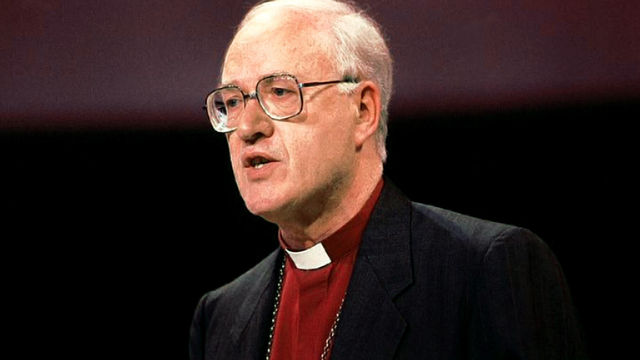
Sometimes it takes the return of the grizzled, world-weary veteran, called out of retirement one last time, to show the flailing stars of today exactly how it should be done, and to save the day.
So it was when George Carey, the former Archbishop of Canterbury, spoke out in a newspaper column, castigating his fellow bishops for their naive and fumbled entry into the British welfare reform debate.
The Daily Mail reports:
Last night, Lord Carey of Clifton said that it was too simplistic to blame the recent welfare cuts for the rising use of food banks and bishops are doing the Church no favours by entering the debate.
He said such opposition to reducing the welfare bill was ‘Canute-like’ and reflected an ‘overt left-right politicisation of Church versus government’.
The former Archbishop of Canterbury said Anglicans and Catholics share outrage at the rising levels of hunger among the most disadvantaged and that the welfare state has reached ‘gargantuan’ proportions.
Lord Carey continues:
‘All three political parties acknowledge the need for reductions to welfare spending, wastage and fraud in the system and have all talked about the dangers of welfare dependency and the need to get people into work.
‘They are not agreed on precisely where the axe should fall, but the Churches should beware of the dangers of blithely defending a gargantuan welfare budget that every serious politician would cut as a matter of economic common sense.’
This really hits the nail on the head. Reading or watching the initial intervention in the debate by Catholic Cardinal Vincent Nichols, and the follow-up letter by the Church of England bishops, one got the overwhelming sense that the key figures had not done their homework. So shallow was the level of understanding, and so absent was any sense of historical context or detailed knowledge of government policy, that the bishops may just as well have been standing at the gates of Number 10 Downing Street waving “Down With This Sort Of Thing” placards.
A strong sense that Lord Carey was embarrassed by the incompetence of his successors’ handling of what is a complex and fraught issue pervades his column.
But most heartening of all is this acknowledgement – albeit from a former rather than a current religious leader – that the problems in our society will continue for just as long as we continue to look exclusively to government to solve our problems and address human suffering rather than looking to ourselves:
Lord Carey said: ‘They are right in describing a serious problem but only partially correct in their analysis.
‘It is much too simplistic to blame these problems on cutbacks to welfare and failures in the benefits system, whether it be payment delays or punitive sanctions.
He added that the welfare system is being ‘asked to replace kinship and neighbourliness’ and is ‘never going to pass muster as the ideal vehicle to deliver aid to those in greatest need when they most need it.
This is precisely the problem. Faced with a situation where millions of people are dependent on various kinds of welfare and often kept down through a series of perverse incentives, the bishops did not stop to consider how they as leaders and their church as a community could step in and provide positive solutions. Rather, they wrung their hands and passed the ball to the government, a shameful abdication of responsibility.
It is not the Church’s job to simply take note of suffering and pass it on to the government for review – indeed, while it is clearly not in the interests of the people for whom they supposedly advocate, neither is it in their own, more narrow interests. As I wrote last year:
… perhaps it is directly because the state plays such a large part in everything that we do, from cradle to grave, that the church to which [we belong] is withering and shrinking by the year.
To a great extent, aside from the divine aspect, has the British welfare state not done away with the purpose of church, of knowing your neighbour, of being part of a community, altogether?
Telegraph columnist Cristina Odone, with whom this blog has had precious little to agree on of late, is also full of praise for Lord Carey’s mature intervention in the debate. Her distillation of Carey’s message is worth reading:
Poverty, he argues, is not caused by Coalition cuts but by multiple factors including the fragility of the family, which results in too many relying on the state. Strong kinship, a helpful community: today’s disadvantaged Briton can no longer depend on either. Stop entering the political fray, he tells his colleagues, but look beyond Left and Right to see the real tragedy of a culture that has lost its way.
Odone’s overall assessment of the debate on welfare reform, and what church leaders need to do in order to regain the right to be taken seriously on the issue, is also excellent:
Dr Carey instead is speaking sensibly and calmly from the sidelines: the analysis is more complex than you’ve allowed for, he chides his colleagues; you’re doing yourselves and our Churches a disservice by blaming the status quo on an unpopular government. Until you can offer either a true analysis of the root causes or a real alternative to the government’s proposed reform, keep schtum.
As Odone makes clear, and as this blog has previously acknowledged, the church has a potentially valuable, even critical role to play in shaping the debate. But they can only do this by temporarily stepping back from the limelight and reading up on the subject a little.
More urgent even than enrolling in Civics and Economics 101, though, our church leaders need to think about the best role of religious organisations in solving the problems of poverty, blight and human misery that they have identified. The fact that their first response was simply to flag the problem to the government and move on is deeply discouraging. Is their vision for the church really nothing more than to observe and report social phenomena to the ‘proper authorities’?
And yet there is hope. The former Archbishop of Canterbury spoke a powerful truth to today’s ecumenical leaders. They may not like being publicly admonished by their predecessor, but if they strive for wisdom they will listen and adapt.
In this important debate, which is ostensibly about welfare reform but in reality touches on everything that governs how we relate to and care for each other, George Carey – twelve years after leaving office – is offering the church a pathway away from irrelevance.
It’s time to follow the leader one last time.


A surprising piece today from Andrew Sullivan, in which he distances himself from certain aspects of the opposition to the anti-gay discriminatory legislation currently working its way through the usual-suspect state legislatures.
Sullivan, gradually sensing victory in his long struggle and seeking (perhaps overly so) to be magnanimous in the face of it, writes:
The truth is: we’re winning this argument. We’ve made the compelling moral case that gay citizens should be treated no differently by their government than straight citizens. And the world has shifted dramatically in our direction. Inevitably, many fundamentalist Christians and Orthodox Jews and many Muslims feel threatened and bewildered by such change and feel that it inchoately affects their religious convictions. I think they’re mistaken – but we’re not talking logic here. We’re talking religious conviction. My view is that in a free and live-and-let-live society, we should give them space. As long as our government is not discriminating against us, we should be tolerant of prejudice as long as it does not truly hurt us. And finding another florist may be a bother, and even upsetting, as one reader expressed so well. But we can surely handle it. And should.
I have read and re-read this paragraph multiple times, and this argument both surprises and concerns me. Boiled down to its essence, it is frankly disturbing – in essence, Sullivan is saying that discrimination in the private sector should be allowed and that a blind eye should be turned, and that we only have real cause for concern if gays (or presumably other minorities) face discrimination at the hands of the government.
Sullivan is also willing to play along with the fairly innocuous example of the gay couple approaching a florist to cater their wedding. It may well be the case that such a couple, spurned by one business, will be able to find an alternative provider in their town. But equally, it may not. There may be only one business of its kind in the vicinity, or there may not be the time or money to go on a Nativity-style trek through town trying to find a spare room at the inn.
More seriously, the business in question may be more important than providing flowers for a social occasion. What if it is accounting services? Or social care? A funeral home? Or medicine? Would it be permissible to deny services to gay or lesbian couples in one of these fields? If so, which ones? And what would be the logic behind such a consideration?
Sullivan’s desire to reach out to the viscerally anti-gay hold-outs in society (and if your beliefs prompt you to deny service to someone based on them, they are visceral) comes at the expense of the logic of his own argument. Sullivan remains fully cognisant of the danger of using religious freedom arguments to permit discrimination:
But the wording of the bills in question – from Kansas to Arizona – is a veritable, icy piste for widespread religious discrimination. And that’s for an obvious reason. If legislatures were to craft bills specifically allowing discrimination only in the case of services for weddings for gay couples, as Erickson says he wants, it would seem not only bizarre but obviously unconstitutional – clearly targeting a named minority for legal discrimination. So they had to broaden it, and in broadening it, came careening into their own double standards. Allow a religious exemption for interacting with gays, and you beg the question: why not other types of sinners? If the principle is not violating sincere religious belief, then discriminating against the divorced or those who use contraception would naturally follow.
This awareness only makes Sullivan’s desire to reach an accord with those who want to enshrine discrimination in law all the more bizarre. Sullivan seems to want to have it both ways – to point out the impossibility of the “religious freedom” bills, while also holding out an undeserved olive branch to the fundamentalists and proclaiming his unwillingness to force them to stop discriminating.
Sometimes it is appealing to float serenely above the fray and call for moderation and respect. Most of the time, it is probably the right course of action. But sometimes it is not.
The people currently trying to enshrine anti-gay discrimination into law want nothing more than to hoodwink the public into fretting about an imaginary future where beleaguered mom-and-pop businesses are forced at shotgun to commit acts in violation of their religious beliefs, acts that risk sending them straight to the pits of hell.
They want to recast the ignorant, the hateful and the prejudiced in the role of the plucky underdog hero, humbly attempting to live their simple lives according to their God-fearing values, but being thwarted and dictated to by the arrogant metropolitan elites. This image is sensationalist and false.
And the last thing that these cynical people deserve is the sympathy and respect of Andrew Sullivan or anyone else who has fought so hard to end discrimination.


 Semi-Partisan Politics