Should We Punish Artists For Their Political Beliefs?

LSO Valery Gergiev
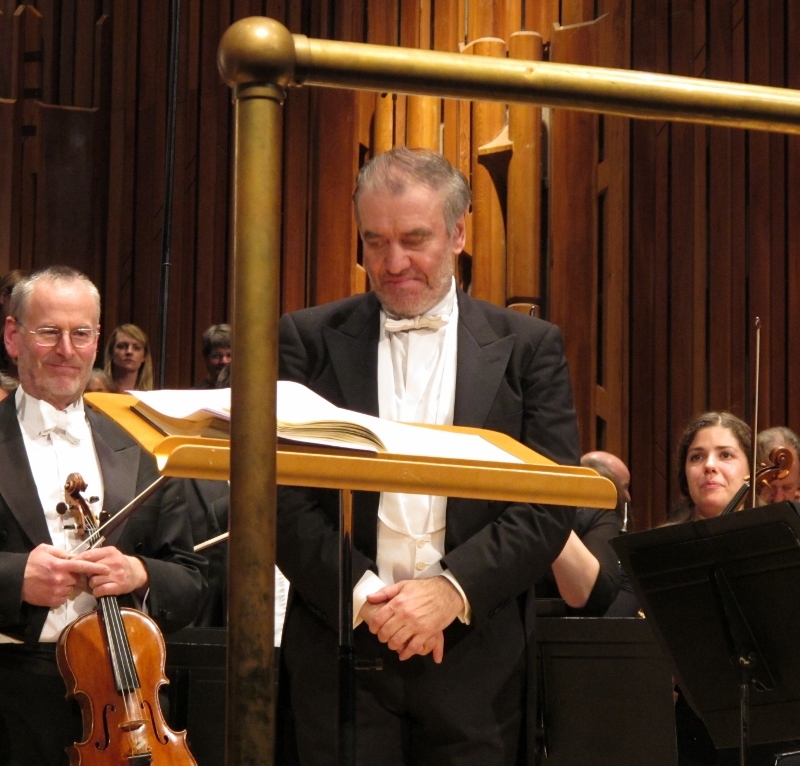
Maestro Valery Gergiev with the London Symphony Orchestra


Music and politics make uneasy bedfellows, and this timeless truth has only been reconfirmed with the continuing tumult and unrest in Ukraine.

Russia, the protagonist in this latest crisis, provides ample recent evidence that politics and music are best kept apart. The punk band Pussy Riot, for example, is hardly ever out of the headlines in recent months, with members being jailed, released, threatened and attacked by the authorities merely for adding their voices to the civic discourse, for wanting to make themselves and their beliefs heard.

But at the other end of the artistic spectrum, for the fine arts – especially classical music – the problem is not the Russian government’s persecution of artists, but artists’ apparent eagerness to praise the political leadership and to lend President Vladimir Putin their credibility.

The most famous current case is the Russian conductor Valery Gergiev, principal conductor of the London Symphony Orchestra. Gergiev was one of the most prominent Russian artists to sign an open letter in support of Vlarimir Putin’s foreign policy towards Ukraine. Part of the letter’s text reads:

In the days when the fate of our compatriots in the Crimea is decided, Russian cultural figures can not be indifferent observers with a cold heart . Our common history, our cultural roots and spiritual origins , our fundamental values ​​and language have united us forever. We want to see the commonality of our peoples and our cultures have a strong future. That is why we firmly reiterate support for the position of President of the Russian Federation and Ukraine Crimea.

Sometimes, these messages of support for Vladimir Putin’s policy of aggression are downright perplexing, such as when the Russian Writer’s Union decided to make their love and support for Putin known in a very Soviet style open letter, a sloppy wet kiss to power. Craven though they can sometimes be, one can hardly imagine the British or American press joining together as one to praise and defend the Cameron or Obama foreign policies.

At other times, however, particularly in the case of artists responsible for institutions that depend on government support, the situation is not so clear-cut and such acts of public sycophancy may be part of the inevitable cost of doing business. The Financial Times picks up on this point:

There is little doubt [Gergiev’s] position is compromised. Deep down he is a nationalist, as his ill-judged support for the Russian intervention in Georgia in 2008 demonstrated. At his two Mariinsky theatres in St Petersburg, he has 3,000 employees on his payroll and a rich tradition to maintain. No other figure could raise the kind of money that Gergiev does to keep the Mariinsky going. Much of that money comes from members of the Putin circle. If Gergiev is presented with a petition in support of government policy, he is obliged to sign – unlike prominent freelance musicians such as Denis Matsuev and Yuri Bashmet, who have foolishly toed the line.

This is perhaps a distinction worth making, though it could equally be argued that the brave and moral thing to do would be to speak out against government malfeasance, consequences be damned. US country music group The Dixie Chicks tried this approach in 2003 when they spoke out against their president and their country’s imminent invasion of Iraq.

The aftermath was not pleasant, and it is a brave person who now does what the Dixie Chicks did – and this was in the United States, where the rule of law still means something. One can only imagine what might befall the likes of Gergiev if they actively spoke out against their government, when even maintaining a diplomatic silence would invite negative repercussions.

But of course Valery Gergiev would not speak out against Vladimir Putin’s policy of bullying and undermining Ukraine; he actively supports it, his signature to the open letter was enthusiastically given. So the question then becomes one of whether artists with differing political or world views should continue to be welcomed in foreign concert halls, or be else ostracised and made artistic pariahs?

A significant weight of critical opinion seems to be coming down on the side of ostracisation and intolerance. Prominent human rights campaigner Peter Tatchell has already made headlines by protesting Valery Gergiev’s continued association with a top-flight British artistic institution, going so far as to hijack the opening night of the London Symphony Orchestra’s Berlioz season in November 2013 and later issuing an open letter to the LSO, effectively demanding Gergiev’s dismissal. The letter concludes:

It is our view that Mr Gergiev’s current position is untenable and he should be suspended with immediate effect until he officially withdraws his name from the list published on the Russian Culture Ministry’s website and fully explains his position on the Anti-Homosexual Propaganda Bill.

If he decides he is not prepared to do this, his employment should be terminated as he is not an appropriate person to be in receipt of UK public funding. He supports discriminatory legislation which goes against the UK values of equality and diversity, and he supports Russian military action which the prime minister and foreign secretary have unequivocally condemned.

Ironically, the open letter sent by the Peter Tatchell Foundation and the Ukrainian Institute uses the same basis of government-policy-as-justification that we see in the Russian Ministry of Culture’s letter of support from Russian artists. Tatchell’s letter demands that Gergiev be fired because he supports a policy “which the prime minister and foreign secretary have unequivocally condemned”. Does this then mean that any artist or artistic institution not in complete accordance with the current views of the British government should be denied funding and actively picketed?

As is so often the case with campaigners from the political left, it is never enough to let the people vote with their feet on matters of moral principle. Rather, they instinctively turn to the government to invoke its power to make people fall into line. If it transpired that Valery Gergiev was jetting off between concerts to personally help foment unrest in eastern Ukrainian cities, people would be outraged and his situation would immediately become untenable. But he has not, and would never do this. Ultimately, Gergiev is guilty of little more than supporting the overwhelming view – however wrong it may be – among his own countrymen, something that most of us would likely do ourselves.

The Washington Post also picks up on this point, noting that famous Soviet artists were welcomed when they performed in the West even at the height of the Cold War, at a time when diplomatic relations were far more precarious than they are now:

If a musician chooses not to take a stand, he or she is often automatically charged with collaboration in any case. Gergiev, through his support of a challenging regime, may have in some sense “deserved” the protests at some of his concerts in 2013 (though this was not a reaction many Soviet artists got when they performed in the West at the height of the Cold War, sent by an even more suspect government).

For those in the West who watch Russia’s bullying and takeover of parts of Ukraine with mounting concern and anger, it may well provide a moment of catharsis and sweet justice to send the likes of Valery Gergiev packing prematurely from the London Symphony Orchestra, and to see other prominent Russian artists who do not disavow their country similarly exiled.

But it is precisely at times like these – when passions are high and tempers flared – that humanity most needs to remain in touch with the few common threads that unite us all. Music is perhaps the most precious of these unifying threads. After all, while the West may have a legitimate quarrel with the Russian government, the Russian people are largely innocent, as much victims of Putin’s repressive regime as the people of Ukraine and Crimea.

And even when prominent artists such as Valery Gergiev weigh in on the “wrong” side of an international dispute or a political debate, how can it be right to sever an important international cultural tie, a key reminder (to quote John F. Kennedy) that whatever our many differences, “We all inhabit this small planet. We all breathe the same air. We all cherish our children’s futures. And we are all mortal”?

In the end, it was Valery Gergiev together with the London Symphony Orchestra and Chorus who answered the conundrum most eloquently, with their recent concert performance of Alexander Scriabin’s First Symphony, part of Gergiev’s ongoing promotion of the Russian classical repertoire and a concert attended by Semi-Partisan Sam.

Sitting in London’s iconic Barbican concert hall, the rich sound of the LSO’s strings and peerless brass section enveloping the audience as the symphony drew toward its noble conclusion, hearing the chorus intone “Slava isskustvu vo veki slava!” – Britain’s finest musicians conducted by a Russian maestro – it hit home that if anything is truly transcendental, if anything must be held sacred and kept apart from our cynical, self-serving and sometimes hypocritical geopolitics, it should be music.

From the text of the choral finale to Scriabin’s first symphony, in praise of art’s unifying gift to humanity:

You are an exalted vision of life,
you are celebration, you are peace,
you bring your enchanted visions
as a gift to humankind.
In those cold, dark moments
when our souls are troubled,
mankind can discover in you
life’s joys, consolation and forgetfulness.

Gather here, all nations of the earth,
let us sing the praises of art!
Glory, eternal glory to art!


More on Scriabin‘s first symphony hereMore on the London Symphony Orchestra here.


Editor Willing To Publish Anything Doesn’t Think Public Deserve To Know About Government Surveillance

Only honourable men wear poppies


The ongoing public debate about the Snowden NSA leaks and government surveillance was effectively settled once and for all today, as former News of The World editor Andy Coulson informed the world how he would have acted had Edward Snowden approached him – rather than The Guardian’s Glenn Greenwald – with his cache of classified security documents.

The Guardian reports:

The former NoW editor Andy Coulson said he would have rejected the Edward Snowden story if it had been offered to him when he was editing the newspaper, the Old Bailey has heard.

Coulson told the phone hacking trial on Tuesday he felt the news story about US National Security Agency surveillance, based upon a cache of documents leaked by the whistleblower Snowden, would have endangered lives.

Andy Coulson – known by many of his peers as the Saint of Fleet Street – distinguished himself throughout his career by his unimpeachable journalistic ethics, frequently declining to run lucrative stories picked up by other newspapers because he could not be absolutely certain that the information had been gleaned from reputable sources or that its publication would serve the public interest.

Showing the steady, high-handed professional judgement which was the hallmark of his tenure as editor of the News of the World, The Guardian reports Coulson as saying:

“It’s a topical example, Edward Snowden. If they came to me at the News of the World, I think I would have turned them down,” he said, adding that the story on sweeping surveillance by the US government had “a potential for lives to be put at risk”.

The fact that Andy Coulson decided to weigh in on this contentious issue can only add further weight and moral credibility to the government’s argument that it has the unlimited right to take any action in the name of national security without either informing or seeking the consent of the public.

Coulson’s intervention is also a tremendous setback for The Guardian and The Washington Post newspapers, who only yesterday were boasting about their newly-won Pulitzer Prize for reporting on the Edward Snowden NSA leaks. Indeed, the judgement and reputation of the entire Pulitzer Prize committee must surely now be called into question for conferring an award on two newspapers who so egregiously violated what is already becoming known as the ‘Coulson Doctrine’ of fastidiously weighing the public interest before publishing sensational material.

Coulson could not be reached for further comment as he is currently standing trial at the Old Bailey on charges of phone hacking and committing perjury, absurd and hurtful accusations that were probably concocted by jealous rivals who can never live up to Coulson’s exemplary standards of professional and moral conduct.

Spot The Bully – Journalism or Government?

SPS Polis 2014 journalism conference

The POLIS 2014 Journalism Conference, held on the campus of the London School of Economics, played host to a number of luminaries from the British media establishment and debated some important issues. But among the various items on the agenda – including riveting discussions on the methods and ethics of investigative journalism, an interview with Guardian editor Alan Rusbridger and a forum on the use of social media in the newsroom – was a slightly incongruous, strangely titled session.

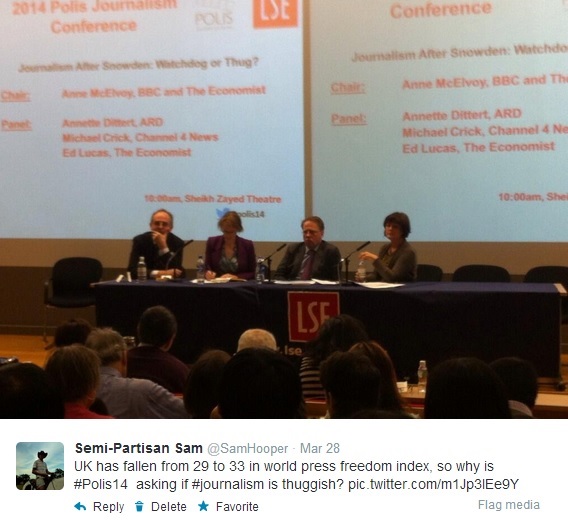
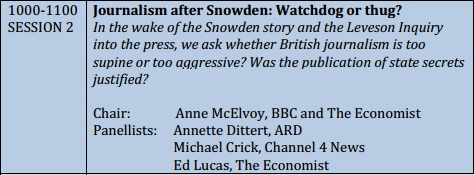
In the second session of the day, the panel – comprised of chair Anne McElvoy (BBC and The Economist), Annette Dittert (German broadcaster ARD), Michael Crick (Channel 4 News) and Ed Lucas (The Economist) debated the following topic:

Journalism after Snowden: Watchdog or thug?

In the wake of the Snowden story and the Leveson Inquiry into the press, we ask whether British journalism is to supine or too aggressive? Was the publication of state secrets justified?

SPS_Polis2014_01

Semi-Partisan Sam, attending the POLIS Journalism Conference for the first time, took the opportunity to ask the following question of the panel:

QUESTION – Given the facts: that Reporters Without Borders downgraded the UK from 29th to 33rd in the World Press Freedoms rankings for 2014;  that the British government now assumes the right to stop and detain partners and relatives of journalists at Heathrow airport under grossly misapplied anti-terror laws; that the Prime Minister last year saw fit to dispatch his Cabinet Secretary to the offices of a major national newspaper in order to threaten it with closure unless they desisted with the publication of materials embarrassing to the government; and that the government forced that same newspaper to destroy their privately owned computers and hard drives under the watchful presence of intelligence and GCHQ officers – why are we sitting here having an introspective debate about whether or not journalists are behaving like thugs when the real thug is clearly the bullying, heavy-handed British government?

The question was extremely well received among the attendees in the hall, prompting a significant round of applause from delegates. Sadly, this did not translate into a a full or robust answer from the panel, who at times had been happier to wander off-topic and waste time debating side issues such as America’s merits as a country and the proper role of the intelligence services.

The panel’s complete answer – such as it was – to the question can be seen in the video below (Semi-Partisan Sam is “the gentleman” referred to by Anne McElvoy):

The Economist’s Ed Lucas, an enthusiastic apologist for anything and everything that the government decides to do in the name of ‘security’, was obviously unsympathetic to the idea that the British government has displayed thuggish behaviour. But since even Lucas was unable to justify what the government has been caught doing without public knowledge or consent, he instead diverted attention by building up and then destroying a straw-man argument of his own creation – namely that those who speak out against government persecution of journalists who expose overreach by the security services are somehow naive pacifists who want to abolish the military and the intelligence services entirely.

Lucas said: “If you want to have a country which has no intelligence and security services, where there are no state secrets or no penalty for stealing state secrets, then fine – I guess that may be the world that the Green Party would like. I suspect it’s a minority point of view.”

This is a patently false and absurd proposition. No serious critic of the British or American governments as pertaining to their secretly allowing their security services to infringe on citizen privacy is suggestion that GCHQ, MI6, the CIA or NSA be disbanded, and Lucas insults our intelligence to cast this aspersion. The issue is not whether we have security and intelligence services, but the lengths to which we as a society are prepared to let them act in our interest.

The other fatuous argument sometimes made by apologists – and indeed by Ed Lucas himself during this same session – goes along the lines of: “Why are people so surprised that we have spies, and that they are involved in acts of spying?” Again, this is a deliberate and misleading attempt to change the terms of the debate. Citizens fully understand the need for foreign and domestic intelligence, but they also have the right to expect that the technology and bureaucracy of surveillance will not be turned inwards upon themselves. While no one expects (or demands) a list of current surveillance targets to be posted and regularly updated on the  internet, the public should have input as to the criteria for targeting through the democratic process.

It is a rather sad statement on the current status of British journalism that the only panellist to seriously engage with the question and agree that it is government – not the press – who have been acting the bully, was Annette Dittert from German broadcaster ARD.

Even the panel chair, Anne McElvoy, felt the need to reframe the question and make the unsubstantiated claim that Glenn Greenwald’s partner, David Miranda, had been carrying “shedloads of secrets with him” when he was detained at Heathrow airport, and that rather than being an outrage, this was just one of the “more difficult areas” where the public “might begin to have some doubts” and feel that the government has a case to answer.

In her response, Dittert correctly identified the apathy of the British people as being partly responsible for the lack of public outcry at the Edward Snowden revelations, saying that Britain has an “almost romantic relationship with the security services” – our experiences of the fictional James Bond being somewhat different to the German experience of the Stasi.

Responding to the question, Dittert said: “I thought it was really concerning – the Prime Minister threatening in the House of Commons a newspaper and journalists … in case they go on publishing is something that shouldn’t happen in a democracy.”

Dittert then went on to describe the way that The Guardian newspaper was treated as being “entirely wrong”.

It is profoundly worrying that even at a prestigious journalism conference such as POLIS 2014, so few of the attendees (and only one of the panellists – a German television correspondent) felt able to push back against the notion that it is the journalistic profession that has become the bully and the thug rather than the British government, whose track record on secrecy, paranoia and intimidation speaks for itself.

And while the POLIS 2014 conference was excellent, the fact that the whole day passed with virtually no observance or mention of the harrassment and intimidation of the British press by the goverment will only reinforce the belief that the establishment media with their well-connected sources and comfortable positions within the Westminster bubble are, at times, quite incapable of holding to account the government that they simultaneously both depend on and fear.

Polis Annual Journalism Conference 2014

LSE_Polis_Journalism


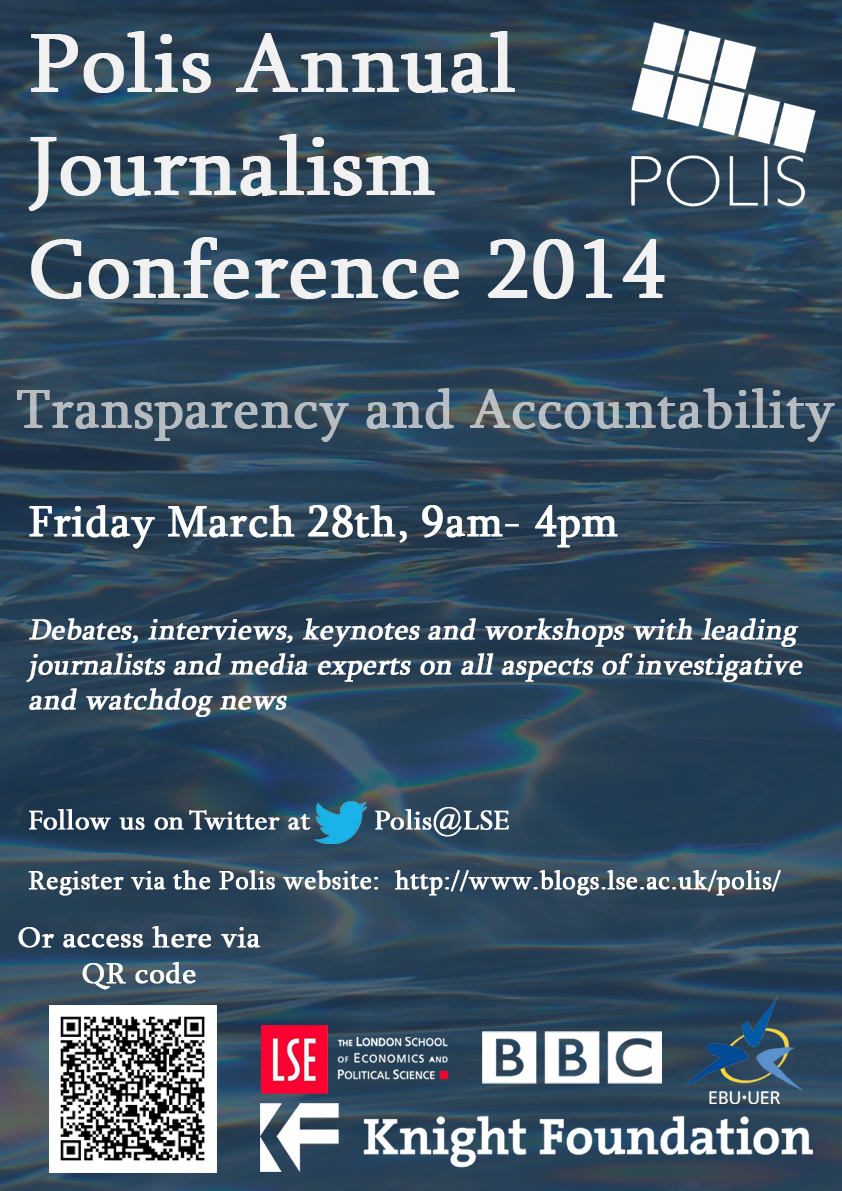
Semi-Partisan Sam will be attending the annual Polis Journalism Conference later today at the London School of Economics for what promises to be a very stimulating day of discussion and debate, featuring – for good or for ill – a Who’s Who of the British media establishment.

Several sessions in particular are especially relevant to the aims and objectives of this blog:

Journalism after Snowden: Watchdog or thug? In the wake of the Snowden story and the Leveson Inquiry into the press, we ask whether British journalism is too supine or too aggressive? Was the publication of state secrets justified?

Taking on the world: The Guardian In the last 12 months The Guardian has published one the biggest scoops in its history. The Snowden revelations brought intelligence officials into its offices to smash up hard-drives. At the same time it is re-inventing itself as the radical liberal journalism platform for the world. Steve Hewlett puts its editor under the spotlight.

The future of transparency journalism A new generation of journalists is emerging, finding fresh ways to hold power to account. What skills do they need? How will their work change? We bring together former top news professionals and journalism educators to debate the way forward.

Holding Europe to account As Europe prepares to go to the polls in a month’s time it is facing a political crisis. How can journalists get citizens to engage with European issues and how should they report on the growth of scepticism?


Stay tuned to @SamHooper on Twitter for live-tweets from the event, and to this blog for discussion and analysis of the conference after the fact.