A moving performance of Aaron Copland’s “Billy The Kid”, arranged for two pianos and performed by Albert Tiu and Thomas Hecht:
The arrangement is slightly richer in detail than the solo piano version, yet still retains that essential, desolate sparseness that makes up so much of Copland’s best writing. In so doing, it also put me in mind of another of Copland’s works, the hugely evocative Quiet City with its glorious solo trumpet.
Christians actively NOT being persecuted in Britain.
The Telegraph’s resident Moraliser-in-Chief, Cristina Odone, has done it again.
In a short column, clearly phoned in and devoted more to promoting her “new ebook” than advancing an intellectual idea of any kind, Odone decides to directly compare the persecution of Christians in other lands – persecution often marked by violent killing – to what she sees as persecution of Christians at home here in Britain. No really, she does:
Being a Christian, in some parts of the world, carries a death sentence. It carries little weight — and attracts a lot of opprobrium — in this part of the world. Having done their best to erase God from public life, secular authorities have stealthily loosened our identity as Christians. As I have written in my ebook, “No God Zone”, traditional ceremonies, rituals and even pledges have been suppressed because of their “religiosity”. Thus, when we witness the sufferings of our “brothers and sisters in Christ”, we feel only a twinge, where once we would have felt a shock.
One poorly written ebook about how Cristina Odone is prohibited from practising her religion in that terrible place, the United Kingdom, available now on your Kindle or iPad. Check for yourself.
And let me paraphrase. Cristina Odone feels so persecuted and reviled for her faith here in Britain that when she sees fellow Christians hacked to death in the middle east it is now all she can do to give them a wry, knowing nod of the head, empathising with their pain? And she thinks that other similarly “afflicted” British Christians feel the same way?
There follow a couple more uninspired paragraph where Odone waffles and fails to express an idea, and then we end with this:
Tragedies like the ones in Nairobi and Peshawar do not make me think all Muslims want to kill Christians; the al-Shabaab guerrillas are no more representative of Islam than the suicide bombers in Pakistan are. But these atrocities do bring home, as a Spectator blog quotes the former Chief Rabbi saying, the dangerous “silence of our friends”. Sadly that silence is rooted in hostility to our faith.
Where to begin? Let’s start with the notion that nefarious “secular authorities” have “stealthily loosened our identity as Christians”.
Odone would do well to find out how many readers of her column attended a church service last Sunday. Or this year. Or in their recent memory. I suspect that when she talks of “our [shared] identity”, she is actually speaking to a minority, even if they call themselves Christian (let’s call them CINOs, people who erroneously use the word Christian interchangeably with “British” or “white”).
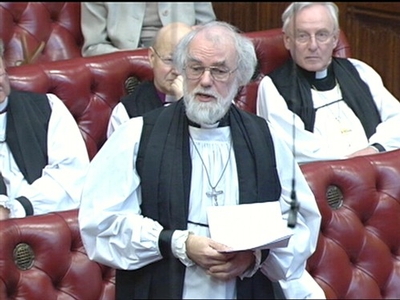
While we’re at it, we should also send Odone back to Citizenship 101 class, so that she can learn about our hereditary monarchy pledged to “defend the faith”, the Lords Spiritual who meddle in our laws and seek to impose their particular brand of Christianity on the nation, the fact that public holidays in Britain coincide with Christian festivals and that Christian hymns are sung in state school assemblies up and down the land. How dreadfully secular.
A walking, talking advertisement for the benefits of separation between church and state
How huge must Odone’s white persecution complex really be, to behold these manifold examples of the Christian faith woven into the fabric of our society, and still come away feeling slighted, aggrieved and persecuted? Newsflash, Odone – denying civil rights to gay people and imposing your morality on others is not part of expressing your faith. Expressing your faith is all about what you yourself choose to say, read, write, eat or wear – not what you want other people to do.
Odone also chooses to bemoan what she perceives as a weak-willed response by western nations to [real] persecution of Christians abroad:
Why should the Foreign Office move heaven and earth to protect Christian minorities in the Middle East when this Coalition allows Christians to lose their livelihood on account of their religious beliefs? Why should the EU get heavy with governments in the Middle East when its member states have signed up to 41 laws that discriminate against Christians?
Here we actually have the semblance of a lucid thought, but of course Odone stops at the feeling aggrieved part rather than proposing any potential solutions to this problem. The EU does not seek to use any of its economic leverage to stop persecution of Christians in the middle east – okay, so what form should this leverage take? Cristina Odone is silent on the matter.
Actual persecution of Christians might look like this.
As for the recent suicide bombings and mass shootings at churches in Pakistan and Kenya, Odone is similarly silent when it comes to a plan of action. Does she favour a military intervention, economic sanctions, or just harsher diplomatic words? We don’t know, because she doesn’t say. And she doesn’t say because she hasn’t given it a moment’s thought.
Because of course, to Cristina Odone, this isn’t really about those long-suffering Christians tucked away in the far corners of the world. It is all about her, the Cristina Odone show, railing against the fact that centuries of engrained bias in favour of her own religion (my religion too, incidentally) are starting to be rolled back in favour of something more slightly resembling equality before the law.
I don’t know who has laid down the definitive best recording of Verdi’s opera “Otello” – not because I have failed to listen to them all in my thirty years on this Earth, but because there are several top contenders. This one, surprisingly, only barely makes the cut for the top five. It does, of course, on the strength of Kiri Te Kanawa and Placido Domingo in the title roles.
Here is “Gia Della Notte Densa” by Domingo and Te Kanawa performed at the Royal Opera, under the excellent baton of Georg Solti:
I defy anyone to name a better performance of this particular duet.
And I’m sorry, but not all arts are equal. Dissenters and critics are free to call me out and accuse me of snobbery on my Comments or Contacts pages; but if you took Miley Cyrus’ twerking antics at the VMAs, multiplied it by a million and plated it in gold, you would have, at most, a hundredth of this performance.
Andrew Sullivan’s take on the extraordinary interview given by Pope Francis to a Jesuit publication is well worth a read. In this series of articles, Sullivan explores not just the stylistic differences between the new pope and his predecessors, but also the likely (and less likely) implications for church doctrine and policy. Well worth a read.
Well, if the theocons hadn’t got the message by now, they can only blame themselves. The new interview with Pope Francis is a revelation. This Pope is not the Pope of a reactionary faction obsessed with controlling the lives of others – a faction that has held the hierarchy in its grip for three decades. He is a Pope in the spirit of the Second Vatican Council, a Pope with a larger and more humane perspective than the fastidious control-freaks that have plagued the church for so long. I need to read and absorb the full interview – it’s 12,000 words long – before I comment at any greater length. But here are the key phrases that are balm to so many souls:
“This church with which we should be thinking is the home of all, not a small chapel that can hold only a small group of selected…




 Semi-Partisan Politics