–
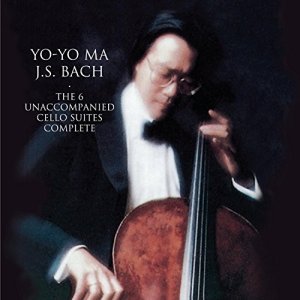
The Sarabande from Bach Cello Suite no. 6, performed by Yo Yo Ma.
And the subsequent Gavotte, from the excellent recent recording by David Watkin:
–
Follow Semi-Partisan Politics on Twitter, Facebook and Medium.
–
The Sarabande from Bach Cello Suite no. 6, performed by Yo Yo Ma.
And the subsequent Gavotte, from the excellent recent recording by David Watkin:
–
Follow Semi-Partisan Politics on Twitter, Facebook and Medium.

–
Definitely not Gilbert & Sullivan
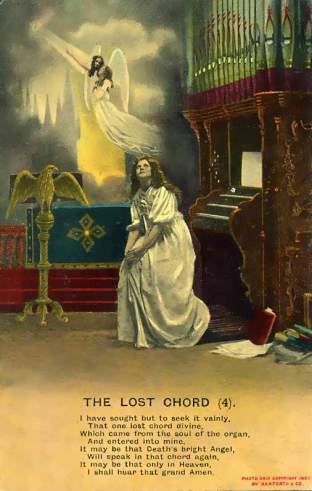
“The Lost Chord”, a song by Sir Arthur Sullivan, setting to music a poem by Adelaide Anne Procter. In this 1939 recording, the song is performed by British tenor Webster Booth.
The song was immediately popular on its publication in 1877, and was memorably performed by Italian tenor Enrico Caruso at a benefit concert for the families of the victims of the Titanic sinking at the Metropolitan Opera in New York on 29 April 1912.
The song is also performed movingly in the Mike Leigh film “Topsy Turvy”, focusing on the famous and often fraught partnership between Arthur Sullivan and his librettist WS Gilbert.
Almost achingly Victorian in style, The Lost Chord has more than a shade of morbidity to it, together with that 19th century greater ease and familiarity with death and loss, which 140 years of medical advances have incrementally, thankfully, deprived us.
The Lost Chord
Seated one day at the organ, I was weary and ill at ease,
And my fingers wander’d idly over the noisy keys;
I knew not what I was playing, or what I was dreaming then,
But I struck one chord of music like the sound of a great Amen.
It flooded the crimson twilight like the close of an angel’s psalm,
And it lay on my fever’d spirit with a touch of infinite calm.
It quieted pain and sorrow like love overcoming strife,
It seem’d the harmonious echo from our discordant life.
It link’d all perplexèd meanings into one perfect peace
And trembled away into silence as if it were loth to cease;
I have sought, but I seek it vainly, that one lost chord divine,
Which came from the soul of the organ and enter’d into mine.
It may be that Death’s bright angel will speak in that chord again;
It may be that only in Heav’n I shall hear that grand Amen!
–
Image: Gilbert and Sullivan Archive
–
Follow Semi-Partisan Politics on Twitter, Facebook and Medium.

–
Ethereal, desolate, beautiful choral music by Vaughan Williams
From the hushed and mystical opening to the blazing fanfares and choruses which follow, the rarely heard oratorio Sancta Civitas (The Holy City) by Ralph Vaughan Williams is one of that composer’s finest compositions and a marvellous addition to the English choral music tradition.
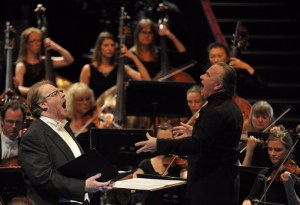
I had the privilege to be at a performance of this work last summer as part of the BBC Proms 2015 season (a much better season, incidentally, than this year’s truly awful, themeless programming – barely one concert worth attending) conducted by the superb Mark Elder and the Hallé Orchestra and Choir.
Though it lacks the splashy, memorable tunefulness of, say, Walton’s Belshazzar’s Feast (which also focuses on the fall of Babylon), Sancta Civitas is no less dramatic, with blazing brass and quickly moving strings as the chorus intones “His eyes were as a flame of fire, and on his head were many crowns” – and “many crowns” crisply emphasised by percussion, adding suitably apocalyptic weight to these extracts from the Book of Revelation.
The offstage boys chorus, trumpet and tenor solo are also used to great effect – acoustically, this worked particularly well in the Proms setting of the Royal Albert Hall – and the piece closes in the same foreboding murmur in which it begins.
As Michael Steinberg puts it in “Choral Masterworks: A Listener’s Guide”, describing the culmination of the piece:
And now comes the miracle in this great work, a new voice, a solo tenor, saved for this moment, and singing just sixteen words: “Behold, I come quickly, I am the bright and the morning star. Surely I come quickly.” Barely above the threshold of audibility the choir, ppp and parlando, responds: “Amen. Even so, come, Lord.” And with last recollections of the opening music, the vision of Sancta Civitas fades beyond our hearing.
Sancta Civitas is performed all too rarely, which is a great shame. The score possesses a rare, brooding, desolate beauty – particularly understandable, perhaps, given that it was composed in 1923-5 and had its premiere during the 1926 General Strike, so soon after the guns of the First World War fell silent.
Religiously speaking, this is an inescapably austere vision of the Holy City. No clouds and rainbows and reunions with long-deceased pets here; this is a vision of the Holy presence of God which strikes awe and no small amount of fear in the heart. Part of me responds positively to this – often the Christian faith today seems to be sanitised or presented in U-rated form, be it deliberately childish-sounding worship songs or watered down teaching of core doctrine. Sancta Civitas evokes something much more traditional and even severe, which in some ways is no bad thing.
Regardless: here is quintessentially Modern English choral music at its very best – but you probably have to be in the right mood.
–
Follow Semi-Partisan Politics on Twitter, Facebook and Medium.

–
Thank you for the music
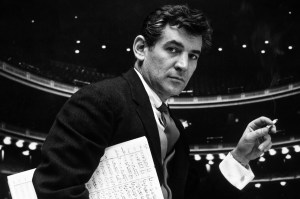
The late Leonard Bernstein, whose 98th birthday would have been today, conducting Candide Overture from a concert performance of Candide with the London Symphony Orchestra and Chorus, recorded in December 1989.
This performance took place just a few short years before I started the first of many pilgrimages to the Barbican Centre to see the LSO perform. Many faces in the orchestra, some sadly now departed, are familiar to me.
Leonard Bernstein is one of my heroes – an exuberant man brimming over with talent and energy, someone who knew exactly what he wanted to do with his life, and who got on and did it: making music in all its glorious forms.
A rich life truly lived, and an unparalleled contribution made to American music, including some of the 20th century’s most achingly beautiful.
Happy birthday, Maestro.
–
Follow Semi-Partisan Politics on Twitter, Facebook and Medium.



 Semi-Partisan Politics