OscarsSoWhite: The Self-Flagellating, Social Justice Academy Awards

Chris Rock - Oscars Monologue - OscarsSoWhite

Chris Rock’s opening monologue was brilliant – but bombarding Oscars viewers with four hours of social justice preaching was too much, and served the messengers far more than the causes they promoted

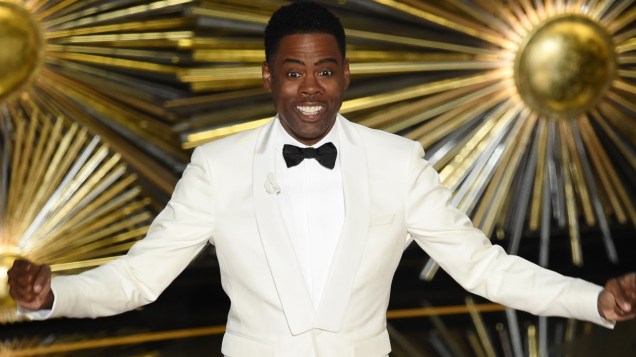
At the opening of Chris Rock’s excellent hosting of the 88th Academy Awards in Hollywood, the comedian made a joke which sets some very important and much-needed context for the #OscarsSoWhite and social justice-obsessed debate leading up to the star-studded ceremony.

From the New York Times transcript of Chris Rock’s remarks:

It’s the 88th Academy Awards. It’s the 88th Academy Awards, which means this whole no black nominees thing has happened at least 71 other times. O.K.?

You gotta figure that it happened in the 50s, in the 60s — you know, in the 60s, one of those years Sidney didn’t put out a movie. I’m sure there were no black nominees some of those years. Say ‘62 or ‘63, and black people did not protest.

Why? Because we had real things to protest at the time, you know? We had real things to protest; you know, we’re too busy being raped and lynched to care about who won best cinematographer.

You know, when your grandmother’s swinging from a tree, it’s really hard to care about best documentary foreign short.

It is great to see Chris Rock – incidentally, one of the many high profile comedians who now refuse to perform on American college campuses because of the stultifying and censorious climate created by Social Justice Warrior (SJW) activists – making this point, which frequently gets lost in our climate of perpetual outrage.

(Though sadly, because everything and everyone is “problematic” these daysand because Social Justice Warriors ruin everythingthe bien pensant criticism of Rock’s monologue is already gathering steam).

Is it perhaps unfortunate that there were no black nominees among the various acting categories? Maybe so – although it was hardly statistically unlikely, given the fact that African Americans make up just thirteen per cent of the US population. But the mere fact that we are now arguing about whether black actors (Hispanics and other minorities seemed to do quite well in terms of winning awards) are being systematically excluded from the ultimate expression of Hollywood elitism shows in itself just how far we have come.

This is not to negate the very real discrimination against black people which still exists, particularly in the criminal justice system and law enforcement – notably several high profile killings of unarmed black suspects by the police. This blog covered the Michael Brown shooting in Ferguson, Missouri and I offered my own sympathetic perspective from having spent many months and years visiting the St. Louis area.

But one has to go back only a few short decades to encounter a time when the threat to “black bodies” (a strange term which is increasingly fetishised in the media – particularly through use by writers such as Ta-Nehisi Coates, whom I greatly admire even when we disagree) was far more universal, and not primarily the concern of black teenagers murdered while committing a minor misdemeanor, or black actors shunned by the movie industry.

What became increasingly concerning as the Oscars wore on, though, was the fact that Chris Rock’s excellent, light-hearted but pointed acknowledgement of the controversy and the shortcomings of Hollywood, was only the first salvo in a barrage of social justice virtue-signalling and white guilt self-flagellation which ultimately consumed the entire ceremony. Every segment between awards seemed to have to involve conspicuous references to the #OscarsSoWhite drama, which became grating and unnecessary after awhile.

Some people were quick to sanctimoniously declare that this was deserved:

https://twitter.com/gmgannon/status/699455425633243137

Because not only does every occasion now have to be a teaching moment for the social justice agenda, the point must be laboured again and again. Not because it does anything to actually improve the availability of good roles for black actors in Hollywood, but because each presenter who touched on the theme was then able to imbue themselves with the same “I’m part of the solution, not the problem aura”.

This reached a heady climax when Vice President Joe Biden made a surprise appearance on stage to introduce Lady Gaga and plug his campaign against sexual assaults at college. While every decent person should be able to get behind the idea that nobody should be raped while studying at university, or indeed at any other time, this was then followed by the pernicious idea that “It’s on us” (i.e. perfectly innocent members of the public) to prevent rape.

The organisation promoted by Vice President Biden, ItsOnUs.org, asks us to take the following actions in our own lives:

To RECOGNIZE that non-consensual sex is sexual assault.

To IDENTIFY situations in which sexual assault may occur.

To INTERVENE in situations where consent has not or cannot be given.

To CREATE an environment in which sexual assault is unacceptable and survivors are supported.

The first pledge seems perfectly reasonable. But the remainder seek to transform us into perpetually vigilant informants and secret police agents, scanning crowds and charging to intervene in situations where we are uncertain that consent has been given, even when we lack critical context.

The idea that the average person will ever have the opportunity to “intervene in situations where consent has not or cannot be given” is particularly ludicrous – but these days, one can quite easily imagine squads of purse-lipped student “consent educators” roaming popular nightspots and breathalysing couples leaving bars and clubs to ensure that sexual relations do not follow the consumption of beer (heaven forfend).

But scroll to the end of the ItsOnUs website and you’ll see the only possible tangible outcome of the campaign – the ability to superimpose the organisation’s logo on to your social media profile picture, thus allowing those who take the pledge to ostentatiously parade their “I, too, am not a rapist” credentials before their equally vapid friends.
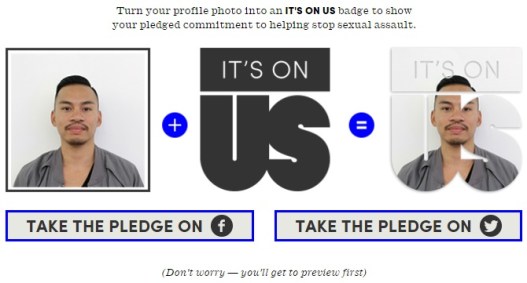
It's On Us - Rape Culture - Sexual Consent - Oscars - Joe Biden

The idea that college campus rape can be prevented by mandatory sexual consent workshops, “raising awareness” or taking online pledges in a blaze of self-promotion is utterly ludicrous. Nobody who has been raised since childhood to disrespect women or act in a sexually entitled and bullying way is going to be reformed or turned away from committing rape by being lectured by an earnest Social Justice Warrior. The revolution which must happen is in our homes, our morals and our family life, and will not be accomplished through lectures from the stage of the Dolby Theatre in Los Angeles.

But words are very much the SJW tool of choice, and the extent to which language is being weaponised in furtherance of a certain narrow agenda again became much clear later in the Oscars ceremony.

The BBC reported:

And oh, were there causes! A whole smorgasboard of enlightened liberal issues, as if everyone thought they had to live up to the tone of noble chastisement set by the diversity issue. Lady Gaga, seated at a starkly lit white piano, sang ’Til It Happens to You, the song she wrote for the campus-rape documentary The Hunting Ground, and though it’s a lugubrious number, her goggle-eyed manner seemed like an attack on the audience.

The movement for transgender rights was propped up by several mentions of the forward-thinking phrase “gender confirmation surgery”.

This, of course, is in relation to the film “The Danish Girl”, the biographical portrayal of the life of Lili Elbe, one of the first recipients of sex change surgery, who transitioned from male to female.

Eddie Redmayne’s Oscar nominated performance was by all accounts outstanding, and the issues raised about the prejudice, discrimination and abuse suffered by many transgender people are real and worthy of serious discussion. But this cannot come at the expense of our language and our shared perception of reality, and unfortunately the attempt to shoe-horn the new phrase “gender confirmation surgery” (as opposed to gender reassignment surgery) into the Oscars ceremony does just that.

You may recall attempts in the more conservative, right-wing media over the past decade to re-name suicide bombings as “homicide bombings”. This seemed to stem from the feeling that to focus on the suicide of the perpetrator gave undue prominence to the terrorist and detracted from the victims, which was of particular concern to conservative news outlets covering terrorist attacks against Israel and the West.

Unfortunately, the phrase “homicide bombings” also sows confusion, obfuscates reporting and makes it much harder for people to understand what has taken place. All bombings (or all successful ones, anyway) are homicide bombings by definition, since their purpose is to kill people. But not all bombings also involve the deliberate suicide of the perpetrator in the explosion. This is a characteristic unique to suicide bombing, and is what makes it distinct from, say, the IRA’s bombing of the 1984 Conservative Party conference in Brighton, England, where the bomber set the explosive device a month prior to the attack and was well out of harm’s way when it took place.

Regular bombing versus suicide bombing – an important distinction in terms of terrorist tactics is mirrored and emphasised by a difference in language. In the case of suicide bombing, the language rightly calls our attention to the unique aspect of that style of attack. Calling it “homicide bombing” makes such attacks indistinguishable from any other terrorist attack, and actively decreases our understanding. Some conservatives believe that this mangling of language is nonetheless desirable in order to express our particular disapproval of suicide bombing. Most sensible people would scoff at such a fatuous and superficial idea.

And this is exactly what we saw take place on stage at the Oscars last night. Not a suicide bombing, thank God. But an attempt to forcibly change the language we use, stripping away the most descriptive part of a commonly used phrase like “gender reassignment surgery” by substituting the word “confirming” instead, in order to bestow our further approval on the act.

Prevailing sentiment dictates – quite probably correctly – that transgender people are born into the wrong bodies, and that surgery which physically changes their genitalia and appearance is therefore merely correcting a mismatch between physical reality and mentally experienced reality. But now, it is no longer politically correct to talk about somebody changing their gender through means of surgery, because that sounds too drastic. Now we must say that the surgery merely “confirms” their existing, mentally experienced gender. Surgically removing a penis and creating an artificial vagina can no longer be described truthfully as a medically significant and life-changing physical alteration, but merely a “confirmation” of someone’s inner being.

Regardless of one’s thoughts about transgender issues, there should be no disputing that forcibly mutilating our shared language just to signal our approval or disapproval of an act – at the expense of clear meaning – is not merely an act of wishful thinking, trying to conjure a new reality by stating it loudly enough, but is also a bleakly totalitarian way to approach the issue. And yet this, too, was preached to us during the Oscars ceremony.

All in all, it was quite an evening.

White privilege-shaming in nearly every segment. Sexual consent shaming from no lessa figure than the Vice President. All capped off with a deliberate attempt to wrest control of the English language, bending it away from reality and toward to the will of the Social Justice Warriors and their remarkably intolerant form of tolerance.

And this is just Hollywood – that bastion of progressive opinion – talking to itself, preaching fervently to the choir.

If this is what they are prepared to inflict on themselves, God only knows what forms of indoctrination, shaming and corrective punishment lie in store for the rest of us.


OscarsSoWhite - Academy Awards - Social Justice - Virtue Signalling - 2

Agree with this article? Violently disagree? Scroll down to leave a comment.

Follow Semi-Partisan Politics on TwitterFacebook and Medium.

BBC Daily Politics: If Students Need Safe Spaces, They Have No Business Voting

BBC Daily Politics - Sam Hooper - Samuel Hooper - Semi Partisan Politics - semipartisansam

Today I will be a guest on the BBC’s flagship Daily Politics show, discussing the worrying and accelerating infantilisation of today’s university students and asking whether young people who need the protection of trigger warnings and safe spaces can possibly be trusted to responsibly exercise their democratic right to vote.

Last year, in response to a brilliantly provocative column by American law professor and political blogger Glenn Reynolds – in which he argued that today’s generation of coddled, micro-aggression fearing students have utterly failed to earn the right to vote – I went along for the ride, agreeing:

It is ironic that at the same time there is a push to lower the voting age in the UK – the Lords recently voted to allow sixteen and seventeen-year-olds to vote in the coming Brexit referendum – people only slightly older and now at university, who already have the vote, are busy regressing back into emotional childhood.

[..]  Given the increasing number of campus incidents of precious snowflake students demanding that the authorities curtail their liberties for their own “safety” – and the fact that increasing age is the last, best hope of gaining wisdom – the idea of raising the voting age does start to feel awfully tempting.

Response written, I then didn’t think much more of it. That is, until the other week when I was contacted by the BBC and asked whether I wanted to state the same case on their flagship political programme, the Daily Politics.

The context of the issue is known well enough, and I have blogged extensively about the worrying and absurd rise of calls to outlaw clapping and booing, tearful temper tantrums about dress codes, stifling ideas by labelling them ‘problematic’, the tedious insistence on “safe spaces” and mandatory sexual consent workshops, all of which are flourishing on British and American university campuses.

Now, do I really want to stomp around like a little authoritarian, summarily revoking the franchise from every group of people who happen to rile me up? Well, as readers of this blog already know, I would generally rather leave the screeching, sanctimonious authoritarianism to those who do it best – the student activists busy cocooning their young minds in an ideologically homogeneous bubble, and purging any dissenting viewpoints which threaten their “mental safety”.

But I couldn’t resist the opportunity to make the urgent case that if things continue on their current course – with children being raised to believe that “sticks and stones may break their bones, but words will kill them stone dead”, and growing up to become intolerant students intent on purging anybody who fails to fawn deferentially over their delicate sensibilities – then before long, none of us will possess the intellectual and social robustness required of an engaged citizenry. And none of us will make good voters.

I want to stop the rot before it gets that far. But doing so will require confronting some difficult truths. And among these truths are the fact that the world of academia (particularly in the US – but where America goes, Britain already follows) has become infected with a virus which produces legions of what can only be described as adult babies – people who are physically mature, but with the emotional and psychological resiliency of a toddler.

The extent of the rot was laid bare in Spiked’s 2016 university free speech rankings, which forensically detail the extent to which free speech is curtailed at every university campus and students union in the country.

To give just a few examples, at present there are 30 students union which have banned newspapers (no prizes for guessing which publications), 25 which have banned mainstream hit songs for being “offensive” and 20 which have banned clubs or societies. But they only take their cue from the universities themselves, nearly half of which enforce “No Platform” policies against controversial speakers and a fifth of which have already moved to import American-style “safe space” policy onto their campuses.

I’m due to debate with Conservative MP and Culture Minister Ed Vaizey, as well as Labour MP Kate Green. It will be very interesting to see whether I am able even to extract any acknowledgement that there is a problem which needs to be tackled. However, with the Conservative government leaning hard on universities to protect the fragile minds of their students by banning extremist speakers and Labour poised to benefit disproportionately from the authoritarian student vote, I’m not expecting a tremendously sympathetic hearing.

Watch this space!

Watch me debate on Wednesday’s edition of the Daily Politics, broadcast on BBC Two at 11:30 for the start of the programme (and PMQs), and at 12:20 onwards for my segment.

Alternatively, watch live or catch-up on BBC iPlayer.

Safe Space Cartoon - 1

Bottom image: Honey Badger Brigade

Support Semi-Partisan Politics and independent political writing:

Agree with this article? Violently disagree? Scroll down to leave a comment.

Follow Semi-Partisan Politics on TwitterFacebook and Medium.

Why I Write

Political Blogging

At the risk of sounding like a PBS telethon…

Why isn’t there more good journalism out there? Gawker paints a depressing picture for those of us who toil away in the often thankless business of writing.

Hamilton Nolan writes:

Many writers believe that our brilliant writing will naturally create its own audience. The moving power of our words, the clarity and meaning of our reporting, the brilliance of our wit, the counterintuitive nature of our insights, the elegance with which we sum up the world’s problems; these things, we imagine, will leave the universe no choice but to conjure up an audience for us each day.

Time and experience have long since disabused me of any such idea. Fortunately, writing about politics and public policy – if immensely frustrating at times – is also its own form of reward.

Nolan concludes:

Maybe there is a talented young writer out there with a dream of starting the very best, smartest magazine or website that has ever existed, and building it into their very own historic legacy. I am here to tell you that it will not work. The business of media has very little, if anything, to do with quality journalism. If you aspire to be a Writer of Legitimately Good Things, the best you can hope for is to get the prestige spot that is paid for by the garbage. To hope for a prestige spot that is not paid for by garbage, or by a lone rich wacko, or by a new advertising technology, but instead by the mass audience that will flock to your brilliance is to ask for too much. If you are able to get a job writing good stuff, you are one of the lucky ones in the big Exercycle of Mindless Entertainment that is “the media.”

Now, political writing certainly shouldn’t be an easy career option. After all, it takes a certain arrogance to expect to be remunerated for sitting at a keyboard ranting about the state of the world and pontificating on the “obvious” solutions to society’s ills, particularly when there are people out there doing real work like serving in the armed forces, providing healthcare, creating world-class art, working out how to get to Mars or producing amazing, unthought-of new consumer products.

There are certainly times when my own efforts at political writing seem depressingly far from the high ideal set out by George Orwell, and much closer to the ranting of the pub bore or the slick keyword focus of the SEO marketer – though having done this (with varying levels of commitment) for four years now, I hope that I am somewhat better than when I started out.

Earlier this week I was at a talk given by Dan Hodges about his general election book “One Minute To Ten”, and got chatting to a senior journalist from the Sunday Times. I put to him that while political blogging may have been ripe with promise ten years ago, the format seems to have dried up today, and readers left with the choice between established legacy media outlets or the latest viral clickbait funnelled through social media.

He didn’t disagree, and hammered home the fact that many readers currently have almost zero loyalty to any specific news outlet, and instead get their news according to what happens to be trending on social media or appear in their (often bias-reinforcing) news feeds. This trend is reflected in the traffic stats for Semi-Partisan Politics. A sizeable minority of traffic now comes through Facebook in particular, and there is always the temptation to devote time and effort to promoting pieces on Facebook to get more eyeballs on the latest piece, even if it brings in few potential long-term readers with whom one can develop a relationship.

The one positive trend at present is the growing and thriving community of Brexit bloggers and campaigners coalescing around eureferendum.com and the work of Dr. Richard North to promote Flexcit – by far the best (and only) properly thought-through plan for how Britain might best leave the European Union and re-emerge as a globally engaged, prosperous sovereign democracy.

If only the same collegial, rigorous and dedicated spirit could be found elsewhere in the political blogosphere as exists among many of my fellow Brexiteers (see links in the sidebar on the right), journalism in this country – particularly citizen journalism and the concept of the campaigning blog – might not be in quite such a parlous state.

Regardless: whatever the people at Gawker say, Semi-Partisan Politics will continue to grow and flourish as we enter 2016, and will campaign – loudly and unapologetically – for the following goals and ideals:


Brexit: freedom from the European Union

Democracy and national sovereignty

Constitutional reform and a federal UK

Separation of church and state

Healthcare reform, not NHS worship

Smaller, smarter government

Free speech, without restriction

Fighting timid centrism on the Right

Fighting empty virtue-signalling on the Left


If you agree with these objectives and enjoy this blog’s coverage of UK politics and current affairs, please do consider using the PayPal tip jar to make a small regular contribution or a one-time donation:


Any reader donations will 1) be a personal ego boost to myself, 2) help me to do more original reporting, like the successful live blog of last year’s UKIP annual conference, and 3) help me promote this site and the work of other like-minded writers – particularly in the crucial effort to win a “Leave” vote in the coming Brexit referendum – so that we can actually make a difference.

Small donations from individual contributors are not only greatly appreciated by me, but also help to preserve independent journalism and commentary in general – so that nobody has to rely exclusively on the BBC, the Guardian or the Telegraph to understand what’s going on in our country and around the world.

But it’s not all about the money. What matters even more than that (for me) is spreading the word and sharing the message – and these days, like it or not, that means social media. So if you read something you like here, don’t just sit on it. Share it on Twitter or Reddit. Email it to a friend. Be that person on Facebook who posts provocative political articles on their timeline.

2016 is already off to a good start – pageviews and comments are at their highest ever, and an appearance on a certain major national political TV show (to be announced soon) is in the works. Onwards and upwards!

Many thanks to all my readers for your continued generous support.

Follow Semi-Partisan Politics on TwitterFacebook and Medium.

A Merry Semi-Partisan Christmas

Political Blogging 2

Onward to 2016, with your help

2015 has been a very good year for this blog. The frequency of posts increased dramatically as we covered the general election and its aftermath, and we have kept up the pace ever since. There are now new articles nearly every day, as well as a more lively Twitter feed.

The net result has been an increase in readership of nearly 400%. This blog is still small, but a number of articles have caught the attention of influential MPs, journalists and activists. And nobody recognised or wrote about the eventual cause of Labour’s general election defeat before this blog, though many others have subsequently swooped in to take credit.

My writing is syndicated at Guerilla Policy, where I seem to be the lone conservative voice amid a sea of unabashed lefties, and I am proud to contribute regularly to the excellent campaign group Conservatives for Liberty.

Semi-Partisan Politics will continue to grow and flourish as we enter 2016, and will campaign – loudly and unapologetically – for the following goals and ideals:


Brexit: freedom from the European Union

Democracy and national sovereignty

Constitutional reform and a federal UK

Separation of church and state

Healthcare reform, not NHS worship

Smaller, smarter government

Free speech, without restriction

Fighting timid centrism on the Right

Fighting empty virtue-signalling on the Left


If you agree with these objectives and have enjoyed this blog’s coverage over the past year, please do consider using the PayPal tip jar to make a small regular contribution or a one-time donation:


Any reader donations will 1) be a personal ego boost to myself, 2) help me to do more original reporting, like the successful live blog of this year’s UKIP annual conference, and 3) help me promote this site and the work of other like-minded writers so that we can actually make a difference.

As I swiftly learned this past year, writers don’t get paid very much (unless you are Owen Jones). This blog is written in my spare time around a day job, usually between midnight and 3AM, and is available to everyone free of charge.

However, small donations from individual contributors are not only greatly appreciated, but also help to preserve independent journalism and commentary in general – so that nobody has to rely exclusively on the BBC, the Guardian or the Telegraph to understand what’s going on in our country and around the world.

If you are happy getting all of your news, analysis and commentary from the BBC or the big national newspapers, then by all means carry on. But if you value independent writing which is not beholden to any party, clique or the Westminster establishment, then please consider helping to ensure its continued existence by donating a couple of quid to the independent sites which keep you coming back for more.

But it’s not all about the money. What matters even more than that (for me) is spreading the word and sharing the message – and these days that means social media. So if you read something you like here, don’t just sit on it. Share it on Twitter or Reddit. Email it to a friend. Be that person on Facebook who posts provocative political articles on their timeline (but all things in moderation).

With the help of my informed and generous readers, 2016 will be another record-breaking year for Semi-Partisan Politics.

Many thanks to all of you, and a very Merry Christmas.

Christmas Wreath 2

Follow Semi-Partisan Politics on TwitterFacebook and Medium.

The Daily Smackdown: Cynical Bishops Exploit Terrorism For Publicity

BBC Religion Television

Who will condemn the bishops for exploiting our fear of terrorism in their grubby bid to preserve taxpayer funding of the BBC’s religious output?

The Church of England is very upset that the BBC is considering cutting the amount of taxpayer money it spends on (predominantly) Christian television output.

From the Telegraph:

A spokeswoman confirmed that the BBC was planning to “look at ways we can reduce costs” as it faced “huge financial challenges” but added that cuts would come from across the corporation.

The Bishop of Norwich, the Rt Rev Graham James, the Church of England’s lead spokesman on media issues, said the move could threaten something which was “fundamental to our public life”.

“It seems to me that religion has already taken a hit,” he said.

“It has already been reduced certainly in terms of its scope as an independent part of the BBC, at a time when we already need – as everyone acknowledges – more religious literacy in the nation.”

Nothing unusual there. The Church of England is a well oiled lobbying machine, and any private organisation lucky enough to have a bloc of 26 unelected representatives sitting in parliament to influence our laws in their favour would be foolish not to make good use of them. Thus it is no surprise that the unelected theocrats of our state church have been hard at work speaking out against the BBC’s planned actions.

But the fact that the Church of England’s behaviour is understandable does not make it any less reprehensible. Firstly, because it makes a total mockery of the idea of the BBC as an independent broadcaster. Nobody seriously believes that an organisation whose budget is nearly totally dependent on taxpayer money can be truly independent, but the fact that the Lords Spiritual are now actually speaking in parliament about the internal decisions and strategy of the BBC makes any pretence of the BBC’s impartiality or the government’s non-involvement utterly ridiculous.

Worse than this, though, is the flimsy rationale now offered by the bishops as a pathetic excuse for more taxpayer funded religious programming:

Bishops have warned the BBC it risks turnings its back on efforts to tackle extremism and aid integration by slashing spending on religious programming.

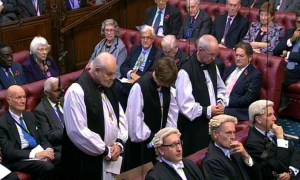
[..] The first female cleric in the House of Lords, the Bishop of Gloucester, the Rt Rev Rachel Treweek, remarked that the decision had presumably been taken “to reduce the possibility of offending people with too much God stuff over the holiday”.

It is good to see the newly enobled Rachel Treweek, my Lord Bishop of Gloucester, is wasting no time in rolling up her sleeves and interfering in our national democracy as generations of theocrats have done before her. She will be making the home team very proud. But unfortunately, she and her fellow Lords Spiritual are talking nonsense.

The argument that cutting the amount of taxpayer money devoted to religious television and radio programming on the state broadcaster is somehow a threat to anti-extremism efforts is as ridiculous as it is unfounded.

More moderate Christianity on TV will not result in less Islamic extremism on the margins of British society. And pontificating, busybody bishops who abuse their parliamentary platform to suggest otherwise should provide evidence for the supposed link, or else retract the claim and admit that they are simply exploiting serious issues of national security in a cheap ploy to gain more taxpayer-funded airtime.

The real issue is not so much the pull factor of extremism as the push factor of the alienation of too many young Muslims from British society. It’s the fact that we have living among us too many self-segregated societies comprised of people who hold the same passports as us, but look upon us – and the enlightenment values of reason, education, liberty and democracy to which we try to adhere – as alien and unwelcome. By failing to inculcate a strong and inclusive sense of Britishness, out of craven fear of causing offence, we provide the Islamist recruiters with easy fodder.

Do my Lord Bishops of Gloucester and Norwich (flowery titles for a bygone age) seriously believe that the kind of alienated youths and their families who are now quietly slipping away to ISIS in Syria or seeking out radicalising materials online are the same type of people who tune in to BBC Two at six o’clock in the evening, ready to be reached out to and placated with a documentary about public spirited imams, rabbis and priests working together to open a new community centre? What nonsense.

The people most in need of the BBC’s moderate religious programming and generally liberal worldview are those whose eyes are glued to YouTube videos of anti-American 9/11 conspiracy theories or seditious social media conversations on their smartphone screens. More government intervention – be it through Prevent or the BBC – is not going to make meaningful inroads to these people. The only lasting solution must come from the bottom up, a revitalisation of patriotism and pride in Britain, and the promotion of a common British identity which transcends racial divides (rather than revelling in a multicultural dystopia which sees groups living side by side but separately in parallel, alienated lives.

Do the Lord Bishops have anything meaningful to say about that? No, they do not – perhaps with the exception of the Bishop of London, Richard Chartres.

This is in no way intended as an attack on religion, or on the Church of England (so long as it stays within its own boundaries and stops trying to play an undue role in our public life). I grew up watching Songs of Praise on a Sunday, and have happy memories of doing so. But it is not right for general taxpayers of an increasingly secular country to continue funding religious programming using a model that invites some appointed bureaucrat or another to choose which religions or denominations are to be favoured above others.

Perhaps the Lords Spiritual begin to grasp this. Perhaps they are grasping at these increasingly ludicrous excuses for their continued influence because deep down, they realise that they have no place in the government of a twenty-first century democracy.

But if these are the death throes of theocracy in Britain, they are still very offensive indeed. Claiming that the BBC should continue to spend taxpayer money on religious output favouring the established church because failing to do so will unleash more extremism – and note how the bishops cannot bring themselves to utter the name of the religion from which that extremism currently emanates – is cynical and manipulative, playing on the fears of British people just to win more free promotion.

I have never expected much from the Church of England’s upper hierarchy, or their antidemocratic parliamentary delegation. But this is low, even by their rock-bottom standards.

First female bishop to sit in House of Lords

Agree with this article? Violently disagree? Scroll down to leave a comment.

Follow Semi-Partisan Politics on TwitterFacebook and Medium.