Clarence Darrow vs The Rotten Soul Of Today’s Labour Movement

Kevin Spacey Clarence Darrow 2


What would the famous labour lawyer and anti-death penalty advocate Clarence Darrow say to the late RMT union leader Bob Crow if the two men were to meet in Heaven?

The mental image of their fictional meeting would not leave my mind after I watched Kevin Spacey’s remarkable portrayal of the former unfold in the eponymous one-man play Clarence Darrow at London’s Old Vic Theatre on Friday.

The production – which is well reviewed here, here and here, and in which an elderly Darrow looks back on the many victories and tribulations of his long legal career – gave considerable attention to Darrow’s union activism through his defence of the American Railway Union leader Eugene Debs in the 1894 Pullman Strike, and of the McNamara brothers charged with dynamiting the Los Angeles Times building in 1910, among other famous episodes.

But watching Kevin Spacey portray Clarence Darrow is to see an impassioned and eloquent defence of the rights and dignity of working people that today’s current and recently departed left wing political and union leaders could never hope to equal.

Witnessing the spirit and passion of Clarence Darrow flicker to life on a London stage made it starkly apparent just how close the modern labour movement is to purposelessness and death in the Age of Miliband.

While Darrow in full rhetorical flight could have convinced Ronald Reagan or Margaret Thatcher themselves of the need to concern themselves with the welfare and aspirations of the mother and father working minimum wage jobs on zero hour contracts, today’s left-wing figureheads come across as whiny, self-entitled and spitefully partisan by comparison.

Here are the stirring words of Clarence Darrow in an address to the inmates of Cook County Jail in 1902, the theme of which would be taken up by Ed Miliband and the Labour party in a bold reassertion of conviction politics were today’s labour movement not so politically calculating and intellectually inert:

To take all the coal in the United States and raise the price two dollars or three dollars when there is no need of it, and thus kills thousands of babies and send thousands of people to the poorhouse and tens of thousands to jail, as is done every year in the United States — this is a greater crime than all the people in our jails ever committed, but the law does not punish it. Why? Because the fellows who control the earth make the laws. If you and I had the making of the laws, the first thing we would do would be to punish the fellow who gets control of the earth. Nature put this coal in the ground for me as well as for them and nature made the prairies up here to raise wheat for me as well as for them, and then the great railroad companies came along and fenced it up.

How relevant to today, given the present Labour Party’s focus on the “cost of living crisis” and its apparent determination to freeze consumer energy bills.

But here instead is Ed Miliband warning us of the supposedly mortal threat to the unions posed by David Cameron’s Conservative-led coalition government, in a typically unmemorable speech to the 2013 TUC conference:

We have a Prime Minister who writes you and your members off. Who doesn’t just write you off, but oozes contempt for you from every pore. What does he say about you? He says the trade union movement is a “threat to our economy”. Back to the enemy within.

Six and a half million people in Britain. Who teach our children. Who look after the sick. Who care for the elderly. Who build our homes. Who keep our shops open morning, noon and night. They’re not the enemy within. They’re the people who make Britain what it is.

How dare he? How dare he insult people – members of trade unions – as he does?

Terrible speechwriting aside, Miliband’s suggestion that David Cameron spends his every waking hour plotting against the trade union movement like a modern-day Iago is patently absurd. While the Conservative Party – as one would expect – raises objections to various union policies and rhetoric and their self-interested leadership, you will search in vain to find any evidence of the prime minister “oozing contempt”.

Ed Miliband (in his halting, aggrieved and ineffectual way) and others try hard to continue the life-and-death struggle narrative laid out by Darrow a century earlier, but the fact that their comments are aimed at a modern British audience – even the poorest of whom likely own smartphones, personal computers and enjoy access to universal healthcare via the NHS – renders them ridiculous.

Where Darrow wore his heart on his sleeve and walked the walk of labour advocacy – foregoing a more lucrative career in order to oppose his old railroad bosses who were oppressing their workers – today’s leaders such as Miliband and his union counterparts often hail from the same metropolitan middle and upper-middle classes who form the middle management and ranks of senior civil servants for whom so many working Brits toil. And what’s more, Labour politicians and the management class now talk and sound alike.

Whereas Clarence Darrow stood firmly for worker’s rights without lapsing into sentimental and unworkable socialism, the response of the likes of Ed Miliband, Len McCluskey and Mark Serwotka to our present pale shadow of real austerity has been snarling and misleading hyperbole about the Conservatives “hating” the poor and taking an obscene delight in their suffering.

(It is conveniently forgotten by these anti-Tory crusaders that the suffering was largely created by a gradual bipartisan expansion of the state, and by making so many British people dependent on the government for one thing or another that any retrenchment of spending now has a widespread, painful effect that would not be the case if the government didn’t try to do so much.)

The victories won by organised labour in Clarence Darrow’s day saved lives and liberated millions of people from what William Beveridge would later describe as the five “Giant Evils” in society: want, disease, ignorance, squalor and idleness. And they are immortalised in rights and traditions which endure to this day, such as the annual May Day march and rally in London, and the Labor Day federal holiday in America.

The victories won by the left wing establishment of today (and the debauched, rudderless trades union to whom they are captive) are comparatively petty and trivial, and each passing ‘victory’ incrementally serves either to perpetuate inefficient public sector service delivery or entrench benefits for union members at the expense of the ranks of the budding entrepreneur class, the self employed, the underemployed and the jobless.

The union men of Darrow’s America (and their British counterparts) would be horrified to witness the tanned, bloated, self-satisfied swagger of men like Bob Crow, who delighted in tormenting other ordinary working people with their undemocratic strikes in order to preserve the gold-plated salary and benefits of, say, a tube driver on the London Underground who gets paid well over twice as much as a newly trained Private fighting for his or her country in the British Army.

So how would Clarence Darrow feel upon meeting the likes of Bob Crow?

One can only imagine, but in fairness, it is not unreasonable to think Darrow would first feel immense satisfaction and relief that the causes for which he fought have come to fruition and done so much good, not just in the United States but throughout the Western world.

His heart might swell to know that not only have child labour and the exploitative company towns of his day been cast into history, but that the strength of public sentiment stands firmly against multinational companies who try to take undue advantage of lower standards and regulations in other parts of the world – although there is undeniably still much work to be done.

But a man of such conviction as Clarence Darrow would also likely recoil at the nanny-state socialism, self-entitled smugness and the bitter, envious rhetoric of people like Bob Crow and today’s labour movement leaders, who have casually sauntered in his hard-fought footsteps across what is now much easier political terrain.

And a final bold prediction: A century from now, in the year 2114 – no matter how much the current generation of labour leaders try to portray themselves as intrepid generals locked in an ongoing epic battle for the rights of the downtrodden and the dignity of man – nobody will spend hours queueing for return tickets to a play honouring the life’s work of the likes Ed Miliband, Bob Crow or others of their calibre.

Truly great women and men like Clarence Darrow fought and won ninety percent of the battle before today’s privileged, metropolitan, self-appointed guardians of the common man ever picked up a protest placard or stumbled into their first Labour Students Society meeting.


Clarence Darrow finishes its run at The Old Vic Theatre tonight. Kevin Spacey also portrayed Clarence Darrow in a PBS biopic movie of the same name, the climactic speech of which is shown above.


If you enjoyed reading this article, please take a second to LIKE or SHARE it on social media using the buttons below. Help to spread the word and continue the debate.

The British Immigration Debate: From The Inside Looking Out

SPS UK Immigration Life In The UK Test 4


Most British people will go through life not knowing what it takes for a foreigner to become a citizen of the UK. Why would we? By accident of birth most of us had the immense good fortune to grow up in one of the greatest, most wealthy, powerful and free countries on Earth, never giving our 0.89% against-the-odds luck a second thought. We have no experience of uprooting our lives and moving to these isles from somewhere else, or of the financial and bureaucratic hurdles that must be overcome in order to settle here and acquire a British passport.

Our lack of empathy – together with widespread ignorance of the various types of immigration and the differing rules and laws governing them – makes it very hard to have a rigorous, fact-based discussion of past and present British immigration policy. Throw in the careerist short-term focus of our politicians and a sane debate becomes next to impossible, as we have seen over and over again, most recently in the 2014 European elections.

Witnessing the British immigration system close-up when you are already a UK citizen, safe and secure in your legal status, offers a dispassionate but revealing glimpse of what it is actually like to go through the arduous and often stressful process of settling permanently in Britain. If only our political leaders and opinion-setters in the media would disengage from the battle of the 24 hour news cycle for one day and take the time to see for themselves, they might have a small epiphany and (for those with genuinely open minds) become willing to think and talk about immigration in a different way, giving us the debate we need rather than the one we have.

You don’t have to travel far for this reality check because the heart of Britain’s current immigration problem is best expressed not at passport control at Heathrow airport, the migrant camps in Calais  or the Polish grocery store on the high street, but in the accredited test centres up and down the country that administer the “Life In The UK” test to people seeking permanent residency or citizenship of the UK.

To be clear, the problem is not the “Life In The UK” test itself – though one could certainly quibble with the curious selection of factoids and trivialities that the Home Office proclaims to represent a sound working knowledge of modern Britain, or speculate endlessly about the percentage of immigrants who exercise their right to take the test in Welsh or Scottish Gaelic (at unknown cost to the taxpayer).

The problem is that the “Life In The UK” test takers are in the midst of a long, demanding and expensive process to settle permanently in Britain, one which an equal number of immigrants – by virtue of being EU citizens – are free to bypass altogether. This disparity of treatment, a function of Britain’s membership of the European Union, inadvertently reveals almost everything that is wrong with the current British immigration debate.

Observing the waiting room in of one of these anonymous-looking test centres as an existing, documented British citizen is a revelatory and slightly humbling experience, because here you are surrounded by people who fiercely covet something that you already have. As you enter, you are quite likely to pass by people leaving in tears because they have failed the test and have to take it (and pay the fee) again.

The prevailing mood is one of fear – the candidates sit in tense silence, often with heads bowed over test prep books, going over a few final practice questions before showtime. Did the Roman occupation of Britain last for 150 years or 400 years? Who fought in two wars against Napoleon – Horatio Nelson or Winston Churchill? And is driving your car as much as possible one of the two things you can do to look after the environment?

Softball questions aside, the bar to settle here when you come from outside the EU is set very high. To seek permanent residency or citizenship is to make a significant investment of time, energy and money towards an application which may not even be successful (and for which there is no refund in the event of rejection).

It involves divulging every conceivable detail about your life and proving to immigration officials beyond reasonable doubt that you are capable of sustaining yourself economically without becoming a burden on the state. And to top it off, your biometric information is taken and added to a database for identity verification whenever you enter or leave the country, and for any other purpose that the government may concoct in future.

SPS UK Immigration Life In The UK Test 2
A and B might be more fun.


The process by which someone from the European Union settles in the United Kingdom is rather simpler. The single market ensures that citizens of any EU member state  can move to the UK to work and live indefinitely as they please, bypassing all of the steps and hurdles facing a Sri Lankan, American, Turkish or Chinese immigrant. The minimum logistical requirements consist of packing a bag and turning up.

This is great for those of us who want (and are able) to live an itinerant life or pursue a multinational European career – the benefits of the single market cannot then be overstated. But for every British person who sees only opportunity in the EU’s free movement of people, there is another working for the minimum wage who will never be offered a secondment to the Brussels office by their company, and who must console themselves with the second-order benefits of free movement – such as “delighting in the capital’s kaleidoscopic culture” or being served their “early morning coffee” by someone from Spain.

The single market in its current and unamended form may yet be in Britain’s best interest, and the free movement of people may be a net positive thing – but the British people have not had a say in the matter since the 1975 European Community referendum, and it’s quite clear that they want to have a debate about it now.

Sometimes that desire is expressed forcefully and unpleasantly – any talk from politicians and their supporters about “hordes of Romanians” or slurs about eastern European workers is rude, disrespectful and unbecoming – but it is categorically not racist. Those who disagree need to check their dictionary and contemporary history books to reacquaint themselves with the true meaning of the word.

(It should – but does not – go without saying that just because the immigration sceptics have their fair share of racists within the ranks, this does not imply or prove that all anti-immigrant positions are necessarily racist. All racists are against immigration by definition, but not all people – or even most people – with concerns about immigration are racist).

Our British democracy is neither perfect or universal. That’s how it comes to pass that people have voted in every general and European election since the 1975 referendum but still ended up in 2014 with an immigration policy widely considered unsatisfactory. We have been guided to this bad place by generations of politicians who were too cowardly to start a difficult conversation on the subject during their own tenures, happy to leave the issue on the back-burner until it is now finally starting to boil over in the age of Cameron, Clegg, Miliband and Farage.

A real leader would seize the opportunity to give the British people the debate that they want, and which has been wrongly suppressed for too long by a political consensus that cried “racism!” at the first mention of immigration. A real leader would step up and proclaim the many benefits that immigration confers on Britain, while acknowledging its wildly varying impact on different sections of society, and discussing ways to mitigate the negative aspects. A real leader – and for all he has done to start the debate, Nigel Farage has failed here – would do all of this without resorting to scapegoating or undue exploitation of people’s fears.

In short, none of Britain’s party chiefs can at present be described as a responsible leader on one of the most important political issues of the day for many people. As it stands, our country loses no matter who wins in 2015.

If Labour (who have been almost entirely captured by their metropolitan professional class at the expense of their former party base) win the general election, nothing will change and the increasingly poisonous status quo will continue. A majority within this rootless Labour Party still see any questioning of immigration as morally equivalent to owning a signed first edition of Mein Kampf, and Ed Miliband has apparently decided that refusing to acknowledge UKIP’s victories and the public sentiment behind them will somehow be interpreted as a sign of his strength and resoluteness.

If the Conservatives win, they will likely fail in their attempts to extract meaningful concessions for Britain on inter-union movement of people from the EU or changing the eligibility for immigrant access to public services and the welfare state (getting unanimous support from the other 27 member states being a dim prospect). The only way the Tories will then be able to save face is to increase the already onerous barriers and impediments to those seeking to come to the UK from outside the European Union, many of whose talents and skills we urgently need – and the last thing we should be doing is further discouraging them from coming here.

If the Liberal Democrats avoid complete electoral annihilation in 2015, their best hope is to join another coalition government, in which case their natural instincts could only lead them to solidify Ed Miliband’s “full steam ahead” policy on Europe in the event of a Labour-led government or act as a minor brake on any destructive moves to crack down further on non-EU immigration in the event of another Conservative-led coalition.

And if UKIP were to perform well and capture a significant number of seats at Westminster without toning down their overly strident rhetoric or adding any kind of nuance or acknowledgement of geopolitical reality to their own policies, the other parties would likely be so unwilling to deal with them that their MPs would simply be frozen out of the process altogether.

SPS UK Immigration Visas

For all this ambivalence, Britain is a diverse and mostly tolerant land, and immigrants have played a huge part in our history and heritage. In today’s modern economy we need to be able to compete for the brightest and best of all the world’s talent, making it attractive for people to study at British universities, work for British firms and settle here with their families.

Somewhere between the onerous and expensive application process for non-EU immigrants combined with quotas and limited access to public services on one hand, and the EU single market’s wide open borders on the other, lies the best answer to Britain’s immigration conundrum. Unfortunately, Britain is not able to choose the perfect point along this spectrum because  the EU mandates an all-or-nothing approach. You are either part of the European Union and a full member of the single market, or you are on the outside.

The free-movement aspect of the single market makes perfect sense in the context of the ‘ever-closer union’ that the EU’s founders envisaged would one day become a single political European superstate – indeed, such a goal cannot be realised without total, unimpeded free movement of people. But if the goal is anything less than total political union (and a vanishingly small proportion of Brits  or other Europeans want to be subsumed into such an entity) then there is no real reason for the absolutist status quo, in which any controls on people coming from the EU to live and work in Britain are prohibited.

Unlike the United States of America – a real political, cultural and economic union – in Europe there are naturally occurring impediments to the free movement of people anyway, due to differences in language, culture, currency (not all of the EU is within the Eurozone) and other factors. Imposing modest, light-touch limitations in response to the wishes of the people need not bring the European Union crashing down or mean the imposition of ‘fortress Britain’.

The free movement of people within the EU may or may not remain the correct policy for Britain once all is said and done. But those who trumpet only the benefits and view any discussion of the cost as tantamount to xenophobia are guilty of shutting down an important debate whose time has come.

In this age of austerity, the main political fault line is over how much the rich should contribute versus the poor at a time of cuts to government services. Some of those who speak out most eloquently and forcefully on behalf of the poor are the same relatively wealthy middle class people who also unquestioningly support unlimited immigration.

These left-wing champions of the downtrodden would be aghast at the suggestion that their noble and high-minded political beliefs are in any way hurting the working classes for whom they presume to speak, but in supporting unlimited EU immigration and seeking to shut down any debate on the matter with accusations of racism and ignorance, they are doing just that – preserving benefits for themselves at the expense of the less privileged.

And if you personally benefit from immigration because it keeps your gentrified city neighbourhood more interesting and makes it affordable to get your house cleaned twice a week, but you don’t care about the effect – real or perceived – on those who are never likely to enjoy these benefits, how are you any better than the hated ‘bankers’ who protest higher taxes because (according to the received wisdom) they are good for society but bad for them?

The current immigration debate sees the British metropolitan left doing what it does best – high mindedly pontificating on what’s best for the country and for the less well-off in particular, and then being horrified when those same people actually express ideas and opinions of their own rather than following the script carefully prepared for them.

Immigrants studying for the “Life in the United Kingdom” exam often use the official Home Office approved test preparation book, which contains 408 practice questions to rehearse before subjecting themselves to the real thing. As a result, some newly-arrived immigrants find themselves better versed in fundamental aspects of British life than those of us who have lived here our whole lives.

Those politicians, journalists and activists who still seek to police the immigration debate and preordain its outcome could do worse than studying up on this one, known to every new British citizen:

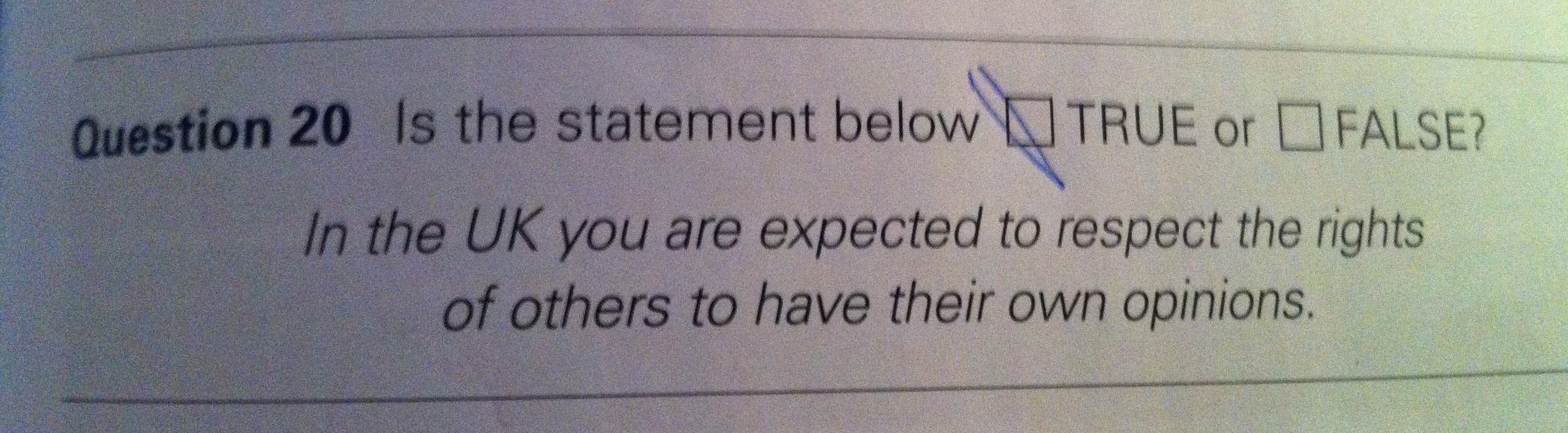
Is the statement below TRUE or FALSE?

In the UK you are expected to respect the rights of others to have their own opinions.

SPS UK Immigration Life In The UK Test 3


If you enjoyed reading this article, please take a second to LIKE or SHARE it on social media using the buttons below. Help to spread the word and continue the debate.

Texas Spares No Expense To Kill

texas_death_penalty


In Texas today,  there is apparently no expense too great when it comes to efficiently killing people, and no expense too small to be called unaffordable and cancelled if it preserves or improves quality of existence for the living.

This has nothing to do with the Democratic gubernatorial candidate Wendy Davis, or the ongoing and contentious argument over abortion; those battles are raging on their own elsewhere.

Rather, this is about the eagerness of the state of Texas to go to any expense and any length to continue dispatching prisoners on death row with clockwork efficiency and regularity, under a veil of secrecy and unknown cost, while any other state expenditures are castigated as a sign of ‘big government’ and pared back – even as those who have (rightly or wrongly) come to depend on that government support suffer grievously as a consequence.

The Guardian reports on the extraordinary lengths to which the Texas state government – which takes every opportunity to position itself as staunchly pro-life and legislate based on the ‘sanctity of human life’ – is willing to go in order to continue performing lethal injections once its current supply of lethal injection drugs runs out at the end of March:

Texas has obtained a new batch of the drugs it uses to execute death row inmates, allowing the state to continue carrying out death sentences once its existing supply expires at the end of the month.

But correction officials will not say where they bought the drugs, arguing that information must be kept secret to protect the safety of its new supplier. In interviews with the Associated Press, officials with the Texas Department of Criminal Justice also refused to say whether providing anonymity to its new supplier of the sedative pentobarbital was a condition of its purchase.

It should be noted that Texas is not the only state to go above and beyond in its zeal to continue killing inmates – Ohio also recently switched to a new cocktail of lethal injection drugs after it found itself unable to obtain new supplies of the original formula.

The fact that no international pharmaceutical company is willing any longer to supply drugs to be used for barbaric executions was a mere obstacle to be overcome for Ohio, who found a new drug and a new supplier, and subsequently botched their first execution using the new method. One eyewitness, a priest, reported:

I was aghast. Over those 11 minutes or more he was fighting for breath, and I could see both of his fists were clenched the entire time. His gasps could be heard through the glass wall that separated us. Towards the end, the gasping faded into small puffs of his mouth. It was much like a fish lying along the shore puffing for that one gasp of air that would allow it to breathe. Time dragged on and I was helpless to do anything, sitting helplessly by as he struggled for breath. I desperately wanted out of that room.

For the next four minutes or so a medical tech listened for a heart beat on both sides of his chest. That seemed to drag on too, like some final cruel ritual, preventing us from leaving. Then, at 10.53am, the warden called the time of death, they closed the curtains, and that was it.

I came out of that room feeling that I had witnessed something ghastly. I was relieved to be out in the fresh air. There is no question in my mind that Dennis McGuire suffered greatly over many minutes. I’d been told that a “normal” execution lasted five minutes – this experimental two-drug concoction had taken 26 minutes. I consider that inhumane.

But let us return to Texas, so often the protagonist in these stories. The reason given by Texas state officials for not releasing details of where their shiny new supply of lethal injection drugs came from – in response to an entirely justified request by the AP – sets a new standard for cognitive dissonance and Orwellian doublethink:

The decision to keep details about the drugs and their source secret puts the agency at odds with past rulings of the state attorney general’s office, which has said the state’s open records law requires the agency to disclose specifics about the drugs it uses to carry out lethal injections.

“We are not disclosing the identity of the pharmacy because of previous, specific threats of serious physical harm made against businesses and their employees that have provided drugs used in the lethal injection process,” said Texas Department of Criminal Justice spokesman Jason Clark.

It is already well known that Texas’ supposed devotion to the sanctity of life does not apply to those on death row, just as the state that held a prayer event to ask God to intercede and end a long-running drought is also quite happy to ignore Jesus’ teachings about mercy and forgiveness.

But now it also appears that the state of Texas is acting in this opaque and clearly antidemocratic manner because of fears for the safety of those people who are involved in producing the deadly drugs.

Imagine, for a moment, that the Texas Department of Criminal Justice had instead released their statement with the following revision (amendments in brackets):

“We are not disclosing the identity of the [people and organisations involved] because of previous, specific threats of serious physical harm made against businesses and their employees that have provided [services] used in the [abortion] process.”

Pigs would fly and snow fall in hell before the state of Texas would ever consider withholding the names and details of people involved in providing abortion services out of a desire to protect their safety, even though there are many real, tangible examples of such people being subjected to harassment, intimidation, physical harm and assassination. By contrast, anti-death penalty campaigners have shown no signs of wanting to intimidate or harm those with whom they disagree.

The key difference (and reason for the massive divergence in treatment of the two groups) is that as far as those in power in Texas are concerned, anyone ever involved in facilitating an abortion is inherently evil and deserves whatever comes their way, but anyone who facilitates an execution is doing their God-fearing, patriotic duty.

And this dichotomy exists because the governing majority in Texas, from Rick “Oops” Perry on downwards, do not see the execution of an incarcerated inmate by the all-powerful government as a violation of the commandment Thou Shalt Not Kill.

texas_executions
One of the indispensable functions of government?


At this point, two disclaimers:

1. The purpose of this article is not to elicit sympathy for murderers, or even to debate the merits of the death penalty – though this blog will go on record as being resolutely against the death penalty, viewing it as a barbaric practice from a bygone age best relegated to the past.

2. Nor is the purpose of this article to debate the issue of abortion – though this blog will go on record as believing that life begins at conception, but that there are various times and circumstances (rape, incest, catastrophic developmental anomalies, risk to the life of the mother) when two equally terrible choices must be weighed and the resultant answer may come down on the side of terminating the pregnancy at the earliest opportunity; and that in these terrible, heart-wrenching circumstances, no one is better placed to make the awful decision than the mother, least of all government.

The purpose of this blog is to ask a very simple question of the Texas government: where the hell are your priorities?

Why, when Texas struggles with shameful rates of illiteracy, teen pregnancy, teen births, adults in correctional facilities, adults under probation, citizens without health insurance and food insecure children, is the state government rummaging for spare change and wasting precious time and resources in order to continue funding executions, of all things?

Why, when life is so difficult and wretched for so many Texans, is their state government more interested in preserving its ability to smite the guilty (or not guilty) than help the needy?

When conservative Texans are not threatening to secede from the United States in protest of the Tyrannical Kenyan Socialist Marxist Fascist Community-Organising Gun-Confiscating Traitor unlawfully occupying the White House, they often like to pledge their love and respect for the Constitution. Section 13 of Article 1 (Bill of Rights) of their own Texas State Constitution has this to say on the matter of punishing the guilty:

Sec.13. EXCESSIVE BAIL OR FINES; CRUEL AND UNUSUAL PUNISHMENT; REMEDY BY DUE COURSE OF LAW. Excessive bail shall not be required, nor excessive fines imposed, nor cruel or unusual punishment inflicted. All courts shall be open, and every person for an injury done him, in his lands, goods, person or reputation, shall have remedy by due course of law.

“Nor cruel or unusual punishment inflicted.”

In Texas, it appears that selective reading is not limited to the Bible.

Citing Religious Freedom To Excuse Discrimination Will Come Back To Bite

segregation

If your religion requires that you attend church every Sunday, you have the right to do so, and no government should ever strip you of that freedom. And if your religious beliefs compel you to speak out publicly on social issues, that also should be your absolute right, provided that you are not inciting violence against anyone else.*

But if the free exercise of your religion requires that you don’t serve gay people at your place of business because you disapprove of their lifestyle choice, that is just called being sanctimonious, and has nothing to do with piety and everything to do with being judgmental – incidentally, a character trait that some major religions frown upon.

And yet this is exactly the type of behaviour that would be sanctioned under a raft of discriminatory legislation working its way through a number of state houses throughout America. MotherJones reports on this new social conservative backlash:

Kansas set off a national firestorm last week when the GOP-controlled House passed a bill that would have allowed anyone to refuse to do business with same-sex couples by citing religious beliefs. The bill, which covered both private businesses and individuals, including government employees, would have barred same-sex couples from suing anyone who denies them food service, hotel rooms, social services, adoption rights, or employment—as long as the person denying the service said he or she had a religious objection to homosexuality. As of this week, the legislation was dead in the Senate. But the Kansas bill is not a one-off effort.

Republicans lawmakers and a network of conservative religious groups has been pushing similar bills in other states, essentially forging a national campaign that, critics say, would legalize discrimination on the basis of sexual orientation. Republicans in Idaho, Oregon, South Dakota, and Tennessee recently introduced provisions that mimic the Kansas legislation. And Arizona, Hawaii, Ohio, Oklahoma, and Mississippi have introduced broader “religious freedom” bills with a unique provision that would also allow people to deny services or employment to LGBT Americans, legal experts say.

One gets the very strong sense that the principle of “religious freedom” is being used by the proponents of these bills as a cudgel with which to hit people that they don’t much like.

We can also safely strike out the word “religious” and replace it with “Christian” without affecting the real intent of the legislation, because you can bet your life that supporters of the Kansas bill would go insane if the same law that they support was cited in defence of a Muslim waiter who refused to serve pork sausages to a customer. In fact, ten new campaigns to “keep Shariah law out of America” would be launched before you could utter the phrase “hypocritical, discriminatory nonsense masquerading unconvincingly as a principled defense of religious freedom”.

In short, these bills are exactly what we have come to expect from a religious and social right wing in America that believe the founding fathers established America as an explicitly judeo-Christian land and that the Constitution is nothing more than an appendix to the Bible.

Dan Savage pulls no punches in delivering his verdict on the spate of new discriminatory legislation:

I don’t remember where I read it but this is a good idea: these laws should include a provision requiring business owners who wish to access their “protections” to publicly post signs in their windows and on their websites that list the types of people they refuse to serve. That might prompt some hateful Christianists to think twice. Because then they wouldn’t just be losing the business of the odd gay couple they got to turn away in a fit of self-righteous assholery. They would also be losing the business of straight people who don’t want to patronize businesses that discriminate against their gay and lesbian friends, neighbors, and family members—and others who worry about where empowering religious bigots could ultimately lead.

Not a bad idea at all. Savage may propose it only in jest, but perhaps, if these odious bills are to be passed over Democratic opposition, they could be sabotaged with amendments to include just such a poison pill clause. You want to arbitrarily turn away gay people from your business establishment? Well sure, go right on ahead – but make sure that you post a big sign out front listing all of the types of people whose lifestyles you frown on and consequently refuse to serve. And while you’re at it, post the same list prominently at the top of your company website, just to make absolutely clear which potential customers you are willing to welcome and which ones you will shun. After all, a well-functioning market requires perfect information.

In seeking to usurp the protections of the First Amendment and bastardise them in service of their cynical anti-gay agenda, supporters of this pro-discrimination legislation are starting down a dangerous road. Having only recently put the Jim Crow era behind them, some people seem only too eager to dust off the old “No Colored Allowed” signs and repurpose them for the war against their next target.

Of course, even if the pro-discrimination bills do successfully make it through the state legislatures and get signed into law by the Governors (many of whom have national political aspirations of their own), and even if they survive their inevitable challenge all the way up to the Supreme Court, the legislation would almost certainly be destroyed in the fiery crucible of broader public opinion, most of all among young people with whom the Republican Party has enough of an image problem already.

One of the main problems is the fact that there are no real logical or enforceable limits to “religious freedoms” being proposed. One can easily picture Newt and Callista Gingrich forlornly walking the streets of Washington D.C. in the rain, being turned away from one fancy restaurant after another because the proprietor’s sincerely held religious beliefs prohibit adultery and call it a sin. Of course, under no circumstances could the proprietor ever entertain the idea of serving a customer whose life story did not perfectly comply with the teachings of Jesus Pat Robertson, and if the new legislation is passed he would now have the weight of the law to back him up.

A prohibition on stealing was important enough to be included among the Ten Commandments, so perhaps we can also expect huge lines building outside places like Starbucks as the already overworked employees complete the mandatory criminal records background check before serving you your tall non-fat vanilla spice latte with extra nutmeg.

We are able to laugh at these ludicrous examples of the laws being applied to their bizarre extremes because although the attempt to push new legislation is troubling, it is really nothing more than the death throes of an old way of life where persecution and ostracisation of people because of their sexuality is excused and permitted. The legislation represents a collective shriek of indignance and self-pity from people who are finally starting to realise that they have irretrievably lost the argument, and will soon have to change their own behaviour rather than bully others into suppressing their real selves for fear of causing offense or inviting persecution.

As Andrew Sullivan said of the Kansas bill:

It is premised on the notion that the most pressing injustice in Kansas right now is the persecution some religious people are allegedly experiencing at the hands of homosexuals.

Such a notion is plainly absurd. Certain bigoted Christianists may have convinced themselves that they are being persecuted because they are no longer allowed to inflict their worldview and moral code on others, but there are now too few Americans willing to show up to their pity party to be of any help. Playing the victim card will not work outside the confines of their own shrinking closed network of intolerant people. Sullivan continues:

It’s a misstep because it so clearly casts the anti-gay movement as the heirs to Jim Crow. If you want to taint the Republican right as nasty bigots who would do to gays today what Southerners did to segregated African-Americans in the past, you’ve now got a text-book case. The incidents of discrimination will surely follow, and, under the law, be seen to have impunity. Someone will be denied a seat at a lunch counter. The next day, dozens of customers will replace him. The state will have to enforce the owner’s right to refuse service. You can imagine the scenes. Or someone will be fired for marrying the person they love. The next day, his neighbors and friends will rally around.

If you were devising a strategy to make the Republicans look like the Bull Connors of our time, you just stumbled across a winner. If you wanted a strategy to define gay couples as victims and fundamentalist Christians as oppressors, you’ve hit the jackpot. In a period when public opinion has shifted decisively in favor of gay equality and dignity, Kansas and the GOP have decided to go in precisely the opposite direction.

Instead of full-throated encouragement from the Republican national leadership in support of what the state parties are doing in their name, there is nothing but a conspicuous silence from the likes of John Boehner and Eric Cantor. Nothing from the congressional leadership and precious little from the conservative blogosphere either – tumbleweeds abound. There is a reason for this.

There exists a group of people whose behaviour is so odious and disgusting that it should not be spoken of in polite society; those involved in promoting it are amoral subversives perpetrating foul deeds which constitute an affront to God and to civilisation itself. Such people can barely be described as Americans, and certainly don’t deserve acknowledgement from Washington or protection by the law.

Unfortunately for the Kansas GOP, through their actions they are now that group, not the gay people they so love to persecute.


* Should be, but sadly is not currently the case in modern Britain, where the rights of the ultra-sensitive and the politically correct not to be offended supersede the right of the people to free speech.


Is Microsoft Voluntarily Censoring The Internet?

There was once a debate about whether large Western multinational corporations – particularly the newly rising high tech companies such as Google, Twitter and Facebook – should do business in countries such as China, where governments are openly hostile to the concept of free speech, a free media and unregulated access to information for their citizens.

That debate was settled some time ago, the winners being those who advocated expanding into China and then perhaps doing a little bit of agitating or talking up the virtues of freedom when time and decorum allowed. And though there has been precious little lobbying of the government in favour of free speech by those multinationals, the investment in China has, by and large, been a good thing.

Having long ago lost the argument that it is not their place to participate in Chinese government efforts to filter and censor the web when operating in China itself, everyone was bobbing along quite merrily in a morally dubious equilibrium, where the big tech companies would parade their wholesome, consumer-oriented credentials around in front of anyone who would listen or take down quotes, while also co-operating with Chinese censorship requirements and allowing the NSA ready back-door access to personal information held on their servers.

Enter Microsoft.

It is now believed that in addition to complying with the Chinese government’s demands that search engine query results originating from mainland China are filtered and censored, Microsoft’s also-ran search engine, Bing, has been applying those same censorship algorithms to searches in the Chinese language originating from anywhere on the planet. In other words, Microsoft, either in their zealousness to please the Chinese regime or out of sheer laziness and unwillingness to maintain two separate protocols, has apparently been applying Chinese-style censorship to internet searches not just where the Chinese government has geographical jurisdiction but anywhere in the world, whenever the user happens to be searching in Chinese.

chinese-authorities-force-businesses-to-help-censor-the-web-pg

The Telegraph reports:

According to research by Greatfire.org, an anti-censorship campaign blog, Microsoft’s Bing search engine filters Chinese-language results around the world, in the same way as it does in mainland China

Searches for potentially controversial terms such as “Dalai Lama” produce very different results when they are carried out in Chinese than they do in English, even if both searches are carried out on US soil, Greatfire said.

Its claims are likely to raise questions about whether Beijing is trying to extend its censorship regime to the Chinese populations of other countries, and whether Microsoft is making inappropriate concessions.

This is inappropriate to say the very least. The Chinese government’s policy of filtering the internet for its citizens so as to effectively pretend that certain viewpoints, ideologies or historical events are not real is bad enough, as is the fact that Western technology companies have complied with it in order to gain access to Chinese markets while demanding and extracting no concessions or easing of restrictions in exchange. But this allegation, if correct, suggests that corporate malfeasance has been taken to a much more worrying level.

One of the great advantages of globalisation and the free movement of people is that people from different countries can be exposed to different ideas, practices and ways of working. Even though the internet is restricted in mainland China, Chinese citizens could access the full, uncensored internet when traveling abroad, just as they could read the free press. In turn, exposure of Chinese citizens to new and contradictory ideas from outside could ultimately increase pressure on the government to relax their draconian policies.

Basing internet censorship on language rather than geography, as Microsoft appears to be doing, completely destroys this premise and removes the potential for this to happen. As the Telegraph rightly indicates, it would appear that Microsoft is aiding and abetting efforts by the Chinese government to extend their control over expatriate Chinese populations in other countries. In countries such as Britain this may merely be an odious and shameful act, but in other countries such as America, where the right to freedom of expression is constitutionally enshrined, a plausible legal argument could potentially be made that Microsoft is committing a First Amendment violation and breaking the law.

This revelation also contrasts Microsoft very negatively with Google, whose own search engine results for sensitive topics prime for Chinese censorship remain similar whether the search is conducted in English or Chinese, when outside of the Chinese mainland:

Users searching for “Dalai Lama” in Chinese were offered a link to information about a documentary produced by CCTV, the Chinese state-owned broadcaster, before any other search results of results linked to two entries on Baidu Baike, a heavily-censored online encyclopedia. Yahoo, whose search engine is powered by Bing, produced the same results.

By contrast, Google produces broadly similar results for web searches conducted in the US, regardless of whether the terms are searched for in Chinese or English.

But it is Greatfire, the online transparency and pressure group, who pose the ultimate question to Microsoft:

But whose law is dictating the manipulation of search results for Americans who are using Bing in the United States? Or French who are using Bing in France?

It is one thing to prostrate oneself to the laws and whims of a foreign government when negotiating terms to do business in that country. But if incompetence or monetary greed has led Microsoft to start applying Chinese censorship laws to citizens of other countries, then they have a big case to answer.

Where else are Chinese web censorship algorithms lurking?

Satya Nadella, Microsoft’s new CEO, may only be one week into his tenure in the top job, but this is a potential crisis of image and trust that needs to  be nipped in the bud and resolved – yesterday.

Microsoft has gone silent in response to the allegations from Greatfire so far. When the firm eventually comes up with an official story and breaks the silence, it will be very interesting indeed to hear their excuses.