If the Allegretto from Beethoven’s Symphony No. 7 starts to play in the background of the film or television programme you are watching, you can bet good money that something sad, terrible or otherwise wrenchingly significant is about to happen, if it isn’t already unfolding on screen.
What better piece of music to choose, then, when crafting the soundtrack for the scene in your fake documentary where a future UKIP government MP takes the stage at a conference to announce Britain’s tough new immigration policy?
One can guess the bias of Channel 4’s fictional UKIP: The First 100 Days by the mere fact that it was produced and shown on television at all. It continues a noble tradition of “what if” mockumentaries imagining what would happen if some terrible catastrophe were to befall Britain – a smallpox outbreak, major terrorist incident, and now, apparently, the election of Nigel Farage as Britain’s next Prime Minister. That the filmmakers consider a (thoroughly inconceivable) UKIP general election victory to be a calamity on the same scale as a global smallpox pandemic tells you everything you need to know when judging their level of impartiality.
In the opening montage, we are treated to the sight of a bald, white, working-class market trader casually referring to British Sikhs as one of “your lot” when greeting UKIP’s new Asian woman MP for Romford. Because that is just how all white working class people think and talk, rubes that they are, according to the received wisdom of the London-based middle class liberals who make these programmes.
The BBC – our national treasure or money and creativity-sapping black hole (depending on your viewpoint) has been given due notice by Sajid Javid, the new Culture Secretary, that every aspect of its future funding and existence is under review.
The Huffington Post reports:
All aspects of how the BBC is run and paid for will be reviewed when its charter comes up for renewal, the Culture Secretary has said. Sajid Javid said “everything” would be looked at, including licence fees and governance structures, when negotiations get under way … Tory Party chairman Grant Shapps warned the corporation last year it could lose its exclusive right to the £3.6 billion raised by the licence fee if it failed to tackle what he believes is a culture of secrecy, waste and unbalanced reporting in the organisation.
For those who believe that on balance the BBC is currently doing more harm than good, this is welcome news. Indeed, this kind of root-and-branch re-evaluation of public services is precisely what many people who voted Conservative in 2010 expected but have not seen thus far under the coalition government.
Re-evaluation and reform is sorely needed. The BBC has recently struggled to defend itself against allegations of incompetence and institutional corruption following the Jimmy Savile sexual abuse scandal, excessive remuneration of top talent and high level executives, and catastrophically poor editing of it’s flagship nightly news programme. And only last week the corporation defiantly kept the editor of the BBC News Channel in her post despite the fact that she posted highly partisan and derogatory comments about a political party on her Twitter account, in flagrant violation of BBC rules.
This blog is not alone in noting the gradual fall in the quality of the BBC’s political output in particular. The Telegraph’s Dan Hodges rightly lambasted the corporation’s recent election results coverage for being both lightweight and unresponsive to complex, dynamic situations. Hodges notes that despite token efforts by the legacy broadcasters to acknowledge the existence of social media, the BBC’s election results programme (for the recent local council and European elections) was way off the mark in its analysis, seizing upon the first narrative that emerged and stubbornly sticking with it throughout the evening even as Twitter started to better reflect the more nuanced results which later emerged.
It is worth quoting Hodges at length, because he makes a vital point:
I’m usually quite sceptical about the whole “social media is taking over the world” meme. But on Sunday night it became very obvious. Twitter and the other social media outlets are making the big election night programs utterly redundant.
It wasn’t apparent when they were the only outlet for results and analysis. But last week both main broadcasters were horribly exposed. What was amazing was the way it was clear neither Sky nor the BBC were taking the slightest bit of notice of their own output. They were engaged in a logistical exercise – “Let’s make sure we don’t miss the returning officer from Torquay” – rather than an analytical one.
What I also couldn’t understand was who they thought their audience was. The same headline mantra was chanted – “Ukip earthquake, Ukip earthquake” – over and over again, but no serious effort was made to deconstruct it. Surely the only people watching local election results at one in the morning are political geeks like me. And what we’re looking for is serious analysis.
Watching the difference between the discussion in the election studios and the discussion on Twitter was like the difference between watching Gary Lineker and Alan Shearer on Match of the Day and Gary Neville and Jamie Carragher on Monday Night Football. The former talk blandly about great attacking or terrible defending. The latter explain in granular detail precisely why it’s great attacking or terrible defending.
Sadly, that just about sums up the BBC’s approach to political programming today. There is a heavy focus on the personality-based politics (epitomised by the need to muckrake, sensationalise and have a “gotcha” moment in every interview) and the logistics of electioneering, but a rapidly fading focus on the comparative assessment and scrutiny of opposing policies. These days, the BBC’s political coverage is all about The Game – who’s up and who’s down at any given moment. Who’s wrong and who’s right barely gets a look-in any more.
What’s worse, the increasingly lightweight personalities – journalists and contributors – deployed by the BBC to cover the political beats are often incapable of the latter, more serious type of reporting, able only to offer superficial ‘analysis’ of the ups and downs of parties and personalities as measured by the twenty-four hour news cycle. Over time, the BBC divested itself of much of the expensive, skilled talent needed for good quality political coverage, either reshuffling them, demoting them or letting them go – and with them, their vital knowledge.
Before the BBC apologists leap to their feat in protest, no it does not have to be this way. High quality, penetrating analysis is not thwarted by the need to remain impartial (an imperative that the BBC fails to achieve anyway), but the BBC is in danger of succumbing to the worst current instincts of political coverage on American network television – giving each ‘side’ of an argument equal weight and validity out of desperation to appear non-partisan, even when the truth is quite clear-cut and largely occupied by one particular party.
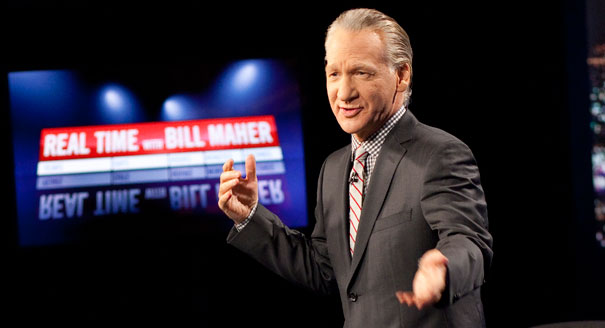
The liberal comic Bill Maher perfectly skewers this unnecessary impulse, increasingly seen in BBC political broadcasting, as it pertains to the non-existent flat-Earth debate:
In other respects, though, Americans enjoy far better political coverage than their British cousins. America benefits from the existence of C-SPAN, a private but nonprofit cable network set up by the US cable television industry, who pooled their resources to establish a one-stop shop that they could all draw on for in-depth political coverage.
The BBC’s own effort, BBC Parliament, does not compare favourably with C-SPAN. BBC Parliament occupies one channel, while C-SPAN has three. C-SPAN provides much more extensive and flexible coverage of both houses of Congress, while BBC Parliament is bound by the ludicrous and archaic rules governing the televising of Parliament. C-SPAN offers a much wider range of other programming such as book talks, public debates and call-in shows, while BBC Parliament has to fit its own meagre offerings of this type in the periods when Parliament is not sitting. C-SPAN’s online presence vastly outstrips that of BBC Parliament in terms of depth of analysis and availability of archive footage.
But most importantly of all, C-SPAN has a reputation for balanced programming and is well-regarded by both liberals and conservatives. British conservatives, by contrast, have long since given up trying to get a fair shake from the BBC – though this article makes a persuasive case for the BBC’s innate small-C conservatism.
It is impossible to properly compare the entire outputs of two news networks in this short space, but a lot can be learned by watching the following excerpts of political output from the BBC and C-SPAN respectively.
First the C-SPAN show, a typical and broadly representative example of their output; in this case a call-in show featuring the national security journalist Glenn Greenwald as special guest:
And here is a C-SPAN StudentCam short film, also on the topic of national security. Such segments form a regular part of C-SPAN programming, filling the time slots between regular programming and encouraging young people to take an active interest in civic issues:
Contrast these with the BBC’s recent efforts, this exerpt taken from the flagship Daily Politics show:
The difference in focus, tone and overall quality could not be more striking. Even the student effort on C-SPAN outmatched the quality and seriousness of the BBC’s political output – and again, these examples are fairly representative of each network’s normal output, not chosen to unduly embarrass the BBC.
The obvious question that must be asked is this: Why the grave disparity in service, given the deep pockets and institutional clout of the BBC compared to its upstart American counterpart?
(In the interest of fairness, it must be mentioned that much of the BBC’s radio coverage is of significantly higher quality, particularly Radio 4’s Today in Parliament).
It’s not that there are necessarily more smart people with a burning interest in politics and public policy in America than there are in Britain. But because the BBC’s omnipresent dumbed-down approach crowds out all other offerings in the marketplace, politically interested citizens are much better catered to in the United States than they are in Britain, where the Daily Politics-style cartoonification of politics insults those with real knowledge and interest.
The truth is that the quality gap between C-SPAN and BBC Parliament has not always existed – it was brought about fairly recently by people who should be ashamed of their decisions, and whose CVs should carry indelible black marks as a consequence.
Before the Daily Politics came along and ruined everything, the BBC’s flagship political programming consisted of shows such as On The Record, Despatch Box and Westminster Live. Much like C-SPAN’s offerings in the United States, the budgets were small and the production values cheap; but this had the beneficial effect of making it all about the programming – the quality expertise and the analysis shared with the viewer.
This all changed when former BBC Director General Greg Dyke commissioned a review of the BBC’s political output, leading to a wholesale relaunch and rebranding. By 2003, out had gone the old shows with their dull but informative content, and in came the quirky, zany future where everything is a joke, everything is accompanied by a jaunty animation and theme tune, and everything is lightly mocked from the couch by host Andrew Neil and his unglamorous assistants.
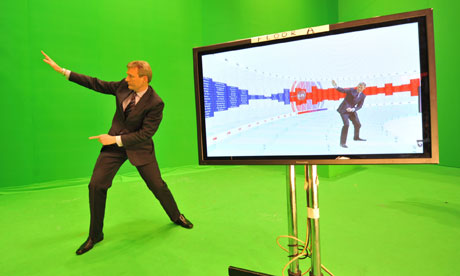
Viewers can discern everything they need to know about the Daily Politics from the opening title sequence, without sticking around to suffer the show itself:
Portraying the British political system as some kind of sputtering, wheezing steam engine perpetually on the verge of breakdown may sometimes be uncomfortably close to the truth, but the BBC’s flagship daily political programme should not lead with this suggestion. Disillusionment with politics is high enough as it is without making jocular reference to all the reasons why in the opening credits.
To be clear, this is not to say that the politician themselves should be necessarily be treated with respect, reverence or deference, particularly when their actions have merited the opposite – but there should be a baseline of respect for the political process itself that now seems entirely absent from the BBC’s output. And all for what? What grand prize is the BBC seeking that is worth so much debasement?
The BBC is chasing a pipe dream if they believe their new dumbed down approach will result in more people tuning in and engaging with politics. Tacky, irreverent output better suited to satirical comedy shows will not draw in viewers who currently favour watching repeat episodes of Top Gear on Dave – it only serves to patronise and alienate those viewers who are interested in political coverage anyway, without the added allure of bright colours and jaunty theme tunes.
This isn’t helping.
The point is not that the BBC should be disbanded entirely, or that the license fee should necessarily be scrapped (although it certainly should), or any one other prescription. The point of shaming the BBC with the woeful quality gap in its political programming is to point out that there are other delivery models out there in the world that work and which could produce good results back here in Britain, if only we would allow ourselves to consider them without feeling that we are somehow “cheating” on Auntie.
Those who become overly sentimental about the BBC in its current form suffer from the same forgiving and idealistic delusion as people who create Twitter hashtags or found political parties to “save the NHS”. Just as some NHS activists prize the survival and continuity of that organisation over the outcomes it was created to deliver (the best possible healthcare for British citizens), so BBC defenders cling to nostalgia rather than acknowledge the fact that the beeb can learn a lot from other broadcasters, at home and abroad.
There are many ways in which the BBC must prove its continued legitimacy other than in the field of news and political reporting. Why, for example, does a state-owned broadcaster need to operate eight national television channels, sixteen national radio stations and forty local stations when there is a thriving commercial sector? But the BBC also gets many things right when it comes to news coverage – no one else in the world can match its depth and breadth, while British audiences tend to trust it above commercial rivals at times of crisis or when major incidents are unfolding.
The BBC’s political coverage, however, goes from bad to worse; and if left unaddressed for much longer it not only runs the risk of negatively colouring Sajid Javid’s upcoming review, but it will start to undermine British democracy itself.
As a first step in the right direction, the BBC News Channel’s editor, Jasmine Lawrence, needs to be reassigned to another role where her toxic anti-UKIP beliefs are in no danger of bringing the corporation’s impartiality into further question. But above all, the BBC needs to stop dumbing down in the one key area where dumbing down offers no benefits at all in terms of audience engagement or viewing figures.
The BBC’s Royal Charter – a delightfully worded document whose preamble would not be out of place in a Shakespeare play – defines the corporation’s public services (in part) as follows:
(a) sustaining citizenship and civil society; (b) promoting education and learning;
Unless our national broadcaster is happy to continue fostering a state of cultural apartheid, where radio listeners receive tolerably decent political news output while television viewers are talked down to and belittled at every turn, the BBC must acknowledge that it is currently failing to meet these public service requirements.
And as it goes for anyone finding themselves on the wrong path in life, the first step toward the BBC’s redemption will be admitting that they have a problem.
US comedian Bill Maher is publicly ending his romance with the MSNBC news network.
The liberal entertainer and commentator, an unapologetic supporter of President Obama and donator to his Super-PAC, has finally been persuaded to look for love elsewhere because even though they share a similar core ideology, MSNBC has become too strident and partisan in its approach to delivering the news. In short, he claims, MSNBC is becoming Fox News:
Whatever we had is not working any more. You’re obviously interested in another man: Chris Christie. You’re obsessed with him. So I wanted you to hear it from me first. I’m going to start seeing other news organizations. I’ll miss what we had. It was a rocket ship ride. We were both passionate flaming liberals and we didn’t care what the world thought of us. It was a glorious time. We finished each other’s Sarah Palin jokes. But now we never talk about any of the things we used to talk about: global warming, gun control, poverty… All because Chris Christie came along and put you under his spell.
Look at yourself. You’re turning into Fox News. Bridgegate has become your Benghazi, and this isn’t easy to say, but you and I are no longer on the same news cycle. Sure, you read me the results of a recent Gallup poll, but you never really ask me how I’m feeling. It’s not you, it’s… Chris Christie.
While the reality is not quite so black-and-white, it is certainly true that MSNBC’s programming has suffered lately as editorial focus (particularly in January) seized on New Jersey Governor Chris Christie’s political travails at the expense of almost everything else, abandoning any significant discussion of public policy in favour of personality-based and partisan attacks.
Sure, Chris Christie may yet be proven to be at fault in the Bridgegate scandal, and the network’s intrepid main anchor and personality, Rachel Maddow, was covering the story long before it exploded into the national consciousness. But the degree to which the network then seized on the issue, to a far greater extent than other news networks, shows the Fox mentality starting to manifest itself in a very real way at MSNBC.
Bill Maher has long been able to draw laughs from his audience by pointing out the formulaic approach to journalism that lies behind the success of Fox News, as shown in this typical excerpt:
Here is the key quote:
They [Fox News and other populist right wing media outlets] have discovered that there is a fortune to be made keeping a small portion of America under the illusion that they are always under attack, from Mexicans or ACORN or Planned Parenthood or gays or takers or global warming hoaxers…it doesn’t matter. They don’t want a majority, they want a mailing list. A list of the kind of gullible Honey Boo-Boos out there who think that there’s a war on Christmas, and that the socialist policies of our Kenyan president have been so disastrous that the end of the world is coming.
The fact that Maher now sees parallels in MSNBC’s programming should concern anyone who has an interest in promoting a free and principled media providing a service essential to democracy over an array of narrowly-targeted niche outlets, each making their money by reinforcing the existing fears and prejudices of their respective audiences.
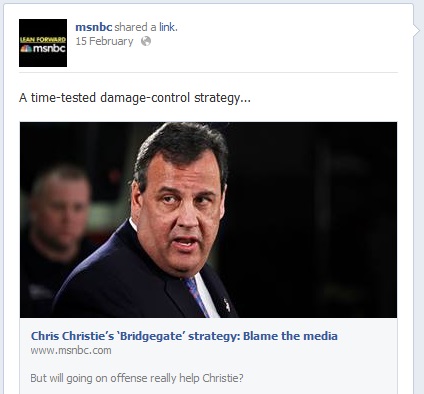
And the extent of MSNBC’s decline does not stop there. Any reader of MSNBC’s facebook account would struggle sometimes to distinguish it from President Obama’s. They trumpet the same initiatives, promote the same causes, celebrate (or invite their readers to celebrate) the same successes.
And, increasingly, they are starting to get touchy when called out on it:
Ultimately, the problem extends far beyond Fox News and MSNBC who are only the latest media organisation trying to emulate Fox’s success. The real problem occurs when any news outlet decides that its primary purpose for being is to help “balance the debate” in response to perceived slanting or bias from elsewhere.
The Fox News Channel proclaims itself to be “Fair and Balanced”. But when probed further about specific instances of right-wing bias on-air, Fox’s journalists, editorial staff and managers do not rush to draw public attention to the Fox News editorial guidelines or their policy on political impartiality. Instead, they draw attention to what they see as the liberal bias of the “mainstream media” and describe their role as being to correct the bias by offering an alternative point of view.
But as soon as you start seeing yourself as a counterweight to something else, you can no longer plausibly claim to inhabit the centre. This is what has now happened to MSNBC. That network watched for a long time as Fox News grew, prospered and humiliated them in the ratings by offering their viewers a diet of politically conservative-skewed infotainment, and now appears to have decided to copy and emulate large sections of their business plan, likely out of a twin desire to reap the same success and to give liberal voices an equally brash, punchy voice. Thus, their motto “Lean Forward”, is becoming increasingly descriptive of what they do, and not for the better.
Progressive opinions and ideas can expect to be given more airtime and favourable editorial consideration on MSNBC, while dissenting conservative voices will be fewer and further between. It is true that many of the new generation of Republicans, hailing from conservative gerrymandered districts and used to sympathetic media, are virtually incapable of taking part in real fact and reason-based debate, and shy away from MSNBC anyway. But even more so than has already been the case, when conservatives do feature on MSNBC it will more likely be as the targets of scandal-related investigative journalism along the lines of Bridgegate.
This is not a positive trend. Were it to continue, the only feature of MSNBC preferable to Fox News will be the honesty of their motto. “Lean Forward” at least strongly hints at the network’s political leanings, whereas “Fair and Balanced” is a running joke in the media world, so clearly does it contradict Fox News’ real motives.
There is probably an initial rush of euphoria to be had, discovering and catering to a new, thus far neglected market of strident and angry liberals who are happy to be fed the Obama administration line. And it may be some time until the network misses the favour of Bill Maher and others who are happy to wear their liberalism on their sleeve, but do not wish to be condescended to by being fed a heavily curated and redacted leftward spin on the news.
But, if they do not change course, the time will come when MSNBC regrets taking the low road. Bill Maher was not the first to compare MSNBC to Fox, and he won’t be the last. Perhaps when the two brands become equally synonymous with partisan propaganda, the executives in charge will realise what they have done.
Though it has been depressing to witness the extent to which homophobia and violence against LGBT people remain so widespread in Russia as the Winter Olympics take place, it has been commensurately heartening to see the outpouring of support from so many other countries for Russia’s beleaguered gay population.
Artists, celebrities, politicians, ordinary citizens and fellow sports people have all registered their solidarity with the LGBT community and spoken out against discrimination and Russia’s strict laws against ‘homosexual propaganda’.
This is good – Russia continues its regrettable backward slide from nascent democracy into a corrupt authoritarianism, and as the IOC saw fit to make Sochi the winning bid for the Winter Olympics it is only right that the rest of the world ensures that the event does not descend into a mere forum for pro-Putin glorification.
But as the swell of voices raised in protest at Russia’s treatment of the LGBT population grows, it is becoming increasingly difficult to ignore the fact that many of those people throwing stones are living in enormous glass houses of their own – and that while it is great to revel in being less homophobic than Russia, this achievement alone is not much of an accolade.
As Laurie Penny writes in the Guardian, being less homophobic than Russia is no great feat of tolerance – the bar set by Russia can be cleared by almost anyone:
There’s absolutely nothing wrong with expressing support for LGBT people in Russia, who are facing grotesque discrimination. But being less homophobic than Russia is not necessarily something other countries should give themselves a medal for. A lot of things are less homophobic than Russia.
Queer activists call this sort of thing “pinkwashing” – playing up the gay-friendly branding of a state or corporation to make it seem more liberal than it actually is. Britain likes to think of itself as a tolerant place, but the Border Agency has been accused of almost “systematic homophobia” by the gay rights group Stonewall. Leaked Home Office documents show bisexual asylum seekers being asked degrading questions during hours of interrogation by Home Office officials – questions that included: “What is it about men’s backsides that attracts you?”
This is just one of several examples given by Penny, who points out the less-than-stellar track records of various other supposedly enlightened western countries – even the Canadians.
All too often, a generally increasing acceptance of homosexuality and LGBT people within the general population is not met with an equal acceptance in national bureaucracies and institutions. This is certainly true in Britain, as Penny points out, but is just as true in the United States, where condemnation about Russia’s awful treatment of the gays has been vociferous, but also seemingly ignorant of the many cultural and legal barriers to the full acceptance of gay rights that remain in America.
Britain’s Channel 4 television network apparently decided that the best way to respond to homophobia in Russia would be to make this video – entitled “Gay Mountain” – which has been playing nearly continuously between their scheduled programmes:
The song, which begins in the same portentous style as the Russian national anthem, quickly descends into a camp, colourful, musical extravaganza as the (shirtless) singer exhorts “Good luck Gays, on Gay Mountain”. The profound lyrics continue “Mens and all mens / And womens and all womens / Come together tonight, sing with pride”.
One YouTube user, identifying him or herself as IMB2U, commented:
We should all thank the Russian government for bringing everybody together and creating this huge wave of support and love for the LGBT community. Their hateful ignorance has brought on something wonderful.
Something wonderful? Really? Mildly amusing, perhaps. Entertaining and catchy, yes – if your tastes lean that way. But “wonderful” seems to be overdoing it a little.
While the sentiment behind Channel 4’s video – that of solidarity and support – is certainly admirable on the surface, one has to admit that it does absolutely nothing to improve the lot of gay, lesbian, bisexual or transgender people in Russia. Gay Mountain works perfectly at enabling us Brits – enlightened and sophisticated as we supposedly are – to feel good by sneering at the “backward” Russian people, but does absolutely nothing about actually helping the Russian LGBT community.
Laurie Penny also questions the value of these flamboyant gestures of support which do little, if anything, to help people in real need of tangible help and intervention:
Personally I have no problem with media outlets, businesses and individuals making jokes at the expense of homophobes, or hanging out the queer pride flag. It’s a statement of support that’s fun and costs nothing. But the fact that it costs nothing is precisely the problem. As soon as there’s a price tag attached, the foot-shuffling begins. The rainbow flag is supposed to symbolise safety. Hung over a bar, it’s supposed to mean that this is a place of refuge. For western nations to brand themselves in this way while subjecting LGBT people to humiliation and imprisonment at their borders is simply disingenuous.
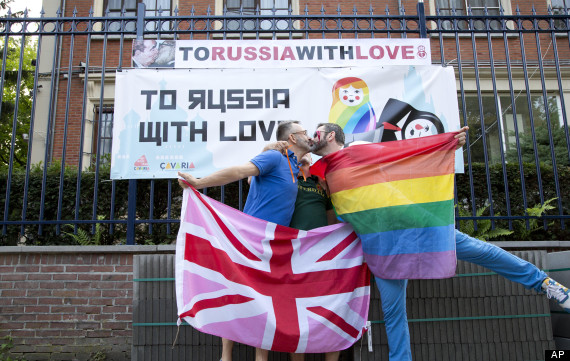
While western nations flap the rainbow flag defiantly in Russia’s face, actual lesbian, gay, bisexual and transgender people are being harassed and abused at their borders when they arrive seeking safety. Supporting the rights of LGBT people worldwide is to be commended, but if that sentiment is more than pinkwashing, it should be backed up by action at home.
This just about sums it up. Statements of support from any quarters are welcome, but they don’t mean an awful lot when there is nothing to be lost by making them. Channel 4 has no business interests in Russia, the Russian people will not see the Gay Mountain video in any significant numbers, and Channel 4 has no contracts or revenues at stake in that country. In other words, they have absolutely nothing to lose. Contrast this with the behaviour of a western company such as Coca-Cola, which has a direct financial stake in Russia – both through sales of their product and sponsorship of the Sochi Games – and which has been very timid indeed when it comes to condemning the persecution of gay people there.
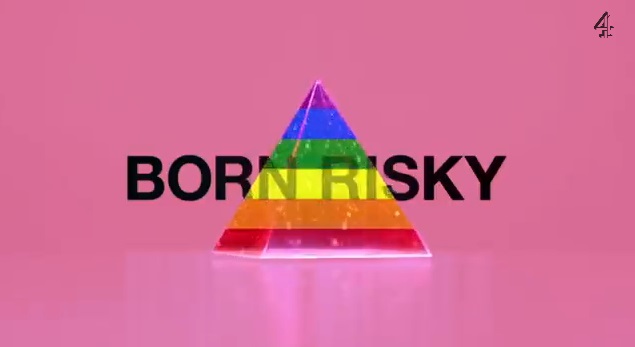
But what really tarnishes Channel 4’s civil rights musical extravaganza is not the pinkwashed song, but the caption that appears on screen at the very end – the words “Born Risky” superimposed on the gay rainbow flag:
So edgy.
What exactly does Channel 4 believe to be “risky”? They risked absolutely nothing, we know that. But we do know that Channel 4 is inordinately proud of the fact that they like to get a rise out of people by setting out to provoke and offend them:
We were set up to experiment, provoke and entertain, and to put our profits into our programmes. You may love us, you may want to punch our lights out, but we make programmes we believe in. We can do this because we were Born Risky. That doesn’t mean “risky” as in naked abseiling, it means creatively risky. Like seeking out undiscovered talent, making films about taboo subjects or championing alternative voices. Born Risky means going where other channels can’t to create something new, alternative and different.
And so the whole campaign is revealed to be not about actually improving the circumstances of gay people in Russia (which we already knew) and not even about believing in or promoting gay rights in general, but rather about product differentiation. It was about burnishing Channel 4’s image as a provocative, edgy television network that likes to push the boat out, defy normal conventions and be a hip alternative to the boring old BBC.
Gay Mountain wasn’t about concern for LGBT people – it was just the next iteration of a very slick, very successful marketing campaign. And that goes rather beyond mere pinkwashing. I’m not sure which colour best represents the soul of a television network which is happy to capitalise on the suffering of foreign LGBT people to show its domestic audience just how cool and trendy it is, but it almost certainly would not be pink.
So by all means, let’s join in another rousing chorus of Gay Mountain. Let us be proud on gay mountain, as the song exhorts us to do. But when the singing is over, let’s not fool ourselves that we have done anything other than disturb the neighbours and make ourselves feel better, comfortably smug in our relative openness and tolerance.
And at least we helped improve the ratings of a certain television network.
Sometimes, when you spend too long in the corporate bubble, bad things start to happen. You can start to believe that everyone back in the real world is also drinking the brand-building Kool-Aid, and that they are as concerned about the fortunes of the ACME Widget-making Company as you are. And that mindset can lead to unfortunate and excruciating public exhibitions such as the above from Coca-Cola.
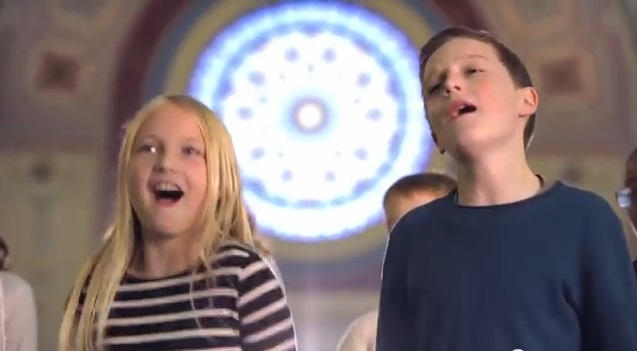
It doesn’t start promisingly, because there is a choir. Not the Halifax choir imploring us to believe how well we will be treated if we switch our current accounts into their loving care – no, it’s the worst kind of choir when it comes to television commercials. A youth choir.
It’s a youth choir singing an inspirational song. Run. RUN!
As the adorable, angelic youth choir intones “sometimes I feel like throwing my hands up in the air”, we are treated to bland, politically correct, focus group-approved pseudo-inspirational statements flashed on our screens, such as:
“For every tank being built… there are 1000s of cakes being baked” – contrast picture of an evil tank factory with a birthday cake
“For every person running from the law… there are 100s running for a cure” – to the backdrop of people running in a charity race
“Each time a red card is given… there are 12 celebratory hugs” – cue footage of the winning goal celebrations
“For every display of hatred… there are 5000 celebrations of love” – cut to footage of a newly married gay couple at their wedding
The grotesque display of emotional manipulation culminates in the inevitable:
“For everyone who doesn’t get along [cue two siblings arguing]… there are many more sharing a Coke”
Okay, Coca-Cola Corporation. I get it. You hate war, criminality, intemperate bad sportsmanship, public rioting and sibling rivalry. And…what? By drinking your carbonated brown sugary liquid, we can extinguish these evils from our world? Increasing the presence of Coca-Cola in our refrigerators will bring peace to the streets of Fallujah?
Tone it down a bit, little Billy.
For the final coup-de-grace, we are encouraged to submit our own “reasons to believe” (as to what, it is never explained) using the Twitter hashtag #ReasonsToBelieve. Because clearly none of us have anything better to do than become servile, willing pawns in Coca-Cola’s latest social media campaign.
Each time a large corporation tries to shoehorn its way into the nation’s affection with an affected, overly sentimental commercial in which they try to imbue their brand with the universal ideas of peace, love and goodwill… Semi-Partisan Sam throws up a little in his mouth.
Did they really just do that?
Bring back the “Holidays Are Coming” Coke ad. At least that one made a modicum of sense.







 Semi-Partisan Politics