Music For The Day

Ethereal, desolate, beautiful choral music by Vaughan Williams

From the hushed and mystical opening to the blazing fanfares and choruses which follow, the rarely heard oratorio Sancta Civitas (The Holy City) by Ralph Vaughan Williams is one of that composer’s finest compositions and a marvellous addition to the English choral music tradition.

I had the privilege to be at a performance of this work last summer as part of the BBC Proms 2015 season (a much better season, incidentally, than this year’s truly awful, themeless programming – barely one concert worth attending) conducted by the superb Mark Elder and the Hallé Orchestra and Choir.

Though it lacks the splashy, memorable tunefulness of, say, Walton’s Belshazzar’s Feast (which also focuses on the fall of Babylon), Sancta Civitas is no less dramatic, with blazing brass and quickly moving strings as the chorus intones “His eyes were as a flame of fire, and on his head were many crowns” – and “many crowns” crisply emphasised by percussion, adding suitably apocalyptic weight to these extracts from the Book of Revelation.

The offstage boys chorus, trumpet and tenor solo are also used to great effect – acoustically, this worked particularly well in the Proms setting of the Royal Albert Hall – and the piece closes in the same foreboding murmur in which it begins.

As Michael Steinberg puts it in “Choral Masterworks: A Listener’s Guide”, describing the culmination of the piece:

And now comes the miracle in this great work, a new voice, a solo tenor, saved for this moment, and singing just sixteen words: “Behold, I come quickly, I am the bright and the morning star. Surely I come quickly.” Barely above the threshold of audibility the choir, ppp and parlando, responds: “Amen. Even so, come, Lord.” And with last recollections of the opening music, the vision of Sancta Civitas fades beyond our hearing.

Sancta Civitas is performed all too rarely, which is a great shame. The score possesses a rare, brooding, desolate beauty – particularly understandable, perhaps, given that it was composed in 1923-5 and had its premiere during the 1926 General Strike, so soon after the guns of the First World War fell silent.

Religiously speaking, this is an inescapably austere vision of the Holy City. No clouds and rainbows and reunions with long-deceased pets here; this is a vision of the Holy presence of God which strikes awe and no small amount of fear in the heart. Part of me responds positively to this – often the Christian faith today seems to be sanitised or presented in U-rated form, be it deliberately childish-sounding worship songs or watered down teaching of core doctrine. Sancta Civitas evokes something much more traditional and even severe, which in some ways is no bad thing.

Regardless: here is quintessentially Modern English choral music at its very best – but you probably have to be in the right mood.
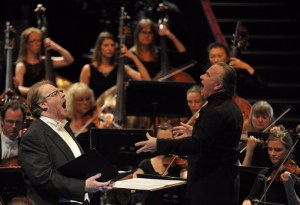
 

Sancta Civitas - Vaughan Williams - BBC Proms

Follow Semi-Partisan Politics on TwitterFacebook and Medium.

Music For The Day

Thank you for the music

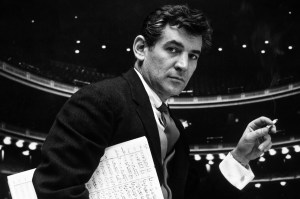
The late Leonard Bernstein, whose 98th birthday would have been today, conducting Candide Overture from a concert performance of Candide with the London Symphony Orchestra and Chorus, recorded in December 1989.

This performance took place just a few short years before I started the first of many pilgrimages to the Barbican Centre to see the LSO perform. Many faces in the orchestra, some sadly now departed, are familiar to me.

Leonard Bernstein is one of my heroes – an exuberant man brimming over with talent and energy, someone who knew exactly what he wanted to do with his life, and who got on and did it: making music in all its glorious forms.

A rich life truly lived, and an unparalleled contribution made to American music, including some of the 20th century’s most achingly beautiful.

Happy birthday, Maestro.


Leonard Bernstein

Follow Semi-Partisan Politics on TwitterFacebook and Medium.

Music For The Day

Богородице Дѣво, Bogoroditse Devo, “Rejoice, O Virgin” from Rachmaninoff’s Vespers (All-Night Vigil).

Sung by the Choir of King’s College, Cambridge, under the direction of Stephen Cleobury.

Bogoroditse Devo

Rachmaninov Vespers - Stephen Cleobury - Choir of Kings College Cambridge

Follow Semi-Partisan Politics on TwitterFacebook and Medium.

Music For The Day

A flawed, beautiful 20th century masterpiece

Is there a more beautiful 20th century chorale than “Almighty Father”, the hushed invocation from Leonard Bernstein’s Mass? If so, I struggle to bring one to mind.

Almighty Father, incline thine ear
Bless us, and all those who have gathered here
Thine angel send us,
who shall defend us all.
And fill with grace,
All who dwell in this place.
Amen.

Leonard Bernstein is my favourite composer. Several of his compositions make my Top 50 list – Serenade for Violin and Strings in particular, but also Chichester Psalms and Symphony no. 2, The Age of Anxiety – and while other pieces of music by other composers often get more of a hearing on my iPhone, it is my contention that these Bernstein compositions contain some of the most beautiful (and profoundly human) music ever written.

This is certainly the case with Mass. As to whether Bernstein’s dramatic staged reworking of the Latin Mass works as a cohesive whole, my answer probably varies day by day and according to my mood. Mass is certainly transcendent, flawed, beautiful, stark, cheesy, smug, original in places, derivative in others and often achingly rooted in 1970s style.

The orchestral meditations, interspersed throughout the piece, have a uniquely haunting beauty of their own – particularly the first meditation, whose desolate questioning in the ethereal violin phrase followed by the slowly-building crisis and final, soothing, repeated falling notes on the organ are about as close to a religious experience as music has yet taken me.

A rather mediocre recording of the first meditation is here:


The complete recording of a recent (2012) performance of Mass at the BBC Proms is below:

https://www.youtube.com/watch?v=9tjsKzhpSwE


Leonard Bernstein - Mass - Kennedy Centre

Leonard Bernstein

Music For The Day

https://www.youtube.com/watch?v=xlcOWLUbnAo

Some restorative Bach for Sunday afternoon

The late, great Glenn Gould dissects one of my favourite fugues from the Well-Tempered Clavier, Fugue no. 9 from Book II.

As Glenn Gould says, at the conclusion of his discussion with biographer Bruno Monsaingeon:

It’s rudimentary material, but it makes for one of the most gloriously fulfilled codas he [Bach] ever wrote, I think.

True. Unlike the brisk and rather superficial version of this fugue in Gould’s complete recording of the WTC, here he takes it at a funereal pace, allowing each voice to truly sing on its own. The slow, steady accumulative effect of Bach’s ingeniously weaved, achingly unresolved theme makes the incredible catharsis of the final coda all the greater.

Here is the complete performance:


Glenn Gould

Follow Semi-Partisan Politics on TwitterFacebook and Medium.