Where Are The Women In British Politics?

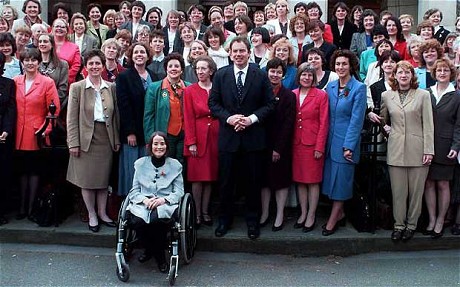
Blair Babes women British politics


The conventional wisdom holds that Ed Miliband managed to land a serious blow on David Cameron at this week’s Prime Minister’s Questions, exposing the Tory leader and his party for their chronic shortage of women in leadership positions and the key offices of state. Miliband makes a good point – an abysmal 4 out of 22 cabinet ministers in the coalition government are women, and only one of those, Theresa May at the Home Office, occupies a position that really matters (Culture, Northern Ireland and International Development, the other ministries headed by women, are either irrelevant or decidedly junior-league). That simply is not good enough, and David Cameron has just cause to feel ashamed.

The Guardian makes the case:

[David Cameron] was taunted about the Conservatives’ “women problem” by Ed Miliband in the same week it emerged several prominent women have recently been sacked from government jobs and Anne McIntosh, a high-profile female Tory MP, was deselected by her local association.

The Labour leader also claimed a prominent businesswoman, who is the wife of a Tory donor, had been greeted by Cameron with the remark: “Where’s your husband?”

He then accused the coalition of failing women across the UK by allowing the pay gap between men and women to widen for the first time in five years.

“You promised to modernise your party, but you are going backwards. You run your government like the old boys’ network – that’s why you are failing women across your party and across the country,” Miliband said.

And the initial exchange between the two leaders at Prime Minister’s Question Time can be seen here:


Less reported is the fact that the Labour Party has a record on promoting women every bit as appalling as do the Conservatives, as Dan Hodges correctly observes in his Telegraph column:

Women still aren’t allowed to hold senior positions in the Labour party. The three major political briefs are Prime Minister/Leader, Chancellor and Foreign Secretary. Apart from a short period during the fag end of Tony Blair’s administration when Margaret Beckett was placed in charge of the Foreign Office, and 14 weeks when Yvette Cooper oversaw the shadow post under Ed Miliband, none of those offices have been held by women. The Labour party has been in existence for 114 years. And during that time – under Labour – a woman has held or shadowed one of three major offices of state for a period of 14 months.

Fourteen months. And yet you would not think that Labour was sitting on such a poor record when Ed Miliband stood preening at the dispatch box in the Commons on Wednesday. One could have been forgiven for thinking that women made up a statistically and politically perfect 51% of Labour seats in Parliament and in the shadow cabinet, particularly given the rather unusual concentration of the Labour Party’s female talent on the front bench alongside their leader:

When PMQs started, several people commented on the fact that a number of Labour’s women shadow cabinet members were artificially concertinaed together close to Miliband. The reason they did that was because if they hadn’t done that they wouldn’t have been in camera shot. And that’s because there’s a convention that people sit alongside their leader based on seniority.

If something about the picture below strikes you as odd – don’t worry. There is indeed something different about the Labour front bench at PMQs this week – namely, a lot more women clustered on either side of Eds Miliband and Balls than is usually the case. It is hard to determine which is worse – Ed Miliband’s disingenuous photo opportunity, or the willingness of a number of female Labour MPs to go along with it by essentially allowing themselves to be used as props by their leadership.
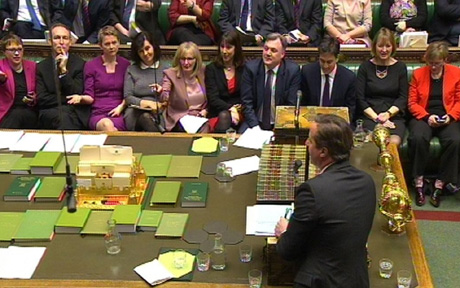
Not your standard distribution.


A less-reported fact amid the furore is that all four women cabinet ministers in the coalition government are Conservative MPs, which rather begs the question of how the Liberal Democrats have managed to fly under the radar and avoid being called out for their own shameful inability to recognise and promote female talent within their own ranks. But somehow the party of Lord Rennard seems to be scoring a free pass on their own institutional sexism for the time being – at least as far as Ed Miliband’s focus is concerned.

The lack of women in senior positions in all political parties is a real problem, one which Miliband does little to debate or address by trading barbs with the Prime Minister. Some advocate all-woman shortlists as a solution to the problem, and of course the Labour Party has adopted this particular approach. This blog disagrees with it – firstly on the grounds that it robs local constituencies of the opportunity to select from the widest possible pool of talent when choosing who they want to represent them in Parliament, and secondly because if we must tolerate reverse discrimination as a necessary evil to help put right historic wrongs (and I’m far from convinced that we should), it should be done at the earliest stage possible and certainly not at the point of parliamentary candidate selection.

But while we may condemn Miliband’s posturing on the subject and question his methods, we must also acknowledge that at least the Labour Party under Ed Miliband is engaged in a bona fide effort to increase the number of women in their parliamentary party. There is a lot of rueful head-shaking from the Conservatives at the conspicuous lack of women in theirs, but not much action of any kind at all.

Four women out of twenty-two cabinet members in the British government, in the year 2014. This is a national scandal, far more serious than localised spats about the deselection or resignation of individual constituency MPs, or accusations of politicising quango appointments. This is about the integrity of our democracy and our desire to be a more practically and visibly meritocratic country.

The Conservatives, the party of Margaret Thatcher, should be leading the charge on anything to do with meritocracy. The fact that they are not currently doing so is alarming.

UKIP’s Choice

I like the commitment to giving the British people a say on our future membership of the European Union. I like the commitment to stripping away burdensome regulation from business. And I really like the libertarian streak which says (with the shameful and notable exception of opposing gay marriage) that you can do what you damn well like in your eating, drinking or recreational life without fearing either chastisement or prosecution by the government. But the recent scandals and dramas within UKIP are making me realise all over again that having a few really great core principles is simply not enough. Not for a political party with serious national electoral ambitions, at any rate.

In moment of great frustration with British politics and the day-to-day compromise of coalition government I have flirted with the idea of giving UKIP my vote. There are parts of the UKIP agenda – you’ll only find them on the UKIP website, the British media generally fails to report the serious stuff – that make perfect sense and which should appeal to anyone of a conservative-libertarian leaning. And in the past it has frustrated me that the focus on UKIP’s more sensible ideas has been continually taken away by the actions of some of UKIP’s more unhinged, out-of-the-mainstream supporters.

I continued to make this argument in good conscience throughout the Godfrey Bloom saga and then the David Silvester affair, because the first was a nonsense and the second was a nonentity. But not so this time.

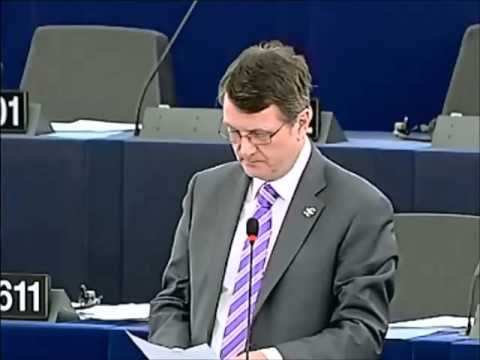
Gerard Batten is a serving MEP and a serious voice within his party – not a swivel eyed lunatic from the fringe. And so when he publicly advocates making Muslims effectively sign an oath of loyalty and nonviolence to prove their harmlessness to the state, this represents a very real problem for UKIP, damages their pro-liberty credentials and alienates many people (myself included) who were otherwise inclined to give them a fair hearing.

gerardbatten

The Guardian gives some of the detail:

Gerard Batten, who represents London and is member of the party’s executive, told the Guardian on Tuesday that he stood by a “charter of Muslim understanding”, which he commissioned in 2006.

The document asks Muslims to sign a declaration rejecting violence and says parts of the Qur’an that promote “violent physical Jihad” should be regarded as “inapplicable, invalid and non-Islamic”.

Critics said his comments represent the “ugliest side of Ukip” and “overlap with the far-right”, in spite of the efforts of party leader Nigel Farage to create a disciplined election machine ahead of the European elections.

Asked on Tuesday about the charter, Batten told the Guardian he had written it with a friend, who is an Islamic scholar, and could not see why “any reasonable, normal person” would object to signing it.

One hardly needs to restate their horror and revulsion at all forms of violence and terrorism in the name of religion before condemning this politician’s attempt to take a redacting pen to the holy book of a faith not his own – but I shall do so anyway. We can abhor the violence, but that does not make it right to propose amendments to the religious texts of a faith that you do not yourself practice. Indeed, if Gerard Batten is to apply his editing skills to every major religious text touting a menu of violent and uncivilised punishments to be meted out to those who accidentally violate the etiquette of their ancient day, he will not only raise Muslim ire but also the outrage of other religions perhaps much closer to his own heart.

Seeing the “I have Muslim friends” card played as a defence by Godfrey Bloom is also quite depressing, and hardly mitigates the fact that he is basically advocating state interference in the workings of a religion, state interpretation of religious texts and state monitoring of compliance with religious teaching.

And in a final flourish, Batten also failed to repudiate his 2010 call for a ban on new mosques in Europe, apparently confirming the suspicions of many that UKIP is concerned about freedom of religion and freedom from religious persecution only when it can be used as an argument to allow certain Christians to continue discriminating against gay people.

The latest UKIP scandal has, naturally and rightly, drawn condemnation from across the political spectrum, with Conservative MP Robert Halfon (of the Jewish faith) describing Batten’s “Islamic code of conduct” as the first step toward making a persecuted people wear a visible gold star on their clothing:

Halfon, who is Jewish and has spoken out repeatedly against Islamic extremism, told the Guardian he considered Batten’s views “unbelievably sinister” and “frightening”.

He tweeted: “Big difference btwn lawful Muslims & extreme Islamists. UKIP MEP Batten’s statement a 1st step to wearing a Yellow Star.”

Sarah Ludford, a Liberal Democrat MEP for London, also criticised the comments, saying they “rip apart Ukip’s pretence” that it treats everybody equally.

“His offensive blanket stereotyping of Muslims speaks volumes about Ukip’s extremism and should warn voters that voting Ukip means associating with hatred and Islamophobia,” she said.

These shenanigans within UKIP must come to an immediate halt if the party is to staunch the bleeding and begin to repair its tarnished reputation. The existing media portrayal of the party as a club for closet racists, little-Englanders and swivel eyed loons is harmful enough without having senior MEPs throwing more fuel on the fire. The fact that some of the provocative statements in question were given in the year 2006 is no defence or mitigating factor here – all that means is that eight years have passed without a public apology and withdrawal of the remarks.

True to recent form, Nigel Farage has been slow to respond to this latest volley of bad publicity – and so, for the moment, Gerard Batten is left to twist in the wind. This, in itself, is unacceptable. This is a time for the leader to lead. Perhaps UKIP wants to be a party of unapologetic Islamophobia and a cheerleader for freedom of religion, but only when Christian freedoms are perceived as being threatened. And if so, that is their choice to make – free speech is still just about protected in this country, and UKIP are entitled to campaign on that platform. In turn, I would also then be freed from the desire to give them any further serious consideration and airtime on this blog, because I would exercise my right to avoid associating myself with such a party.

But if the UK Independence Party actually stands for personal liberty and does not wish to associate itself with religion-specific loyalty tests and bans on practicing Islam (because that is what withholding permission to build new mosques would ultimately mean), with fearmongering or with discriminatory policies, then Nigel Farage needs to speak up and show any recalcitrant members the door.

Newer, less established and experienced political parties eventually have to choose between their fiery, populist rhetoric and the need for sober policymaking; between courting any stray vote that can easily be won and accepting that the votes of some other people are fundamentally undesirable. The Liberal Democrats faced their reality-check on the topic of undergraduate tuition fees, and for better or worse they chose responsible government over delivering on their tuition fee cap bribe to their starry-eyed voters. It increasingly looks as though UKIP will have a dual reckoning – with their attitude to gay marriage on one hand and the decision to condone or condemn Islamophobia on the other.

If Mr. Farage could please make up his mind on these issues and convey the message to his troops, the rest of us will know whether to keep giving UKIP the time of day, or letting them jog on by.

The Conservatives After Cameron

Apparently running the Home Office is no longer the political kiss of death that it once was. ConservativeHome highlights an interesting and worrying trend in the sentiments of the party base – a strong, and growing, preference for Theresa May to be the next Conservative Party leader after David Cameron:

Last month, the Home Secretary squeaked it, displacing Boris Johnson from the top of the poll by 22.7 per cent to 22.6 per cent – in other words, there was one vote in it out of some 800 responses.

This month, she does so again, by 23 per cent to 22 per cent – or, if you prefer, by a margin of three votes.  Michael Gove’s rating is down from 17 per cent to 14 per cent; William Hague’s is up from 10 per cent to the same total, 14 per cent.

What’s striking about this month’s result is that the gap between May and Boris is more or less unchanged – but the survey got roughly 200 more replies.

Looking back over the record of previous Home Secretaries, I was recently arguing with a friend about whether the office of Home Secretary tends to naturally attract the authoritarians and those casually dismissive of civil liberties from within their parties, or whether working in the Home Office makes a person that way, and that even an ardent libertarian would come out of the Home Office singing the praises of indefinite detention without charge, bulk data collection and citizenship revocation without criminal conviction. Which came first, the chicken or the egg? In the case of Theresa May, an uninspiring record prior to government has only been tarnished further since 2010.

The only thing more worrying about this preference for Theresa May is that her chief threat is the implausible Boris Johnson. The Mayor of London’s ability to say what he actually thinks, bypassing the usual politician’s filter, is admirable and refreshing in a high profile political figure. But he has a tendency toward the ridiculous, harms London’s competitiveness by his intransigence on the expansion of Heathrow airport, and is weak on free speech issues. His shortcomings exceed his no-nonsense attitude and his love of Latin.

By contrast, the Education Secretary, Michael Gove – perhaps the torchbearer for the more libertarian, small government / maximum personal liberty wing of the Tory party – languishes in third place, tied with William Hague.

Two very different visions for government.

The bright side, as Benedict Brogan points out in his Morning Briefing, is that Theresa May’s popularity with the party base is not matched by equal enthusiasm in the parliamentary party. Since the leadership election rules in the Conservative party give MPs the job of whittling down the field to the final two candidates who stand before the entire party membership, it is possible that May could fall at the first hurdle, perhaps opening the way for someone who does not quite so closely adhere to the authoritarian mould of New Labour.

Talk of the next Conservative leader may be very premature – Cameron could well win a second term in 2015, either to govern as a majority Tory administration (which would be a real test of his principles – no longer would he have the fallback excuse of placating LibDem coalition partners) or in another coalition. And of course the 2015 general election and upcoming European elections this year will change the electoral landscape further still. But it is disconcerting to note that as we stand, after reviewing the performance of all the Conservative ministers in government and comparing their rhetoric to their actions, a substantial part of the Tory base believes that Theresa May represents the best way forward.

Finally, Rejecting The Mediocre In Education Policy

On the right track.


It is quotes such as this, from Education Secretary Michael Gove, which remind me why I pounded the pavements in support of my local Conservative parliamentary candidate back in the 2010 general election:

“My ambition for our education system is simple – when you visit a school in England standards are so high all round that you should not be able to tell whether it’s in the state sector or a fee paying independent.

“We know England’s private schools are the best independent schools in the world. Why shouldn’t state schools be the best state schools in the world?

“I want to see state schools where the vast majority of pupils have the grades and skills to apply for university, if they want to, where a pupil being accepted to Oxbridge is not a cause for celebration, but a matter of course.

“Where it is the norm for state pupils to enjoy brilliant extra-curricular activities like sports, orchestras, cadets, choir, drama, debating, the Duke of Edinburgh scheme, and more.”

There have been many disappointments from the Conservative-led government since they came to power and ejected Gordon Brown from office. Only last week in Prime Minister’s Questions, David Cameron could not bring himself to say that taxes should ideally be cut for all citizens across all income levels – instead trying to outflank Ed Miliband and appease his supporters by claiming that the rich and successful were paying more under the Conservatives despite the abolition of the 50% top rate of income tax. But while David Cameron and Theresa May equivocate on civil liberties, and while George Osborne neither delights nor grossly offends at the Treasury, Michael Gove continues to quietly get the job done over at Education.

The Telegraph reports on Gove’s upcoming keynote speech at the London Academy of Excellence:

State schools will test children using private school exams for the first time under plans to make them the “best in the world”, the education secretary will say in a speech on Monday.

Michael Gove will say that schools must set their standards “so high” that they are indistinguishable from the best fee-paying schools like Eton and Harrow.

He will say he wants to end the perception that state education is “bog standard” by emulating independent schools with tougher tests, longer school days, more extra-curricular activities and better discipline.

There are some indisputably good ideas in the meat of the speech – ideas such as setting state school children some of the same exams used to measure ability in private schools, and using international tests to better benchmark performance against schools in other countries. It is similarly hard to argue against the renewed emphasis on extracurricular activities and discipline.

Of course, reciting a shopping list of common sense ideas doesn’t mean that the British educational system will improve overnight, or even that dramatic improvements will come about in the very short term. Neither does it acknowledge the reality that all of these changes will be of zero benefit if parents remain disengaged from their children’s education, either unable or unwilling to nurture and help them, or if poverty and the varied symptoms of socioeconomic disadvantage continue to suppress the educational attainment of poorer children. And too often, the Labour Party have more to say on mitigating these real problems than do the Conservatives.

But there is no reason why we should not hold these high aspirations for our public schools, and use this aspirational language as Michael Gove does. Indeed, there is something refreshing about it, and this is what makes Gove so appealing to many people of a libertarian-Conservative persuasion. Gone is the talk about sharing burdens, paying “fair shares”, postcode lotteries and equality of outcome, and in its place we have talk of benchmarking, experimentation, variation and unbounded possibility. It is quite hard to not get excited, even in the absence of any of the finer detail as to how we get there.

The Telegraph’s editorial mirrors this optimism and sense of a refreshing change:

This is why his agenda for state schools so terrifies the Left. It represents a much-awaited rejection of bog-standard equality in favour of the excellence that typifies the independent ethos.

We shall observe with interest the reaction from the rest of the news media as it comes in. And as always, the devil will be in the details. But with precious little by way of new policy announcements or radical ideas as the coalition government trudges toward lame duck status and general election 2015, at least one government minister is still doing his job.

A New Argument Against Defence Cuts

troopingthecolour
Maybe they can fill out the ranks with some extra CGI characters.


When even this Conservative-led government is willing to degrade the military capacity of our nation, it has been understandable to despair of anyone in British politics other than Defence Secretary Philip Hammond continuing the argument for a strong, fully-capable armed forces.

Arguments against making experienced veteran soldiers redundant while flashy recruitment drives for new recruits clog the airwaves have fallen on deaf ears, as did the arguments against leaving Britain without full aircraft carrier capability until the new Queen Elizabeth class ships are commissioned. But now a new argument against further cuts to the military may succeed – and it is, of course, the least important or relevant of them all.

The Telegraph reports that additional cuts to the armed forces could impair their ability to carry out ceremonial functions such as Trooping the Colour or participating in state funerals:

Cuts to the armed forces are threatening to undermine the pageantry and pomp of Britain’s biggest ceremonial events, one of the Army’s most senior officers has warned.

Garrison Sergeant Bill Mott, who oversees all major ceremonial events, says he is now struggling to produce the “same spectacle” as the armed forces have shrunk.

His comments are likely to prove especially sensitive as Prince Harry is now a staff officer in the same district as Mr Mott, with a responsibility for helping to organise ceremonial events.

The Telegraph’s source is highly experienced and not prone to hyperbole:

Over the past 12 years Garrison Sergeant Major Bill Mott has overseen every major ceremonial event in London including the royal wedding, Baroness Thatcher’s funeral and the tradition of Trooping the Colour.

However, Mr Mott told Defence Focus, an internal Ministry of defence magazine, that soldiers are “gritting their teeth and getting on with it” in the face of the cuts.

I wonder if this approach might actually work. Since the memory of the Falklands conflict seems to have evaporated from the minds of most people, and a large segment of the population equates maintaining a strong national defence with a desire to embark upon new neo-conservative inspired nation-building jaunts abroad (when in fact there is no reason for the two to be linked), there has been no real attention-grabbing or compelling argument to make in favour of ring-fencing defence spending. Until now.

If this is what it takes to wrestle back the momentum and initiative in favour of protecting military spending, then I’ll take it. But it will not speak highly of the British people if we prove to be more concerned about our future ability to stage a Princess Diana-style funeral than we are our ability to protect ourselves and defend our interests.