American Conservatives For Brexit, Part 3

Jim DeMint - Brexit - European Union - EU Referendum

A bold warning against supranationalism

This blog has rarely found common cause with former Senator for South Carolina Jim DeMint, but his OpEd in CapX (written with Nile Gardiner) is a welcome expression of solidarity with the Brexit cause.

From the OpEd:

The contrast could not have been starker – between a message of genuine optimism on the Brexit side, and the language of gloom and doom emanating from the Remain camp. It was frankly sad to witness an intensely negative campaign by those who suggest that Britain will not benefit from being a free and independent nation.

It is unthinkable that Americans would ever subject themselves to the kind of suffocating supranationalism that exists within the EU, with nation states surrendering large amounts of their sovereignty to unelected bureaucrats in a distant capital, with their courts overruled by foreign judges. It is all the more disturbing therefore that the leader of the free world, the president of the United States, has chosen to warn our British friends against leaving the EU.

This very much echoes the sentiments of this blog – the United States branches of government would not for one second tolerate the kind of subjugation to a supranational entity and curtailments on sovereignty that are required of EU member states – therefore, Barack Obama’s intervention in the EU referendum debate was very much a case of “do as I say, not as I do”.

Moving on to security, they point out:

Ignore the childish scaremongering coming from the White House. If the British people decide to leave the EU, their national security will be enhanced, not least because Britain can retake full control of its own borders. And the NATO alliance would actually be strengthened, rather than weakened, if Britain left the EU. The European Commission’s drive to create a European Union Army would draw vital resources away from NATO, and lead to duplication of key military assets in Europe. It is NATO, not the EU, that has secured peace in Europe in the post-World War Two era.

Before concluding:

A British exit from the EU would be good for Britain, Europe, and the United States. A United Kingdom that is not shackled to a declining EU that is mired in a culture of big government, soaring public debt and welfare dependency, would be a better partner for the US. A resurgent, self-confident Britain that looks outward to the world instead of inward, that is free to shape its own destiny, decide its own laws, craft its own foreign and security policies, and negotiate its own trade deals, can only strengthen the Anglo-American Special Relationship. A Great Britain that has absolute control of its own borders will also be a stronger partner in the fight against ISIS and Islamist terrorism.

Our former Heritage Patron, Margaret Thatcher, loved the United States and cherished the bonds that tie our two great nations together. She condemned the European Project, the idea of a European superstate, as “perhaps the greatest folly of the modern era.” The Iron Lady was absolutely right about the dangers of ever-closer union and rampant supranationalism in Europe, and how it threatened both Britain and the transatlantic alliance. We owe a huge debt of gratitude to Lady Thatcher’s leadership on the world stage. Her warnings against a federal Europe have come true. Today, Great Britain has an opportunity to be a free country once again. If the British people seize the day and break free of the EU, this should be a cause for celebration and rejoicing on both sides of the Atlantic.

Jim DeMint and Nile Gardiner are quite right to warn about “rampant supranationalism”. A point which has rarely been made in the EU referendum debate is the fact that no other countries in the world have rushed to replicate the EU model. One might point to the African Union and its Pan-African Parliament, but the two institutions are hardly comparable – the second objective of the African Union is “to defend the sovereignty, territorial integrity and independence of its Member States”, a goal to which the EU most certainly does not subscribe, in theory or in practice.

Look elsewhere in the developed world, to Asia, Australia and the Americas, and there is no desire whatsoever to form a political union based on the supranational form of government, in which a new pan-national entity takes on more and more of the traditional roles of the nation state. This should tell us something – and yet the EU persists with the steady, stealthy implementation of its mid 20th century blueprint even as globalisation and the emerging global regulatory system makes it increasingly irrelevant, a clumsy middleman rather than an effective defence.

And at a time when too many voices from the United States – the one country which should truly understand the desire for independent self government – have been fearfully urging Britain to stay in the EU, it is good to hear some bold conservative voices supporting Brexit.

 

European Union - United Kingdom - Britain - Flags

Top Image: Washington Post

Agree with this article? Violently disagree? Scroll down to leave a comment.

Follow Semi-Partisan Politics on TwitterFacebook and Medium.

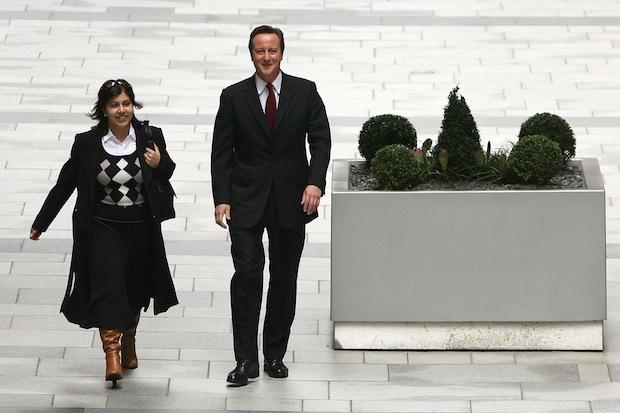
The Baroness Warsi ‘Defection’ From Leave To Remain Is Virtue Signalling Politics At Its Worst

Conservative Party Annual Conference - Day One

Changing one’s mind about an existentially important constitutional and geopolitical question merely because of the tone of the campaign is either criminally idiotic or part of a deliberate campaign of deception

Top of today’s communications grid for the Remain campaign – jostling with their tawdry efforts to make political capital from the murder of Jo Cox MP – has been their attempt to capitalise on the supposed “defection” of former Conservative Party chairman Baroness Warsi from the Leave to the Remain campaign in the EU referendum,

The Telegraph reports:

A former minister has announced that she is abandoning Brexit and defecting to the Remain campaign in protest at its “hate and xenophobia”.

Baroness Warsi has accused Michael Gove, the Eurosceptic Justice Secretary, of “peddling complete lies” and said her final decision was prompted by a Nigel Farage-backed poster depicting Syrian refugees with the slogan “breaking point”.

[..] Baroness Warsi, a former chairman of the Conservative Party, told The Times: “That ‘breaking point’ poster really was, for me, the breaking point to say ‘I can’t go on supporting this’. Are we prepared to tell lies, to spread hate and xenophobia just to win this campaign? For me that’s a step too far.”

She made the decision to defect despite Mr Gove saying that the poster made him “shudder” and describing it as the “wrong thing to do”.

This fails the smell test for a number of reasons, not least of which is that the natural action to take if one feels repulsed by the behaviour of other people arguing for something that you believe in is to disassociate yourself from them, not to join the other side and immediately adopt a completely different set of beliefs and arguments than you were professing moments earlier.

This is precisely what members of The Leave Alliance, including this blog, have done. As proponents of a small-L liberal vision for Brexit in which we leave the EU to better engage with the entire world (and hopefully reboot our democracy in the process), we were naturally repulsed by many of the anti-immigration arguments, as well as the rank amateurism of the official Vote Leave campaign. But this did not turn us into enthusiastic Remainers. Rather, it encouraged us to carve out our own niche of bloggers, experts and advocates to promote our message within the wider Brexit movement.

If Baroness Warsi was really that upset about the tone of the mainstream Leave campaign, she or one of her researchers could have discovered the Leave Alliance in the time it takes to do a quick Google search. Warsi could have found a community of passionate, knowledgeable and highly principled Brexiteers who would have welcomed her into the fold. But Warsi did not do so, either because her mind genuinely cannot conceive of a world and a referendum campaign beyond that waged in the Westminster bubble, or because she had no intention of looking for other Brexiteers with values closer to her own.

Of course, we have seen this before, with the defections of Tory MP Sarah Wollaston and Labour MP Khalid Mahmood, also ostensibly because of their disgust at the tone of the Leave campaign. As backbenchers, one might be more charitable and chalk this up to idiocy rather than political machinations, but in the case of a former Conservative Party chairman and minister like Sayeeda Warsi it all reeks very strongly of a PR stunt.

And shame on the Times newspaper, incidentally, for allowing themselves to be used quite blatantly as the prime minister’s personal propaganda mouthpiece rather than applying the most basic level of journalistic scepticism to their reporting – in their eagerness to report on the supposed “turmoil” created by an utterly inconsequential figure in the broader Leave campaign they made themselves look politically calculating and stupid at the same time.

As Guido Fawkes points out:

The Times have watered down their mischievous first edition claiming Sayeeda Warsi has ‘defected’ from Leave to Remain. No one in Vote Leave thought she was a Brexit supporter or is aware of her doing any campaigning for them at all. She has only tweeted about Vote Leave once – ten days ago – to attack them. She did not appear on the website of pro-Leave group Muslims for Britain. In February Warsi told Eurosceptic campaigners she had not declared. When Dan Hannan invited her to join the Leave campaign, she declined. Neil Kinnock even once backed her for EU commissioner…

Hardly the very model of an arch eurosceptic and committed Leave campaigner.

Much more admirable is the late decision by Bristol West MP Charlotte Leslie to support the Leave campaign. Unlike Baroness Warsi, Sarah Wollaston and Khalid Mahmood, Leslie did not seek to make herself look good by feigning horror at the conduct of the opposing side, but rather made up her mind after much careful thought and deliberation.

This comes through strongly in Charlotte Leslie’s official statement:

My decision is with nothing to do with either the Leave or Remain Campaign, but as an individual who has done their best to assess the situation and come to a conclusion based on my assessment of the facts to which I have access, my experience in working with European colleagues from many EU Member States over the years, and my own personal understanding of human behaviour and risk.

As I have said repeatedly, I do not necessarily think there is a right or wrong answer to this question, and I have the utmost respect and appreciation for those who disagree with me. I celebrate and welcome disagreement and debate.

After all my deliberations, I found myself coming back to a principle on which I try to lead my life: That you have to face realities, however difficult, because to attempt to deny a reality leads to more pain in the long term.

Personally, I cannot see the European Project, whose express aim is to further homogenise the very different nations of Europe into an ever closer political union, as anything but a fantasy, and as such, dangerous.

Therefore, however much I appreciate and understand the risks and challenges of voting ‘leave’, I find myself completely unable mandate this madness.

What a contrast in tone and class with the fiery, bitter and sanctimonious MP defections from the Leave campaign, which have never been based on a genuine reappraisal of the merits of Brexit but always out of a desire by MPs to publicly disassociate themselves from supposedly unsavoury people.

And this is key. Beyond the tawdry, transparent and frankly amateurish attempt at choreographing a political defection stunt, there is a serious point here. As we have seen, Baroness Warsi is not the first politician to rend their garments, reach for the smelling salts and publicly switch sides in the EU referendum in protest at the “tone” of the campaign.

Looked at more broadly, this is symptomatic of the same trend towards public virtue signalling that we see on social media and our university campuses now entering the world of politics. For many contemporary politicians, ideology and policy positions are not things to be adopted based on a serious consideration of their value and applicability to the modern world, but rather items of clothing to be worn or discarded like this season’s latest fashion.

Almost the entire official Remain campaign is based not on an enthusiastic defence of the European Union as it currently is or is likely to become, but rather the flimsy assertion that supporting the EU is somehow the progressive and virtuous thing to do. Hence you will almost never find a Shoreditch hipster or a Brighton artist proudly campaigning for Leave – it would go against the very grain of their “social uniform”. Hence Britain Stronger in Europe’s latest social media advertisement which asserts without a shred of evidence that voting Remain is the “kind, open, inclusive, tolerant” thing to do.

And in this age when politicians sometimes build up substantial social media followings and careers live and die by successful media appearances, is it really any wonder that the glibness of our political discourse now attracts equally glib politicians – MPs who will change their opinion on an issue as fundamental as Britain’s continued membership of the EU at the drop of the hat, depending on which hashtags are trending positively on Twitter?

In the case of Baroness Warsi, we can safely chalk up this non-defection to a good old-fashioned political stunt, a piece of theatre shamefully performed by the Remain campaign to help add to the illusion of momentum and inevitability going into the closing stretches of the EU referendum campaign.

But on a rather sombre day when we seem duty-bound, even pressured, to say nice things about politicians, it is worth considering the calibre of individuals we are actually attracting to Westminster when some MPs clearly possess so few core convictions (and such flair for self-promotion) that they will execute a 180 degree U-turn on the greatest political decision of our generation, based not on the issues but the execution of the campaigns.

At this time we need seriousness and depth in our politics – in parliament and outside -and not this growing superficiality motivated by the gnawing desire to loudly signal our virtue at all times.


European Union - United Kingdom - Britain - Flags

Top Image: Spectator

Agree with this article? Violently disagree? Scroll down to leave a comment.

Follow Semi-Partisan Politics on TwitterFacebook and Medium.

Conservative MPs Must Feel The Political Consequences Of Supporting Remain

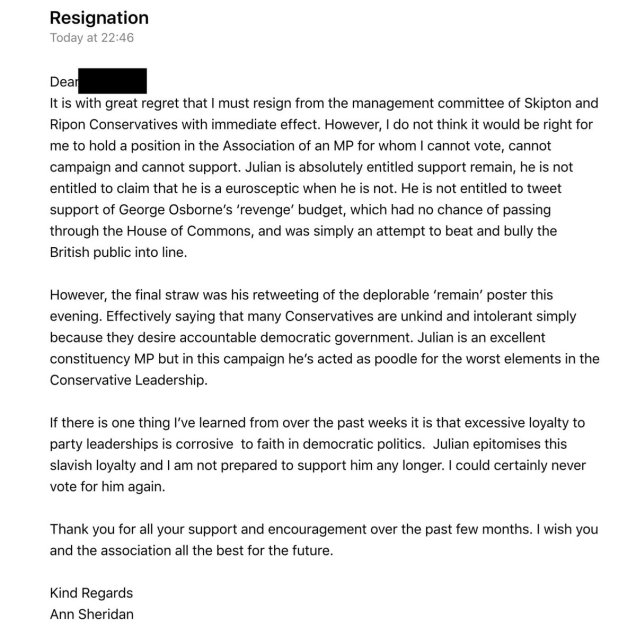
Ann Sheridan Resignation Letter - Julian Smith

Conservative MPs who contravened the will of party members in order to support the prime minister’s tawdry, deceitful Remain campaign should rightly be afraid for their positions

Hopefully this will be the first of many  dominoes to fall – Ann Sheridan, local activist and committee member for Skipton and Ripon Conservatives, is no longer willing to support her turncoat Tory MP, Julian Smith, who ditched his avowed euroscepticism to slavishly support the prime minister’s Remain campaign.

Sheridan writes:

I do not think it would be right for me to hold a position in the Association of an MP for whom I cannot vote, cannot campaign and cannot support. Julian is absolutely entitled [to] support Remain, he is not entitled to claim that he is a eurosceptic when he is not. He is not entitled to tweet support of George Osborne’s ‘revenge’ budget, which had no chance of passing through the House of Commons, and was simply an attempt to beat and bully the British public into line.

However, the final straw was his retweeting of the deplorable ‘remain’ poster this evening. Effectively saying that many Conservatives are unkind and intolerant simply because they desire accountable democratic government. Julian is an excellent constituency MP but in this campaign he’s acted as a poodle for the worst elements in the Conservative Leadership.

If there is one thing I’ve learned from over the past weeks it is that excessive loyalty to party leaderships is corrosive to faith in democratic politics. Julian epitomises this slavish loyalty and I am not prepared to support him any longer. I could certainly never vote for him again.

Ouch.

If this sentiment is widespread among Conservative constituency activists – and personally speaking, I sincerely hope that it it – then the inferno poised to consume the Conservative Party will be even greater than many had previously anticipated. Good. MPs who either ran for selection or cultivated their subsequent reputations as staunch eurosceptics should be made to suffer the consequences for betraying their constituents on such a fundamental matter as Britain’s future governance and democracy. And while it does not presently seem likely, if a wave of de-selections were to take place (as advocated by Momentum within the Labour Party) then this blog would loudly cheer on the process.

Back in 2010, I supported Rob Halfon‘s campaign to unseat the Labour minister Bill Rammell in my hometown of Harlow, Essex. I now sincerely wish that I had not bothered. Halfon’s timid, tremulous and utterly pessimistic argument for staying in the European Union (“I am voting to stay in the European Union because I am frightened by an uncertain world”) is utterly repulsive, the worst of all reasons for Britain to remain in the EU. It betrays a staggering lack of confidence in the country and people which Halfon represents to the degree that his undeniably good work as a constituency MP is utterly negated.

One of the reasons that there is such a “toxic” political atmosphere in the country at the moment directed at our poor old elites is that the main political parties present a stubborn consensus of opinion which is far from settled in the country. Most MPs in nearly all parties are pro-EU, and all parties have been complicit in handing ever more powers and competencies from Westminster to Brussels, hollowing out our own government.

It is bad enough that the Labour Party supports this process of democratic decay – and in fact there are many reasons why principled left-wingers should support Brexit. But it is even worse that so many MPs from the so-called Conservative Party are also cheerleaders for a supranational government of Europe which actively hollows out and undermines the very institutions, traditions and democracy which conservatives are supposed to value.

The decision by so many Conservative MPs to support the Remain campaign has rightly enraged many small-c conservatives, this blog included. It is a show-stopper, a deal-breaker, something which conservatives of principle cannot forgive, forget or move past on 24 June. For whichever way the referendum goes, the fact will remain that over half the Conservative parliamentary caucus – including the prime minister and his despicable chancellor – may as well belong to the Labour Party, for all the good they are doing in power.

Something needs to change – and realistically this can only take the form of real conservatives abandoning the Tory Party en masse, or forcing these ideology-free careerists from their positions and replacing them with people of principle. And since starting a new political party almost never works, most of us choose the latter option. Conservative MPs who betrayed their principles and their constituents to support keeping Britain in the EU should therefore be rightly afraid for their positions. Because hopefully Ann Sheridan’s public denunciation of her own MP will only be the beginning of a grassroots backlash to mirror the turmoil that will soon engulf Westminster.

And those Conservative MPs who served as loyal cheerleaders for the EU from Day 1, or who ditched their previous euroscepticism either through failure of courage or craven desire to curry favour with David Cameron and George Osborne, might then be made to feel the political consequences of their actions by their local constituency associations.

In fact, this blog’s aspiration for the future political and ministerial careers of those Tory MPs like Julian Smith and Rob Halfon is perfectly captured in Job 38:11:

“Hitherto thou shalt come, and shalt go no further.”


European Union - United Kingdom - Britain - Flags

Agree with this article? Violently disagree? Scroll down to leave a comment.

Follow Semi-Partisan Politics on TwitterFacebook and Medium.

The Remain Campaign’s Last Stand

Stronger In - Kind Open Inclusive Tolerant Together - EU Referendum

The Remain campaign is so used to loudly claiming the moral high ground and dismissing Brexiteers as backward, nasty reactionaries that even their “positive” closing message is unintentionally insulting toward half the country

Well, that calmer, politer politics didn’t last very long, did it?

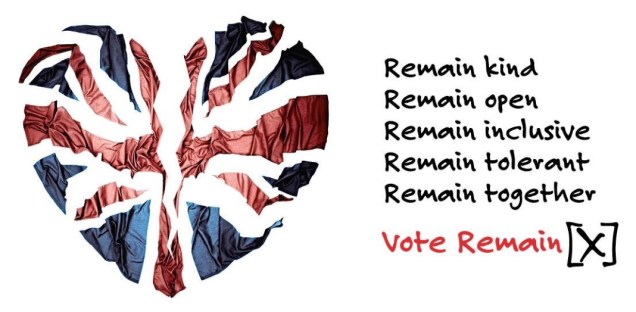
On the first day of real campaigning following the murder of Jo Cox MP, the Remain campaign has hit the airwaves with this new meme, now being widely shared on social media.

Displaying a heart shape in the colours of the Union Flag, Britain Stronger in Europe exhort us to:

Remain kind

Remain open

Remain inclusive

Remain tolerant

Remain together

All pleasing words, you might think. But what does it say about those Britons – nearly half the country, according to opinion polls – who think that Britain should leave the European Union. Are they unkind people? Are they closed-minded and closed-hearted? Do they all seek to exclude people? Are they all racist? Apparently the official Remain campaign thinks so.

The image is accompanied on social media by the following message:

This referendum is about the type of country we want to live in.

SHARE this if you believe Britain is at our best when we’re outward-looking, inclusive and we stand together.

Just hammering the point home.

From a purely strategic and tactical viewpoint one can understand why Britain Stronger in Europe went for this approach. After all, almost none of their argument for staying in the EU has been based on the positives of the European Union (beyond woolly platitudes about “cooperation” and “working together”, which a ten year old can work out does not require the intermediation of Brussels). Rather, their argument has been a relentlessly fear-based approach, threatening and even bullying voters to vote Remain on pain of supposed economic disaster compounded by George Osborne’s vindictive “punishment budget”.

But to get Remainers to the polling station on Thursday, the campaign needs to give them something positive to think about, too. Even if it later turns out to be a pile of nonsense, their supporters must be made to think that they are doing something noble in choosing to fearfully stick with the status quo. And in this day and age, even better if they can then broadcast this positive message to others in order to signal their own virtue.

This social media post accomplishes the Remain campaign’s objectives brilliantly. It doesn’t get bogged down in the details of why the European is so great (it isn’t) or necessary (it really isn’t), or even why leaving would be so calamitous (it wouldn’t be). On the contrary, the Union Jack coloured heart and childish font keep things very superficial. It declares to the world that the person liking or sharing the message is a Good, Enlightened and Virtuous Person, unlike those knuckle-dragging, murderous subhumans who dare to believe in Brexit.

Another similar meme is also being shared widely on Facebook, as a play on Nigel Farage’s tired old “I want my country back” theme:

I want my country back, too. The country which celebrated Mo Farah winning at the Olympics, the same one who is proud to call Tom Daly or Mark Foster part of the British Olympic team, the country who cheers for Tanni Grey-Thompson. That, that’s my country. The same country which took Malala Yousafzai to its heart. My country is better for the diverse country it is, from the food available in the supermarket to St Paul’s Carnival & drinking Kenyan coffee with a Jewish bagel to cure a hangover from French wine. My Britain is not filled with hate or extremism. My Britain is not perfect but it isn’t better alone. My Britain is open, inclusive, progressive and an inspiring place to live.

Because of course a post-Brexit Britain would rejoice in none of these things, all of which are only made possible thanks to our membership of the European Union. Quite why Britain’s departure from a supranational political union would mean that Britain would become a country which starts booing its own black athletes, burning down bagel shops or pouring French wine into the sea at Dover harbour is of course never explained. But the Remain campaign don’t need to explain it. This is their own form of “dog-whistle” campaigning. They just have to suggest these these links, and immediately everyone who is preconditioned to equate euroscepticism with xenophobia or racism immediately pricks up their ears and awaits orders.

This is insulting beyond words to half the country who currently favour Brexit, particularly considering the hurried vow everybody took in the wake of the Jo Cox murder to immediately (and rather implausibly) be nice to one another. But one must admire the way that the Remain campaign stuck to the letter (if not the spirit) of their pledge – they managed to grievously insult half the country without using a single negative word, instead simply suggesting that Brexiteers represent the opposite of all these positive values.

Though as one commenter put it on the Britain Stronger in Europe Facebook page:

This idea that only those voting for Remain uphold those values is disgusting. None of us have a monopoly on those things. Remain shouting the loudest about being decent – total and utter hypocrisy #Brexit

But this is literally all they have. The Remain campaign kept the focus relentlessly and myopically on the economic question, wheeling out all of the same experts who told us two decades ago that Britain would wither and perish outside the euro. And the message has not gained sufficient traction to leave Remain confident of victory. So all they have left is to demonise the other side.

They cannot speak too passionately and warmly about the European Union, because the organisation is distrusted or hated – quite rightly – by anybody who remotely cares about democracy or the continued importance of the nation state. They cannot openly commit Britain to the EU’s clearly stated end goal – a common European state – because it would alienate too many people.

So all that is left for Remain is to demonise the other side, either explicitly (as they did before the murder of Jo Cox) or implicitly (as they are doing now, by suggesting that Leave voters are the antithesis of the wonderful, warm qualities listed in the Facebook meme).

And in terms of winning the referendum, it may just work. The relentless fearmongering, the demonising of Brexiteers, the desire of many people to virtue-signal the fact that they hold “open” and “progressive” views and the usual tendency for people to gravitate back towards the perceived status quo at the closing stages of a referendum campaign may push Remain over the line. Possibly quite convincingly.

But it has made the job of stitching the nation back together again almost impossible. And each time sanctimonious, preachy little graphics concocted by Britain Stronger in Europe are created and shared, it makes the task that much harder. Because whatever misanthropes, racists and bigots may support Leave, the vast majority of Brexiteers are good, honest decent people. They are patriots who genuinely (and in this blog’s view, quite rightly) believe that they are doing the right thing. And you can’t spend three months loudly questioning half the country’s intelligence, tolerance and moral code and then expect everybody to hold hands like one big happy family.

Given the way that this referendum has been fought by pro-EU forces, a vote to Remain will therefore resolve absolutely nothing. And prissy, sanctimonious little declarations of virtue like Stronger In’s “Remain Together” campaign message are the reason why.


Postscript: Mark Wallace also takes exception to Stronger In’s latest advert, in a piece for Conservative Home:

The implication is clear – if you’re someone who is voting Leave, you are supposedly declaring yourself to be unkind, closed, not inclusive, intolerant and in favour of division.

Not only is that entirely in conflict with the weekend’s warm words about a more reasonable and less unpleasant tone in the final days of the referendum campaign, but it is an extraordinary attack on the millions upon millions of voters who are – rightly, in this site’s view – planning to Vote Leave.

It isn’t the first time we’ve heard such dismissive criticisms of those who dare to disagree. Only yesterday, the Prime Minister declared that there is not “a single credible voice” arguing we will gain by leaving the EU, implicitly suggesting several members of his own Cabinet lack credibility. But the content of this particular advert makes it the broadest insult to voters, Party members, MPs and Ministers so far, and the timing makes a mockery of recent promises to raise the tone.

If Stronger In’s management intend to stand by this scurrilous line, will their overseers, Cameron and Osborne, continue to do so as well?


European Union - United Kingdom - Britain - Flags

Agree with this article? Violently disagree? Scroll down to leave a comment.

Follow Semi-Partisan Politics on TwitterFacebook and Medium.

The Petition To Cancel The EU Referendum Showcases The Remain Campaign’s Dim View Of Democracy

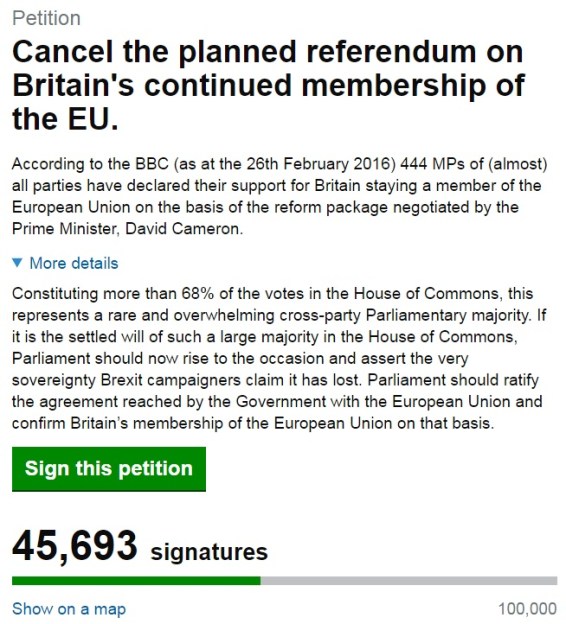
Cancel EU Referendum - Brexit - Remain - Parliament Petition

The divergence between the strong preference of most MPs and the sentiment of the British people is the main reason we are having this EU referendum, not a reason to cancel it

Last week, before the awful murder of Jo Cox MP changed the character and atmosphere of the campaign, it was widely agreed that the Remain campaign were on the back foot, behind in some of the polls and certainly lacking in anything like momentum.

And so perhaps it is unsurprising that late last week, a petition started by Remainers began to circulate on social media, calling for the EU referendum to be scrapped altogether.

The text reads:

According to the BBC (as at the 26th February 2016) 444 MPs of (almost) all parties have declared their support for Britain staying a member of the European Union on the basis of the reform package negotiated by the Prime Minister, David Cameron.

Constituting more than 68% of the votes in the House of Commons, this represents a rare and overwhelming cross-party Parliamentary majority. If it is the settled will of such a large majority in the House of Commons, Parliament should now rise to the occasion and assert the very sovereignty Brexit campaigners claim it has lost. Parliament should ratify the agreement reached by the Government with the European Union and confirm Britain’s membership of the European Union on that basis.

What a cynical, opportunistic and fatuous thing to do – to seek to cancel an imminent referendum just because their own side happens to be in danger of losing.

The “444 MPs” line does not hold water, either. The whole purpose of this referendum is to settle what is in effect a dispute between past and present parliaments on the one hand, and the British people on the other. It is parliament which has knowingly and willingly signed away endless new competencies and powers to the EU, hollowing out the British state at the expense of the growing supranational European government in Brussels – a parliament often composed of many MPs who described themselves as “eurosceptic” while being complicit in the process.

This includes many Conservative MPs who were only ever selected by their parties or constituency associations as candidates because they professed strongly anti-EU sentiments to the Tory party base. Now, it has sadly been the case that many of these MPs were revealed to have lied during their selection processes, telling eurosceptic party members what they wanted to hear while themselves being ambivalent or even pro-European, as evidenced by their decision to support the Remain campaign. But it is clearly disingenuous to claim (as the petitioners do) that the majority of MPs favouring Remain represents the settled will of the people – the tightening polls, some showing a lead for Leave, prove this to be otherwise

It should also be pointed out that many of the “444 MPs” supporting Remain would not presently be sitting in Parliament had David Cameron not taken the sting out of UKIP’s tail by promising the referendum in the first place. Prior to that pledge, two former Tory MPs (Douglas Carswell and Mark Reckless) had already defected to UKIP in a blaze of publicity, and more threatened to follow. If Cameron had not neutered part of UKIP’s appeal by promising the referendum, there could have been up to a dozen more defections prior to the general election, and then tens more UKIP MPs elected in May last year. If anything, promising the referendum helped to keep a pro-EU majority in the House of Commons. That same majority can not then also be used as grounds to take the referendum away.

But the root of the matter is the “parliamentary sovereignty” referenced in the petition text. I cannot speak for all Brexiteers, but I know I speak for many other liberal leavers when I say that I am not fighting with every fibre of my being to secure a Brexit vote because I want to re-establish the sovereignty of parliament and re-empower the very people who so blithely gave it away to Brussels in the first place. On the contrary, I want the British people to finally be sovereign in this country. And this is the wider debate which has been entirely missing throughout this sorry referendum campaign, but which we need to have.

What, after all, would be the point of striving to claw back sovereignty and decision-making power from Brussels only to give it back to the same people operating under the same laws who gave it away? This is why Brexit must just be part of a broader process of democratic renewal, making the people sovereign and beginning with the assumption – much as in the United States of America – that “Parliament shall make no law…” except in those areas where we the people explicitly grant permission.

This then opens up a whole load of other questions which gleeful Remainers would doubtless seize upon as more evidence that Brexit would cause problems and be “difficult”. Well, yes, it would. Unsurprisingly, great deeds require a commensurate effort in their accomplishment, and throw up lots of problems which need to be patiently solved along the way. Man did not walk on the moon the day after John F Kennedy idly thought out loud that it might be a good idea. The Apollo Programme took place in many stages after Kennedy set the initial goal, each one solving a particular problem or proving a new competency until all of the pieces were in place for Apollo 11 to finally touch down on the surface of the moon.

It is reasonable to expect that the process of extricating our country from forty years of gradual, incessant political integration by stealth should be a task of comparable difficulty. But it is not scientific and technical expertise which we must rebuild, but political, constitutional, democratic, trade and regulatory knowledge, much of which we have lazily outsourced to the EU.

And unfortunately the prize cannot be measured in pounds or euros, or any economic model pointed to by David Cameron’s hallowed “experts”. The ability of people to exercise meaningful control over their leaders, communities and futures cannot be boiled down to numbers in an Excel spreadsheet or one of the smug infographics shared by the Remain campaign. But this does not mean that democracy lacks value – rather, that it is priceless.

Those who would have us vote Remain on June 23rd look at British independence and see it as a series of problems and risks, all of which our country and our people are too small, too weak and too incompetent to overcome. They genuinely cannot understand why a country as “small” and supposedly inconsequential as Britain would want to leave a supranational political union in which we trade our democracy for the illusion of influence which comes from being a member of a big club.

Those advocating Brexit, on the other hand, see opportunity and feel a sense of optimism grounded in a healthy sense of what this country and its people are capable of accomplishing. They generally accept that there may be some short term political instability, but that there is just as much instability in our future if we remain shackled to an EU beset with so many intractable problems it is simply unwilling and unable to address. And they also value democracy sufficiently highly that endless, apocalyptic scaremongering with doomsday economic scenarios simply doesn’t resonate. The prime minister appears genuinely frustrated that we Brexiteers are not more responsive to his Project Fear, because he fails to appreciate that the core Remain argument does nothing to neutralise the reasons why many of us want out of the EU.

And sadly, this difference in mindset is not one which we can reconcile (or persuade any hardcore Remainers to the Brexit side) in the little time left of the campaign. But while we Brexiteers are happy to fight on to the end, making the case as best we can, some on the Remain side want to circumvent the process and take the choice away. Hence this ridiculous petition, arguing that because a majority of the very people you would expect to love the EU think that we should stay in it, there is no need to further consult the British people.

I would state again that the very existence of this petition shows a contempt for the will of the British people – but when the entire Remain campaign focuses myopically on short term economic indicators rather than the long term health of our democracy, it hardly needs saying.


European Union - United Kingdom - Britain - Flags

Agree with this article? Violently disagree? Scroll down to leave a comment.

Follow Semi-Partisan Politics on TwitterFacebook and Medium.