There Is Nothing Noble Or Virtuous About Defending The EU

European Union - USA - UK British flags

The EU’s defenders in the middle class and political/cultural elite love to believe that they are supporting a grand and noble project, but close their eyes to the economic and democratic damage wrought by this failing supranational union

An opinion piece in the New York Times provides a welcome antidote to that newspaper’s fatuous, instinctive pro-Europeanism.

Tim Parks writes:

Had I had the right to vote, which I have lost after 30 years living in Italy, I would have voted to remain in the European Union. But I do not think it a scandal that others think differently. If it was a scandal that people voted to leave, then surely it was a scandal to have held a referendum at all. And if it is a scandal to hold a referendum on an issue central to the destiny of a nation and about which its people feel deeply, then I have misunderstood the meaning of freedom and democracy in the West.

So why the extraordinary incredulity and indignation? Why the sense of betrayal? Why do so many people find this result unacceptable? It seems that over the last 30 or 40 years the idea has taken hold that there can be no peaceful or productive future for Europe without the European Union. As a result, anyone who voted to be outside it must be discredited as pernicious or ignorant, perpetrator or victim of some sinister populism. In the United States, this unhelpful reaction has taken the form of likening the leaders of the Leave campaign to Donald J. Trump. But Britain is not America and this was not a presidential election. Immigration played a role, but no one in the Leave campaign was suggesting Muslims be banned from Britain. On the contrary, some Muslims supported the Brexit vote. To see the debates of other countries in terms of one’s own internal politics is always a failure of imagination.

All this shock, horror and kneejerk denigration might be understandable if the European Union were notching up important successes and resolving its member states’ many problems, or if, at the very least, it had a figurehead with whom European citizens could identify, someone of whom one might say, “However badly things are going, I have faith in so and so, I believe he or she really does have the interests of my nation at heart, really is concerned about unemployment in my town,” be it Newcastle or Naples.

Obviously the EU has no such figureheads. Its vaunted “founding fathers” are unknown and unloved by all but the most starry-eyed euro federalists, its parliament a fraud, its stolen anthem a joke and its leaders held in widespread contempt. It cannot appeal to any sense of collective destiny because the loyalty of the vast majority of EU citizens lies first and foremost with their own nation state.

And Parks is quite right to note that the EU is failing across most of the metrics by which one might reasonably judge success. Economic growth, employment and social cohesion have all been thrown under the bus in the name of European political union, while the countries most let down by the EU project remain within the union only because they suffer from a national form of Stockholm Syndrome.

Parks points out:

But the Union’s greatest failing is that after decades of regulations of every possible kind it has not brought the nations of the Continent closer together. Day by day Italians are told whether their government’s economic policy has been accepted or rejected by Berlin, but about the Germans they know little or nothing. In each country, we follow our own national news media and are locked into the agendas of our own political systems. We are separate nations but not sovereign nations. We obey the dictates of Brussels and read Jonathan Franzen and “Harry Potter.” We watch American films and follow the American elections far more closely than those of any other country in the European Union. Is this a community?

But best of all is when Parks turns his gaze on the middle class and political elites who remain the EU’s strongest defenders:

The middle classes, the cultured elite, love the idea that they are taking part in a historic project that will bring peace and prosperity to the Continent, put an end to war, take steps to defend the environment, protect Europeans from superpower ambitions and multinational depredations, etc., etc. I love this idea, too. Like so many others, I take comfort in this noble enterprise.

But when the project does not bring prosperity, when it does not do enough to protect the environment, when its protectionist trading policies systematically damage the economies of the third world, I, like everyone else, don’t want to think about it; we prefer to close our eyes. This is not the narrative we like to believe we live in.

[..] With Brexit this decades-old spell is set to break. And how does the liberal elite on both sides of the Atlantic react to this deafening alarm? They scream foul and blame the dumb British working classes for spoiling the party. It might be wiser to examine our own attachment to a narrative that is going nowhere.

But the defiant liberal elite will not let go of their false narrative, preferring to nurture a sense of grievance and display to the world a shameful contempt for democracy.

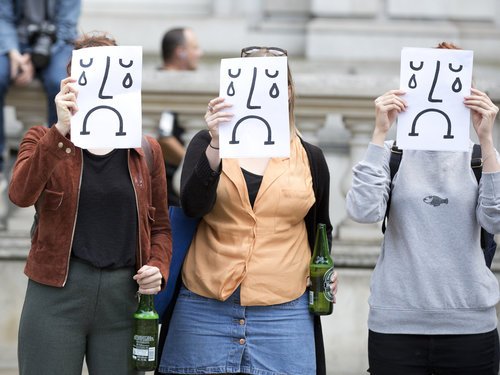
Just this weekend, grieving metropolitan Remainers held a “Picnic against Brexit” in Green Park, in what was billed as an opportunity for people to “heal” and “comfort” one another. Disappointed Remainers are literally treating their defeat in the EU referendum as a kind of emotional trauma, an unendurable shock to the system for a group of people who have had their way since 1973, came to rely on the EU’s comfort blanket and who simply cannot conceive of life as a citizen of an independent country.

An emotional reaction of this strength is only possible when one genuinely believes that one is fighting on the side of righteousness and possesses a monopoly on the virtues of wisdom, compassion and truth. It is much like the arrogance of tearful Labour supporters who simply could not understand why the country rejected Ed Miliband and re-elected the Evil Tories in the 2015 general election. The strong overlap between these two groups of people is no coincidence.

For people who make up a supposed intellectual and moral elite, the Remainers-in-denial are extraordinarily unperceptive. Even now, they can not accept that the 52% of their fellow citizens – including many working class voters – who voted to leave the EU might have a point, that their beloved European Union might not be the wonderful and benevolent force for good that they insist it is. On the contrary, they stubbornly continue to insist that those who voted for Brexit did so  either out of ignorance or malice, and work to prevent Brexit from happening.

This will not end well. Sneering contempt for the political opinions and values of ordinary people has not done the elites any good this electoral cycle, in Britain or America. If the elites are at all interested in bridging the divide and repairing their relationship with the rest of the country then they must start displaying the kind of introspection and empathy demonstrated by Tim Parks in his NYT article – and far fewer disdainful middle class picnics against democracy.


Brexit - EU - European Union Flag - Missing Star - Britain - UK

Top Image: CNN

Agree with this article? Violently disagree? Scroll down to leave a comment.

Follow Semi-Partisan Politics on TwitterFacebook and Medium.

A Tory-Labour Centrist Alliance? The Self-Serving Establishment Will Stop At Nothing To Stay In Power

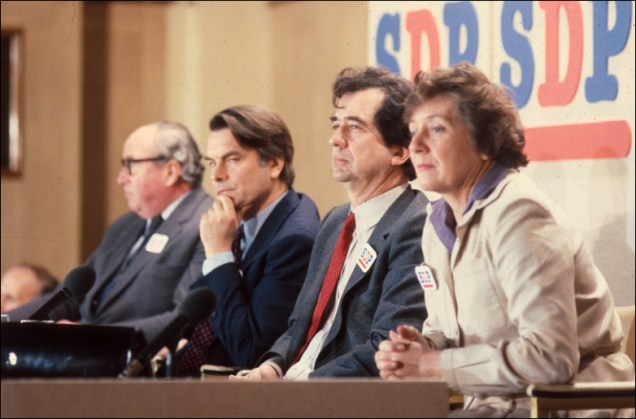
SDP Launch

The British people have made clear that they want their two main political parties to once again stand for recognisably different policies, values and objectives. But the response of calculating, stale and ideology-free centrist MPs seems to be to reorganise themselves in order to avoid dealing with a reality they would rather ignore

Politics is finally getting interesting again. After more than two decades of stale, centrist managerialism following the resignation of Margaret Thatcher, we are finally starting to see real ideological and intellectual dividing lines re-emerging in our political discourse.

After a long and dismal period where it barely mattered whether you voted for Team Red or Team Blue, so similar were their policies, we face the delicious prospect of which way people vote actually mattering once again. This is a good thing. Dry, stultifying conformity might just about be acceptable when things are in a good state, everyone is prosperous and happy, and a safe pair of hands is all that is required to keep the good times rolling.

But while many prosperous, metropolitan professional types (including nearly the entire British political class) may have been coasting through life thinking that everything was fine and dandy, in fact things were not fine for millions of their fellow citizens. And when the status quo is failing so many people, a consensual, moderate and determinedly un-radical form of politics is the very last thing which will bring about the required change.

This is why we should celebrate the short-term chaos which is roiling British politics. For too long we have been cursed by a Labour Party which cares more about making its middle class, urban supporters feel good about themselves than actually delivering tangible improvements in the lives of the working poor and the dispossessed or responding to their concerns about our democracy and our country. And since Thatcher’s departure, the ideologically rootless Tory Party – this blog describes the Cameron cohort as Coke Zero Conservatives, the same conservative taste you recognise but with none of the caffeinated, calorific oomph which makes it worth drinking – has adopted one socialist, redistributionist policy after another in a desperate, failed bid to shake off their so-called “Nasty Party” image.

In other words, within the space of twenty years the two major political parties have converged to such an extent that they were almost indistinguishable from one another – Ed Miliband’s Labour Party went into the 2015 general election flogging coffee mugs on their campaign website which promised to “control immigration”, while David Cameron’s Conservative Party manifesto was creepily subtitled “A plan for every stage of your life” – statist control freakery if ever there was.

The result of this, we all know, was the rise of the fringe parties – the incredible success of the Scottish National Party despite their utterly woeful record actually wielding power in Scotland, and the rise and rise of UKIP which set the wheels in motion for David Cameron’s bitterly regretted decision to offer the country a referendum on our continued EU membership.

Since the shock victory for Brexit in the EU referendum, things have only gotten worse for the forces of dull, greyscale centrism. David Cameron resigned in justified humiliation having waged a deceitful and bullying campaign in favour of remaining in the EU, in which he threatened his own citizens with punishment if they voted the “wrong” way, and yet still managed to lose. Meanwhile, the Labour Party, whose parliamentary caucus never accepted Jeremy Corbyn’s leadership and sought to undermine it from Day One, decided to make their last stand. Unfortunately, that last stand appears to be the utterly bland and uninspiring figure of Angela Eagle, whose coming leadership challenge will be utterly obliterated by Jeremy Corbyn, who remains very popular with the expanded Labour Party membership.

In other words, this has been a bad time for the establishment. Our poor superiors have endured setback after setback, with their preferred centrist candidates being routed as the public justifiably yearn for the return of authenticity and ideological coherence to their politics. And now they face a setback which cannot be endured – the prospect of seeing their country taken out of the European Union (that great escape from accountability for Europe’s governing elites) against their will.

But they are not going to take this lying down.

The Guardian reports on an utterly despicable new development – the fact that centrist Tory and Labour MPs, terrified at the prospect of the bland, consensual form of politics in which they thrive being brought to an end, are now proposing to unite in order to form a new centrist political party.

From the Guardian:

Tory and Labour MPs have held informal discussions about establishing a new political party in the event of Andrea Leadsom becoming prime minister and Jeremy Corbyn staying as Labour leader, a cabinet minister has disclosed.

Senior players in the parties have discussed founding a new centrist grouping in the mould of the Social Democratic party (SDP) should the two main parties polarise, according to the minister. Talks should be taken seriously, though they are still at an early stage, according to the source.

“There have been talks between Labour and Tory MPs about a new party,” the minister said. “A number of my colleagues would not feel comfortable in a party led by Andrea Leadsom.”

It is understood that MPs in both parties who campaigned to remain in the European Union believe there is an opportunity to build on the newly founded relationships between centrist MPs in both parties made before the EU referendum.

A Tory party source said Labour and Conservative MPs who campaigned in favour had become closer during the campaign and increasingly come to regard themselves as “a tribe”.

In other words, if the centrists do not get their way (as they have done uninterrupted since at least 1991) then they will take their toys and leave, founding an entirely new political party for their own glorification rather than doing the hard work of convincing existing party members that they are wrong.

This seems to be prompted largely by the fact that certain prima donna centrist MPs, used to enjoying the trappings of power and influence which come from senior positions in government or opposition, are unable to tolerate even a brief period in the wilderness while more unabashedly ideological leaders have their turn running the show, and so must orchestrate a way for their own failed and reviled centrist clan to continue pushing their self-serving, wishy-washy agenda.

In Labour’s case, this is just about understandable. Jeremy Corbyn is indeed vastly different to what we have been trained to think a Labour leader should be since the days of Michael Foot. The post-Clause IV, post-Blair accommodations with capitalism mean nothing to Jeremy Corbyn, and he is proud to admit as much. Under Corbyn’s watch, the Labour Party has indeed become markedly more left wing. Therefore, a convincing case could indeed be made that moderate, centrist Labour MPs have no place in the party of Jeremy Corbyn. But since Corbyn is supported by a thumping majority of Labour Party members, it would rightly be for the centrist MPs to toddle off and find a new home (and new supporters). Labour is Corbyn’s party now, not theirs.

The Conservatives, though, have far less of an excuse. It would be interesting to know whether the Tory SDP plotters come predominantly from the older guard or from the 2010 and 2015 intakes. Logic would suggest that many of the more recent Tory MPs, who entered parliament in the dismal Age of Cameron, are most ill at ease at the prospect of being led by a superficially more Thatcherite leadership candidate like Andrea Leadsom. But then Theresa May hardly fits the profile of progressive conservatism, with her flinty-eyed authoritarianism, disdain for civil liberties and championing of a large, overbearing nanny state to watch over us and regulate our speech and behaviour. None of these are endearing qualities in a future Tory leader and prime minister, so any Conservative MP happy to wear the blue rosette for Theresa May but happy to shack up with Labour in case of Andrea Leadsom clearly has a very broken and opportunistic political compass.

The Guardian article continues:

A senior Labour party source confirmed that at least one Conservative minister and one of the shadow cabinet ministers who resigned last week had been involved in discussions about such a reshaping of British politics.

“There is a feeling that there might have to be a new party at the centre of British politics,” he said. “It’s early days, but the conversations are at a pretty high level.”

The suggestion comes as the Liberal Democrat peer Shirley Williams demands a central role for all pro-EU parties at Westminster in shaping the UK’s relationship with the EU. She warns that, without a cross-party consensus on the final deal, the country could fall apart in bitter post-Brexit division and acrimony.

Trust Shirley Williams to be at the centre of this subversive attempt by the political class to reorganise themselves so as to thwart the will of the people. She may play the part of the kindly faced elderly lady very well, but is there any more noxious emblem of our centrist malaise than Baroness Williams? I can think of none.

We now witness the depressing fact that a group of Conservative and Labour MPs – we do not yet know how large this potential grouping may be – have a shared love for keeping Britain chained to the antidemocratic EU which transcends whatever minor differences they may have on policy. And those policy differences between Tory an Labour are undoubtedly very few in this centrist age. Therefore, in a last-ditch effort to avoid being dragged out of the EU kicking and screaming, these MPs are now willing to betray the constituents who elected them to parliament by defecting to join a “worst of all worlds” Party of the Damned, a cesspit of wishy-washy MPs who startle like shy fauns at the first sign of passionate ideological debate.

Even before the official result of the EU referendum was declared, there were noises being made by pro-EU Remainers in denial that some means should be found to overturn the public’s vote to leave the European Union on one spurious pretext or another. Most popular now is the idea that the referendum should be ignored or re-run because the public are gullible fools who were tricked by the slick lies and distortions of the official Vote Leave campaign (as though the Remain camp was not engaged in lies, threats and downright cheating of its own). And it now seems that this is to be used as cover, an excuse to legitimise the subversion of British democracy by a group of spoiled sore losers accustomed to always getting their way.

We must not allow these machinations to succeed. While Labour MPs – so diametrically at odds with a leader who commands overwhelming support among the party membership – should arguably do the decent thing and walk off into obscurity and irrelevance by attempting to form a new party of the centre-left, there is absolutely no excuse for Tory and Labour MPs joining together to create a hybrid centrist party – particularly when neither of the two remaining Conservative leadership candidates can be described as right-wing ideologues in the mould of Thatcher.

That such a dramatic step is even being considered shows the rot in our national and political life wrought by the EU. We are now lumbered with a largely useless political class, wobbly-lipped MPs who are terrified at the prospect of Britain governing herself and not having our government’s every decision vetted by the omniscient supranational European government in Brussels. These plotting MPs are behaving like children suddenly separated from their parents in a busy crowd – screaming, weeping, arms outstretched in anguish at having been ripped away from that which gives them comfort and succour, their alpha and omega. It is an unseemly, pathetic exhibition which they are putting on in their desperation to stop Brexit, stop the realignment of British politics along more ideological lines and return to the happy days when fast-track ministerial careers were their for the taking so long as they managed to be sufficiently bland, predictable and uncontroversial.

Hopefully before long we will learn the names of these Labour and Tory MPs who care so much about their future career prospects but so little for their own constituents that they would abandon the parties under which they were elected in order to create a new centrist holding party to achieve through political skulduggery what they were not able to achieve at the general election or the EU referendum.

And hopefully those MPs concerned will then quickly face the full wrath of their constituency parties and associations for having entertained such self-serving thoughts.

God willing, none of them will be in parliament by the time of the next general election, having been deselected and replaced by new MPs for whom socialism, conservatism, ideology and principle are not such dirty words.


SDP - Charles Kennedy

Brexit - EU - European Union Flag - Missing Star - Britain - UK

Agree with this article? Violently disagree? Scroll down to leave a comment.

Follow Semi-Partisan Politics on TwitterFacebook and Medium.

This Nauseating Self-Pity From Disappointed Remainers Should Be Treated With The Scorn It Deserves

EU Referendum - Brexit - Despair

Disappointed Remainers may be anxious and upset at having their European identity “ripped away from them”, but Brexiteers have been voiceless and disenfranchised for their entire lives. The collective middle class hissy fit from sore loser Remain supporters is nothing more than their privileged reaction to not getting their own way for once

Melissa Kite tells an anecdote in The Spectator which will be immediately familiar to any Brexiteer stuck behind “enemy lines” with a social circle consisting primarily of disappointed Remain supporters:

‘Of course, there will be no air quality now,’ said a friend, shaking her head over my support for Brexit.

‘You what?’

‘Air quality,’ she said. ‘Or green belt. Or Sites of Special Scientific Interest, preserving the countryside and wildlife… All those really good EU regulations have all gone now.’

‘What on earth are you talking about?’ I started to feel exasperated, inwardly thinking, ‘Uh-oh, here goes another friendship…’

‘All those EU regulations safeguarding everything. All gone. No more air-quality rules. No more SSSIs.’

‘So you’re saying Brexiteers have ruined the air now, are you? That’s where we are up to with the scaremongering? No more air now we’re out of the EU.’

‘Well, I’m just saying…’

The air of surly resentment against Brexiteers – ranging from generalised “woe is me” laments to very specific lists of the many plagues of Egypt which will now befall them in an independent Britain – is getting tiresome in the extreme.

And it gets worse:

‘Oh my god! The scaremongering!’ I moaned. ‘I’ve had it up to here with it!’

‘Fine. We won’t talk about it,’ said my friend, who is a science teacher and ought to know her stuff when it comes to SSSIs and all that malarkey.‘I’m just saying, they’ll probably build all over the green belt now. And big business will take over the world…’

‘Stop it! I can’t take any more! There’s nothing you can say that will make me regret backing Brexit. Even if you tell me they’re going to build a million houses on every last inch of the green belt, and turn all the air into carbon monoxide, I still want to be able to elect the people who make the laws that govern me!’

‘Fine. We won’t talk about it. Although you could elect them if you bothered, but no one does…’

‘Not the MEPs! They don’t make the laws! The commissioners make the laws and they’re unelected… Oh my god, I’m turning back…’

‘Fine, let’s just not talk about it at all. My son just got a job and he’s bought two new suits…’

I assumed she was going to say, ‘…that were made out of toxic, poisonous wool because all the safety laws have been scrapped so he ended up in A&E…’ but she didn’t.

Of course Brexiteers would be equally grumpy if the result had gone the other way (as many of us expected it to), but it is hardly comparable. Remainers at least got to enjoy the European Union for all this time. Brexiteers had to suffer it.

But certainly, this blog would certainly have been apoplectic in the event of a Remain vote, and with good reason. Remainers love to whinge that the Leave campaign won based on lies and distortions, while conveniently overlooking the fact that the prime minister and chancellor debased their high offices by using the full machinery of government and Whitehall to work incessantly for a Remain vote.

Whether it’s the £9m government propaganda mailshot, the Obama intervention, Cameron’s violation of purdah rules or the way in which the Remain campaign shrank the debate to focus purely on the economy and then wheeled out expert after expert to suggest that the avoidance of short-term economic disruption should be our sole concern (while utterly ignoring the democratic question), the Remain campaign is just as guilty of lies and obfuscation as Vote Leave.

More to the point, Remain had a massive advantage in the status quo factor which makes it prohibitively difficult for the radical option to prevail in a referendum. Not only did they have the 24/7 support of the British government propelling them onward, they had a built-in advantage of thousands of wavering voters who would ultimately vote for continuity. And still they could not triumph. Without these aids, the margin of victory for Leave would likely have been even greater.

So while Remain supporters may be disappointed now, it is worth remembering that nothing will change for them until Britain actually leaves the EU (whenever that may be), and that many of the things which they treasure to the extent that they were willing to bargain away our democracy may still be available to them. Certainly if Britain pursues an interim EFTA/EEA access solution (as this blog advocates) then their economic nightmares will prove utterly unfounded while their precious freedom of movement is left largely untouched.

And while Remainers may be devastated at the prospect of soon no longer being EU citizens, Brexiteers have had to endure being in the EU against our will since 1973. And while I’m dreadfully sad that Remainers will not get precisely what they want handed to them on a silver plate for once in their lives, many Brexiteers have suffered what we see as an undemocratic, unjust status quo for our entire lives. Let’s not get so caught up in concern for the Brexit-inspired mental trauma of Phoebe and Rupert from Islington that we forget the fact that Jack and Gary from Sunderland have been losing out for decades, and only now are getting the opportunity to taste victory for the first time in their lives.

Of course, much of the commentariat struggles to wrap their heads around the fact that Brexit is not a calamity for everyone. They live among Phoebes and Ruperts, and rarely (if ever) meet Jacks or Garys, let alone identify with their lives, struggles and ambitions. That’s why the Guardian finds endless examples of delicate people whose anxiety has gone through the roof and have retreated to their safe spaces in terror, but then extends the same nauseating sympathy to celebrating Brexiteers, assuming that we uneducated rubes have been tricked to vote against our own interests and will soon regret our vote for democracy and self-governance.

What we are now witnessing, with these tearful examples of pampered middle class pseudo-trauma and calls to ignore the result of the EU referendum or to keep holding votes until the British public give the “right” answer, are nothing but a collective hissy fit from people who have had their way since 1973 and are furiously, childishly determined that nobody else should ever get to influence the future of their country and exercise control over their lives.

And while remaining magnanimous toward individuals and genuinely disappointed EU supporters in general, we should treat any further such selfish, self-pitying sentiments with the scorn they richly deserve.


Trigger Warning

Agree with this article? Violently disagree? Scroll down to leave a comment.

Follow Semi-Partisan Politics on TwitterFacebook and Medium.

Vote Leave’s Stupidity Echoes On, Threatening To Undermine Brexit

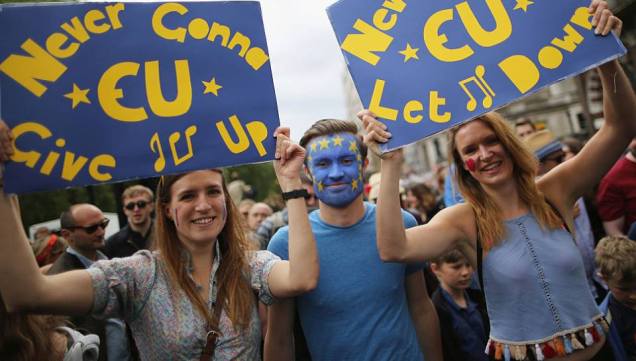
Thousands Of People Take Part In The March For Europe

The flimsy, amateurish lies told by Vote Leave are coming back to bite, and threaten to undermine and unnecessarily complicate Brexit

Two weeks after the astonishing vote for Brexit in the EU referendum, and the sheer amateur stupidity of the official Vote Leave campaign is still causing problems, exactly as this blog and others predicted that it would.

The Guardian reports:

In a separate development, Anthony Eskander, a criminal barrister at Church Court Chambers in London, has posted an opinion arguing that politicians supporting the Vote Leave campaign might have opened themselves up to legal action for alleged misrepresentations over claims that quitting the EU would allow an extra £350m to be spent on the NHS.

It claims politicians might have committed offences of misconduct in public office by promoting the £350m claim. The figure has been called “potentially misleading” by the independent UK Statistics Authority, for failing to take into account the UK’s rebate from the EU. Vote Leave denied during the referendum campaign that it was misleading the public.

We’ve heard this charge that politicians’ claims should be vetted by some kind of Ministry of Truth levelled by lots of people, including an audience member on last night’s Question Time. But this is the first time I have seen it translated into legalese, and even if nothing comes of it (as is likely) it further chips away at the legitimacy of the Brexit vote, further dividing the country and encouraging pro-EU supporters to dig in and calcify their positions rather than accepting the country’s verdict and coming together to make the best of Brexit.

Now, of course if they were not hung up on the false £350 million claim they would have found something else to moan about. Many prominent Remainers (and those in the general public) have shown themselves to be exceedingly sore losers in the aftermath of the Brexit vote, seizing on the slightest fault, misstep or constitutional ambiguity to claim that democracy should be suspended and the result of the referendum overturned.

But still, there was no need for the supposed grown-ups in charge of Vote Leave to make it quite so easy for them. There was no need to persist in publicly airing a patently false and comprehensively debunked (by activists on both sides including thinking Brexiteers, incidentally) claim about how much money the UK stood to save from leaving the EU.

The true figure – closer to £160 million once the UK rebate and EU disbursements back to Britain are taken into account – is still a lot of money, and would have looked just as effective plastered on the side of a bus. But no, the Boris/Gove/Cummings triumvirate decreed that £350 was the magic number, and far too many prominent Brexiteers squandered their credibility by repeating it in some form or another over the course of the campaign.

It is now becoming crystal clear that rather than accepting the result of the EU referendum, many disappointed Remainers are determined to wage a guerilla campaign of attrition against Brexit, a last-ditch rearguard effort to prevent the UK from leaving the European Union. They will use the claims of prominent Brexiteers against them (while sweeping their own dubious claims and falsehoods under the carpet, naturally), explore legal loopholes, use delaying tactics and throw every procedural obstacle they can find across our path out of the EU.

None of this is remotely surprising. All of it could have been predicted – and was predicted by this blog. But still the shining ones at Vote Leave persisted with their strategy, handing the pro-EU crowd more ammunition with every new over-hyped soundbite.

That’s why it is good that both Boris Johnson and Michael Gove are now no longer in the running for the Conservative Party leadership, however dubious the choice before us now is. Remainers (and their celebrity chums) talk about the unravelling of Johnson, Gove and Farage as being akin to the captain abandoning ship after steering his vessel onto the rocks. But the Brexit vote was achieved in spite, not because of, the campaigning of Vote Leave. The fact that some of their leading lights have now been snuffed out is cause for satisfaction, not concern, because it increases the chances of a mature adult taking the reins and negotiating Brexit like a grown-up.

I don’t want somebody who stubbornly persisted in broadcasting a patently, risibly false claim – like a petulant child caught in an obvious lie – to represent Britain in the coming difficult secession negotiations with the EU. I don’t want anybody leading this country whose antics during the referendum and in its immediate aftermath make Brexit any more complicated than it needs to be.

And regrettably, that rules out many of the people most closely connected with the official Leave campaign.


Brexit - EU - European Union Flag - Missing Star - Britain - UK

Top Image: Spiked

Agree with this article? Violently disagree? Scroll down to leave a comment.

Follow Semi-Partisan Politics on TwitterFacebook and Medium.

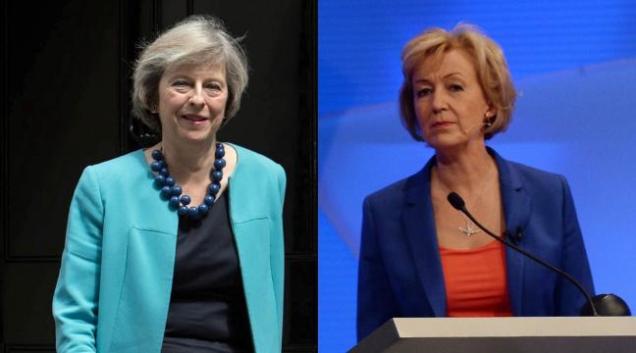
Leadsom vs May – Two Risky Options

Theresa May - Andrea Leadsom - Conservative Tory Party leadership

The very qualities which make Theresa May an awful Conservative leadership candidate on domestic policy mean that she is best equipped to handle our tough secession negotiations with the EU in Brussels. But the future leadership of the United Kingdom cannot be viewed solely through the lens of Brexit…

Dr. Richard North perfectly captures this blog’s dilemma in trying to choose between two highly sub-optimal candidates for Conservative Party leader and the next prime minister:

With a final contest between May and Leadsom, [if] Leadsom wins, we are faced with the great danger of having a woman as prime minister who has little understanding of what it takes to negotiate a successful withdrawal from the EU, and no capacity to develop that understanding.

On the other hand, if May is elected, we are faced with a danger just as great, in having a prime minister who brokers an exit plan which is so successful that we end up stuck with it, and in a position far worse than we are at present.

If this sounds perverse, it is. What we are seeing from the “remains” is a sudden enthusiasm for the Efta/EEA or “Norway option”, an option which, prior to the referendum, they had all been falling over themselves to demolish.

This, as readers here well know, we support as an interim option, acknowledging that it would be completely untenable for the United Kingdom in the longer term. We thus look for a different end game, which then takes us out of the EEA – with other Efta members – leaving the Agreement to collapse.

Unfortunately, the opposition is wise to the flaws of the EEA option and, from the Robert Schuman Foundation, the intellectual heart of the EU, we see proposals to modify the EEA to such an extent that it will soften some of the worst features of the EEA, and thus weaken the pressure to move on.

Dr. North goes on to describe the chicanery by which this might be accomplished – basically by making the EEA Council rather than the Council of the European Union the lead body in approving single market legislation, tackling the (already disingenuous) complaint that being in the EEA means accepting all of the rules while “having no say”.

While superficially appealing, this could lead to Britain being permanently parked in a significantly sub-optimal position on the edge of a still-integrating Core EU in which the eurozone would inevitably be dominant. It would certainly undermine one of the key benefits of Brexit to an interim EFTA/EEA access “departure lounge”, namely the restoration of Britain’s right of reservation which we could apply to new regulation which threatened to inflict significant or unacceptable harm on our key industries or vital national interests.

But while a Theresa May premiership increases the risk that Britain is sucked into a sub-optimal “associate member” status on the EU’s margins, Andrea Leadsom would do almost the exact opposite – invoke Article 50 almost immediately and then effectively let Jesus take the wheel, hoping that something satisfactory is miraculously negotiated within two years. Having recently started to appreciate the true complexity of the global trading and regulatory environment, largely thanks to my involvement with The Leave Alliance, it is immediately apparent that Leadsom’s cavalier approach to our EU secession negotiations is fundamentally unserious, no matter how genuine her euroscepticism.

Leaving aside issues of personality, experience and gravitas – for few could seriously deny that May would be the more formidable negotiator to fight Britain’s corner – it is hard to see how a Leadsom negotiation could succeed when the candidate seems sure of little besides her impulse to take Britain out of the EEA, making our trade subject to the EU’s common external tariff in the far from certain hope that doing so dramatically cuts immigration.

Therefore, from a purely Brexit-related perspective, Theresa May seems (counter-intuitively) to be the better choice if we want to maximise our chances of escaping from the EU’s always-tightening political union while disrupting trade as little as possible – even if this means that we have to remain permanently vigilant to ensure that May does not backslide from her commitment that Brexit means Brexit.

But of course this Tory leadership election is not only about Brexit – though our secession from the European Union is by far the most important issue on our national plate, and will be for some time. Still, other issues cannot be overlooked entirely. Foreign policy, civil liberties, economic freedom, education, healthcare and the role of government matter enormously too. And in many of these areas, Theresa May is extraordinarily deficient.

This is why I cannot simply swallow my distaste and endorse Theresa May outright. All of these other policy considerations must also be factored into the mix – which is what I shall attempt to do in my next blog post.


Brexit - EU - European Union Flag - Missing Star - Britain - UK

Top Image: BT

Agree with this article? Violently disagree? Scroll down to leave a comment.

Follow Semi-Partisan Politics on TwitterFacebook and Medium.