Brexit: The (Animated) Movie

A clear, concise and grown-up case for Brexit, in under three minutes

If you do nothing else today, watch and share this video.

Once again, the hard work and inspiration of independent citizen campaigners puts the official Leave campaign to shame in this EU referendum. This video, created by Piffle (real name Matt, a British animator) does a better job summing up the pro-democracy, pro-trade, pro-globalisation case for Brexit in three short minutes than most of the main Leave campaign figureheads put together.

The transcript:

Hello, Britain.

This EU referendum has been made to look really rather confusing, but it’s actually all quite simple. Britain, as a part of the EU, is in a free trade area that spreads from Iceland to Turkey. Free trade is great as it makes trade easier. However, not all countries in this free trade area are EU members, and no one is proposing we would ever leave the trade bloc if we exit the EU – least of all Germany, who earns billions selling us their cars.

Britain voted to join the EEC back in 1973 [Note: Britain joined in 1973 but the referendum was actually in 1975] when it looked like regional trade blocs were the future. This was long before the internet or mass container shipping, and the Soviet empire was in full swing. Technologies have since made the idea of local trading unions completely obsolete, as it is now as cheap and easy to do business anywhere in the world.

Britain’s future is way beyond the EU. Remaining an EU member means we can’t negotiate favourable trade or business deals – we’re stuck with whatever the unelected EU commissioners think is best. In the past decade, our trade with the EU has fallen from 55 percent to 45, and this idea that we must merge our political institutions for the sake of this shrinking minority of our commerce is just frankly stupid.

But is Britain too small to compete? Britain is the fifth largest economy in the world, has the fourth largest military budget, is a founding member of NATO, a permanent seat holder on the United Nations Security Council, the G8 and the G20, has the world’s most widely spoken language, the world’s best universities, and has a cracking history of maritime trade and independence. If Britain isn’t big enough to compete on the world stage, who the bloody hell is?

Those wanting Britain to remain in the EU are using uncertainty and doubt to spread fear. They claim that each British household could lose as much as £3000 every year by leaving. But even if we pretend this idiotic claim were true, would £750 really be all it takes to purchase your democratic rights? Is the ability to hire and fire our lawmakers, democratic freedoms fought for over hundreds of years, now only worth two month’s rent for a studio apartment in Glasgow and a packet of Wotsits? If 28 unelected British plutocrats tried to pull this crap, I’m sure we’d tell them to bugger off, too.

However you vote, everything is going to change. The EU Commission has made it quite clear that they are on the path to closer financial, legal and border integration. Staying on that bus will lead to us having to ditch the pound sterling, our entire common law judicial system and our borders for the euro, bench trials and Schengen in due course.

The Union is of course desperate to maintain its control, but I don’t think that a few measly threats mean we need to commit our future to this authoritarian regime. Besides, we have been getting on wonderfully well trading, emigrating to and allying with other countries without needing to give their government control over our laws.

So let’s use this one chance to wish the EU the very best, be their trading partners, business colleagues, military allies and friends, but let them know we’ll govern ourselves from here on out – thanks all the same.

My emphasis in bold, minor corrections in brackets.

It is almost as though the creative mind behind Piffle is a reader and admirer of eureferendum.com or The Leave Alliance …


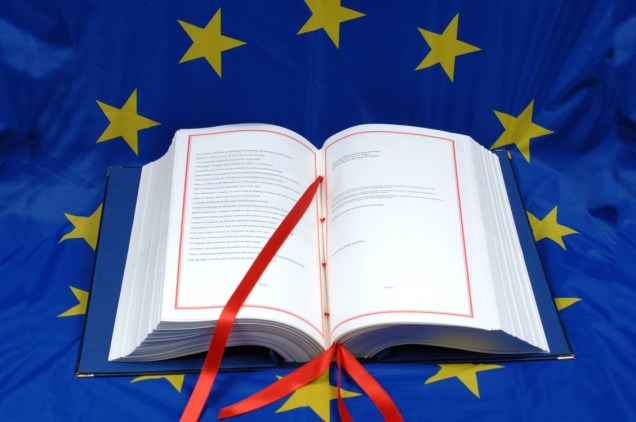
European Union - United Kingdom - Britain - Flags

Video:  “Brexit: The (animated) Movie” created by Piffle

Agree with this article? Violently disagree? Scroll down to leave a comment.

Follow Semi-Partisan Politics on TwitterFacebook and Medium.

The Seven Deadly Sins Of Pro-European Union ‘Remain’ Campaigners

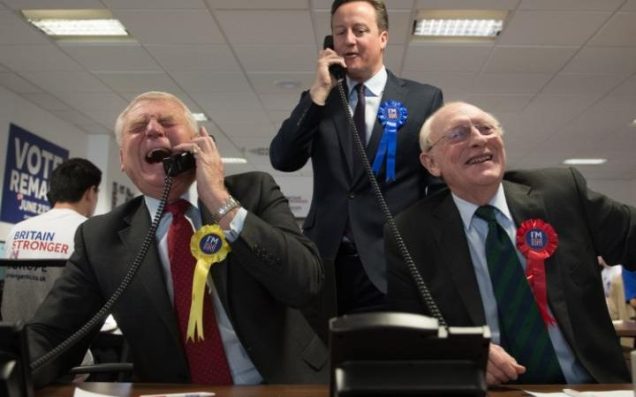
David Cameron - Neil Kinnock - Paddy Ashdown - Stronger In - EU Referendum - Brexit

Zealotry, pessimism, denialism, idiocy, treachery, materialism and sloth – the Seven Deadly Sins of those campaigning for Britain to remain in the European Union

The Financial Times reports on German moves to bring long-simmering plans for an eventual European army back to the boil with the submission of a significant new white paper – the release of which has been conveniently deferred until Britain’s EU referendum is concluded:

Germany is to push for progress towards a European army by advocating a joint headquarters and shared military assets, according to defence plans that could ricochet into Britain’s EU referendum campaign.

Although Berlin has long paid lip-service to forming a “European defence union”, the white paper is one of the most significant for Germany in recent years and may be seized by anti-integration Brexit campaigners as a sign where the bloc is heading.

Initially scheduled to emerge shortly before the June 23 referendum vote but now probably delayed to July, the draft paper seen by the Financial Times outlines steps to gradually co-ordinate Europe’s patchwork of national militaries and embark on permanent co-operation under common structures.

[..] At the European level, the paper calls for “the use of all possibilities” available under EU treaties to establish deep co-operation between willing member states, create a joint civil-military headquarters for EU operations, a council of defence ministers, and better co-ordinate the production and sharing of military equipment.

“The more we Europeans are ready to take on a greater share of the common burden and the more our American partner is prepared to go along the road of common decision-making, the further the transatlantic security partnership will develop greater intensity and richer results,” the paper states.

This is not shocking. This is not surprising. This is what the gradual creep toward European political union looks like. Proposals like this are raised before being quietly deprioritised, seemingly dropped in the face of political backlash, only to be resurrected and advanced once more, each time gaining a little more ground until the end result is achieved – not necessarily by its original name (as with the Constitution) but always in practical effect. No never means no with the European Union. It simply means brief retrenchment before pressing ahead the same thing with a slightly different label.

At this point I do not know what more can be said, what further evidence can be presented, to convince people that the European Union is not the benign, happy-go-lucky club of friendly countries occasionally coming together on a super voluntary basis to fight crime, Save the Earth and braid each other’s hair that they are so desperate to believe it to be.

The EU is not shy about its intended direction of travel. None of the EU’s “founding fathers” were remotely shy about what they wanted their creation to become. For all of its bureaucracy, the Brussels machinery is usually quite transparent in its workings, for those with the patience to look and discover what they do in our name. And yet there persists a massive disconnect between the European Union’s own self-declared purpose and the way in which it is perceived and portrayed in Britain.

I once ran for the train at London Euston station, intending to go to the city of Wolverhampton (don’t ask why). But I didn’t look closely enough at the departure screen, and accidentally boarded the service to Manchester, engrossed on a phone call, only realising my error when the train first stopped at Stoke-on-Trent. But crucially, once I realised my mistake I did not stay on the train in the forlorn hope that by staying in my seat I might still somehow end up in the West Midlands. No – I got off the train and rectified the error. I did so because like most people, on matters of travel I am capable of perceiving and understanding objective reality – in this case, the reality that I was sitting on a train taking me at great speed to somewhere I had no wish to go. My destination and that of the other passengers were irreconcilably different.

As it was with my ill-fated train adventure, so it is with Britain, currently being borne along on the semi-fast service to European political integration. It should now be abundantly clear to everyone that the destination is not “friendly trade and cooperation” as the EU’s desperate apologists claim, and yet many wavering voters still believe that if they close their eyes, ignore the mounting signs and stay fearfully on the train, it will take them somewhere acceptable.

And I don’t get it. I just do not understand those of my fellow countrymen who are educated people and not hardcore European federalists – people who do not want Britain to become subsumed into a European political union or cast aside as the rejected half-member with no influence on the periphery – but who nonetheless intend to vote Remain in this EU referendum. I’m not being dramatic. I have tried very hard to put myself in the position of a soft Remain supporter, and I can no longer do it. Clearly I have passed the Brexiteer event horizon and can no longer turn back, not that I wish to. And I speak as a former hardcore euro-federalist (back in my student days).

Basically, to vote Remain in this EU referendum, one quite simply has to either:

1. Be a committed euro-federalist, eager for a United States of Europe

2. Understand that this is the end goal, abhor it, but think so little of Britain’s prospects as an independent, globally-engaged nation that being part of such a European state seems like the “least worst” option

3. Summon enormous powers of denial in order to ignore the EU’s trajectory and accept at face value David Cameron’s fraudulent assertion that he has secured meaningful concessions from Brussels

4. Be incredibly ignorant of recent history and basic, easy to research facts

5. Actively wish harm to one’s own country and democracy

But perhaps that is not entirely fair. As I wrote recently, I can see how some voters – particularly those from my own Millennial generation – might choose to prioritise short term financial stability over long-term democratic health, though I think that such people seriously underestimate the risks inherent in surrendering the last vestiges of our democracy to an unaccountable supra-national government. And of course some people are just incredibly apathetic.

So there are also the further two possibilities:

6. Self-centred materialism

7. Laziness and apathy concerning an issue of fundamental importance

That’s it. Those are the choices. Zealot, pessimist, denialist, idiot, traitor, materialist or sloth.

If you are planning to vote Remain in the EU referendum, which one are you?


European Union - United Kingdom - Britain - Flags

Agree with this article? Violently disagree? Scroll down to leave a comment.

Follow Semi-Partisan Politics on TwitterFacebook and Medium.

On Brexit, Nigel Lawson Should Stick To Being A History Professor

Nigel Lawson - Brexit - EU Referendum

When it comes to the history of the EU, Nigel Lawson actually has his facts straight. It’s a shame he also feels the need to weigh in on the political and economic aspects of Brexit

When he isn’t single-handedly torpedoeing the thinking Brexiteer’s case for leaving the European Union with fatuous and cavalier pronouncements on the economic aspect – or wrongly whipping up fears that Brexit would mean border controls with Ireland – Nigel Lawson can sing quite a nice tune on the issue of democracy and the unabashedly federalist imperative of the EU.

From Lawson’s OpEd in yesterday’s Telegraph:

On the European mainland it has always been well understood that the whole purpose of European integration was political, and that economic integration was simply a means to a political end.

In Britain, and perhaps also in the US, that has been much less well understood, particularly within the business community, who sometimes find it hard to grasp that politics can trump economics.

The fact that the objective has always been political does not mean that it is in any way disreputable. Indeed, the most compelling original objective was highly commendable.

It was, bluntly, to eliminate the threat to Europe and the wider world from a recrudescence of German militarism, by placing the German tiger in a European cage.

Whether or not membership of the EU has had much to do with it, that objective has been achieved: there is no longer a threat from German militarism.

But in the background there has always been another political objective behind European economic integration, one which is now firmly in the foreground.

That is the creation of a federal European superstate, a United States of Europe. Despite the resonance of the phrase, not one of the conditions that contributed to making a success of the United States of America exists in the case of the EU.

But that is what the EU is all about. That is its sole raison d’être.

This is a condensed and fairly accurate restatement of the EU’s underlying purpose, more fully laid out in “The Great Deception” by Dr. Richard North and Christopher Booker – though this essential book makes the additional important point about just how much of the EU’s evolution has taken place by stealth, cloaked in deliberate secrecy.

Anyone still labouring under the illusion (or burying their heads in their sand to convince themselves) that the EU is nothing but a happy-go-lucky club of countries coming together voluntarily to “cooperate” and solve common difficulties together should read “The Great Deception” and let the scales fall from their eyes. For all his other faults, Lawson does at least have a firmer grasp of history than most starry-eyed EU apologists.

Does this OpEd make up for everything else that Lawson has unfortunately done to retard the case for Brexit? No. But it does show quite starkly the positive case for Brexit which the main Leave campaign is throwing away by refusing to commit to an anxiety-soothing EEA-based exit plan and then, once the public’s understandable economic concerns are neutralised, letting the case for democracy speak for itself.


European Union - United Kingdom - Britain - Flags

Top Image: The Irish News

Agree with this article? Violently disagree? Scroll down to leave a comment.

Follow Semi-Partisan Politics on TwitterFacebook and Medium.

Federalism Is Not A Dirty Word Simply Because It Is Associated With The EU

Towards a Federal Europe

If political and social cohesion is fraying even in the United States, where citizens share a strong common American bond, what chance is there for successful European government?

In her latest Telegraph column, Janet Daley makes an interesting comparison between the prospects of European federal union and those of the United States (currently experiencing its own political turmoil with Donald Trump’s successful insurgency on the Right and a nearly-successful  insurgency on the Left in the form of Bernie Sanders).

Daley writes:

That ideal of the European continent as a unified entity, presenting an alternative presence in the world to the overweening superpower across the Atlantic was once the whole point – wasn’t it?

[..] But, as I say, nobody who favours remaining in the EU is talking up that idea these days. In fact, it’s the other guys – the ones who want to leave – who are most inclined to remind us of it, to the clear embarrassment of the Remainers. Could this be because the political model itself – the American success story of a federation of states joined together under a central government – seems to be going badly wrong? The nation that appeared to have found the ultimate solution to conjoining separate states, each with its own semi-autonomous authority, under one set of national governing institutions is now apparently facing an electoral choice between the demagogic and the disreputable.

I get what Daley is trying to do here, but she makes a leap too far in suggesting that the nature of federal government itself is responsible for American political woes. The federal model has served the United States well for nearly 250 years; today’s problems are indeed mirrored in Europe and America, but they are not the result of federalism, tempting as it might be to discredit federalism in order to prevent its unwelcome imposition on the countries of Europe.

On the contrary, the current political disillusionment and the rise of the insurgent outsider candidates is largely the inevitable consequence of corporatism, an unhealthy perversion of capitalism in which unaccountable and undistinguishable elites from all major parties leech off the state to unfairly consolidate their hold on power, which is common among many Western governments. And tellingly, Daley provides no evidence to back up her assertion that federalism is to blame for this.

Daley then goes on to discredit her argument further with this highly inaccurate portrayal of conservatism in America:

Most disturbingly, the US seems to be prey to the same excesses which are so worrying n the European scene. American federal elections both at the presidential and the congressional level, used to be predictably, boringly moderate. For generations, both the major parties (and there were no others worth considering) could have fit within what was, in European terms, a narrow spectrum of political possibility: roughly the middle ground of the British Conservative party. Capitalism under reasonable controls and a strong defence of individual liberty were the basic tenets of a consensus which underpinned every plausible candidacy, allowing only for differences of emphasis and intonation.

This is wrong on several counts. Firstly, it is a wholly wrong to suggest that the entire spectrum of American political thought would miraculously fit within the British Tory party. To make this claim is to overlook the numerous areas of social policy (gay rights, abortion and religion in public life are just the first which spring to mind) where the British Conservative Party has more or less completely moved on and abandoned its past conservative stances, while the Republican Party continues to exploit the culture wars as a vote-winning wedge issue.

It is also to overlook the fact that in terms of economic policy, the Tories are often comfortably to the left of even the US Democratic Party in terms of their tolerance for state involvement in political life, the scope and depth of the welfare state and – how can one forget – the British worship of nationalised healthcare. True, there are isolated Democrats who openly support a “public option”, but almost nobody in American political life thinks that the NHS is a great model to emulate, or would be caught dead suggesting its adoption by the United States.

In almost every way, the British political spectrum sits (at least) a few points to the left of America’s, with our dreary post-war collectivism standing in marked contrast to the individualism of the United States. To suggest that both Republicans and Democrats would find a comfortable home within the Conservative Party is simply false – even the most Thatcherite of Tory MPs would be laughed out of the GOP as a ludicrous socialist.

Secondly, while recoiling in horror from Trump (admittedly a demagogue) and Bernie Sanders (who this blog admires for bringing genuinely left wing conviction to the debate, if only so that it can be exposed as flawed) Daley seems almost approving when she writes of “predictably, boringly moderate” government which allowed only for slight “differences of emphasis and intonation”. But this is exactly the problem – it is when the major political parties begin to look and sound indistinguishable from one another that a void opens which is often filled by glib and unsavoury types like Trump. In many ways, Britain has been fortunate in this regard – going into the 2015 general election, Labour and the Conservatives could hardly have been more depressingly alike, and yet the worst we have to show for it is a diminished UKIP and Jeremy Corbyn.

Daley appears to be defending consensus politics and railing against demagoguery at the same time, while failing to understand that an excess of the former all but guarantees the latter. Her column also forms part of an unwelcome trend of unnecessarily problematising issues around the EU referendum. Both sides are guilty – mostly desperate Remainers, who in their desperation to win are prone to suggesting that the smallest of bureaucratic or diplomatic hurdles to Brexit is an immovable showstopper, but also many on the Leave side who are apt to grasp at any problem with the EU or any world event and seek to fashion it into a weapon to be fired at Brussels.

In this case, holding Donald Trump and Bernie Sanders up as evidence suggesting that the American federal model itself is broken may help to land a solitary punch on the European Union this once, because the EU’s inexorable direction of travel is toward federal union. But by slandering an entire mode of governance in this way, we limit ourselves when it comes time to think about how we may wish to be governed if and when we leave the European Union. Some – including this blog – actually believe that moving towards a federal United Kingdom following a constitutional convention to be held after Brexit would be a great outcome.

So a plea to everyone on both sides (but in reality, only to those on the Brexit side – for we know that the Remain camp will tell any lie and stoke any fear in their desperation to win): there are sufficient real problems with the European Union as it is now and is soon likely to become without attacking every single word or concept associated with Brussels. So let’s debate where we can win – not getting into a mud slinging contest with trumped up economic figures, and not disparaging every single thing associated with the European Union, but by focusing on democracy and sovereignty, and building a positive vision of how Brexit can be the first step in Britain’s re-emergence as a global player.

The Brexit side is already accused of being alarmist. Let’s not live up to the hype by slandering federalism – a mode of government which has worked exceedingly well for many countries, including the most powerful and prosperous on Earth – in our desperation to slander everything which is also connected with the European project.


European Union - United Kingdom - Britain - Flags

Agree with this article? Violently disagree? Scroll down to leave a comment.

Follow Semi-Partisan Politics on TwitterFacebook and Medium.

Cameron’s EU Deal – Reaction

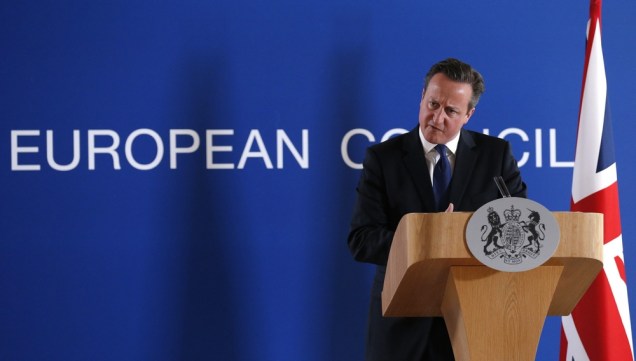
BELGIUM EU SUMMIT

Didn’t he do well?

As our victorious prime minister returns to London to chair the fateful cabinet meeting which will now likely set the wheels in motion for a June referendum, it’s worth taking a brief survey of how David Cameron’s deal – essentially an embossed, artfully decorated statement of the status quo – is being received.

The division between those who are angry or depressed and those who are buoyantly cheerful really tells you all that you need to know.

Toby Young bristles at being asked to greet the status quo like a shiny new present, but recognises that such a devoutly europhile prime minister could scarcely be expected to to any better:

The attempt to spin this deal as a great victory, which grants Britain a “special status” within the EU, is unlikely to win the Prime Minister many friends. On the contrary, it may end up alienating people who haven’t yet made up their minds who will feel they’re being taken for fools.

[..] Crucially, the EU leaders made it clear that there won’t be any further reforms, at least none that will mean a transfer of powers away from the centre. So Downing Street won’t be able to spin this agreement as the beginning of a reform process rather than the EU’s best and final offer.

Many of the “wins” Cameron boasted about in his speech were just assurances that the EU isn’t going to take away the protections for Britain already won by Margaret Thatcher and John Major. We won’t be forced to join the euro! Whoopee doo.

Tim Stanley channels his inner Tony Blair and declares Cameron’s pitiful outcome to be “weak, weak, weak”:

David Cameron’s deal with Europe is weak, weak, weak. It could never be anything but. Why? Partly because the Prime Minister is an inveterate Europhile.

He approached these negotiations from the stance of someone who ultimately wanted to stay in – and how could he negotiate from strength when everyone around the table knew that he was bluffing? More importantly, the idea that Britain can build for itself a “special status” within Europe is pure fantasy.

The EU cannot be decentralised; the UK cannot prosper on its fringes. The only real choice is between the status quo and Brexit.

[..] The Europeans made it clear from the outset that there would be no rewriting of the fundemantal principles. Rightly so: one country cannot determine the direction of travel for the entire continent. And if one country gets to pick and choose its own rate of integration into the new super state – why, everyone else will want to do the same.

So Cameron could never have been given substantial reforms because just putting them on the table would have jeopardised the grand European project. We have reached a point in the history of the EU when what Britain needs and what Europe wants are no longer compatible. The only logical thing left to do is to leave.

Paul Goodman compares David Cameron’s loftily declared original list of renegotiation objectives with the limp and shrunken prize he now holds in his hand – and he makes the choice facing Conservative MPs crystal clear:

Many Conservative MPs told their voters and Associations at the last election that Britain’s relationship with the EU cannot go on as it is.  They are fully entitled to say now that they have changed their minds.  That they have been persuaded that Britain’s future is brighter as an EU member state.  That they will swallow any misgivings they have about the deal, and back their Party leader – who, after all, is on some measures the most successful Conservative leader of modern times bar Margaret Thatcher.  That this is no time to campaign for a referendum result that would turn an election-winning Prime Minister out of office, and destroy the reforming work of the first majority Tory Government in over 20 years.

What they cannot say, if they have declared that Britain’s relationship with the EU must see real reform, is that this deal makes a difference.  And if they want to see such change, the lesson of this summit is that it isn’t on offer.  Which leaves only one option open to them, and to Party members of the same mind – to back Brexit.

Meanwhile, the Guardian is priming its core audience of nodding-dog virtue-signallers with key arguments to use against Brexiteers, and confirms what any thinking person knows – that the ultimate decision has nothing to do with David Cameron’s non-existent concessions from Brussels:

First of all, the details of the deal are not the crucial issue. Months ago, when David Cameron revealed his renegotiation agenda, it was already clear that this was not going to be a fundamental redefinition of Britain’s relationship with the EU. Nor would we suddenly find ourselves in “a reformed Europe”. On this, Eurosceptics are right: Cameron’s demands were less than he pumped them up to be, and inevitably, given that 27 other European countries had to be satisfied, what he achieved is even more modest. But it would be madness to let a decision about the economic and political future of Britain for decades ahead hinge on the detail of an“emergency brake” on in-work benefits for migrants.

New Europeans – that pressure group of proto-EU citizens waiting impatiently for the new  European that they crave to finally hatch – are happy too:

The Prime Minister has secured his so-called “emergency brake” on in-work benefits paid to mobile EU citizens coming to Britain. However, it will not be his hand that is on the brake, despite his announcement to the contrary.

The brake is in the hand of the Council.  The Council may be ready to pull the brake for the UK already – but it is still the Council’s hand on the brake. The European Parliament would need to pass the necessary legislation.  So the earliest the legislation could be in place is 2017.

The emergency brake will operate like the transitional arrangements – after 7 years it will drop away. In the meantime, very few people will be affected because mobile EU citizens rarely apply for in-work benefits in the first four years. There is very little evidence to show that EU citizens are claiming in-work benefits on arrival in Britain.

[..] The potential savings from David Cameron’s “clamp down” on other benefits for mobile EU citizens are trivial and petty in the context of the national accounts. They amount to about £30m on some estimates. This is less than what it costs to run the Royal Opera House.

And they are right – the main “headline concession” that David Cameron managed to secure from Brussels remains entirely in the hands of the EU rather than Britain, and would make absolutely zero tangible difference to anything whether it is ultimately pulled or not.

These people have no reason to lie. They are the people who were potentially most affected by any major changes that David Cameron might have negotiated, so their relief (bordering in crowing) is absolutely genuine – and utterly damning of Cameron’s claim to have fundamentally changed our relationship with the EU.

Back to Tim Stanley for another eloquent denunciation of this brazen establishment stitch-up:

There are a million reasons to hate politics: the groupthink of the establishment is one of them. Cowardice is another. It’s like being governed by jellyfish: spineless synchronised swimming in one terminal direction.

For years Tories have used the issue of Europe to win votes, promising us either serious reform or a campaign to leave.

But not only was David Cameron’s renegotiation effort a paper tiger (Francois Hollande: “Just because it lasted a long time doesn’t mean that much happened”) but now the Cabinet has largely decided to follow its leader and back the In campaign.

[..] The entire weight of the state, media and big business will fall behind a campaign saying that Europe is good for us even if, from a distance, it appears to be a giant ball of flame hurtling into an abyss of despair.

Against this confederacy of dunces stands a small number of politicians brave enough to risk friendships and careers to tell us the truth – that this deal is a sham, the EU is dying and Britain is better off out.

I myself have nothing to add at this time. Others have already encapsulated what I feel, and said it better than I could – most notably Dr. Richard North at eureferendum.com, who echoes my reference last night to Neville Chamberlain:

Mr Cameron may have in his mind’s eye the image of Prime Minister Neville Chamberlain returning from Munich in 1938, triumphantly waving his “piece of paper” at Heston Airport (where the M4 service station now stands), but at least Mr Chamberlain’s “deal” bought us critical time, allowing us to re-arm sufficiently against the Nazi menace.

But this piece of paper is nothing but a fraud – a pretence. This Prime Minister has brought nothing back, nothing of substance, and is now intent on using is as the basis for a referendum where he is intent on selling his snake-oil “special status”.

Yet, all the time, Mr Cameron’s efforts have been a sideshow besides the main event – the real renegotiation under way to transform the 19 members of the Eurozone into a single state. That is the EU real agenda not the stage-managed drama of the Prime Minister emerging blinking into the light and announcing he has secured our future for a generation.

Nor should we assume that the Brussels barons will treat us kindly if we vote to remain in the EU. They will brush aside future British protests, telling us that we have had our chance to do things our way and rejected it. Our prospects sitting uneasily on the margins of the emerging superstate will not be promising. Unloved, ignored and marginalised, we face an uncertain, even risky future, on the outskirts of the new European empire.

But I, and this blog, will have much to say as we now fight onward to the 23 June referendum date. And those politicians who built their jealously-guarded careers and reputations on what turns out to be paper-thin euroscepticism should expect no understanding and no mercy.

The divided Leave camp has been caught napping – Cameron is going to the country with a desultory deal, entirely based on the belief that we are so divided that we will not be able to mount an effective Remain campaign – and by publicly embracing people like George Galloway, it seems that some of us are determined to prove him correct.

If you haven’t been paying attention so far, or have only half tuned in, then now is the time to perk up and fulfil your duty as an engaged citizen. We have just four months to win our freedom from the European Union and, if we succeed, potentially spark a renaissance of real democracy through Europe.
BELGIUM-EU-BRITAIN-POLITICS

Agree with this article? Violently disagree? Scroll down to leave a comment.

Follow Semi-Partisan Politics on TwitterFacebook and Medium.