Live Television – How Not To Do It

There has been widespread public criticism – and not just from the usual suspects in the fusty, traditionalist right-wing media – about the quality of the BBC’s coverage of the Queen’s diamond jubilee river flotilla, which aired on Sunday.

The Telegraph, twisting the knife, claims that the BBC’s reputation is “sunk” in the River Thames:

Like many viewers, I watched the BBC on Sunday with incredulity and mounting anger. It has become a truism that our national culture has been infantilised and made stupid. But if ever anything could be relied on to provide a temporary halt in that slide it would, surely, be the BBC’s coverage of the Diamond Jubilee. Much to the irritation of other channels, we turn to the national broadcaster at times of national togetherness. The BBC just gets it right.

Not any more. Sunday’s broadcast was not merely inane, it was insulting. The instruction had clearly gone out from on high that the audience would comprise imbeciles with a mental age of three and a 20-second attention span. And that any celebrity sighting, no matter how minor, would trump anything happening on the river.

So the flotilla – an event so awe-inspiring that it drew well over a million people, on a cold wet day, to stand 10-deep on the banks of the Thames to try to catch a sight – was treated merely as background for the witterings of the BBC’s most lightweight presenters and the D-list celebrities they had lined up to lurk anywhere but on the river.

http://www.telegraph.co.uk/comment/9311490/The-BBCs-reputation-is-sunk-in-the-Thames.html

The Daily Mail sneers about the tasteless product placement during the broadcast:

The item that came in for most criticism featured Miss Cotton discussing a jubilee sick-bag with singer Paloma Faith.

After being asked by Miss Cotton whether she had had ‘a lovely jubilee weekend’, the singer seized the opportunity to plug her new album.

The pair then went on to discuss a number of bizarre items of jubilee memorabilia, including jelly moulds shaped like the Queen’s face; a high-visibility vest bearing the words ‘High Viz, Diamond Liz’; and, finally, a sick-bag bearing an image of the Queen.

Holding the bag, Miss Faith explained: ‘Then, if you’ve eaten too much, you can just vomit into a jubilee sick-bag.’

Miss Cotton replied: ‘Lovely, isn’t that just lovely? And you can choose your colour, red or blue, it’s up to you.’

The presenter, 30, last night congratulated herself and colleagues on ‘seven hours of spotless TV’.

http://www.dailymail.co.uk/news/article-2154222/Queens-Diamond-Jubilee-2012-BBC-sank-tide-wittering-inanity.html

Having personally sat through most of the Sunday coverage myself, I can only agree with these assessments.

Traditionally, Sky News has been (to my mind) the channel you turn to when there is breaking news and you want to see immediate, if somewhat shaky footage, shot from a helicopter and narrated by the reporter who is first on the scene, but is perhaps not fully briefed on the background of the story they are covering, while the BBC is the channel that you give an extra half hour for their reporter to turn up at the scene, but who then delivers a more nuanced and knowledgeable report when in situ.

This Jubilee weekend the situation was reversed, and I found myself giving up on the BBC’s lamentable, dumbed-down coverage in disgust, and switching over to Sky News so that I might actually learn something about what was taking place on the river, rather than have my intelligence insulted any further by the BBC’s callow, youthful and unknowledgeable presenters.

I suppose that my serious point would be that any large commercial broadcaster (Sky, ITV) can televise a large outdoor event and make it cheerful and perky. However, the BBC’s long history and deep institutional experience of broadcasting important national events – not to mention the fact that they are publicly funded by the television license fee – means that they are rightly held to a higher standard on such occasions. Certainly, in my view, the BBC should not merely replicate what is already readily available in the commercial media. But more importantly, like it or not, the BBC’s coverage of such events becomes the “coverage of record”. This is the footage that we will want to watch again when we ourselves are old, and the footage that future historians will study a century from now.

The BBC’s lamentable, frankly amateurish televised coverage of the Queen’s diamond jubilee celebrations has given those future historians an unintentionally revealing insight into what our pop culture, media and attention spans are apparently like in the second decade of the twenty-first century. But they will be sorely disappointed if they watch it with a view to learning anything at all about the British nation, British history or the monarchy – supposedly the reason for the broadcast in the first place.

Happy Jubilee Weekend

In honour of Queen Elizabeth II’s 60 years of service to our country as Queen, here is a stunning setting of the National Anthem, arranged by Benjamin Britten, and performed here by the BBC Singers and  BBC Symphony Orchestra at the Last Night of the 2010 Promenade Concerts:


And three cheers for our great country. No matter our circumstances or political leanings, we are all exceptionally lucky to live here in Britain.

Diamond Jubilee, Daily Mash Style

The Daily Mash’s inimitable take on the upcoming Diamond Jubilee celebrations:

Another old man on television, Sir Roy Hobbs, said: “Who could ever be cynical in this time of woo yay.”

Mother-of-two Emma Bradford was less enthusiastic. She said: “It’s hard to say exactly how good she is because there’s no other Queens of England currently working that we can compare her to.

“I mean, I might have made an even better queen. It’s something I mentioned to the careers advisor at school but he just made a face and gave me a leaflet about jobs in data entry.

“Still, I don’t want to be difficult so…woo yay, the Queen.

“Yay.”

http://www.thedailymash.co.uk/news/society/yay-woo-yay-the-queen-woo-yay-2012060129288

My own take will follow at the weekend.

Gove Educates Leveson On Free Speech

I do admire Michael Gove, the UK Education Secretary. When virtually all of the other Conservative cabinet members from David Cameron on downwards have proven themselves to be one disappointment, letdown and betrayal of principle after another, at least Michael Gove has been steadfastly working away at the Department for Education to bring about some real, conservative reforms.

So I was several steps beyond overjoyed when I found out that Gove had been giving evidence to the riveting Leveson Enquiry “into the culture, practices and ethics of the press”.

Suffice it to say that Leveson met his match yesterday:


Bravo! Since our taxpayer money is being frittered away in order that this pompous, self-aggrandising old gasbag Leveson can sit there like some modern-day oracle, cooking up new ways to constrain freedom of speech in our country, I am happy that those of us who disagree with the premise of the whole enquiry in the first place were able to extract some small measure of payback by sending Michael Gove into the fray to make him squirm a bit.

A couple of points to note from this video:

1. Just look at Leveson’s defensive, hunched posture compared to the relaxed, attentive stance of Gove. Leveson is clearly used to being flattered and deferred to almost all the time, and clearly was not ready to have his assumptions – and the preordained outcome of the enquiry – challenged in so articulate a fashion.

2. This is supposed to be an impartial enquiry, remember? So statements like “Don’t you think that the evidence I have heard from at least some of those who have been the subject of press attention can be characterised as rather more than ‘some people are going to be offended some of the time’?” have no place being uttered by Leveson. What does it matter what other evidence he has heard? Michael Gove is on the stand now, giving his opinion, which rightly should be his alone and not influenced by the parade of people who have already taken the stand. I’m not a lawyer, but isn’t that how these things are supposed to work? This is clearly a man who has made up his mind before he has even started deliberating.

The right-wing press in Britain was of course greatly cheered by this turn of events. From David Hughes, writing at The Telegraph:

Throughout the Leveson Inquiry it’s been pretty evident that it was the lawyers who felt they were the smartest guys in the room. Today that changed. Michael Gove, the Education Secretary, gave a virtuoso display of both intellect and guts as he made the case for press freedom. It’s perhaps no surprise that this journalist turned politician should, for the first time, take the argument to the Inquiry and swing it away from its focus on Murdoch and hacking and concentrate its mind on the wider issue of freedom of expression.

Plenty of witnesses have had mini-spats with Robert Jay QC, the counsel for the Inquiry, but no-one has so far tried to lock horns with Lord Leveson himself. Gove did so with brio: “Before the case for regulation is made, there is a case for liberty as well…I am unashamedly on the side of those who say we should think very carefully about regulation. By definition, free speech doesn’t mean anything unless some people are going to be offended some of the time.”

http://blogs.telegraph.co.uk/news/davidhughes/100161393/michael-gove-plays-a-blinder-at-leveson/

Michael Deacon, also writing at The Telegraph, came away similarly impressed:

Mr Gove was once a journalist, and three months ago said the inquiry might have a “chilling” effect on the press. He clearly hadn’t come to roll over. You could see it in his posture: always leaning sharply forward, as if to confront his interrogators. Without embarrassment he described Rupert Murdoch as “one of the most impressive and significant figures of the last 50 years”. He spoke out against the creation of new press regulations, and stressed the importance of free speech.

Perhaps all this makes his performance sound pompous. Yet it wasn’t. Even – or perhaps especially – at his most serious, Mr Gove is drolly camp. There’s more than a whiff of Niles Crane about him.

Lord Leveson didn’t seem amused. “I don’t need to be told the importance of liberty, Mr Gove,” he said frostily. “I really don’t.” Mr Gove didn’t so much as blink.

http://www.telegraph.co.uk/news/uknews/leveson-inquiry/9298341/Leveson-sketch-Michael-Gove-Secretary-of-State-for-Rogets.html

Even the BBC News analysis was quite complimentary:

He is one of the highest profile libertarians in his party and he gave a passionate defence of the right of freedom of speech. But the suggestion that it counted for nothing unless some people were offended some of the time, clearly got under Lord Justice Leveson’s skin.

The long, tense exchange that followed between the two men got to the very heart of the argument that Leveson is wrestling with – whether new laws and regulation will be needed to rein in the press.

The background to all this is a speech Mr Gove made a few months ago when he warned that the Leveson inquiry could have a “chilling” effect on press freedoms.

The education secretary has expressed his concern that the case for liberty could be drowned out by the anger over phone hacking. This performance in the witness box ensures that that argument will be heard and his close relationship with the prime minister means it’s a message that will go right to the top once the inquiry reaches its conclusion.

http://www.bbc.co.uk/news/uk-politics-18257958

Sadly, this excellent exchange is highly unlikely to have any bearing on the outcome of the enquiry, the findings of which Leveson is probably already writing as he still hears evidence. Leveson clearly views himself as the moral arbiter of the media, and will no doubt recommend some new burdensome regulations and oversight to further suppress freedom of expression in the press. The best hope for those on my side of the argument will be that as has been the case with so many other enquiries, the findings will be warmly praised, filed away and never acted upon.

Nonetheless, yesterday was a good day for freedom of expression in Britain, as Michael Gove revealed the faux-concern of the Levesons and other pro-regulation afficionados for the overbearing, control-freakish sham that it is, and sounded a call to arms for the defence of freedom of speech in this country.

How To Waste Public Money 101

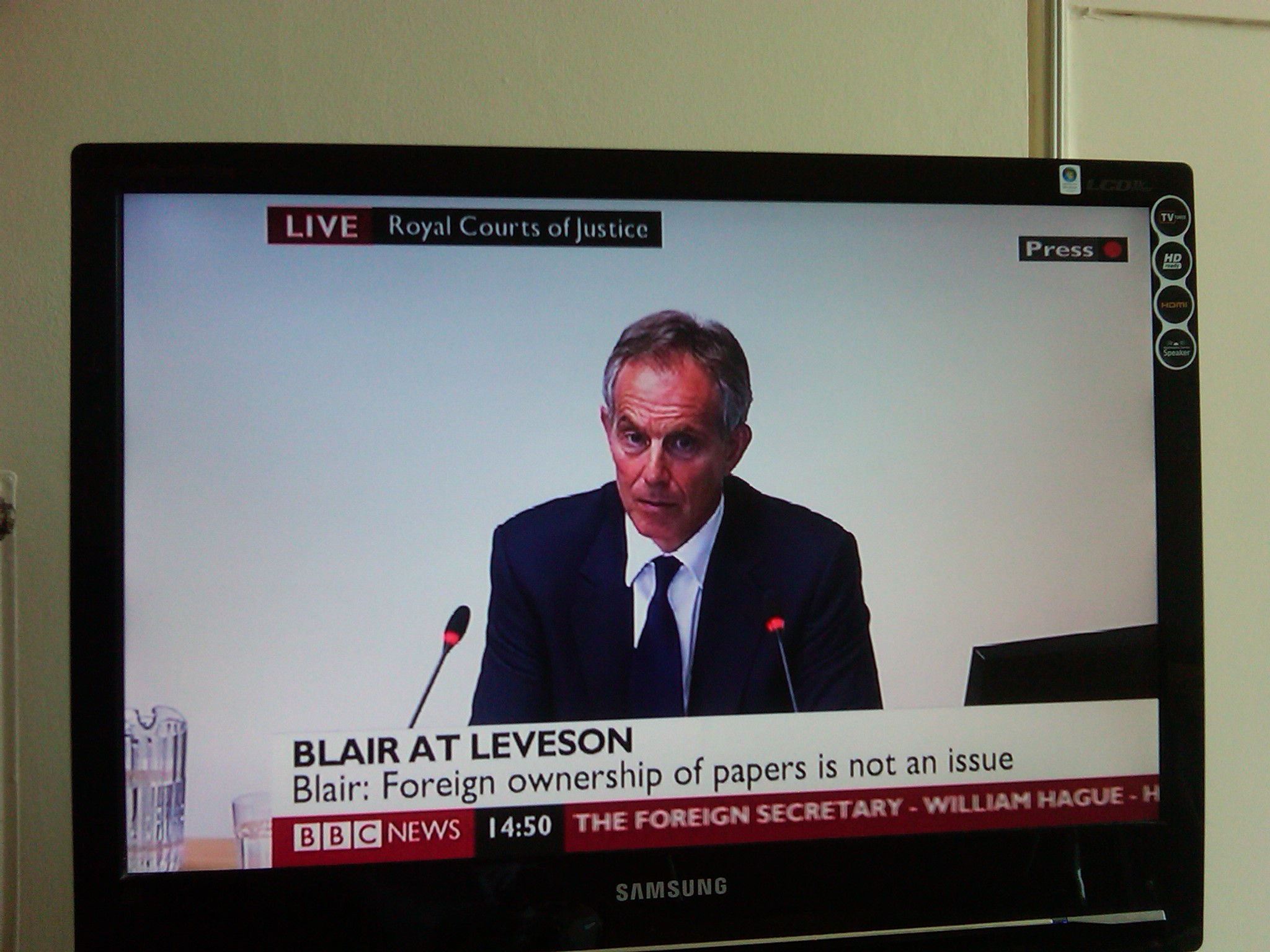
As I type, Tony Blair is giving evidence to the Leveson Enquiry. Why do I care? Because it is receiving wall-to-wall coverage on Britain’s rolling news channels, and as dull as the whole wretched thing is, I cannot bring myself to change channel to The Weakest Link or whatever other daytime television is on offer.

What is the Leveson Enquiry? For those unfamiliar, the enquiry has its own website. And logo. Funny how these things have become a kind of industry of their own in Britain.

http://www.levesoninquiry.org.uk/

I only tuned in toward the end of the session in which Tony Blair was giving evidence, but having subsequently seen the “highlights” repeated on BBC News, I am slightly concerned that we might just be paying a lot of people to sit around for no productive reason whatsoever.

The world’s most tedious man embarks upon a ten-minute, multi-clause question seemingly designed to flatter himself and not to extract any remotely useful information from the witness

Television at its best here.

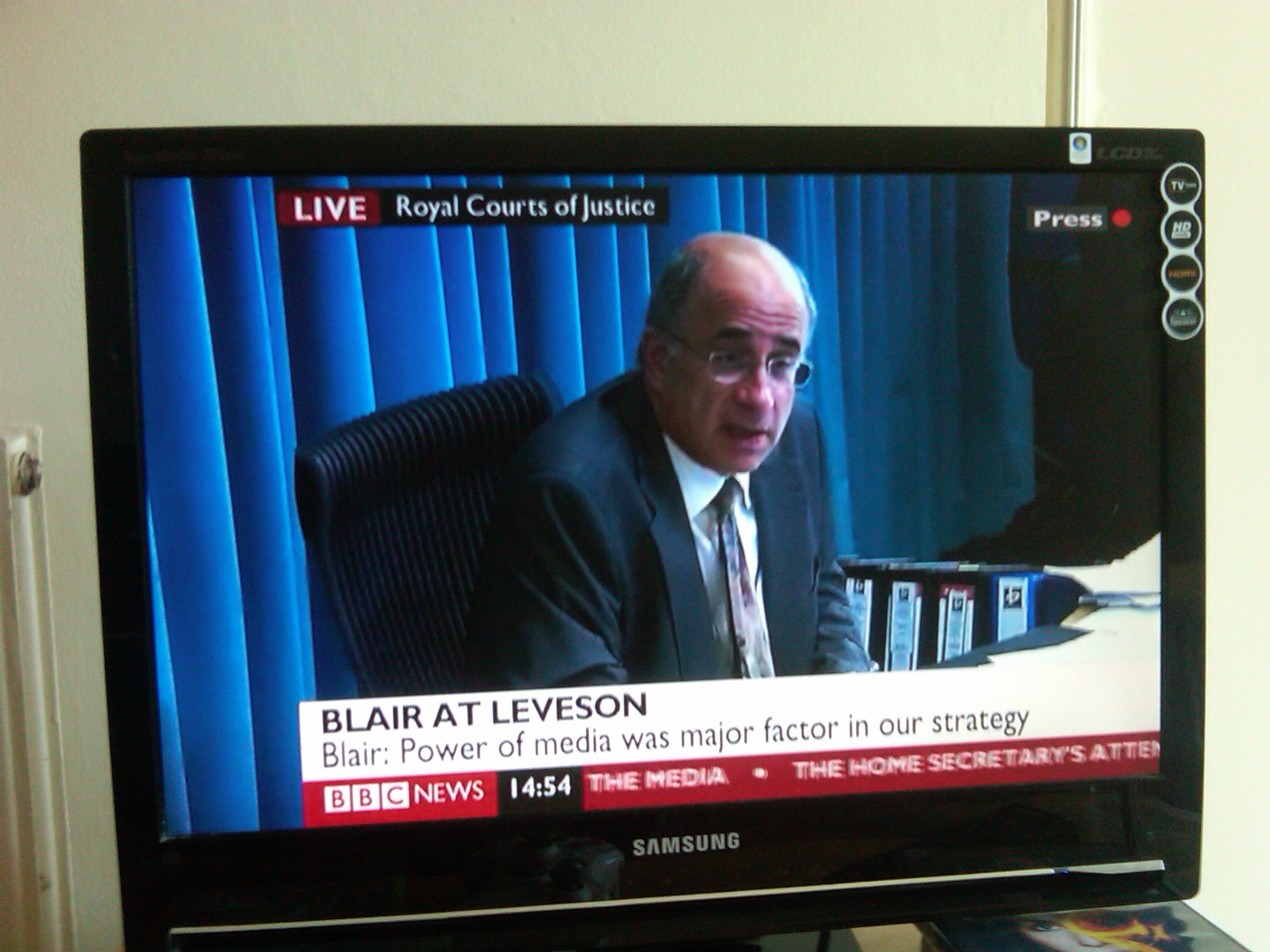
Tony Blair listens to the incredibly long, pompous question being addressed to him before realising that another 3 hours of this lie ahead, losing the will to live and giving another predictably bland answer.

And after all of this drama and posturing, what did we actually learn today from Tony Blair’s evidence? Essentially, that the media is very powerful and that Tony Blair recognised this when he was Prime Minister, and devised clever strategies to try to keep as much of the media as possible on his side. Oh, and that he didn’t think it was really very proper for the press to say nasty things about his wife and children. Fascinating.

We are paying for all of these people to sit in a room, surrounded by their lever-arch files and court stenographers, so that a glossy report can be published and life can continue exactly as it did before.

Here is all anyone needs to know about regulation of the press and freedom of speech in Britain. Quite literally, this is all anyone needs to know:

1. There is a small elite of powerful people in Britain whose families know each other, who attended the same schools, the same parties, and the same social events. Whether they end up in politics (in either of the main parties), industry (running big companies that do business in Britain) or the media (newspaper or television), their personal preferences, feuds and biases are reflected in the attitudes of their respective political parties / companies / newspapers to one another. Anyone surprised by this non-revelation is a simpleton.

2. We will never know whether any secret deals have been done between any prior governments and media entities in the past, because there are no robust rules about lobbying, declaring interests or exercising influence in place at the moment, and no one involved in such a scheme is very likely to blurt out the fact during an on-the-record, televised enquiry. If you are wondering whether this fact renders the whole enquiry a complete waste of time, you would not be alone.

3. Our libel laws are ridiculous and need urgent reform. Nothing to do with the Leveson enquiry, just a fact.

4. The division between news reporting and opinion is not as clear as it should be in British newspapers.

5. British media companies, like companies in general, sometimes hire bad people who do bad things while on the job. Sometimes this becomes endemic in the organisation concerned. We don’t need to create special new laws to prevent such things happening in the future. If phone hacking was illegal before, prosecute the people involved under the existing laws. Just as we don’t need to design new regulations when the misdemeanour happens in a construction company or a bank, so we don’t need to design new laws when it happens in the media. Tempting though it may be when everyone is a lawyer and wants to be paid for doing something.

6. Until we as a country codify at a very high, hard-to-amend level (i.e. in a constitution or bill of rights of some kind) exactly what, if any, restrictions we are willing to accept on free speech – both as individuals and as media – any time that anything happens to rock the boat, any time that anyone in the media does something improper, we will have another enquiry like this and pay a bunch of former and current lawyers and judges to sit around doing what they are doing at the moment.

7. That’s it.

Isn’t our unwritten constitution a wondrous, beautiful thing? Oh, how we must treasure and preserve it for all time.

UPDATE – Oh, here’s the best bit. Because Tony Blair was interrupted by a protester while giving evidence to the enquiry, Lord Justice Leveson has now ordered an enquiry into how his enquiry was interrupted by a protester. I’m not joking. Welcome to Britain.